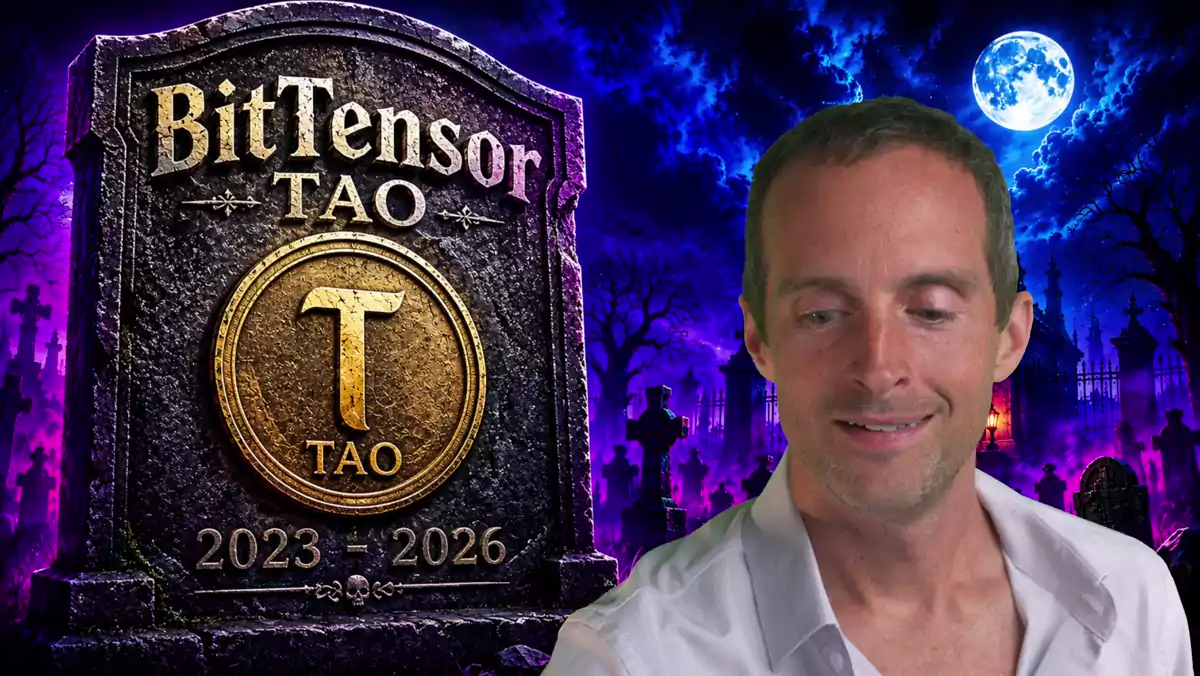
I won't invest in Bittensor TAO, and after digging into how the network actually works, I now think the project is finished as a decentralized AI system. That is my honest opinion, not financial advice. I'm an ICP maxi and I hold a large amount of ICP, so weigh my view with that bias in mind. What follows is my reasoning, so you can check it yourself.
The short answer is that TAO sells a decentralized AI network, but the parts that matter most run off chain and depend on trust. Validators grade the work miners do, the chain does not verify that the grading is honest, and a large share of the activity appears to be carried by token subsidies rather than paying customers. When I put those problems next to centralized tools like ChatGPT, Claude and Gemini, which I already pay for and use, I don't see a reason a regular user would switch.
My view did not form all at once. In my June 17, 2026 post for TAO holders I started with the basics: how the supply is distributed, what the token is actually used for, whether anyone on the team is publicly known, and whether the project is more hype than substance. I said then that I would not invest. I wrote it as questions for holders.
A week later, in BitTensor TAO is Finished (June 24, 2026), I went much deeper into the mechanism, and that is where my conclusion hardened. The core problem there is verification. Most blockchains only record transactions, while the AI compute on Bittensor happens off chain. Validators submit grades on the output of miners, and the chain cannot see the work or prove the grade was honest, so you are asked to trust the grading process. I also pointed to cases where the subnet owner appears to be the top validator and the top miner at the same time.
The second problem is economic. In that post I argued that many subnets depend on large TAO incentives, and that real customer revenue behind them may be small by comparison. I cited reports that 57 subnets were unproductive, and I pointed out that some of them had little or no working mining mechanism while still receiving network support. A subsidy, to me, is not the same as product-market fit. I also noted that the team behind the network appears to have stepped in manually to shut off some pool inductions, which is hard to square with a system that is supposed to run itself.
The third problem is efficiency. When a request goes to a subnet, several miners may produce output for the same job, which means duplicated compute, extra coordination and a slower answer. For thumbnails I go straight to ChatGPT because it produces the best results I have seen. If one model is clearly stronger, the rest of the network adds cost without adding much value, and I don't see a way around that.
I also want to be fair about what I did not find. I did not find proof that the network can verify AI work without trusting insiders, or evidence that customers pay enough to sustain it without emissions. My complaint is that most of the hype focuses on charts, fund buying, partnerships and narratives, instead of the questions a network has to answer before it can be real. I listed several of those questions in the earlier post, and I encourage you to bring them to any TAO content you watch.
Here is how my view has moved. In June I was mainly unwilling to hold. By late June I had concluded the project is finished, meaning I believe its current design cannot deliver what it claims. I am not making a price call with that, and I won't put a date on anything. Prices can stay up for a long time on narratives, and I could be wrong about how the market behaves. My claim is about the technology and the evidence behind it. If you want to disagree, the way to do it is to show the proof.
Below this opening you will find a contents list and then the full text of both posts, newest first, so you can read the later analysis and then the earlier questions. If you want the wider context of how I research coins, I cover that in how to research a crypto before you buy, and I explain why I hold ICP in my ICP hub.
If you hold TAO and want a second set of eyes on your own position, I offer a personal video review of the coins you hold.
On this page
Every post I have written on this subject is below in full, newest first, each under its own heading.
- BitTensor TAO is Finished (June 24, 2026)
- Dear Bittensor TAO Holders: Why I Won't Invest (June 17, 2026)
BitTensor TAO is Finished
From my video published June 24, 2026.
BitTensor TAO is finished, and I'm going to back that statement up with detailed research and very clear points highlighting why. The first thing to start with, though, is why am I sharing this information with you? Because I care about you, because I want you to have the best information you can have in crypto, because I want to cut through the hype and the speculation and get at the truth.
Why this review matters
I've put this into a nice outline so I try and stay focused and on topic and don't randomly rant. TAO has one of the strongest narratives in crypto: decentralized AI, an alternative to big tech, crypto incentives for intelligence, early exposure to the future of AI. If you've bought TAO, and I see the coin people are most bullish on on my main Jerry Banfield ICP channel right now besides ICP is TAO. So this is a video for you.
Me, I'm the opposite. I'm the opposite of bullish on TAO because of the technical reality of how it's built, not because of what other people are saying. So I understand how you could buy TAO. And this obviously is not financial advice. I'm an ICP maxi because it's the best tech by far in crypto. And the goal of this is to get you into reality.
So let's look at the dream versus the mechanism for TAO. Roland, nice to see you. Rick for Liberty, good to see you as well. Bobby Oh just did a debate on TAO, and I'm going to highlight the key points Bobby Oh made in his video, and I'm going to put together several other things with that that deepen it.
The dream TAO sells
BitTensor TAO sells a big dream. They sell the dream that anyone can contribute to AI work, that the network rewards useful intelligence, and then TAO becomes the economic layer for decentralized AI. That sounds really good in theory. And this is why you always need to dig into the details yourself.
Because here's the reality check on TAO. Who actually verifies the work? Who controls the rewards? Is there real customer demand? Can it compete without token subsidies? These to me are all fatal flaws once you dig in. Bobby Oh is absolutely fantastic at looking at TAO and researching from a technical standpoint how it actually works. And I suggest if you want to dig deep down that rabbit hole after my video, watch Bobby Oh's BitTensor TAO debate. This is what inspired me to do this live stream today, because of the way Bobby Oh debated one of the key people in TAO. He just wrecked him. Bobby Oh absolutely destroyed this guy in a debate. The guy got into sputtering and trying to go on tangents and straw man arguments, and that's because the reality of BitTensor TAO does not support defending it very easily in a debate.
And Nuru, nice to see you today. If you have any coins you'd like me to review, you can join Jerry Banfield Family and bring whatever coins you'd like me to look at. You can always ask on a live stream as well, but I'm usually focusing on one coin.
Who's policing the police?
So Bobby Oh's core question: remember, this is a quote, "decentralized AI protocol." Who's policing the police? And I'm going to share much more on both Bobby's criticism, and this is going to get worse and worse as we look into it. Like BitTensor TAO, the more I research, the worse it gets. There are huge serious issues, and this is the main one. Right now, something that's built on decentralized AI as a narrative seems to be a little bit more of a problem. It seems to me to be the reality that it's not decentralized. And there's not exactly transparency about how any of it works either.
So here's how this plays out in detail. Validators have massive power. Voting is stake weighted. The top players can dominate emissions, and this is a critical issue. The system depends on trust, and whales may have way too much influence. That's not a good setup for decentralized AI. A decentralized system should not require blind faith in insiders. This is why I say BitTensor TAO is finished. Once you see that this whole quote "decentralized AI" system requires blind faith in insiders operating with integrity, which in crypto seems to be extremely questionable as to whether we can trust insiders operating with integrity.
So let's dig deeper into the trust problem. TAO is marketed as decentralized very heavily. If you go on CoinGecko or something like CoinMarketCap and look at AI coins, TAO's sitting up there saying that it's decentralized AI. But here's the thing: the technical reality is that the network may depend heavily on trusted validators. And yes, Bobby Oh did do a very respectful slice and dice of the guy, which I would watch. I intend to make my videos more respectful, because if you're a TAO holder, I'll tell you this: I want to be as respectful as possible and see if I can get in past the defense mechanisms as much as possible.
Validators grading miners
So the issue right now: validators are grading miners. Validators are submitting weights, but the chain does not fully verify the off-chain AI work. Users have to trust the grading process. That's a gigantic trust assumption. But it's still going to get worse from here. Do you see how easy this is to start? Whoa, what the marketing and the technical reality start to absolutely fall apart with even a little bit of research.
So first, you have validators grading miners. The basic setup, as Bobby showed in his video, is that the subnet owner has control and then the validators check the work that the miners actually do. But what happens if the validators all just pick one miner? What happens if the subnet owner is also the top validator and the top miner? Looks like that is exactly what is happening in somebody's subnets, when, according to what I'll share in a minute, the guy in the debate was trying to say that's not happening. So we have a major trust assumption that goes against decentralization.
The off-chain verification problem
Let's see how this gets even worse: the off-chain verification problem. In traditional blockchains, the most important work is verified on chain. And that's because with traditional blockchains, besides ICP, all they're actually really doing is sending transactions. They're sending tiny amounts of data across a relatively small blockchain. Most blockchains, besides no blockchain I know besides ICP, because on ICP you can even very quickly and easily throw a phone photo onto the chain.
If you go to jerrybanfield.com for comparison, what you'll see is that this website I've built is on the blockchain. These photos are on the blockchain. No other blockchain does this. Most blockchains are essentially sending small bits of text and numbers from one wallet to another wallet. They are not hosting entire websites directly on chain like ICP is. That means they don't have that much power to actually do real computation.
Because if in your mind you're thinking, well, aren't these blockchains super powerful, they're hosting apps and games and stocks and real world assets? No. Every blockchain besides ICP is basically a spreadsheet secured with cryptography. That means you have to go through a cryptographic protocol to modify the blockchain, but the blockchain itself has very small amounts of actual data on it. The entire Bitcoin blockchain, for 16, 17 years of history, is less than a terabyte. The entire blockchain, all the transactions, and even that's with ordinals getting stuffed in it, wasting the block space. Back in the day, when I had a Bitcoin node, I'd have the Bitcoin core wallet and I'd have the whole Bitcoin blockchain downloaded on my computer. ICP, by comparison, has like 12-plus terabytes directly on chain. Twelve times-plus as large as the Bitcoin blockchain, and all of it's happening on chain.
I needed to explain that so you'll understand what I'm about to say. With traditional blockchains, the important work is sending one transaction to another, not all the other work. If you're hosting a crypto video game, the important work would be playing the game, and that's off chain too. But for most blockchains, the only thing that's focused on is transactions. BitTensor, though, is selling itself as a decentralized AI platform. So with that in mind, just sending transactions on the blockchain is not enough to claim decentralized AI.
With BitTensor, AI compute happens off chain. Because BitTensor itself, the blockchain, has very little computational power. It cannot handle running AI compute fully on chain. Only ICP has that ability. Validators submit final grades for AI computation that's run off chain. Are you starting to see where this is a problem? The chain itself does not see the work. That's like if I just close my eyes and you try and tell me what's happening, and then I'll just take your word for it, as long as nothing happens that I don't like. The AI compute runs off chain, the validators are submitting grades on the output, not what actually happened. The system cannot prove that the grading was honest.
If you remember high school or middle school geometry, you remember how annoying it was to submit proofs of your work. So what is happening on BitTensor? They're showing no proofs of the work. You submit a query and some output comes out. There's no proof. Now, centralized AI is doing the same thing. The difference is I have some trust that the team at OpenAI or Anthropic or Google or Microsoft are trying to do a good job with their AI, and they've got a data system set up that's pretty secure. With BitTensor, I don't have that trust, because it's supposed to be decentralized. So if the compute's happening off chain, and validators are just submitting final grades, the chain doesn't see the work, and the system can't even prove the grading was honest. This is a disaster. Do you see what a problem this is? How is this going to work for real decentralized AI? It doesn't.
The compute inefficiency problem
So you'd think, okay, this is as bad as it gets. No, it gets worse. Then there's the compute inefficiency problem. Right now, I use Claude, ChatGPT, and Gemini. I use them all. That means I submit one request. I sometimes will do all three of them at once for something. In that case, I submit to three centralized networks that I already have a history with, that have proven that they do a good job. You see the difference between that and jumping over to a decentralized AI quote that you don't know?
So here's how the compute process works on BitTensor. Picture you try and use one of the subnets, not the blockchain itself. Keep in mind, not the blockchain itself, which is where all the value of the token is. What we're talking about is you go into a subnet, that subnet is being rewarded with BitTensor tokens, and then all the rest of the stuff's happening off chain. That's important. To use that setup, you go in and make a request.
Let's say, for example, I want an image generated, like I used ChatGPT to generate this thumbnail. The only thing that didn't come out right the first time is TAO was spelled wrong, because the transcription spelled it wrong and I didn't check it. So ChatGPT nailed this based on the prompt. One AI, one prompt, one time. BitTensor TAO is being narratively hyped as something that's better in a lot of ways than just using ChatGPT, like, whoa, it's decentralized.
On ChatGPT, it has to do one computation, one time, for one prompt. On BitTensor, a simple request of the same kind pulls multiple miners, multiple validators, in theory duplicated compute, extra coordination, and more complexity. Let's say there are five miners on a subnet, five different AI models all competing. So those five AI models, when you ask for an image, all crank out an image. Well, that's inefficient, isn't it? Instead of using just one that you know does a good job, you're going to use five. Well, you think, that sounds better, I'll take five outputs instead of one. But look at this thumbnail by ChatGPT. This is the best quality out of AI thumbnails I've seen anywhere. It's vastly superior to Claude, faster than Claude, vastly superior to Gemini Pro. So if I go over to BitTensor TAO and try and use the subnet to generate a thumbnail, there's no point. I would not, for generating thumbnails, go to ChatGPT and give it a thumbnail prompt, and then go to Claude and give it a thumbnail prompt, and then go to Gemini and give it a prompt. No. I went straight to the best one immediately.
In theory, this could lead to using multiple models, but in practice then there's no decentralization. See the problem? If a system truly had some decentralization and real competition, which is questionable, assuming it did have multiple miners and multiple validators, you are guaranteed to get duplicated compute, which is wasteful and increases costs. Then there's extra coordination and more complexity, which is going to slow down how fast you can even get your output. Imagine you make this image prompt and five different AI models have to spin up. The one that takes the longest, you still have to wait for it. Then if four of the outputs are garbage, they don't get anything, and the one output that's good, you get that. So over time, if one AI model was superior, you don't need multiple miners, you don't really need multiple validators either, and one miner will just get all the rewards. And therefore, why don't I just use ChatGPT? What chance is there to come in and even do a better job a lot of the time?
So right now, if there's actually any true decentralization, the compute is wasteful, and the coordination and complexity are a nightmare. The system, from what I see, is slower, more expensive, and less efficient than centralized AI. That makes decentralized AI, in this case, much worse. So where's the benefit of actually using this system? That's what you've got to look into.
Why would anybody use this?
Why would a retail customer stop using ChatGPT when they already pay for it? I pay $100 a month for ChatGPT, $100 a month for Claude, and $20 a month for Gemini. Why would I go use BitTensor when this does what I want, right, immediately, and I'm already paying for it? Well, J Babe, nice to see you. This gets into, well, why would somebody use BitTensor TAO in the first place? How are these subnets, that appear to be gigantically wasteful with duplicated compute, validators, and miners, going to make sense? And it's totally possible to set up a subnet where a subnet owner sets up the subnet, the validators, and the miners. So a subnet owner could set it up so they totally control the entire subnet and there's no actual decentralization at all. And they're using potentially somebody else's AI model to generate the output. I mean, see, this is getting worse.
Is TAO powered by real demand or token emissions?
So the big economic question is, okay, how is this financially sustainable? You need to start digging into TAO. Is TAO powered by real demand or token emissions? Subnets receive large TAO incentives. Why? Because TAO needs to have some actual functioning products for people to use. So at this point, the subnets have to get a bunch of money, so they're essentially not profitable. Is there any evidence that any of these subnets actually have a working business model that's generating revenue? Or are all these subnets just surviving off of incentives? The real customer revenue, from what I can see, may be very tiny by comparison. And therefore, some of the subnets may be heavily incentivized, which is going to make very clear sense in what I'm about to talk about. Thus, the temporary inflation, and people buying a token that don't understand these things, can make the ecosystem look much more active than it really is. A subsidy is not the same as product-market fit, and it is not sustainable, especially when I don't need anything BitTensor TAO has.
Based on what ChatGPT, Claude, and Gemini can do, what is there for me to do on a BitTensor TAO subnet? The centralized AI platforms are utterly dominant at doing a good job with almost anything in AI. Therefore, where's the business model for decentralized AI when it's less efficient, therefore more expensive, and not as trustworthy? Alex, nice to see you. I think I did a review of Theta. If not, I'm not very bullish on it, but if you want me to look at a specific coin for you, you can join me in Jerry Banfield Family. That way, I'll be happy to take a look specifically for you about any coin you want to know about.
The dead subnets
So let's continue with BitTensor TAO. There are the dead subnets. Just recently, 57 BitTensor TAO subnets were reportedly unproductive. So remember what I just said about the subsidy problem. Is TAO powered by real demand or token emissions? It seems almost everything is subsidies at this point, and almost nothing is actually network revenue. That leads to dead, extractive, exploitive subnets, which is a major red flag. Many subnets have been simply doing whatever they can to try and exploit and just steal the incentives. Some of these subnets had little or no working mining mechanism, but they were still receiving network support. Value leaked into the subnets that were not producing real work. This challenges the whole idea that the market is efficiently allocating rewards.
This is going to continue to get worse, because how was this dealt with? If you're talking about decentralized AI, how exactly would you handle subnets exploiting the subsidies? In theory, you'd have voting, and it'd be transparent, it'd be out in the open. But in practice, if the system is truly autonomous, why did centralized actors need to step in? The dead subnets had to be manually addressed, and actions were taken by what looks like the BitTensor team to shut off the pool inductions. The foundation had to intervene. The automated system did not fix the problem by itself. That is not fully or even meaningfully decentralized AI.
And this to me is the truth about BitTensor TAO that every single holder really needs to let sink in. BitTensor TAO is a managed token economy that, generally from what I can see, produces work that is inferior to centralized AI, or relies on miners using centralized AI models. So why not just use a centralized AI model yourself? This is an absolutely critical flaw of all of this. An inefficient business system, not trustworthy, subsidized to get activity, dead exploitive subnets, then centralized intervention. I mean, this is like so dystopian, it's crazy. And these are things that people hyping it never ever talk about anymore. We'll talk about that in a minute.
TAO's flow is supposed to allocate value efficiently. But if dead subnets were receiving support, then the allocation system was not working well enough. If you imagine truly decentralized AI having some ability to clean itself up automatically, as we can see, human intervention was required. And this is a serious tokenomics issue, when you're relying on subsidies to survive, and then those subsidies are subject to extraction. And those were just the subnets that were shut down, because I guess they weren't in good graces with the creators and the foundation. But what if there are still a bunch of subnets that aren't having any real meaningful contribution, but they're just friends, or they're being run by the foundation? How much right now is still being extracted without doing anything genuinely useful?
This criticism is not FUD
Let's go back over what I've said so far. You get influencers and holders that will want to say, well, all these things you brought up are just FUD, you're just FUDing the project, you're trying to make fear, uncertainty, and doubt. The reality is, this criticism is not FUD. This is like, you know, the TAO holders, you're on the Titanic, and you just hit an iceberg, and the boat is sinking. I can see it sinking. I'm telling you, the boat is sinking. This is an extremely dangerous situation that cannot last the test of time. There have been one warning sign after another, like one of the largest subnets dumping their TAO tokens and pulling their subnet, saying that TAO's not actually decentralized. I talked about that in my last TAO video.
A lot of crypto people see somebody hyping a token, and here's what hype usually focuses on. I went through the top TAO hype videos right now, and here's what they focus on: price action, funds buying, big AI narratives, new proposals, and community sentiment. This is all shallow. This is stuff that might make sense if you'd built a rock-solid foundation like Internet Computer has, with the best tech in crypto. But a lot of times what happens in life is we go into this mode called confirmation bias. I've bought coins before where I watched one video on it from somebody who more than likely had been paid to promote it. I bought because they'd been paid to promote it, and then they promoted it. And then confirmation bias sets in, where now I want to be right about my purchase. Now it's not at all about the project, it's about, am I right or am I wrong? And I don't want to look at anything that might indicate I'm wrong.
Crypto could actually use a lot more well-targeted fundamental criticism, because almost all of crypto is based on these: price action, funds, narratives, proposals, and sentiment. But what I'm asking is fundamental questions that are going to determine whether BitTensor TAO survives into the future. Because if these are not answered well, at some point it will all collapse. So here's an example. Somebody says, "I bought ICP but don't hate on my TAO." That's the mindset I'm hoping I can help you work through.
The lightsaber test
This is taking on an identity, the identity of "that TAO is my project, it's my coin." But what is that based on? The TAO hype videos, the newest ones right now, are talking about price action, funds buying, narratives, which I've just shown very clearly do not work at all in reality. It'd be like if I told you I had a lightsaber at my house. You would picture that I have a real working lightsaber, that I'd be a Jedi. But if you came to my house and found out it was some plastic lightsaber I bought at Disney, you'd be pretty disappointed if I'd led you to believe through videos, through talking about it, and through using props to make it look like I had a real lightsaber. But when you came to my house, you realized I was just tricking you, that the hype didn't match what I could actually do.
And what I see is that the hype of BitTensor TAO is based purely on price action, which can easily, at least in the short term, be financially engineered with no spot buying, especially when you combine it with influencer marketing and collaborating with coin listing platforms, where the exchanges often own them, like Binance owns CoinMarketCap, I believe. They can literally make them say whatever they want to say on there. But what will actually work out in the long term is, can the work on BitTensor TAO be verified? Are the rewards fair? Is the demand real? Is anyone actually really putting serious money into using a BitTensor TAO subnet to do meaningful work? Are the TAO emissions sustainable? If not, this turns into something that falls apart. When the insiders realize the game is over and there's no hope, then they dump everything.
I'll go a little faster so we can wrap this up. There have been a bunch of signs that BitTensor TAO is in serious trouble. And I say to you, if you can put all this together, you will see that BitTensor TAO is finished, that it has nowhere to go from here except down. The only way it goes up is financially engineered temporary pumps combined with influencers pushing narratives. This is part of why I keep all of this in my Crypto Reviews playlist, so you can see the pattern across coin after coin.
Answering the hypers point by point
The hypers say, well, one bad actor dumped, but the project is fine, bad actors exist everywhere. That's one response from the hypers to my criticisms. Here's the thing: if one insider can extract huge value, it, to me, reveals a huge structural weakness. The question is not who did it. The question is, why is this system built based on a narrative of decentralized AI, but in reality I don't see any evidence of true meaningful decentralization, or actual real-world use cases that make sense over using centralized AI? The ICP story says it could be sustainable if they had another five years. I wouldn't touch TAO. They don't have five years. I don't think they do either. This project, the only way it can continue to have positive price action is through constant influencer shilling, and through people not looking at the obvious points I make and that Bobby Oh makes in his debate. If you're a TAO holder, this debate is the number one video you need to watch as soon as you're done with mine. I've heard every single criticism you can imagine over ICP, and I've done so much research, it doesn't work.
Another thing the hypers talk about: well, just lock the tokens. Okay, token unlocks can reduce some dumping, but what I'm showing you is there's no easy solution for all these critical flaws in BitTensor TAO. You can't just say, well, it was just bad actors. No, the system is set up in a way that allows bad actors, because it's not actually meaningfully decentralized. And token unlocks can try and reduce some dumping, but they don't fix off-chain verification or validator collusion, where validators can work together. Let's say one validator has a miner whose output they want to pick every time, and they just pay another validator off, or maybe they are the other validator, and all the validators just pick this one miner. So it's the illusion of decentralization, but if you try and actually mine, nobody's going to vote for your output no matter how good it is. The token unlocks do not solve subsidized economics, dead subnets, weak real demand, or centralized intervention. So the solutions that are proposed in response to very obvious critical flaws do not address any of the real critical flaws.
Now the hype about institutions buying. First off, that's not necessarily true. When you see somebody on crypto YouTube telling you an institution's buying, is it actually real? Lots of times, no. And how much are they buying? Tiny institutions can buy tiny amounts, or they can buy gigantic amounts. Funds and people at institutions can also be misled just as crypto retail can. Again, an institution buying does not solve all the huge problems. If anything, it just sets the institution up. If I was an institutional investor, I'd be subscribing to Jerry Banfield crypto reviews. If I was an institutional investor, I'd join Jerry Banfield Family to talk with me and people like Bobby Oh before I put $100 million into a project that some regular person, that has some computers and does YouTube videos, could easily pick apart. Nice, Merle is buying some extra ICP right now. Let's go.
So a lot of crypto is based on money following a story, and hype videos are based on money following stories and promises that can never come true a lot of the time. So funds buying BitTensor, again, does not solve the critical verification, emissions, revenue, subnet quality, or centralization problems. A fund buying addresses none of that.
Now, some of the hypers will say that some subnets have real technology. Is that economically sustainable? Do they have a real business system? Because this is an amazing technology. When I can just talk on my phone and get this thumbnail generated in a minute or two that's this good, like a graphic designer would often, I used to pay people $20, $50, $100 to design something like this, and it'd take them days. ChatGPT did that in a minute or two, and I could have it do a thousand of them in a month. Are any of the subnets on BitTensor TAO doing something on that level? A subnet can be technically interesting, but one of the top subnets right now is a TAO stats subnet. Literally one of the top subnets is providing statistics about the rest of TAO. How useful is this? Where is the real revenue compared to the rewards?
TAO is a speculative casino
WeldMoney, nice to see you here. So what I see is that TAO is really a speculative casino. Almost all the TAO bullish content only looks at charts, moving averages, open interest, futures, supply squeezes, and market maker games. They do not look at the stuff I mentioned here. They don't prove the network works. They don't prove it's sustainable. They don't prove there's a business model. And it's like a magic show. You can only go on with the magic show for so long before people start to figure out what's going on behind the curtain. I went to a magic show in St. Pete and it was fun, because I watched it once for a couple hours and I was like, wow, it's amazing. But imagine if I sat there day after day after day. I'd eventually realize how they did every single trick, and it'd be boring after that.
And this is why I say BitTensor TAO's finished. Once you see exactly these tricks, once you see the difference between a lot of the hype TAO content focusing on stuff that really is irrelevant, and then you see I'm out here, Bobby Oh's out here, when you see people asking real questions that TAO holders and even the foundation don't have any solid answers for, how long's the magic show going to go on? That is really just a magic show to try and keep the price up. How long is that going to last? How long will insiders hold their coins when they realize that retail and institutions understand what's going on? I promise you they'll dump as soon as they think you have seen through the Wizard of Oz curtain. As soon as you've seen through it, they're going to exit. And my God, am I looking forward to that day. Again, I'm just telling you, to me, any TAO holder, you are on the Titanic. It's blasted into an iceberg. It's going down. I'd grab a life raft while it's available. Not financial advice.
The questions TAO has to answer
These are questions that TAO has to answer for it to be truly viable as a real decentralized AI project, and not a token ledger incentivizing activities that happen off chain. Can BitTensor verify AI work trustlessly? Right now, not that I can see. Kung Fu Classic says the thing that's discouraging about crypto is not about the tech or utility, but it's about gaining attention, who's bought and who has financial incentive to push things like HYPE, TAO, Zcash.
Well, if ICP didn't exist, I could say this stuff with crypto could go on forever. But the more ICP gets real adoption, governments, enterprises, solopreneurs building on it, like how my website at jerrybanfield.com is actually hosted directly on the blockchain. When you've got my website, the pictures, the text, all this stuff on the blockchain, and it's served at a 100 Google PageSpeed score, it's secure through my wallet. You can't just go in and hack this because you don't like me. It's practically infinitely scalable and almost free to use. By comparison, all these other cryptos, once you have ICP, yes, ICP opened the matrix. ICP introduced the red pill. The entities doing all these other chains were able to buy time with the ICP rug-pull narrative. But now the technology is in such demand, it's so real and needed, that all these other cryptos are ticking time bombs. They're sinking Titanics. And I hope I can help people get off them, because the foundations and the insiders and the VCs, when they figure out that you've figured out, even when they figure out that 10% of people are in on what's going on in crypto, they're going to exit all their positions. Right now, less than 10% of people know what's really happening in crypto. But I'm helping change that. Bobby's helping change that. Blockchain Pills talking with me. We're all changing that. You can help change that by asking better questions about every single crypto you hold. That's the purpose of my reviews. And I put all these reviews directly on my website, on the blockchain, usually the day after I do them as a blog post. So now I can't get censored either. If you want to see how I lay out the bigger picture of why none of these market caps matter, I get into it in why crypto market caps are a distraction and only ICP is real.
So here's the thing. Can BitTensor answer any of these questions? Can they prevent validator abuse? No, not without using centralized trust-me-bro systems. Can they reward real value accurately? I don't see any proof they can do that. Can they stop emissions leakage? I mean, they can, with the big daddy coming in and shutting down the little ones. Can they generate real customer demand? I'm extremely skeptical. I'm skeptical on this because the system I just showed you does not compete with big tech. Big tech crushes the system that BitTensor TAO is using in almost every use case.
My conclusion
And I would say 99% of the time they cannot survive without hype and subsidies. So this is my conclusion. I love decentralized AI. It's a powerful idea. The problem is that BitTensor appears to rely on trust, subsidies, centralized intervention, speculative hype, weak verification, and unclear real demand. This is why I've very calmly, professionally, no comedy today, presented the case.
And I challenge you as a viewer: don't ask who else is bullish or what the sentiment from other people is. Ask, can the network prove the work that's happening? Can it survive without emissions? Can it compete with big tech? Are real customers paying? Is the system truly decentralized? I ask you these questions when you're thinking about BitTensor TAO. These are the questions that define whether it will last into the future. Because I don't claim to be that smart. In fact, I realize how dumb and ignorant and uninformed I am. So I ask better questions. I ask questions until I get answers that give me a clear picture. The only difference between me and most of crypto retail right now is that I just am more skeptical. So I ask more questions, and the more questions I ask, the more I quickly get into things like this where I'm like, oh, this is bad, this is horrible. Why isn't every TAO holder asking these questions?
Mula says he's making $10K a month right now, planning on throwing $20 per month in ICP. Nice. Well, we'd love to support you on that journey. Wealth Money reminds you: yep, you can only bury the truth for so long. So thanks for watching, and I hope to see you on the next stream.
Dear Bittensor TAO Holders: Why I Won't Invest
From my video published June 17, 2026.
Dear Bittensor TAO crypto holders, if you're researching or holding the Bittensor TAO token, this is going to be an incredibly helpful read for you. I'm big into AI projects and the future of building AI that we can actually use and have ownership of as humans. I've researched the Bittensor TAO project along with thousands of other cryptos, and I care about your success as a crypto investor and want to make sure you have the best opportunities. This is not financial advice. I do hold tens of thousands of ICP, Internet Computer Protocol, but I only hold it because it has the only real technology I see that can actually make putting AI into the hands of us as users. It does that by putting everything fully on chain.
Many of you in the ICP community have asked me, well, what about Bittensor TAO? Doesn't that look great? You've got high profile people promoting it. From what I see, I see nothing to be excited about with the Bittensor TAO project. I encourage you to look this stuff up yourself the way I have.
The supply and token distribution problems
There are a ton of problems I see with Bittensor TAO. The first is the low amount of circulating supply, which is the amount that's tradable on exchanges, versus the high amount that's still in the hands of insiders. On Internet Computer alone, token dumping was a massive part of the price depreciation, and that's the project I consider to have the best technology in crypto. With Bittensor TAO, what I see is that this constant token dumping is going to guarantee, in most scenarios, that things don't go well.
On top of that, there's unclear token distribution. For the first couple of years of the project there was a bunch of mining, millions of tokens mined, but we have no idea who those went to. To make things even worse, there's now an upgrade where subnets can issue their own tokens, which means some people are saying this is a mechanism for insiders to simply be able to exit.
Where is the real utility?
This gets even worse when you explore the real utility of the token. This is the thing that crypto investors are not nearly investigating enough: how much real utility can the token actually have? Right now, with Internet Computer Protocol, for example, you can use the token to stake and participate in fully on-chain governance. You can send the token for transactions and swap it just like you can on most other blockchains with smart contracts. And you can burn the Internet Computer Protocol token to get cycles, which can then be burned to pay for AI models that run fully on-chain.
When I compare that to Bittensor TAO, I see very little real utility that the token appears to have, especially because of what I see as a lack of true decentralization. While the Bittensor TAO team will talk to you about their decentralized AI network, I don't see that this is actually running on a provably decentralized network the way Internet Computer is, where you can see the nodes distributed all over the world, and you can see transparently the exact process to onboard nodes, to reward nodes, and to keep nodes.
What I believe is that Bittensor's resources are actually running on centralized cloud servers, and it's up to them to prove they're not. It's very easy to run a bunch of computation on a centralized cloud service. It's very difficult to set up a truly decentralized network, and the burden is on you if you're claiming it to prove it. I have not seen sufficient proof, and many others have not either.
You can't even train AI on it
Another huge problem: in all the conversations about AI with Bittensor, what I don't see is even being able to train real AI. The network is focused on inference using pre-trained models. Internet Computer Protocol is actually in a much better position for that, because if you already have pre-trained models like DeepSeek, you can put them on Internet Computer Protocol directly and then have transparency and verifiability of the data, which is huge.
By comparison, if you can't train the models with Bittensor, then there's no point in taking an already trained model, putting it on Bittensor, and trying to run that on their network when you can't get all the benefits of having everything 100% on chain like you can with Internet Computer Protocol. So I don't see why any developer who's aware of both of these mechanisms would build and do anything with Bittensor when ICP has vastly superior technology for using the same kinds of pre-trained AI models and then being able to put them in a fully secure, provably decentralized blockchain environment.
Do your own research and look for the criticisms
Meanwhile, there are so many more problems with this. What you can do is just go to something like Grok and ask for all the criticisms. I know that lots of times in life we get confirmation bias, where we make a decision that often wasn't well thought out, whether it's a one night stand to start a relationship or buying a cryptocurrency after seeing one video. I've done both. What I can say is the best things I've had in life were the ones where I did much more research before I put my money in, or anything else. I've done that research, and that's why I haven't invested in Bittensor TAO. There are so many more of these you can look up and read yourself.
This is not financial advice. I'm not telling you what to do with your money; I'm telling you what to do with your research. In my experience, you should be learning and looking for everything that's wrong with every crypto you might have in your portfolio. I've done entire videos on the most serious concerns I have for Internet Computer Protocol. If you're aware of all the criticisms and you're not shaken out, that's great. But when I keep looking at these for Bittensor, it's like you have no memory or learning continuity on Bittensor from what I see, and these things are crucial for advanced AI systems. On Internet Computer Protocol, you can do this, and you can do it all fully on-chain. I don't see where the value is in taking a pre-trained model and then not being able to continuously have it learn with each user.
The economics don't add up
The economic inefficiency of this is also massive. For decentralized AI model training, it's not nearly as efficient. You might as well train things on the centralized alternatives that already have the infrastructure set up, and then you can take that model and put it on ICP for the best experience. Meanwhile, with Bittensor, you're running these models against multiple nodes and offsetting that with token inflation, and on top of that there's a high cost of inference that some say is prohibitively expensive. So where is the real use of this protocol? On ICP, there are very clear use cases and provable, actual technology that real people are running real models on right now. And it's easier than ever. Arguably, it's easier to deploy an AI model on ICP than it is anywhere else.
When you compare ICP having a similar market cap with Bittensor TAO, you have to ask, who's actually using this? One of the big criticisms is a lack of clear use cases. Early subnets have been said to have been created just to earn TAO emissions rather than producing meaningful AI products, which is completely logical, isn't it? So the question is, where are the real world applications? On Internet Computer Protocol, you're seeing real world applications already, where people are building their own AI models, testing out things like DeepSeek on-chain, running AI agents, and doing things like Decide AI's facial recognition to stop bots from claiming airdrops. What real cases that are actually out there can use Bittensor? I've looked at the Bittensor website and ecosystem, and I don't see anything that's actually solving real problems. For as big a value as this project carries, that's huge.
Hype over substance
What I see is hype over substance. People have been speculating on this based on narratives rather than actually looking into the details of how the technology works and whether this is actually decentralized, which almost no AI projects are. Some people have called this a meme coin, and that's where I would put it too. This is basically a cult coin or a meme coin. When I first looked at the Bittensor TAO website about a year ago, it was incredibly simple. There was almost no substance. I am just blown away that people have bought this. But I'm guessing what's happened most of the time is that if you bought this, there's a good chance you haven't ever looked for the criticisms intentionally. Before I put a bunch of money in Internet Computer, I looked for as many criticisms as I could find on purpose, because I know if I'm going to get into something, I want to be very aware of what's wrong with it, what's screwed up about it, what doesn't work well, and what could go wrong.
Who is even running this project?
There's also regulatory uncertainty with the project. Anything intersecting blockchain and AI carries that regulatory uncertainty, especially because I have not been able to find almost anyone on the actual Bittensor team. One of the things claiming your project is decentralized lets many projects get away with is not putting their team out publicly. But when I'm buying something like Internet Computer Protocol, I can go to DFINITY.org and see the hundreds of people, the faces, and the names, and I can see them on the DFINITY YouTube channel doing talks. I can see the people I'm investing in, because ultimately buying tokens truly does come down to the people, just like buying stocks comes down to the actual people working at the company to use all the technology and resources. If you don't have people whose names you know, then I don't have any confidence in that.
Trust is incredibly important online for crypto projects. That means I want to see a lot of names and a lot of faces, or I'm not going to invest in it. That includes Bitcoin. One reason I do not invest in Bitcoin is that the founder is anonymous, and quite possibly the CIA. I'm not investing in something with an anonymous founder, because there's no transparency as to whether that wallet will move. And Bittensor TAO has, to me, that exact problem, except worse.
Invest in what you actually use
For non-technical users, which would be the masses, Bittensor is complicated. I don't believe in investing in anything I'm not using as a regular user myself. My OpenChat community, which I believe is far superior to Discord or Telegram, is fully on-chain, so I'm actually using the Internet Computer Blockchain every day as a non-technical user. There's a common sense investing thought I have loved ever since I heard it from Kyle Langham at DFINITY. He said that someone else originated it: if you use a company's product, then it makes sense to consider buying the stock. What's insane to me is people buying Bittensor TAO and other cryptos that they've never used themselves. I have an iPhone.
Why I Use These Companies but Don't Own Their Stock
I have a brand new iPhone 16. Before that I had an iPhone 8 that I held onto for something like eight years before I finally upgraded. I use Apple products across the board. I have an Apple laptop and an iPad. A lot of the gear in my home studio here I bought on Amazon, and I shop on Amazon every single week. I go to Whole Foods, which Amazon owns, and it happens to be right down the street from me. I've been a big-time Amazon customer for a decade.
Here's the part that surprises people: I don't hold any Amazon stock, and I don't hold any Apple stock either, even though I use the things I bought on Amazon and I shop there constantly. The reason is simple. I don't see how I'm going to get a great return on Amazon stock at this point. In my opinion, the company is already fairly valued, so I don't see why I would invest in it. Same thing with Apple. Apple is already one of the most valuable companies in the world, right alongside Amazon. I don't see why I would put money into that.
As an investor, I only want to invest in things that I believe are drastically undervalued. The question I always ask is whether the price gives me room to grow. With these giants, the answer is no. If anything, in my view, they're drastically overvalued. When I look closely, even when I just search and read through the criticisms, I don't find anything that genuinely impresses me. There's very little to offset that overvaluation except hype, speculation, and what feels to me almost like a cult coin.
Why I Make Videos Like This One
I've made this whole piece knowing that it does not pay. Content like this does not pay very well. What I care about is giving you information that, depending on how you process it, what you think about it, and the decisions you make, might truly save your portfolio. And I want to be clear: I wouldn't take any action immediately. Digest this. Think about it. Process it. This is my experience and my honest opinion, not a recommendation for what you should do with your own money.
Remember that I personally hold a lot of ICP, so I'm sharing where my own conviction sits. Remember that I've been in crypto for eleven years and I've researched thousands of altcoins. I've turned down huge amounts of money I could have been paid if I'd told you how great something was, or hyped up other cryptos like it, instead of telling you the truth: that I honestly don't find anything appealing about it. That's the standard I try to hold myself to, and you can find more of how I think about it in my Crypto Reviews playlist.
I'm a full-time YouTuber. I put out six pieces of content a day, covering everything from gaming to music, inspiration, real-life moments, crypto reviews, crypto hype breakdowns and tutorials, and videos for my fellow YouTubers. I do this full-time, and every day I hope what I make can make your life better.