Starting Over From Absolute Zero
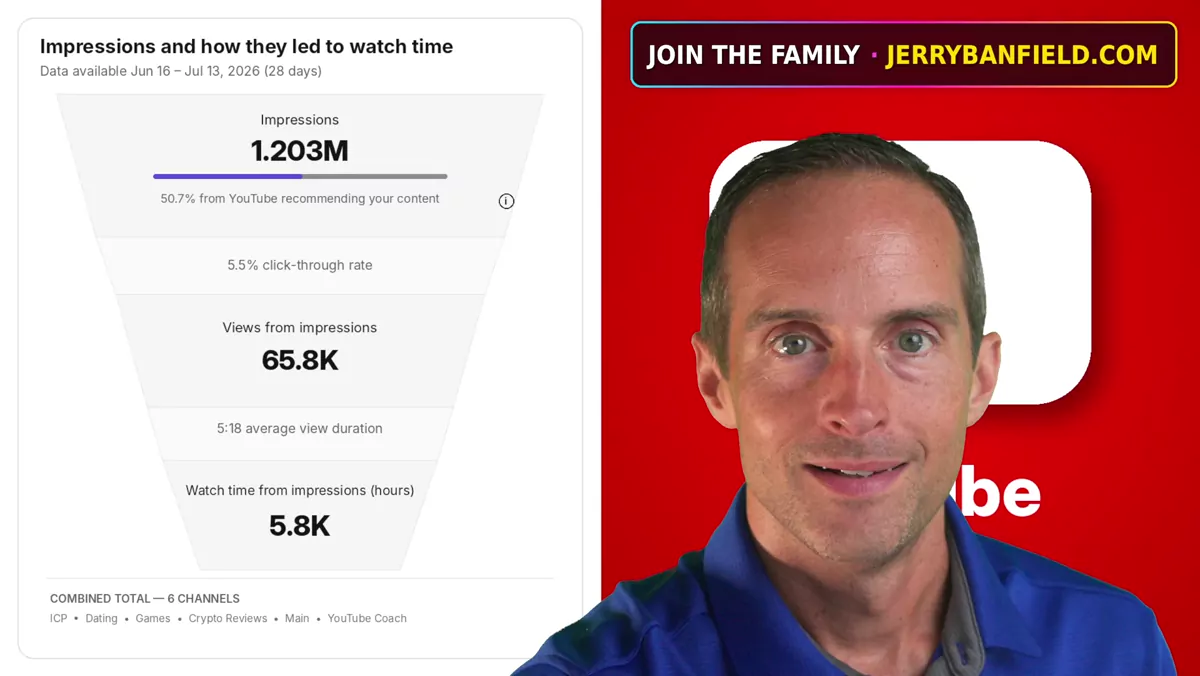
At the beginning of 2026, I had zero channels on YouTube. No email list, no Instagram account, absolutely nothing left online. In March 2026, I started six new YouTube channels from absolute zero. And now, in the last 28 days, I've gotten 1.2 million impressions on my videos, 65,000 views, and 5,800 watch hours. I was making zero income at the beginning of the year, and I'm already up to thousands of dollars a month. I'm going to explain exactly how I did this. This is really powerful information because, unlike people who already have a big audience telling you what they would do if they started over — which is kind of invalid to me — I actually did start over. I began on YouTube in 2011, and I deleted everything in 2025 because I was so burned out. So I have the unique experience of starting over from scratch.
The Number One Thing: Crank Out Videos Every Day
The number one thing I can point to is that I've cranked out videos almost every day on almost all of my channels. I keep a spreadsheet tracking this. It only goes back to May — the first two months I didn't track my videos — but since May 18th, which is about two months ago, I've collected 317 videos, most of them five-plus minutes long. I've averaged filming and publishing five to six videos a day, consistently across my channels. On average, I'm filming 76 minutes of video and live streams every day, and I've got 72 hours of filming done in the last two months. If you want to grow your impressions, the number one thing is to film videos and upload them.
This is more important than what you're doing with your titles and thumbnails. A lot of people are leading you into a trap, thinking that if you make great titles and great thumbnails, you will automatically get views. I've seen how some of the videos where I put the absolute most work into the titles and thumbnails, and tried to come up with the best ideas, went nowhere. And some videos where I just fired from the hip and talked off the top of my head — which is what I do in most of my videos — have gotten fantastic views. So what you don't want to do is try too hard on a limited number of videos. What you generally need to do is crank out videos as fast as possible, with the least resistance and the least time per video. I know that sounds different from what almost everybody tells you, but I can see this working across all different kinds of channels and all different kinds of content, which means it works across the board. Now, you don't want to grind out six videos a day on one channel. And shorts, in my experience, have absolutely sucked — they've added very little to this.
Think Impressions, Not Just Views
What you really want to think about is impressions, because most people talk about views, but impressions are: did anyone see your video at all? That's the biggest difference — between nobody seeing your video versus somebody seeing it. Some people have seen a lot of my videos, but you can guarantee hundreds of thousands of people have seen my videos on YouTube even if they didn't watch them. Thus, I make every thumbnail valuable. Even if you don't watch the video, the thumbnail shows you that there's a family behind it, the thumbnail shows you data, and the title is designed to help you even if you don't watch the video. So even if somebody just sees my thumbnail and title, it could possibly help them. And then, by the time somebody clicks, they're already a warm viewer who has already appreciated the information I've sent them.
Channel by Channel: Finding High Demand With Few Creators
Now, let's take a deeper dive into each of my channels. My Jerry Banfield ICP channel is a channel just about Internet Computer Protocol. This is what happens when you create in a niche where there's very high demand for the content. Internet Computer Protocol is obviously one corner of YouTube, and people love videos about it. Almost anyone can start making videos about Internet Computer Protocol and get views, because there are so many people who want videos about it and not that many people who make them. If you can find areas of YouTube where there's demand for the videos and there aren't as many creators, that's your goal. This was my first channel monetized — although I've had at least ten monetized channels over the years — and this one got monetized within a month of creating it. It's sitting at half a million impressions.
And here's the thing with niching. While some people will tell you to niche and be an authority in one specific area, what I say to do is: yes, definitely make different channels and niche on each channel. But what's special about what I do is that I don't niche overall. I have an ICP channel, a dating channel, a games channel, a crypto reviews channel, a main channel, and a YouTube coach channel. That's a wide variety of topics I get to talk about every day. In the past, I picked one area, like games or crypto, and just did videos about that, trying to maximize the views on that particular channel or audience. That led to massive burnout — in fact, I quit at least twice from doing that exact strategy. And yet that's what almost everybody tells you to do: find a topic you can make money and get views on, and pour everything into that. To me, that's the wrong approach. If you just want a little side hustle and you have a full-time job or something, then that's fine. But I don't want to do anything else. I love doing YouTube and I love talking to people, which is why you can schedule a one-on-one call with me.
With 15 years of experience on YouTube, I've created at least 25 channels by now. I've gotten over a billion impressions across every platform I've been on, with hundreds of millions of views across all of that. I've gone viral. I've been there, done that. And this is why I'm able to start over and get these results. Here's what's cool, though: when you're able to find one niche that people enjoy watching, you can then funnel people over into other content from there. I tried putting everything on one channel in the past, and you never want to do that. You do not want to mix crypto and gaming and dating and YouTube coaching and health videos all on the same channel — it's a nightmare. You want each channel to have its own lane, and then you funnel people from one channel to another.
Videos vs. Live Streams vs. Shorts
I've tested doing live streams, and I've split my content over the last 28 days between videos and live streams. Live streams take a lot more time and a lot more work, but they're much better to monetize. Videos tend to be the highest return on investment, but it depends on the content. For gaming, while videos often get more impressions and views, the watch time is crazy high doing live streams, the monetization is higher, and it's just more fun to me to live stream video games than to try to make a video without a live audience. Whereas with most of my other channels, it's much easier and faster to just crank out videos. I tested doing live streams basically every day, but that just takes too much work setting everything up. I have a really fast AI workflow where I use AI to help generate video ideas, thumbnails, and key points to make into videos — but I just talk off the top of my head in my videos to give the very best experience. On my most viewed channel right now, the views come mostly on videos and then live streams. Shorts really sucked and did very little by comparison, and the watch time on shorts is just absolute garbage.
The Dating Channel and the Games Channel
Here's my Jerry Banfield dating channel. This is my newest channel, and on this one I've done live streams, videos, and shorts. Shorts actually got the most views — but then again, shorts did very little to actually get meaningful engagement, with the largest audience watching videos and live streams. The shorts feed is 26% on this channel, but browse features are again dominant, with search and suggested videos strong, and hundreds of hours of watch time — that's a big step in a single month toward being monetized. My videos are gaining momentum on this channel as well, consistently getting more and more views. It can be difficult to start a new dating channel because, while there is demand, there's heavy competition with all kinds of big channels — whereas in ICP, there are basically no big channels making that content, which is ideal. You can find an audience where there are no big channels; it's not so easy to start in dating with tons of big channels making dating content. But I've really lasered in — you can view any of these channels to see exactly what I'm doing in real time — on making videos that satisfy people like me. And people like me do not have a lot of good videos to watch in dating. So I'm making the best titles, thumbnails, and video ideas I can to get out to them.
Here's my Jerry Banfield games channel. I made a video on this called "The Worst Hearts of Iron Player Ever," and that got thousands of views on that one video. But then people just want me to play the same game all the time, and I don't know that I'm into playing that game all the time. So I got a lot of views on the videos on this channel, but for actual watch time, the live streams get a much higher share — and they're much more fun to do.
Paycheck Channels vs. Passion Channels
Some of my channels are what I call paycheck channels — like my ICP channel, my crypto reviews channel, and my YouTube coach channel. The dating channel is a very strong passion channel. But the YouTube coach, ICP, and crypto reviews channels are paycheck channels. If you're going to be a full-time YouTuber, you need to have paycheck channels where you're getting paid, and where you have very warm viewers who will join, who really want to watch your content, and who will pay to talk to you every week. Those channels are important. But you'll notice three of my channels are passion channels. My dating channel is a passion channel — I really care about dating.
Balance: Passion Channels That Feed Paycheck Channels
I don't care if the dating channel makes any money — I've got to talk about it. Games? I just love playing games, and I don't care if it makes any money; I love doing it. And my Jerry Banfield channel has health and all kinds of random stuff — psychology, spiritual stuff — things I just care about. So three of my channels are paycheck channels: I enjoy doing the videos, but those are like my job. And those job channels feed the other channels, but the other channels also feed back into the job channels. That allows me to have balance. What I didn't do well on YouTube before was having balance. I would either go all in on paycheck channels or all in on fun, and those don't work. You need balance. Ideally, the games channel, the dating channel, and the Jerry Banfield channel will all bring in a paycheck eventually. Right now, I'm so interested to see which channel gets monetized next, because they're all getting a good number of impressions.
You'll notice the average view duration on the games channel is much lower than on the other channels. On the dating channel it's four and a half minutes; on ICP it's six minutes, 24 seconds. On games, that's because one video that got thousands of views was only a five-minute video, and the average watch time on it is only about one minute. But my live streams will often get 20 or 30 minutes average view duration, and on gaming, that's much more important — having people hang out with you.
Crypto Reviews: A Search-Driven Paycheck Channel
Next, over to Jerry Banfield Crypto Reviews, one of my paycheck channels: 325,000 organic impressions — all of these are organic, no paid ads or any of that crap — and 19,000 views from those impressions. This channel monetized about a month or so ago and puts out hundreds of dollars a month in ad revenue. The ICP channel also does hundreds of dollars a month in ad revenue. And those viewers — almost all the ones who've joined the Jerry Banfield Family — came from the Crypto Reviews channel and the ICP channel, with a couple of stragglers coming in from the other ones. This channel sits at four minutes, 24 seconds average view duration, which is another indication that I make a lot of deep, long-form content.
What's interesting about this channel: did you notice the other ones were mainly driven by browse features? All the other ones, mainly browse. This channel is actually 42% driven by YouTube search. So this is another way to build a YouTube channel — YouTube search is a fantastic content strategy if you can find things people search for where they're always desperate for brand-new content or deep, meaningful content about a subject. Anything news-related or tech-related, anything that always has to be on the cutting edge — that's my Crypto Reviews channel. Basically, just by having a brand-new video, YouTube search traffic will prioritize it because it's new, since people tend not to click as much on older videos. And then I go after all kinds of niche search terms, because YouTube is built by taking certain ideas and topics and assigning them a number. Crypto is great for this because you have all these unique cryptos, and those all have their own unique numbers. So you can talk about a specific crypto, and YouTube knows exactly who might be interested in that very easily, and then they can place the video in YouTube search. Whereas dating is a little more difficult, because you have to fit into certain topics about dating — looksmaxxing and whatever people are into — and that makes it harder because the videos are more general. If you can find niche things you know about that have specific keywords, specific acronyms, topics, and companies people talk about, you can get into YouTube search.
I split the Crypto Reviews channel from the ICP channel. I used to have one Jerry Banfield crypto channel where I'd talk ICP and review coins, but this works better. The Crypto Reviews channel is my search traffic — it gets new people in the door, and I mostly roast other coins and call out what scams they are. Then my ICP channel is there to talk about what actually works, what's the most real thing in crypto. You'll notice high click-through rates too, on both the ICP and crypto videos. Crypto is very easy because the content out there is so bad: there are so many people interested in it, and there's hardly anyone who's honest — almost everyone's saying the same thing. The threshold is such that almost anyone can come out and make crypto content that's better than what's already out there, and that gives me a big advantage. Whereas gaming is much more competitive — a lot of people make great gaming content, and while there's a big audience, the ratio of creators and the quality of the content is much higher. Dating is even more competitive, and people are more authority-signaling and biased on dating: they're more likely to watch someone they've already seen before because they're more familiar. Whereas on crypto it's like, okay, I just care about the information — people don't care about the creator as much.
The Variety Channel and How YouTube Connects Your Channels
Next is the @JerryBanfield channel. This is my variety channel — everything else that doesn't fit into the others. It's at 80,000 impressions, and what's cool about this channel is I just talk about anything I want to. I just roasted the carnivore diet on this channel. It's heavily driven by browse features. What's cool is that I've gotten a lot of people from my other channels — from the crypto channels, the gaming channel, the dating channel — coming over to watch videos on this one, because YouTube knows that Jerry Banfield is talking in the videos on this channel as well as the other ones. YouTube knows I'm the same creator behind the videos on all six channels, so it will take people who've watched my content on one channel and show them my content on another. This channel has gotten a lot from the other channels across all kinds of variety videos. I tested shorts on it just a tiny bit, and shorts underperformed. If you're not doing viral shorts and clipping and reactions, shorts are just not worth your time.
And especially if you want to sell something like a membership, bring people together, and make a deeper connection with viewers, you need more minutes watched. Having one person watch 10 or 20 minutes of a video is much better than having 100 people watch for 30 seconds. Even though the watch time might be similar, having depth with one single person is much more meaningful. If you want to build something like a membership family, like I've got — if you want to do what I do and work with me one-on-one on it — I can't think of anything better you could do to advance yourself rapidly on YouTube than that. The key is you need depth with people. You need people to go deeper and become superfans, often from one-plus hours of watching your content. Those are the people very interested in scheduling a call with me, because they know me so well from my videos that they're very comfortable sharing with me. And some of them have been interested in my videos across all my different channels for years. Even though I deleted everything in 2025, they found me again when I started up in 2026. I lost a lot of my audience by deleting everything, but it's amazing how people still watching have come across all different kinds of my content from all my different channels. I have people find me on my YouTube coach channel saying, "Hey, I remember you from 10 years ago."
Sustainability, the Test Channel, and Why the "Biggest Loser" Matters
That's why, on YouTube, you want to make sure to think about sustainability. You do not ever want to put yourself in a position where you're likely to be burned out and can't stand to do YouTube anymore. The best way is to make sure you have content that gets you paid, because if you're trying to just have fun and expecting to get paid, you will burn out. You need content that gets you paid and content that's just fun. So on the @JerryBanfield channel, I put whatever I want. I actually started my dating channel from this one — I originally created five channels, and I ended up breaking off a dating channel because I noticed so many views and I had so much passion about making those videos. This is my test channel: if I start making a lot of content on a certain subject that people really enjoy, then I break off and make another channel from that content.
Last one. The channel I've actually made this content for is, in a lot of ways, what you'd look at as my biggest loser at the moment: 42,000 impressions, a thousand views, 61 watch hours. It actually has gotten a decent number of views, though on average my videos there are only getting 40 to 70 views each in their first 28 days. However, you've got to think about the impressions I'm getting and the ideas I'm communicating — they're building a foundation for the future. Even though I've only got a thousand views from the impressions on this channel, I've gotten 42,000 impressions among people on YouTube who have either watched my videos on other channels or are watching videos from creators talking about YouTube — people interested in building YouTube channels. My goal with my videos is always to communicate the most helpful information possible and give all the information out there for free — and then the best experience is to actually talk to me.
What I've noticed is that most YouTubers need more people to talk to about YouTube. And you don't need the absolute best expert in the world, like MrBeast. What you need is like what Tiger Woods had. I remember thinking how crazy it was that Tiger Woods had a golf coach. You look at Tiger Woods' golf coach and think, this guy's not better at golfing than Tiger Woods. But Tiger Woods and most of the best golfers and pro athletes in the world have a coach, because the coach tells them things they can't see themselves. The coach helps them notice what they're doing right that they might not notice, and helps them notice areas they can improve in. To me, I've set up the coaching offer that I really want and can't find anywhere else. The best coach is someone who's able to show up for you consistently, who has a depth of experience themselves, and who can actually listen to you and get to know your content.
A Two-Way Relationship With the YouTuber You Watch
In my opinion, I should charge a lot more for having a one-on-one call with me every month. Nobody else on YouTube is offering this, especially with my level of experience. But I've made it one of the easiest things you could do to help yourself grow, learn, and expand on YouTube: when you schedule a one-on-one call with me, you get to talk with me about all the ideas and everything you're thinking about on YouTube.
And I actually think this YouTube coach channel — even though you might look at the metrics and think it's the one not doing the best out of all of them right now — matters the most. If you're a YouTuber, consider this: I just met a woman yesterday that I'm so excited about, and I got a date with her on Thursday. Both of us are content creators. When I was in my marriage — I got divorced last year — I hated that I could hardly talk to my wife about my work, and I struggled to have people to talk to about what I was doing on YouTube. If I had had more people to talk to about what I was doing on YouTube, I probably wouldn't have deleted everything. I probably would have built a more balanced business instead of one that hit extremes — where I'm going viral and trying to get as much attention as possible, then I hate that, and then I'm trying to be small and just make money. As a YouTuber, I've been there and done that with so many different things, and I'm in a position to provide fantastic help.
The value I can provide is to be the YouTuber you can have a two-way relationship with. Almost everybody else you watch, you're never going to have a two-way relationship with — it's always going to be you listening to them talk. And in my experience, this is one of the best ways almost any smaller creator can monetize today: opening up the possibility of a two-way relationship with your viewers.
I invite you to give it a try with me — you might end up making thousands of dollars a month yourself by opening up the same kinds of things with your viewers on YouTube. I would love to get to know you better: join the community and schedule your first call with me.
And if you want to see everything I've shared about growing channels from scratch, all of these videos are collected in my YouTube Coaching playlist.