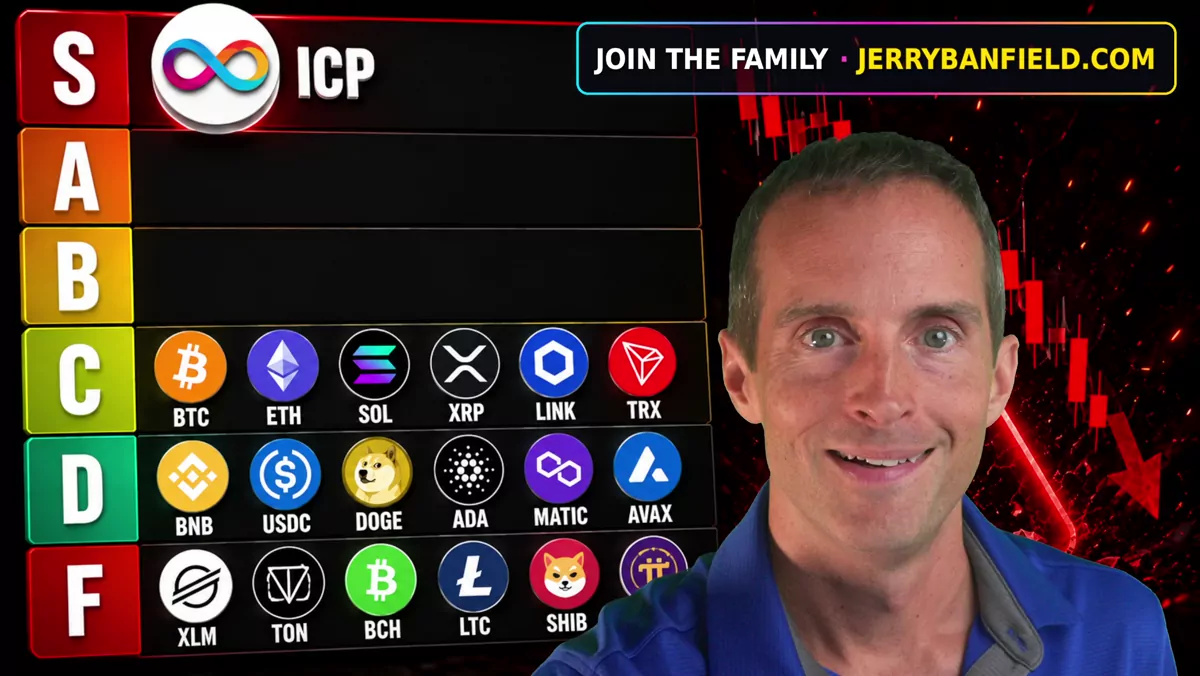
My Executive Summary: ICP Stands Out
I'm going to review the top 100 cryptos rapid-fire, because I want to tell you the most important thing you need to know about every single coin — excluding stablecoins and all that. We're getting into real layer ones, layer zeros, layer twos, and coins that represent something else. My executive summary is that out of these top 100, ICP stands out as the most undervalued, most important asset to look at in crypto right now. I made a website called cryptotechcap.com to emphasize this, based on the real capabilities of the technology, balanced against what the market cap should be if crypto was logical and rational — ranked by what your blockchain can actually do and how important that is to the world, rather than people just talking, hyping, and making promises they can't fulfill. That's how this came out the way it did. That said, I will dig into the details of the biggest issues I see with every single one of the other coins right now.
This is not financial advice. I'm not a financial advisor, and I've already made my position clear — which most other people in crypto do not do. At least you know exactly what I honestly think and what I'm living in my own life. And if you're tired of losing time and being stuck in crypto, I invite you to schedule a one-on-one call with me, where I offer private one-on-one calls. It's the price versus the value you get: you can talk to me about crypto every week, or anything else you want. It's fantastic. So let's dive into the details.
Bitcoin, Ethereum, and the Biggest Names
First, Bitcoin. BTC has the strongest monetary network effect, but the actual technology — what the blockchain itself does — is extremely limited. Almost everything is handled off chain, there's minimal native programmability, and the future security budget is increasingly dependent on fees as the mining rewards continue to halve.
Ethereum, number two, has real adoption, but its scaling strategy exports users to all these layer twos — which Vitalik himself says haven't even been working. Then there are the centralized sequencers, and Ethereum is struggling to recapture enough of the value that's been bleeding out to all these other chains.
BNB, Binance's coin, puts the exchange, the issuer, and the blockchain risk all together into one gigantically valued package — and therefore it's a nightmare in terms of the potential for regulatory or operational trouble at Binance. No way would I hold any exchange coin ever again.
XRP: the fully diluted valuation is absolutely insane on this one, and all the payments hype is extremely shallow, as I explained in my dedicated XRP deep-dive video. The XRP hype is shallow because you can send payments on XRP for almost nothing, and the chain itself only makes a few hundred dollars a day in fees — which means there's almost no real potential of the price pumping. Sorry to break that to you, but somebody needs to tell you these things straightforward instead of just telling you what you want to hear. Even though in the short term you might want to hear the hype, in the long term you want the truth. So I'm going to go ahead and talk about the truth. You can't handle the truth!
Solana has real usage, but its speed requires expensive validator hardware, which seems to be pretty centralized. Much of the activity is just trading and MEV, the fees are tiny, and inflation is the only thing even supporting this via endless subsidies at this point. That looks massively overvalued to me.
Tron, TRX: the stablecoin value is real, but the main thing people are doing is just moving USDT on Tron, which ends up capturing very little value back to TRX itself. And the governance system is heavily concentrated around Justin Sun, so there's no realistic decentralization there.
Exchange Tokens, Memes, and Privacy Coins
WhiteBIT Coin, WBT: its own pages don't even make clear the exact circulating supply, producing a multi-billion-dollar market cap gap. That is absolutely unacceptable for a coin that big.
Hyperliquid: lots of people have been so hyped up on this token, and it does have a real business. But buyers are paying for a nearly $68 billion fully diluted valuation, which is insane — that's up around where Solana is — and only 22% of it is actually represented by circulating market cap. That means you're at extreme risk of token dumpage and extreme risk of price collapse.
Number nine, Dogecoin. I did a dedicated "Dogecoin is finished" video to go further into this. While it does have unmatched meme recognition, it has almost no cash flow and no fixed supply — you've got something like a million dollars a day in new Dogecoin being printed, while the mining is shared with Litecoin. Very problematic.
RAIN is worth $9.6 billion, even though its white paper says the token is not required to deposit or trade markets, grants no ownership, and initially had no actual governance. Extremely dangerous.
Zcash does have some serious cryptography, but the privacy is optional — which, for a privacy chain, seems problematic. And the compliance pressure and exchange delistings make the future of this very uncertain.
LEO token — I ranted about this yesterday. It shows an $8.8 billion capitalization with only $236,000 a day in daily volume, and the token does not give you actual ownership of Bitfinex. All the hype around it is built on people hoping they're going to get a piece of all this stolen crypto tied to that collapsed exchange. It's crazy.
Stellar, XLM: Stellar's low fees help payments, but it has the same basic problem as XRP. It's extremely questionable how the XLM token itself has any real value capture or sustained demand, even if all the hype-boy narratives come true.
Monero, XMR: the strongest privacy coin, but it's the biggest investment risk. Compliance pressure and exchange delistings keep cutting off the liquidity. And ICP has tech that lets you do all of this fully on chain with things like vetKeys, SEV, and your own subnets — in my view, there's no reason for Monero to exist in the future.
Cardano, Chainlink, and the Mid-Cap Field
Cardano, ADA — I already did a video saying how this one is finished. It's had years to turn its peer-reviewed research into economic activity, yet almost all of the numbers you see are horrible for Cardano and don't point to its valuation. Patience has become the product. All you're doing is just waiting — and at some point, people are going to sell, stop waiting, and move into something better.
Chainlink is critical infrastructure for the old crypto ecosystem, but now, on ICP, you don't need oracles anymore. This is also just a token: you don't actually own any of the Chainlink business, and the token isn't strictly necessary to even power that business.
Canton, CC: it possibly may have real institutional users, but it's an optional, network-native payment mechanism with ongoing rewards. Even if Wall Street actually uses the network, that doesn't mean institutions will warehouse speculative Canton coin. I see Canton as extremely dangerous.
Bitcoin Cash, BCH: this is literally just a fork — a copy of Bitcoin at this point — with weaker security, fewer developers, and less demand. It's insane to me that anyone would hold Bitcoin Cash at this point.
DeXe has more than doubled in a month while major sources have disagreed on how many tokens are even circulating. This is fragile price-discovery territory where you can easily lose a huge amount.
Gram — nice rebrand on Toncoin. The Telegram distribution is real, but against the fully diluted valuation there are very few on-chain fees that we can see, and Telegram can continue going on just fine without Gram at all. Owning Gram doesn't give you anything in Telegram either, except whatever tiny features they can integrate into it. And the infrastructure isn't all on chain either — a critical flaw given their branding.
Litecoin, LTC: it's reliable, but reliability is not a growth thesis. It does hardly anything Bitcoin can't do, it has hardly any smart-contract differentiation, and it just survives because it's been on exchanges for a long time. But how long until people realize this is just a zombie coin?
Sui: it's fast, but are we really pricing it at $7.4 billion fully diluted when there's a whole bunch of token unlocks coming and it's directly competing with Solana, Aptos, and Ethereum layers like Base, Arbitrum, and Optimism? That seems like it's not going to work out very well long term. I don't know.
Hedera, HBAR: the governing council gives it enterprise and authority credibility, but that sacrifices any neutrality or even the appearance of decentralization. Meanwhile, there have been all these partnership announcements — but how has the price done since then? And something like Hedera, all it's got is price. It doesn't have the infrastructure like ICP does to weigh against the price.
Avalanche, AVAX: the Etna upgrade just made launching L1s easier. But where does the AVAX demand come from then? This makes it more like Cosmos, which has not done very well even though it's gotten significant adoption.
Cronos, CRO — I just roasted this in yesterday's video too. Cronos is just a mess. It's based on crypto.com, and the $5 billion fully diluted valuation is very difficult to justify against the actual on-chain activity.
Shiba Inu built an ecosystem around being a meme — one of the top meme coins. But to me, a sign that things are not going well is when they create the BONE and LEASH tokens, Shibarium, and other products, all distracting from SHIB itself. To me, those are signs that Shiba has nowhere to go from here.
NEAR Protocol keeps changing its headline — from sharding to chain abstraction to AI — and now they're acting like they can do things with AI that only ICP can actually do. If you look at my crypto tech cap comparison, ICP answers 97 questions "yes" in that equation. And how many does NEAR answer? Not nearly that many — 20, as a matter of fact. The marketing on NEAR is grossly mismatched with the reality of what it can do.
Uniswap, UNI: it finally improved value capture a little bit, but it's $3.3 billion for a governance token fragmented across chains. An absolute disaster.
Bittensor, TAO — I've roasted this repeatedly. I absolutely can't stand Bittensor because the marketing is literally the opposite of the truth, and the more you dig into it, the worse it gets: from gaming subnets to being actually very centralized, according to insiders who've used it and been on the inside. Meanwhile, the token dumpage is huge. An absolutely horrible setup.
World Liberty Financial and More Exchange Tokens
Before we keep going: at any time, you can book a private call with me to talk through more details with me about any of these.
World Liberty Financial — I roasted this in an individual video. While the hype talks about how this is connected to Trump, World Liberty Financial looks absolutely awful: two thirds of the fully diluted valuation is still outside of circulation, with tons of token dumpage coming.
OKB — another exchange token. I can't stand exchange tokens and their buybacks. And HTX DAO, another exchange token, this one in the Tron ecosystem — also just absolutely awful. Why would crypto retail buy this?
Working Down the Rankings: Aster Through Morpho
Aster is a Hyperliquid competitor, and in my view this one is way overvalued and already not even the top project in its lane. Ondo — I did a dedicated teardown for Ondo. Tokenized treasuries and stocks can succeed while Ondo holders get almost nothing back from that success. You see the same thesis with almost all of these. Aave is one of the strongest protocols out there, but there are tons of risks. In my opinion this easily could have some epic collapse and get hacked at a certain point — they already had to put in hundreds of millions after a recent problem. High liability, very low upside.
MemeCore — I roasted this in yesterday's roast. It's great branding and a fun theory, talking about a meme coin layer one, but there's huge competition for that, and MemeCore is not leading the way in it. Huge fully diluted valuation, too. Worldcoin — I roasted this in an individual video, and all my videos become blog posts on my website. They could build the network out just fine while the WLD holders get almost nothing. And again, as with so many of these, a huge amount of the tokens are still locked and going to get dumped on naive retail. Don't be naive retail.
Polkadot at number 38 spent years perfecting parachains, and while I rank it as one of the top projects in actual technology, it's nothing compared to what ICP does. Sky has real revenue and improved value, but the economics depend on real-world assets, custodians, legal entities, and governance decisions that all can fail outside of the blockchain and bring everything down, which is a huge problem. Mantle has a giant treasury that can subsidize growth, but then that's a bet on the community's capital allocation — you're hoping the centralized holders do things responsibly with it. Why would you want to pump the value of their holdings? Morpho has real adoption, but its isolated market design outsources risk to curators, vault managers, and oracles. One bad vault can destroy users locally. And again, so many tokens waiting to dump on retail.
ICP at Number 42: The Standout
ICP at 42 is the standout, and to me it feels like they are doing everything to hide ICP from you, because this is the one crypto — as I said earlier — that I believe really has serious technology that can change the world. And the valuation is tiny. It also is fully vested at this point: you don't have a bunch of token dumpage that can happen. That's why I only hold Internet Computer. You see what an IQ test this is — to get all the way down to 42 before you find one coin that, to me, looks promising.
Exchange Tokens, Old Memes, and Middleware
Bitget token, another exchange token — absolutely awful, in my opinion. Pepe: one thing that doesn't usually do well over time is old meme coins that already had their day, and Pepe already had his day. Ethereum Classic, the original proof-of-work Ethereum blockchain, still survives — which I find ridiculous. This is even ranked around Pi Network, which I roasted individually in a video. Pi is centrally controlled, KYC'd, people tapping on an app — absolute crap, in my view. KuCoin token: I don't see why you'd want to hold an exchange token when it's not even a stock. Quant — I roasted this individually. It sells enterprise interoperability, but it's middleware; you can't really verify anything going on with Quant.
APX is one of the strangest to me: a $920 million market cap, $2.3 billion fully diluted, and only a few hundred in daily volume. What the hell is going on with that? Stable — I roasted this yesterday. You pay gas fees in USDT0, so it's not even "stable," and it has a huge market cap again. It just sits on top of Tron's large stablecoin economy, and mostly the token's role is governance. Governance tokens are so bad. You need more utility — governance tokens are just never going to have enough utility, in my experience watching these.
ADI: another huge valuation compared to the amount circulating. Terrible. POL, the Polygon Ecosystem token, formerly MATIC — a horrible rebrand, and you can't fix how all the partnerships fell through and basically nothing materialized. A perfect example of hype versus reality. Audiera (BEAT): $2.8 billion fully diluted for a rhythm game with an AI music and creator narrative — again, it's obvious to me there's very little substance here. Cosmos Hub (ATOM) did a great job proving app-chains can work, and in doing so showed you that the ATOM token is not really needed for that. Render — I roasted this individually in a video. Decentralized GPU supply is a nightmare in actual execution compared to centralized compute. This is narrative; you look into it and it looks bad. Kaspa — at least it's ranked below ICP. The hype around this is so disconnected from reality it's ridiculous to me. It's just another proof-of-work payment coin, and it looks like things are going to go very poorly from here.
Synthetic Dollars, Centralized Lenders, and Exchange Coins
Ethena — funny enough, I actually had that name idea, Athena, like ten years ago. ENA is a governance token around a synthetic dollar machine whose profits depend on funding rates, and again, a huge share of the fully diluted value is not even in circulation. Nexo is loyalty exposure to a centralized lender, not equity — you don't have audited ownership or a legal claim on company profits. A disaster waiting, in my opinion. Algorand's technology has been praised and it's been around for years, but to me it's weak compared to ICP, and the demand for it is also poor. Binance Life: a meme coin with no team, just leeching off of Binance's name. How gross does crypto have to get? Gate token (GT), another private exchange token. As a retail investor — and this is my opinion, not financial advice — I would never again hold an exchange token. It makes no sense. Crypto is supposed to be about decentralizing power and money; making someone like CZ, or some other person like CZ, rich makes no sense for crypto retail.
Lighter (LIT): nice branding, and the technology is real, but it's weak compared to ICP, and again there's a massive fully diluted value compared to the circulating market cap. Jupiter is a Solana product and it does support on-chain revenue, but revenue accumulation is not the same as cash distribution — and again, half the value is still waiting to be dumped. Beldex sits at almost a billion dollars fully diluted for a privacy ecosystem with far less liquidity and mindshare than Monero. And masternodes — we're still using those in 2026, huh? I thought I flashed back to Dash in 2016 again. Filecoin (FIL) supports enormous storage capacity, but that supply is not actual demand, and the retrieval complexity — which I went off on in the Filecoin video I did — is a huge problem.
Rapid Fire Through the Rest
Let's rapidly finish these. Arbitrum: it's a governance token — absolutely awful, in my view. Pump.fun: $1.2 billion for a launchpad that users can abandon overnight. Flare — I roasted Flare in an individual video; the oracle and interoperability pitch has so many problems. XDC Network is just another basic XRP/XLM copy. Aptos, another one of these "high performance" chains that has totally flopped with almost no adoption. Midnight (NIGHT) — the NIGHT-and-DUST design is complex, and there's lots of token dumpage still to come. Aerodrome Finance — I've roasted this multiple times. It's a brilliant flywheel, but it becomes brutally fragile: whenever DeFi has a crash across these other chains from hacking, this could absolutely get destroyed. Venice Token: all you're doing is staking for AI inference — an absolutely junk use case, to me. Injective, the finance-focused chain some of the Solana shillers have been hyping up — it's not the hot thing anymore, and again, token burns don't compensate for a lack of real demand. Provenance Blockchain (HASH): half a billion dollars of market cap on about $1,700 of daily turnover. Absolutely awful.
PancakeSwap (CAKE) is the DEX on Binance's chain — this was hot nearly a decade ago; you missed it. Dash: I said this was going to be the next Bitcoin in 2017, and it pumped a lot harder than Bitcoin back then. But where is it now? What's it done since? Basically nothing — and that's why I exited it back then. I've done much deeper research before saying something like "ICP is the only thing that has a realistic chance of flipping Bitcoin." VeChain (VET) — I've roasted this individually. It's spent years promising, yet I don't see any significant, meaningful real usage. Ether.fi has some real users, but restaking, stacked smart contracts, slashing — there's so much liability. In my opinion, liquid staking on Ethereum is very likely to go down one day in a catastrophic failure, and this goes with it. Virtuals Protocol: another one of these tokenized AI agent plays where, when you look into the details, I see no way this works long term. Celestia (TIA) — I've roasted this for years. It helped popularize "modular data availability" — do you even know what that is? — but all these other providers are turning away from that approach, so it's useless.
Pudgy Penguins is a meme coin built on a real toys-and-media brand, which could create some real liability as well — and it's still a meme coin. Why would you invest in something where there's nothing underlying it to keep it surviving for the long term? Pyth Network has potentially some limited infrastructure uses, but many of the updates are paid and cost almost nothing — so again, it's effectively a governance token. A nightmare. Official Trump: I told you so. I said this was horrible when it released and that everybody was going to lose money, and that's what happened. Artificial Superintelligence Alliance — I went after this: FET (Fetch), SingularityNET, Ocean. I already attacked that for a whole video. In my view these three projects are weak by themselves, and putting them all together doesn't make anything useful.
The Final Stretch of the Top 100
Sun — look, another Tron token. Bonk, another Solana meme coin. SPX6900 is a clever parody, but again, another useless meme coin. Terra Luna Classic: it's ridiculous that this is in the top 100 (excluding stablecoins) given how many people lost money on it. SEI sells speed for trading, but speed is becoming standard across chains, so it's not needed. Stacks — ICP has a vastly superior Bitcoin layer-two infrastructure, which in my view makes Stacks totally irrelevant. Curve DAO: a DeFi structure like Curve is extremely vulnerable to a DeFi collapse that comes from AI hacking the off-chain infrastructure — which is most everything besides ICP. LayerZero: told you so on this one. There was some problem, it got wrecked, and I warned you. Jito: a Solana coin and another governance bet — governance coins are absolute garbage in 99% of scenarios, in my opinion. Gnosis built wallets and other things, but it's a mess, split across governance, validators, and xDAI for gas; the ecosystem, even if it succeeds — which I think is unlikely — can grow without GNO.
Kite — I roasted this one recently: $1.16 billion valuation with most of it not circulating, and "autonomous agent payments" is just a narrative. I don't see any proof they can really deliver something serious that will be adopted at scale. Monad: another huge fully diluted valuation compared to the circulating supply — extremely risky, with almost guaranteed token dumpage. Bitcoin SV (BSV) is one of the strangest cult coins to me. It does have its bigger-block thesis, but you hear people talking like this is ICP — like it can do absolutely everything on a blockchain, provably and instantly. False. Stop watching those BSV conspiracy videos. Finally, Immutable X (IMX): they built real gaming infrastructure, but the problem is almost all of it is off-chain, and all it is is a layer two. They struggle with retention because it's more expensive, and since the infrastructure is off-chain it carries all these costs and complexities. Some of the games do have the ability to succeed, though — Gods Unchained among them.
Even a Top Immutable X Game Face-Planted
There was a game I was into for a while that was one of the top games on Immutable X, and it absolutely just face-planted. It went nowhere. It's a good example of how almost everybody who bought this got burned.
The One Coin Whose Only Problem Is the Chart
So if you thought this was useful, where I went through and pointed out huge problems with 99 of the top 100 coins, here's where I've landed: ICP is the only one where, in my view, the only problem with it is the price chart — and I've come to believe that chart was intentionally manipulated by exchanges to keep people from looking at the truth of the technology.
If you can handle the truth, I invite you to set up a call with me, where you can get on a call with me — insane value.
If you want more breakdowns like this one, you'll find them in my Crypto Reviews playlist. I'm here to be a person you can count on.