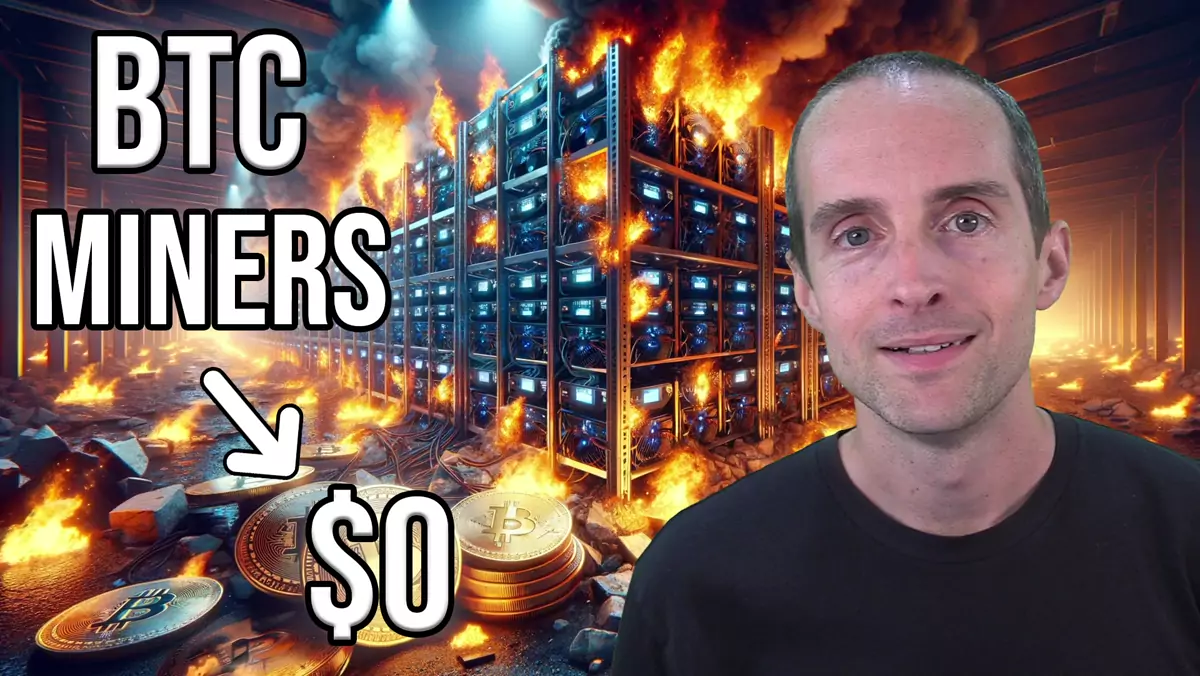
My friends, this is a warning to everyone who's investing in Bitcoin miners or is looking at the future of Bitcoin mining. I think things are going to go very poorly investing in Bitcoin mining in the long term, and maybe even in the short term. I want to walk you through some things I haven't heard anyone talk about to support my point here. Many of you have asked me, Jerry, what do you think about Bitcoin mining? Absolutely under no circumstances would I buy a stock in a Bitcoin mining company, and under no circumstances would I buy any Bitcoin mining rigs. That's because, in my opinion, there's something way better available, and because I've seen how other people like Elon Musk have responded to the massive, wasteful Bitcoin mining and computation. I've heard all the defenses, and I'm going to cut through all that right here.
There's also things like quantum computing. I think Bitcoin could easily crash when Satoshi's wallet gets quantum-compute hacked, which you can't really stop from happening as far as I can see. Therefore, I don't think Bitcoin itself is going to do very well in the long term, which to me makes Bitcoin mining even worse.
The number one reason I'd never invest in Bitcoin miners
But what's the number one reason, to me, that investing in Bitcoin miners is such a poor idea? Let's do something that, somehow out of all the conversations I've seen about Bitcoin mining, nobody's ever said. So I'm going to say it. Let's think about the amount of computation Bitcoin mining uses, and let's compare that to the best that's available, which obviously, if you've watched any of my videos before, is going to be on the Internet Computer.
Right now the hash rate for Bitcoin is 550 million terahashes per second. That's a lot of numbers, but I'm going to break this down in a way that's easy to digest. That's the total amount of computation that's being used currently for Bitcoin mining. Now, keep in mind the rewards for Bitcoin mining are about to drop in half, which means the Bitcoin price needs to double just for things to come out even for Bitcoin miners. So far it's done that, but going forward it's going to be more and more difficult, because there are better options.
Let's look at the price per terahash to buy a new Bitcoin miner. This does not even consider the massive use of energy required to do Bitcoin mining. And let me address all the Bitcoin miner maxis out there who will say, well, this computation is valuable, banks use a lot of energy. That's true. But at what point are we humans going to start just looking for the best solutions and letting go of the old stuff? My question to all the Bitcoin miner maxis is: is this the best option for humanity today?
The cost works out to about $12 per terahash. So we'll do a little math. It's $12 per terahash, and there are 550 million terahashes a second, so I think we've got enough zeros, times 12. That's the current approximate cost if you wanted to essentially make all the Bitcoin mining hardware on the current newest standard. Really it costs more than this in many cases, but there are wholesale discounts. Long story short, the current Bitcoin mining hardware could be valued at approximately $6 billion today.
What is all that hardware actually doing?
So there's $6 billion of computer hardware that's going into mining Bitcoin today. But let's think for a second: what is that hardware actually doing? That hardware is solving a pretty trivial math problem. I mean, it's a difficult math problem to solve, but it's like giving everybody a Rubik's cube and saying whoever does the Rubik's cube first gets to decide who does the next Bitcoin block. It's not doing something that's actually useful. It's essentially just a competition that's gone to a $6 billion equipment-level investment.
This also means that for all the people who say Bitcoin mining is decentralized — no, it's not. It's not decentralized anymore. Have you noticed? If you want to do Bitcoin mining, you have to spend around, by the time you add shipping and tax, about $3,000. And guess how much of the network that would get you? If you bought one $3,000 mining machine, you would have one two-millionth of the Bitcoin mining power. So you basically are never going to get a block in your entire life with a $3,000 machine. You'd really have to spend a lot of money. You'd have to spend at least $100,000 to hope you could even get a block.
And would you even get a block if you spent $100,000? Well, you could expect to get one out of 73,000 blocks with that current amount of mining hardware, and it takes about 10 minutes a block. So you'd need 700,000 minutes to go by with $100,000 of mining hardware. With 24 hours in a day, you'd be lucky to get one block in a year putting $100,000 into Bitcoin mining. And all this time, your hardware is essentially doing nothing for the planet. Your hardware is just spinning, trying to solve a problem. If you're weighing a mining investment like this yourself and want to think it through out loud before you commit any money, you can schedule a private one-on-one call with me and we'll go through the numbers together.
If you want a deeper version of where I land on all this, I put it in Bitcoin Mining: What You Really Need to Know, and I think we're living through the most dangerous time in Bitcoin history for exactly these reasons.
The Internet Computer is doing valuable work instead
What almost nobody talking about Bitcoin mining realizes is that there's an Internet Computer, and the hardware on the Internet Computer actually is doing valuable things, like serving the web. My website is hosted on the Internet Computer. My community, which is in OpenChat and linked on jerrybanfield.com, is on the Internet Computer. So if we look at this not from individuals with our little viewpoints, trying to make profits and pitch our own stuff, but if we look at this as a step up to the big-brain level of humanity and think, what should we do building the infrastructure of this planet — there's a crypto that has changed the game forever. It's called the Internet Computer. It is, to me, the biggest change we've ever seen in crypto since Bitcoin was first invented.
It's a change from all this Bitcoin stuff — all this mining, all these transactions, where most people don't even interact with the Bitcoin blockchain directly. They do it through a third party, like an exchange or a wallet. And if you're interacting through some hardware wallet, you're relying on their software and their hardware. Then all these apps like Bitcoin Ordinals, you have to interact through third-party services, which inevitably are centralized, which ruin the real value of the Bitcoin network. Bitcoin can only do about one megabyte per block per 10 minutes. That means you need 20 minutes, or two blocks and all the block space, just to put one photo on chain, assuming you could even do that.
So the biggest change we've ever seen in crypto, in my view, is that now the Internet Computer Protocol is the first full-stack platform where you can build your website, as I've done, and have everything on chain. The picture is on chain. It's not off on some third party. This means you can have tokens — these Service Nervous System tokens that have launched are directly on chain, governed by DAOs — and you have a new infrastructure that can give all the value Bitcoin can give. It's the most technologically advanced layer two for Bitcoin, and really, if you're even going to scale Bitcoin, I'd argue you need the Internet Computer to do it.
Comparing the cost of the two networks
Let's compare the Internet Computer's computation and use of human resources to Bitcoin. Right now there are 1,399 total node machines in the Internet Computer Protocol network, and these node machines are doing thousands of transactions a second. They are doing valuable transactions, like serving the web, running code in smart contracts, and executing things like Bitcoin Ordinal layer-two transactions and Ethereum layer-two transactions. They're doing all kinds of things.
So how much does this network cost? There are 1,399 node machines on the network. CityScape on YouTube, who's a developer, did a recent computation showing how much the nodes actually cost on the Internet Computer Protocol. I'll be honest, I don't think I actually watched the whole video, but the figure that came out of it was that an ICP node costs around $10,000 — it can be ten or twenty thousand dollars depending on what kind of node it is, but let's go with around $9,000 to $10,000. So you can do the math for yourself, but we'll do it here to make it simpler: 1,399 nodes times $10,000. That's the entire cost of the infrastructure if you're using the Internet Computer.
Now, the nodes have a minimum of four units, so if you actually want to run nodes you need a minimum of four node machines — you can't run one single machine. But if I'm counting each node individually, then 1,399 node machines would cost roughly $1.4 million dollars.
So let's take a look at these two infrastructures. Bitcoin's infrastructure costs $6 billion. The Internet Computer's costs about $1.4 million, which, if you do a little math, is about 4,000 times less.
Now look at what each network does with that money
Now let's look at the computation each network actually does. In a Bitcoin transaction you have about one megabyte of data, and Bitcoin, I believe, can do about seven transactions a second. The Internet Computer's transactions — technically the Ethereum-equivalent transactions are a little more complicated, but for simplicity's sake, the ETH-equivalent transactions give you an idea of the computation that's happening on the Internet Computer. You can compare that to Bitcoin transactions.
So the cost of the network is 4,000 times less. Now let's look at the difference in transactions you get out of that infrastructure. You take the ETH-equivalent transactions, around 267 of them, divided by seven. Computationally, the Internet Computer is doing about 38,000 times as much computation a second as the Bitcoin and Ethereum networks. This is just a rough figure. So now multiply the cost-effectiveness of this. The Internet Computer network is, by my rough math, 150 million times more cost-efficient than the Bitcoin mining network. Think about that for the globe, for the people on this planet.
Is it worth investing in technology that is 150 million times more efficient at doing simple computations? To me, this is the number you need to see. Bitcoin mining is not the future, because the Internet Computer network, computationally — if you're looking at just buying hardware and putting it to work — is 150 million times more efficient than the Bitcoin network at doing simple things like sending transactions. And the thing is, it can do things the Bitcoin network can't even do either. But just for purely sending transactions, it's hundreds of millions of times more efficient.
So for everybody saying that Bitcoin mining is the future and you should invest in it — no, in my opinion, this is the future. This is why I'm all in on the Internet Computer: because I'm thinking from the whole-planet point of view. As a whole planet, if we're buying computers and using energy to run them, it doesn't make sense to me to buy anything outside of the Internet Computer, because it's so ridiculously efficient. I keep these conversations going in my Crypto Reviews playlist if you want to go deeper on how I'm thinking about all of this.
The energy, the security, and what you can build
Look at the power consumption. The entire Internet Computer network uses about 357 kilowatts. That is such a tiny amount of energy. And this, to me, is the future, because it solves one of the largest problems we have in the world on the internet, which is cybercrime. When you build using this crypto, and you're able to build your website and all of your other applications with this technology, you are mostly safe, as far as we can see, from cybercrime. From my experience using it for two and a half years, you don't need firewalls, you don't need a huge IT security team, and you're also safe from being spied on by hostile governments and from third-party companies shutting you down. This is the infrastructure I believe we need for humanity.
This does everything you want to do with cryptocurrency. You can build anything you want on it, from CBDCs to crypto games fully on chain, to websites on chain, social networks on chain, and real-world assets like gold on chain. This is the network. And this is why you need to compare things in life, because until you compare the sheer amount of computation — and this doesn't even talk about the energy. I mean, Bitcoin mining uses probably a million times or something like that as much energy as the Internet Computer does. There's vastly superior technology out there. If you want my full take on where Bitcoin actually goes from here, I laid it out in why Bitcoin's future is being built on ICP.
Comparing the two as an investment
And unlike Bitcoin mining, here's my experience: if you put $100,000 into the Internet Computer, you'll get about 15% back in voting rewards a year, indefinitely, if you lock it up and you vote on everything like I do — and that's without touching the principal. Compare that to Bitcoin mining, where you throw in $100,000 and you've got something like a 50-50 chance of even getting one single block. And consider that with Bitcoin mining, because the mining machines are always getting better, if you run your machines for a few years your principal is essentially going to go toward zero. These Bitcoin mining machines, these Bitcoin mining companies — essentially all their mining equipment in a few years will be worthless.
You put $100,000 into the Internet Computer, even if the price stays flat — which to me is almost impossible because of all the things I'm saying, and because it's the biggest change we've ever seen — but even if the price stayed flat, you get about 15% back in rewards and your principal stays there. So if you compare that to Bitcoin mining, in my opinion there's something way, way better — better for the people who are mining, better for the planet, better for the climate, and better for users. If you actually send a transaction on the Bitcoin network, it's not a great experience. It's only a marginal improvement over wiring money at my bank, and in some ways many people clearly would rather wire money at their bank than use the Bitcoin network. But ICP is a very good, instantaneous transfer experience. This is where I believe the future is going. This is just my opinion and my experience, not investment advice — please do your own research before risking any money.
So to me, being invested in Bitcoin miners is very, very dangerous, because there's this vastly superior infrastructure available, because there's a way better alternative available. That's why I'm all in on ICP. There's nothing better I see in crypto. I've been here 10 years, and that's why I've told you about it. If you want to chat with me when I'm offline, you can find me on OpenChat. Thanks for reading to the end, and I'll get to work on another one for you.