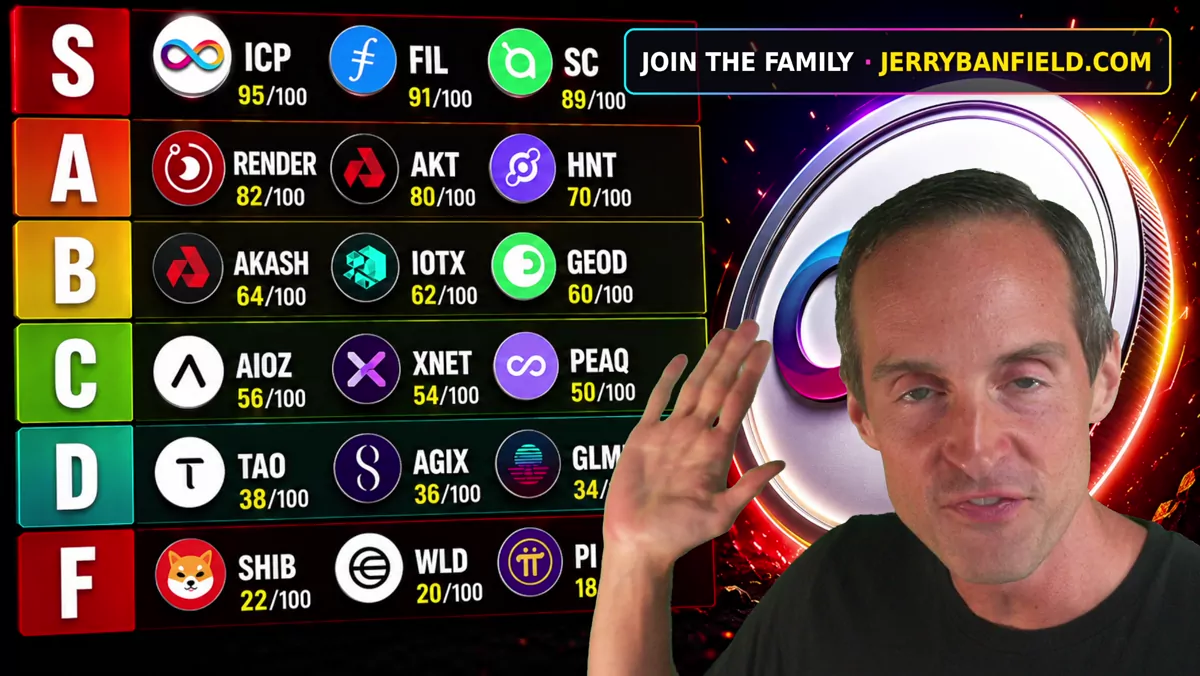
I had this research dossier prepared as the full audit behind my video reviewing every coin in CoinGecko's DePIN category — all 50 entries, plus the Internet Computer (ICP), which CoinGecko leaves out of the category entirely. I'm publishing the complete dossier here so you can check every score, every dimension, and every verdict yourself. The research was produced with ChatGPT Pro deep research over about an hour and a half, prioritizing official documentation, whitepapers, and project sites over marketing.
Full disclosure up front: I hold only ICP, and this research covers ICP directly. Read the methodology and penalties before the scores so you know exactly what is being measured — DePIN integrity, not price potential. None of this is financial advice.
The central thesis
Most DePIN projects do not decentralize the service. They decentralize rewards and settlement around physical work still controlled by providers, schedulers, oracles, telecom agreements or company software. The decisive question is whether consensus executes the service — or cryptographic proof can hold the physical provider accountable.
Snapshot date: July 31, 2026. CoinGecko's top 50 DePIN entries were frozen at that snapshot. Internet Computer was not on the category page, so it is manually added as a 51st audit entry — at the snapshot, ICP's roughly $1.14 billion market cap would place it second in the combined set, behind Bittensor and ahead of Render. No motive is inferred for CoinGecko's omission.
Executive findings
The strongest conclusion is not that every project is fake. It is that most tokens provide much weaker decentralization and value capture than the project name implies.
The defensible headline
ICP is the structural outlier for replicated application execution and direct resource burn. Filecoin, Siacoin and Arweave are genuine non-ICP outliers because their protocols cryptographically enforce storage obligations. Most remaining projects put markets, rewards or receipts on-chain while the actual physical service stays outside consensus.
1. ICP is the only general-purpose service layer in the set that executes application state under replicated consensus. Canister update calls are deterministically executed across subnet replicas, and cycles are consumed for compute, storage and networking. That is a fundamentally stronger architecture than paying an off-chain GPU operator or telecom hotspot.
2. 'Not fully on-chain' does not automatically mean fake. Filecoin, Siacoin and Arweave keep bytes on physical disks but make storage proofs part of protocol enforcement. They solve a narrower problem than ICP, yet they are much more trust-minimized than ordinary cloud marketplaces.
3. Confidential-compute projects are the best middle ground. iExec, Acurast and Phala use trusted execution environments, attestation, staking or worker consensus to reduce off-chain trust. They are meaningful technology, but the security root moves to chip vendors and enclave implementations.
4. Wireless and geolocation DePIN can be real without being fully trustless. GEODNET and Helium operate genuine physical networks with external customers and strong token loops. They rely on telemetry, certified hardware, routing software and oracles. Helium's removal of Proof of Coverage on July 6, 2026 materially weakens its signature verification claim.
5. GPU and cloud marketplaces are mostly decentralized supply with centralized or unverifiable execution. Render, Akash, Flux, Aethir, io.net, Golem, Nosana, Livepeer, AIOZ and others can provide useful compute. Their chains usually prove payments, leases, collateral or rewards - not the correctness of the job.
6. CoinGecko's DePIN category is heavily polluted. Bittensor is an off-chain AI scoring market; Zebec is payroll and payments; IOTA is a general L1; Chia uses disks for consensus rather than customer storage; Radworks governs peer-to-peer developer software. These may be real projects, but the label does not give the buyer clean DePIN exposure.
7. A real product is not the same as a real token thesis. Storj can sell excellent distributed storage while STORJ remains mostly a payment asset beside a company-operated Satellite layer. Powerledger, Jasmy, MVL, Ankr and Zebec can build useful businesses without making their tokens direct claims on business value.
What ‘fully on-chain’ can honestly mean
Physical infrastructure can never be literally inside a blockchain. The meaningful test is how much of the service's control, execution and proof are consensus-enforced.
Necessary correction
A radio, disk, GPU, satellite, power meter or data center is physical and therefore off-chain. Even ICP uses physical node machines. The honest distinction is whether the service code and state execute under consensus, whether cryptographic proofs enforce the provider's obligation, or whether the blockchain merely pays whoever an operator says performed the work.
The five integrity levels
Level 5 — Replicated service execution. The application logic and mutable state are executed by a consensus group, not by one provider. ICP update-call canisters are the clearest example in this set. External inputs can still be false, and physical node admission remains a governance question. (Examples: ICP)
Level 4 — On-chain contract plus cryptographic physical-service proof. The physical service stays off-chain, but the chain can independently verify a proof and release or slash collateral. Filecoin and Sia storage contracts are the strongest examples; Arweave links block production to access to historical data. (Examples: Filecoin, Siacoin, Arweave)
Level 3 — Attested or challenge-verified off-chain execution. Work runs in a TEE or is checked by multiple workers, challengers or sampling. iExec, Acurast and Phala fit here. Trust is reduced, not eliminated, because hardware vendors, attestation keys or validator sets remain in the loop. (Examples: iExec, Acurast, Phala)
Level 2 — On-chain market, payment or staking around off-chain service. Bids, leases, rewards or burns are transparent, while service quality and output remain operational. Akash, Render, Helium, GEODNET and most GPU networks live here. (Examples: Akash, Render, Helium, GEODNET, GPU markets)
Level 1 — Token wrapper or category narrative. The project may use physical devices or host DePIN applications, but the token is generic gas, governance, rewards or a product fee. The chain cannot prove the underlying service and may not be needed by ordinary users. (Examples: IOTA, Zebec, Chia, Radworks and many ecosystem tokens)
Why ICP does not receive 100/100
Its physical nodes are standardized machines in data centers; node providers are admitted through NNS governance; and non-replicated query calls carry a single-replica trust model. The score rewards the replicated control plane without pretending the physical network has disappeared.
Methodology and penalties
Half of the score is reserved for on-chain service control and verifiability. That intentionally crushes projects whose only decentralized component is payment.
The six scoring dimensions
On-chain control / execution (max 30 points). A high score means: Service logic, allocation, contracts and mutable state are consensus-enforced. A low score means: Only payments, rewards or generic gas are on-chain.
Verifiable physical service (max 20 points). A high score means: Cryptographic proofs, replicated execution, credible attestation or strong challenge systems verify delivery. A low score means: Provider, company, oracle or dashboard simply reports that work happened.
Provider decentralization (max 15 points). A high score means: Independent providers can join, ownership is diverse and no central scheduler can quietly replace the market. A low score means: Curated hardware, licensed operators, central gateways or company-controlled supply dominate.
Token-service coupling (max 15 points). A high score means: Customer usage requires, burns, locks or transparently purchases the token; providers risk collateral. A low score means: Token is optional governance, emissions, generic gas or a weak proxy beside the product.
Production evidence (max 10 points). A high score means: Live service, public software, measurable customers, sustained nodes and documented operations. A low score means: Roadmap, testnet, unverifiable counters or partnership marketing dominate.
DePIN category integrity (max 10 points). A high score means: The token represents a real market for physical compute, storage, bandwidth, sensing, energy or infrastructure service. A low score means: The project is a generic L1, payroll app, consensus coin, data token or unrelated software protocol.
Tier meanings
S 85-100 — Structural or cryptographically enforced DePIN (4 projects).
A 70-84 — Strong verifiable DePIN with material off-chain trust (5 projects).
B 60-69 — Real infrastructure with meaningful but incomplete trust minimization (5 projects).
C 45-59 — Real product or network; service mostly off-chain or token exposure compromised (24 projects).
D 25-44 — Narrative-heavy, centralized, generic platform or badly misclassified (12 projects).
F 0-24 — Evidence-poor, opaque or not meaningfully DePIN (1 project).
Hard penalty rules
- If the physical service is off-chain and the protocol cannot prove it, the project cannot reach S tier regardless of node count or market cap.
- A generic L1 or middleware chain receives little category-integrity credit merely because third parties can build DePIN applications on it.
- A TEE earns substantial verification credit, but never the same credit as replicated execution or a protocol-native cryptographic service proof.
- Self-reported node counts, revenue, partnerships and performance are labeled as project claims unless independently auditable.
- A token is not equity. Buybacks, burns, staking, access and collateral are scored as mechanisms, not legal ownership of project revenue.
- Market capitalization has zero effect on the technical score. The ranking measures DePIN integrity, not expected price return.
Ranked results and outliers
The ranking deliberately favors consensus-enforced service and cryptographic physical proofs over market size, brand recognition and node-count marketing.
Top 15 by actual DePIN-integrity score
S tier
- 1. Internet Computer (ICP) 95/100
- 2. Filecoin (FIL) 91/100
- 3. Siacoin (SC) 89/100
- 4. Arweave (AR) 85/100
A tier
- 5. iExec RLC (RLC) 78/100
- 6. Acurast (ACU) 76/100
- 7. Phala (PHA) 74/100
- 8. GEODNET (GEOD) 71/100
- 9. Helium (HNT) 70/100
B tier
- 10. IoTeX (IOTX) 66/100
- 11. OriginTrail (TRAC) 65/100
- 12. Akash Network (AKT) 64/100
- 13. Render (RENDER) 61/100
- 14. Flux (FLUX) 60/100
C tier
- 15. World Mobile Token (WMTX) 59/100
The outliers worth discussing
ICP — structural outlier. Replicated application execution plus direct conversion of ICP into consumed cycles. It is the only general-purpose network here where the digital service itself can live under consensus.
Filecoin, Siacoin and Arweave — cryptographic DePIN. Their bytes remain on disks, but the protocol verifies ongoing storage or access obligations. These are real counterexamples to the claim that every non-ICP DePIN is fake.
iExec, Acurast and Phala — credible confidential compute. They attack the off-chain trust problem with attestation, TEEs, worker consensus and collateral. The tradeoff is hardware-vendor trust instead of replicated execution.
GEODNET and Helium — real physical demand. Both built useful real-world networks and have unusually strong token loops. Their data quality and service verification still depend on operational systems and oracles.
Render and Akash — honest markets, unverifiable work. They decentralize supply and settlement. The GPU or container still runs outside consensus, which is a decisive limitation under this report's weighting.
Bittensor, Zebec, IOTA, Chia and Radworks — category failures. These projects may be legitimate in other categories. Their inclusion demonstrates that CoinGecko's DePIN tag does not reliably identify direct exposure to a physical infrastructure service.
Complete score ranking: all 51 (by DePIN-integrity score)
#1 Internet Computer (ICP) — score 95, tier S, CoinGecko DePIN position manual add. The structural outlier: application code, mutable state, storage, identity, payments and update-call computation can live under consensus, while ICP is converted into cycles and consumed to run the service.
#2 Filecoin (FIL) — score 91, tier S, CoinGecko DePIN position 4. The strongest non-ICP DePIN in the set: storage deals, collateral and ongoing proofs are enforced by the chain even though the bytes live on physical disks.
#3 Siacoin (SC) — score 89, tier S, CoinGecko DePIN position 37. A pure, technically coherent storage DePIN: renters and hosts use on-chain contracts, collateral and storage proofs, with SC directly paying for service.
#4 Arweave (AR) — score 85, tier S, CoinGecko DePIN position 15. A genuine storage DePIN with protocol-level proofs and permanent-storage economics, though its permanence depends on long-run incentives and data availability assumptions.
#5 iExec RLC (RLC) — score 78, tier A, CoinGecko DePIN position 36. A mature off-chain compute market with smart-contract matching, staking and TEE verification - the best bridge between ordinary cloud jobs and trust-minimized execution in this list.
#6 Acurast (ACU) — score 76, tier A, CoinGecko DePIN position 35. One of the strongest compute DePINs: workloads run in phone trusted environments with attestations, but hardware vendors and TEE assumptions replace replicated consensus.
#7 Phala (PHA) — score 74, tier A, CoinGecko DePIN position 47. Strong confidential-compute infrastructure with attested hardware, but still dependent on Intel, NVIDIA and operator-controlled off-chain execution.
#8 GEODNET (GEOD) — score 71, tier A, CoinGecko DePIN position 17. One of the strongest physical DePINs: real base stations sell valuable correction data and revenue buys and burns GEOD, but station quality and data validation are not fully trustless.
#9 Helium (HNT) — score 70, tier A, CoinGecko DePIN position 31. A proven physical DePIN with excellent token-service coupling, weakened by the July 2026 removal of Proof of Coverage and growing oracle dependence.
#10 IoTeX (IOTX) — score 66, tier B, CoinGecko DePIN position 42. The strongest generic DePIN platform after ICP in this list, with meaningful device and zero-knowledge tooling - but third-party physical services still stay off-chain.
#11 OriginTrail (TRAC) — score 65, tier B, CoinGecko DePIN position 14. Strong verifiable data infrastructure with a real token loop, but only loosely fits the physical-infrastructure category.
#12 Akash Network (AKT) — score 64, tier B, CoinGecko DePIN position 12. One of the better compute markets: bids, leases and payments are on-chain, while the actual container and its output remain on provider hardware.
#13 Render (RENDER) — score 61, tier B, CoinGecko DePIN position 2. Real GPU supply and a strong job-to-token loop, but the rendering or AI work happens off-chain and is not consensus-reexecuted.
#14 Flux (FLUX) — score 60, tier B, CoinGecko DePIN position 48. A substantial node network with direct hosting utility, but applications execute in ordinary containers and depend on Flux orchestration rather than consensus.
#15 World Mobile Token (WMTX) — score 59, tier C, CoinGecko DePIN position 40. A serious attempt to build real connectivity, but licensing, operator onboarding, cloud EarthNodes and telecom dependencies prevent trustless end-to-end decentralization.
#16 Livepeer (LPT) — score 58, tier C, CoinGecko DePIN position 20. A live distributed media-compute network whose own documentation acknowledges that most activity stays off-chain.
#17 AIOZ Network (AIOZ) — score 58, tier C, CoinGecko DePIN position 21. A broad, real edge-network stack, but its chain mainly coordinates nodes and payments while content and computation remain off-chain.
#18 peaq (PEAQ) — score 58, tier C, CoinGecko DePIN position 25. A capable DePIN control platform, but buying PEAQ is broad ecosystem exposure rather than ownership of any one physical network.
#19 StorX (SRX) — score 58, tier C, CoinGecko DePIN position 32. Real storage nodes and audit claims, but less transparent proof design and provider openness than the top cryptographic storage protocols.
#20 Theta Fuel (TFUEL) — score 56, tier C, CoinGecko DePIN position 23. The more direct Theta DePIN asset: it pays for edge activity, but the jobs are still executed and checked off-chain.
#21 Auki (AUKI) — score 56, tier C, CoinGecko DePIN position 43. A real and interesting physical-data network with token burns, but spatial truth, domain operation and enterprise deployments remain off-chain and early.
#22 Aethir (ATH) — score 55, tier C, CoinGecko DePIN position 19. Substantial GPU infrastructure and explicit checker roles, but jobs, hardware certification and orchestration remain off-chain and operator-controlled.
#23 XYO Network (XYO) — score 55, tier C, CoinGecko DePIN position 27. A credible location-provenance protocol that can prove interactions among devices, but not the absolute truth of every location claim.
#24 Golem (GLM) — score 54, tier C, CoinGecko DePIN position 16. A genuine open compute market with direct GLM payments, but almost no protocol-level proof that arbitrary jobs ran correctly.
#25 Storj (STORJ) — score 54, tier C, CoinGecko DePIN position 45. A real and mature decentralized storage product whose own documentation makes clear that transfers avoid blockchain consensus and centralized Satellites remain critical.
#26 Bless (BLESS) — score 54, tier C, CoinGecko DePIN position 50. A large-scale edge-compute ambition whose own whitepaper openly describes a hybrid on/off-chain model; useful, but not the fully on-chain infrastructure the branding can imply.
#27 io.net (IO) — score 53, tier C, CoinGecko DePIN position 24. A real supply marketplace with a solid provider-payment loop, but orchestration and workload truth remain off-chain black boxes.
#28 Nosana (NOS) — score 53, tier C, CoinGecko DePIN position 38. A live GPU rental network with direct NOS payments and staking, but weak proof that completed jobs were correct.
#29 Impossible Cloud Network (ICNT) — score 52, tier C, CoinGecko DePIN position 18. Real data-center capacity and meaningful collateral mechanics, but a curated enterprise cloud with off-chain SLA oracles is not trustless infrastructure.
#30 Theta Network (THETA) — score 50, tier C, CoinGecko DePIN position 13. A real edge network, but THETA is the indirect governance/security asset while TFUEL is the operational token.
#31 Grass (GRASS) — score 49, tier C, CoinGecko DePIN position 7. A real distributed data-acquisition network whose core routing, data quality and customer pipeline remain off-chain and centrally influential.
#32 Starpower (STAR) — score 49, tier C, CoinGecko DePIN position 49. Real energy hardware and a plausible virtual-power-plant thesis, but device approval, telemetry and grid value are centrally mediated and only partly proven.
#33 The Graph (GRT) — score 48, tier C, CoinGecko DePIN position 9. Excellent decentralized digital infrastructure, but the indexers run off-chain and the service is not meaningfully physical DePIN.
#34 Ocean Protocol (OCEAN) — score 48, tier C, CoinGecko DePIN position 39. Useful data-market infrastructure with on-chain access rights, but data storage, algorithms and compute providers remain external and the physical-category fit is weak.
#35 Ankr Network (ANKR) — score 47, tier C, CoinGecko DePIN position 29. A mature Web3 infrastructure business with distributed providers, but centralized routing and product operations keep it far from fully on-chain DePIN.
#36 Powerledger (POWR) — score 46, tier C, CoinGecko DePIN position 28. Real energy software and deployments, but utility meters, market operators and enterprise integrations remain permissioned and off-chain.
#37 Dolphin (POD) — score 46, tier C, CoinGecko DePIN position 46. An interesting GPU inference model and aggressive buyback loop, but technical verification and primary documentation remain too thin for trust.
#38 BitTorrent (BTT) — score 45, tier C, CoinGecko DePIN position 5. A real peer-to-peer distribution brand with a loosely connected token, not a cleanly proven decentralized storage service.
#39 Bittensor (TAO) — score 43, tier D, CoinGecko DePIN position 1. A blockchain-paid ranking market for off-chain AI outputs, not a verifiable physical infrastructure network.
#40 IOTA (IOTA) — score 43, tier D, CoinGecko DePIN position 11. A legitimate blockchain platform with IoT ambitions, not direct exposure to a decentralized physical service.
#41 Beldex (BDX) — score 42, tier D, CoinGecko DePIN position 3. A real privacy-node network, but its physical-service claims are secondary to a privacy currency and largely unverifiable at the service layer.
#42 Janction (JCT) — score 42, tier D, CoinGecko DePIN position 26. A plausible GPU market with smart-contract coordination, but current evidence and service verification are too thin for a high grade.
#43 Chia (XCH) — score 42, tier D, CoinGecko DePIN position 34. A real decentralized consensus network that uses hard drives, but the disks secure Chia; they are not rented as a storage service.
#44 MVL (MVL) — score 38, tier D, CoinGecko DePIN position 41. Real mobility businesses with selective blockchain records, but the vehicles, data collection and service economics remain centrally operated.
#45 JasmyCoin (JASMY) — score 37, tier D, CoinGecko DePIN position 6. A data-control product with blockchain hashes and permissions, not a permissionless physical infrastructure network.
#46 Zebec Network (ZBCN) — score 37, tier D, CoinGecko DePIN position 8. A functioning PayFi company with some merchant-device incentives, not a decentralized physical infrastructure protocol at its core.
#47 Holo (HOT) — score 37, tier D, CoinGecko DePIN position 22. An interesting non-blockchain hosting design, but HOT is a weak proxy for a still-evolving Holo hosting economy.
#48 Radworks (RAD) — score 37, tier D, CoinGecko DePIN position 44. Useful decentralized software infrastructure, but neither physical DePIN nor a token-required core protocol.
#49 Spacecoin (SPACE) — score 36, tier D, CoinGecko DePIN position 30. A real and ambitious physical-infrastructure experiment, but one demonstration satellite is not yet a decentralized constellation.
#50 XPIN Network (XPIN) — score 32, tier D, CoinGecko DePIN position 10. Mostly a branded connectivity reseller riding existing telecom infrastructure, with token-mining devices layered on top.
#51 DexNet (DEXNET) — score 22, tier F, CoinGecko DePIN position 33. Evidence-poor, thinly traded and heavily dependent on company claims; the category's weakest entry.
Executive summary: all 51 in market-cap order
Combined market-cap order keeps the market's biggest narratives visible; the technical score beside each one shows how little valuation and DePIN integrity correlate.
How to read this table: combined position includes manually added ICP. CoinGecko position refers only to the site's DePIN category order; ICP is marked as a manual addition. Market caps are a frozen snapshot and will change. Scores do not predict price.
#1 Bittensor (TAO) — $1.84B market cap, score 43 (D tier) (CoinGecko DePIN #1). A blockchain-paid ranking market for off-chain AI outputs, not a verifiable physical infrastructure network.
#2 Internet Computer (ICP) — $1.14B market cap, score 95 (S tier) (manual addition). The structural outlier: application code, mutable state, storage, identity, payments and update-call computation can live under consensus, while ICP is converted into cycles and consumed to run the service.
#3 Render (RENDER) — $712.5M market cap, score 61 (B tier) (CoinGecko DePIN #2). Real GPU supply and a strong job-to-token loop, but the rendering or AI work happens off-chain and is not consensus-reexecuted.
#4 Beldex (BDX) — $651.1M market cap, score 42 (D tier) (CoinGecko DePIN #3). A real privacy-node network, but its physical-service claims are secondary to a privacy currency and largely unverifiable at the service layer.
#5 Filecoin (FIL) — $582.1M market cap, score 91 (S tier) (CoinGecko DePIN #4). The strongest non-ICP DePIN in the set: storage deals, collateral and ongoing proofs are enforced by the chain even though the bytes live on physical disks.
#6 BitTorrent (BTT) — $256.9M market cap, score 45 (C tier) (CoinGecko DePIN #5). A real peer-to-peer distribution brand with a loosely connected token, not a cleanly proven decentralized storage service.
#7 JasmyCoin (JASMY) — $213.8M market cap, score 37 (D tier) (CoinGecko DePIN #6). A data-control product with blockchain hashes and permissions, not a permissionless physical infrastructure network.
#8 Grass (GRASS) — $200.5M market cap, score 49 (C tier) (CoinGecko DePIN #7). A real distributed data-acquisition network whose core routing, data quality and customer pipeline remain off-chain and centrally influential.
#9 Zebec Network (ZBCN) — $181.8M market cap, score 37 (D tier) (CoinGecko DePIN #8). A functioning PayFi company with some merchant-device incentives, not a decentralized physical infrastructure protocol at its core.
#10 The Graph (GRT) — $155.3M market cap, score 48 (C tier) (CoinGecko DePIN #9). Excellent decentralized digital infrastructure, but the indexers run off-chain and the service is not meaningfully physical DePIN.
#11 XPIN Network (XPIN) — $153.7M market cap, score 32 (D tier) (CoinGecko DePIN #10). Mostly a branded connectivity reseller riding existing telecom infrastructure, with token-mining devices layered on top.
#12 IOTA (IOTA) — $143.2M market cap, score 43 (D tier) (CoinGecko DePIN #11). A legitimate blockchain platform with IoT ambitions, not direct exposure to a decentralized physical service.
#13 Akash Network (AKT) — $129.2M market cap, score 64 (B tier) (CoinGecko DePIN #12). One of the better compute markets: bids, leases and payments are on-chain, while the actual container and its output remain on provider hardware.
#14 Theta Network (THETA) — $125.4M market cap, score 50 (C tier) (CoinGecko DePIN #13). A real edge network, but THETA is the indirect governance/security asset while TFUEL is the operational token.
#15 OriginTrail (TRAC) — $118.1M market cap, score 65 (B tier) (CoinGecko DePIN #14). Strong verifiable data infrastructure with a real token loop, but only loosely fits the physical-infrastructure category.
#16 Arweave (AR) — $112.6M market cap, score 85 (S tier) (CoinGecko DePIN #15). A genuine storage DePIN with protocol-level proofs and permanent-storage economics, though its permanence depends on long-run incentives and data availability assumptions.
#17 Golem (GLM) — $93.2M market cap, score 54 (C tier) (CoinGecko DePIN #16). A genuine open compute market with direct GLM payments, but almost no protocol-level proof that arbitrary jobs ran correctly.
#18 GEODNET (GEOD) — $87.4M market cap, score 71 (A tier) (CoinGecko DePIN #17). One of the strongest physical DePINs: real base stations sell valuable correction data and revenue buys and burns GEOD, but station quality and data validation are not fully trustless.
#19 Impossible Cloud Network (ICNT) — $78.8M market cap, score 52 (C tier) (CoinGecko DePIN #18). Real data-center capacity and meaningful collateral mechanics, but a curated enterprise cloud with off-chain SLA oracles is not trustless infrastructure.
#20 Aethir (ATH) — $77.7M market cap, score 55 (C tier) (CoinGecko DePIN #19). Substantial GPU infrastructure and explicit checker roles, but jobs, hardware certification and orchestration remain off-chain and operator-controlled.
#21 Livepeer (LPT) — $61.9M market cap, score 58 (C tier) (CoinGecko DePIN #20). A live distributed media-compute network whose own documentation acknowledges that most activity stays off-chain.
#22 AIOZ Network (AIOZ) — $61.4M market cap, score 58 (C tier) (CoinGecko DePIN #21). A broad, real edge-network stack, but its chain mainly coordinates nodes and payments while content and computation remain off-chain.
#23 Holo (HOT) — $60.2M market cap, score 37 (D tier) (CoinGecko DePIN #22). An interesting non-blockchain hosting design, but HOT is a weak proxy for a still-evolving Holo hosting economy.
#24 Theta Fuel (TFUEL) — $53.2M market cap, score 56 (C tier) (CoinGecko DePIN #23). The more direct Theta DePIN asset: it pays for edge activity, but the jobs are still executed and checked off-chain.
#25 io.net (IO) — $49.6M market cap, score 53 (C tier) (CoinGecko DePIN #24). A real supply marketplace with a solid provider-payment loop, but orchestration and workload truth remain off-chain black boxes.
#26 peaq (PEAQ) — $41.7M market cap, score 58 (C tier) (CoinGecko DePIN #25). A capable DePIN control platform, but buying PEAQ is broad ecosystem exposure rather than ownership of any one physical network.
#27 Janction (JCT) — $41.2M market cap, score 42 (D tier) (CoinGecko DePIN #26). A plausible GPU market with smart-contract coordination, but current evidence and service verification are too thin for a high grade.
#28 XYO Network (XYO) — $40.9M market cap, score 55 (C tier) (CoinGecko DePIN #27). A credible location-provenance protocol that can prove interactions among devices, but not the absolute truth of every location claim.
#29 Powerledger (POWR) — $39.7M market cap, score 46 (C tier) (CoinGecko DePIN #28). Real energy software and deployments, but utility meters, market operators and enterprise integrations remain permissioned and off-chain.
#30 Ankr Network (ANKR) — $33.7M market cap, score 47 (C tier) (CoinGecko DePIN #29). A mature Web3 infrastructure business with distributed providers, but centralized routing and product operations keep it far from fully on-chain DePIN.
#31 Spacecoin (SPACE) — $33.7M market cap, score 36 (D tier) (CoinGecko DePIN #30). A real and ambitious physical-infrastructure experiment, but one demonstration satellite is not yet a decentralized constellation.
#32 Helium (HNT) — $33.5M market cap, score 70 (A tier) (CoinGecko DePIN #31). A proven physical DePIN with excellent token-service coupling, weakened by the July 2026 removal of Proof of Coverage and growing oracle dependence.
#33 StorX (SRX) — $31.6M market cap, score 58 (C tier) (CoinGecko DePIN #32). Real storage nodes and audit claims, but less transparent proof design and provider openness than the top cryptographic storage protocols.
#34 DexNet (DEXNET) — $27.1M market cap, score 22 (F tier) (CoinGecko DePIN #33). Evidence-poor, thinly traded and heavily dependent on company claims; the category's weakest entry.
#35 Chia (XCH) — $26.7M market cap, score 42 (D tier) (CoinGecko DePIN #34). A real decentralized consensus network that uses hard drives, but the disks secure Chia; they are not rented as a storage service.
#36 Acurast (ACU) — $25.4M market cap, score 76 (A tier) (CoinGecko DePIN #35). One of the strongest compute DePINs: workloads run in phone trusted environments with attestations, but hardware vendors and TEE assumptions replace replicated consensus.
#37 iExec (RLC) — $25.2M market cap, score 78 (A tier) (CoinGecko DePIN #36). A mature off-chain compute market with smart-contract matching, staking and TEE verification - the best bridge between ordinary cloud jobs and trust-minimized execution in this list.
#38 Siacoin (SC) — $25.2M market cap, score 89 (S tier) (CoinGecko DePIN #37). A pure, technically coherent storage DePIN: renters and hosts use on-chain contracts, collateral and storage proofs, with SC directly paying for service.
#39 Nosana (NOS) — $25.1M market cap, score 53 (C tier) (CoinGecko DePIN #38). A live GPU rental network with direct NOS payments and staking, but weak proof that completed jobs were correct.
#40 Ocean Protocol (OCEAN) — $24.6M market cap, score 48 (C tier) (CoinGecko DePIN #39). Useful data-market infrastructure with on-chain access rights, but data storage, algorithms and compute providers remain external and the physical-category fit is weak.
#41 World Mobile Token (WMTX) — $21.8M market cap, score 59 (C tier) (CoinGecko DePIN #40). A serious attempt to build real connectivity, but licensing, operator onboarding, cloud EarthNodes and telecom dependencies prevent trustless end-to-end decentralization.
#42 MVL (MVL) — $21.7M market cap, score 38 (D tier) (CoinGecko DePIN #41). Real mobility businesses with selective blockchain records, but the vehicles, data collection and service economics remain centrally operated.
#43 IoTeX (IOTX) — $20.8M market cap, score 66 (B tier) (CoinGecko DePIN #42). The strongest generic DePIN platform after ICP in this list, with meaningful device and zero-knowledge tooling - but third-party physical services still stay off-chain.
#44 Auki (AUKI) — $20.5M market cap, score 56 (C tier) (CoinGecko DePIN #43). A real and interesting physical-data network with token burns, but spatial truth, domain operation and enterprise deployments remain off-chain and early.
#45 Radworks (RAD) — $20.3M market cap, score 37 (D tier) (CoinGecko DePIN #44). Useful decentralized software infrastructure, but neither physical DePIN nor a token-required core protocol.
#46 Storj (STORJ) — $19.6M market cap, score 54 (C tier) (CoinGecko DePIN #45). A real and mature decentralized storage product whose own documentation makes clear that transfers avoid blockchain consensus and centralized Satellites remain critical.
#47 Dolphin (POD) — $19.1M market cap, score 46 (C tier) (CoinGecko DePIN #46). An interesting GPU inference model and aggressive buyback loop, but technical verification and primary documentation remain too thin for trust.
#48 Phala (PHA) — $16.7M market cap, score 74 (A tier) (CoinGecko DePIN #47). Strong confidential-compute infrastructure with attested hardware, but still dependent on Intel, NVIDIA and operator-controlled off-chain execution.
#49 Flux (FLUX) — $16.7M market cap, score 60 (B tier) (CoinGecko DePIN #48). A substantial node network with direct hosting utility, but applications execute in ordinary containers and depend on Flux orchestration rather than consensus.
#50 Starpower (STAR) — $16.7M market cap, score 49 (C tier) (CoinGecko DePIN #49). Real energy hardware and a plausible virtual-power-plant thesis, but device approval, telemetry and grid value are centrally mediated and only partly proven.
#51 Bless (BLESS) — $14.9M market cap, score 54 (C tier) (CoinGecko DePIN #50). A large-scale edge-compute ambition whose own whitepaper openly describes a hybrid on/off-chain model; useful, but not the fully on-chain infrastructure the branding can imply.
Detailed project audits: all 51
Audits are ordered by the combined market-cap snapshot, with ICP inserted where its market cap places it. Project metrics and partnerships are treated as self-reported unless independently verifiable. Each audit includes an explicit trust boundary and token-capture test.
Research discipline. A low score does not mean the software is useless or the team committed fraud. It means the project fails this report's deliberately strict definition of decentralized physical infrastructure and/or the token provides weak exposure to the service. The language is blunt; the claims remain evidence-bounded.
Audit 01: Bittensor (TAO) — 43/100, D tier
Off-chain AI subnet incentive network
Positions: CoinGecko DePIN #1 · combined market position #1 · market-cap snapshot $1.84B · audit rank #39 of 51.
Verdict: A blockchain-paid ranking market for off-chain AI outputs, not a verifiable physical infrastructure network.
Dimension scores: On-chain control / execution 8/30 · Verifiable physical service 5/20 · Provider decentralization 8/15 · Token-service coupling 12/15 · Production evidence 8/10 · DePIN category integrity 2/10
What it actually is. Bittensor organizes independent subnets in which miners provide an arbitrary service and validators score their outputs. The chain allocates TAO emissions from validator weight vectors. Some subnets may use GPUs, APIs or data, but Bittensor itself is a market and incentive layer rather than the compute service.
What is on-chain. Staking, identities, weights, emissions and subnet economics are on-chain. The useful work and the scoring logic normally happen off-chain. Yuma Consensus aggregates validator opinions; it does not re-execute an AI model or prove that a GPU performed a claimed workload.
What remains off-chain. Subnet owners define tasks, miners return outputs, and validators decide what deserves rewards. The system can diversify incentives, but it leaves quality, collusion resistance and ground truth to subnet-specific mechanisms. The physical resources are neither scheduled nor verified by the base chain in a general way.
How the service is verified. The chain can prove who assigned which weights and how emissions were distributed. It cannot, by itself, prove that the underlying output was correct, independently produced, useful to a paying customer or generated by decentralized hardware. Validator consensus is an economic opinion, not cryptographic proof of physical service.
Token exposure. TAO is required for staking and is the central reward asset, so the token is tightly coupled to the incentive system. That is real token utility, but it captures demand for subnet speculation and emissions as much as demand for productive infrastructure.
Bottom line: Bittensor may coordinate useful markets, but calling it top-tier DePIN stretches the term. It is predominantly an off-chain service marketplace with an on-chain scoreboard, and its base protocol does not solve the hard verification problem.
Video roast: The hardware does the work off-chain, validators grade their friends' homework, and the blockchain proves the grades were paid.
Primary sources reviewed: Bittensor documentation | Subnet architecture | Yuma Consensus
Audit 02: Internet Computer (ICP) — 95/100, S tier
Replicated on-chain cloud and application infrastructure
Positions: manual addition (not in CoinGecko category) · combined market position #2 · market-cap snapshot $1.14B · audit rank #1 of 51.
Verdict: The structural outlier: application code, mutable state, storage, identity, payments and update-call computation can live under consensus, while ICP is converted into cycles and consumed to run the service.
Dimension scores: On-chain control / execution 29/30 · Verifiable physical service 19/20 · Provider decentralization 12/15 · Token-service coupling 15/15 · Production evidence 10/10 · DePIN category integrity 10/10
What it actually is. Internet Computer is a public compute network made from standardized node machines grouped into subnets. Developers deploy canister smart contracts that can serve web interfaces, hold application state, call other canisters, sign transactions and run substantial WebAssembly workloads without a conventional cloud backend.
What is on-chain. For update calls, subnet nodes deterministically execute the same canister code and certify the resulting state. That means the application control plane and state machine are not merely logged on a chain after the fact; they are the replicated service. Cycles accounting, cross-subnet messaging and state certification are built into the protocol.
What remains off-chain. The machines are still physical data-center hardware, and prospective node providers enter through Network Nervous System governance rather than an unrestricted home-miner process. Fast query calls may be executed by one replica and therefore do not carry the same trust model as replicated update calls. Frontier-scale GPU training is not the network's current strength.
How the service is verified. Replicated deterministic execution is stronger than a provider claiming a job ran correctly. The subnet reaches consensus on messages and independently derives certified state. This does not make every external input truthful, but it minimizes trust in the application host itself.
Token exposure. ICP is converted into cycles, and cycles are consumed for instructions, memory, storage and network activity. The token also secures governance and pays node providers. AI and software demand therefore can create direct protocol resource consumption rather than merely increasing a narrative around a governance token.
Bottom line: ICP is the closest project in this set to the user's strict version of DePIN: the digital service running on the physical network is itself consensus-executed. It is not literally free of off-chain hardware or governance dependencies, but it is far beyond a token attached to somebody else's servers.
Video roast: Most DePIN coins put receipts on a blockchain. ICP puts the application on the blockchain.
Primary sources reviewed: Internet Computer overview | Execution layer and replicated state | Canister smart contracts | ICP tokenomics and cycles
Audit 03: Render (RENDER) — 61/100, B tier
Distributed GPU rendering and compute marketplace
Positions: CoinGecko DePIN #2 · combined market position #3 · market-cap snapshot $712.5M · audit rank #13 of 51.
Verdict: Real GPU supply and a strong job-to-token loop, but the rendering or AI work happens off-chain and is not consensus-reexecuted.
Dimension scores: On-chain control / execution 10/30 · Verifiable physical service 7/20 · Provider decentralization 10/15 · Token-service coupling 14/15 · Production evidence 10/10 · DePIN category integrity 10/10
What it actually is. Render connects creators and applications with GPU operators. It began with 3D rendering and has expanded toward AI and other GPU workloads. This is a genuine physical-resource marketplace rather than a generic chain adding a DePIN label.
What is on-chain. The network uses blockchain for payments, job accounting and its burn-and-mint equilibrium. Customer work is submitted to an orchestration layer and processed on provider GPUs; the pixels and model computations are not produced by smart contracts.
What remains off-chain. Scheduling, software execution, hardware identity and output delivery depend on network software and provider machines. A bad or manipulated job can be disputed or re-rendered, but the blockchain is not independently executing the workload.
How the service is verified. Render can compare completed frames, use reputation and apply job-specific checks. Those controls are useful, yet they are not a universal cryptographic proof that an arbitrary GPU computation was correct. Verification is much easier for visible rendering than for black-box AI training.
Token exposure. The burn-and-mint model is one of the cleaner token loops in DePIN: RENDER is burned to fund jobs while providers receive newly issued rewards. Actual demand can therefore create token burn even when the customer pays through a familiar interface.
Bottom line: Render is real DePIN, but it is settlement-backed DePIN rather than fully on-chain compute. It earns a respectable score because the hardware and customers exist and the token loop is direct; it loses heavily because the service itself remains off-chain.
Video roast: A real GPU network with honest economics - and still a blockchain receipt for a job performed somewhere else.
Primary sources reviewed: Render Network | Render knowledge base | Burn and Mint Equilibrium
Audit 04: Beldex (BDX) — 42/100, D tier
Privacy blockchain, masternodes and VPN/communications stack
Positions: CoinGecko DePIN #3 · combined market position #4 · market-cap snapshot $651.1M · audit rank #41 of 51.
Verdict: A real privacy-node network, but its physical-service claims are secondary to a privacy currency and largely unverifiable at the service layer.
Dimension scores: On-chain control / execution 8/30 · Verifiable physical service 4/20 · Provider decentralization 8/15 · Token-service coupling 10/15 · Production evidence 7/10 · DePIN category integrity 5/10
What it actually is. Beldex combines a privacy-focused blockchain with staked masternodes and products such as BelNet and BChat. Masternodes secure the ledger and can support privacy applications, giving the project more substance than a pure marketing token.
What is on-chain. BDX transactions, masternode collateral and block rewards are on-chain. Private routing, messaging delivery and VPN performance occur across ordinary servers and networking software outside consensus.
What remains off-chain. Users must trust that the route actually delivers the expected privacy, bandwidth and jurisdictional resilience. Node count does not automatically prove independent ownership, geographic diversity or service quality. The project controls much of the product stack and software direction.
How the service is verified. A masternode can prove participation in consensus, but that is not the same as proving private network traffic was routed correctly or that no metadata was retained. The chain mostly verifies stake and availability, not the full privacy service.
Token exposure. BDX is used for transactions, staking and rewards, so it has a clear role in the network. The link between consumer VPN usage and durable token demand is less transparent than a per-byte burn or an on-chain service contract.
Bottom line: Beldex is legitimate privacy infrastructure, but CoinGecko is blending a privacy coin with DePIN. The physical-service layer is not strongly proven on-chain, so the project's large market cap should not be confused with high DePIN integrity.
Video roast: A masternode coin wearing a VPN cape is still not a trustless proof that your traffic took the route advertised.
Primary sources reviewed: Beldex | Beldex masternodes | Masternode documentation
Audit 05: Filecoin (FIL) — 91/100, S tier
Cryptographically verified decentralized storage market
Positions: CoinGecko DePIN #4 · combined market position #5 · market-cap snapshot $582.1M · audit rank #2 of 51.
Verdict: The strongest non-ICP DePIN in the set: storage deals, collateral and ongoing proofs are enforced by the chain even though the bytes live on physical disks.
Dimension scores: On-chain control / execution 25/30 · Verifiable physical service 19/20 · Provider decentralization 13/15 · Token-service coupling 14/15 · Production evidence 10/10 · DePIN category integrity 10/10
What it actually is. Filecoin is a marketplace where storage providers commit disk capacity to clients under on-chain deals. Providers seal data, lock collateral and must continue proving that the agreed data remains stored over time.
What is on-chain. Deal terms, provider collateral, sector commitments, Proof-of-Replication and Proof-of-Spacetime results are part of protocol state. The chain does not store client files in blocks, but it controls the contract and verifies cryptographic evidence of continued custody.
What remains off-chain. The actual bytes reside on provider hardware, retrieval can use separate markets and software, and clients still face performance, onboarding and deal-management complexity. Filecoin proves storage commitments much better than it proves fast, censorship-resistant retrieval in every case.
How the service is verified. Proof-of-Replication demonstrates that a provider created a unique encoded copy, while recurring Proof-of-Spacetime demonstrates continued storage. These are materially stronger guarantees than uptime dashboards or provider self-reporting and are why Filecoin remains a genuine DePIN outlier.
Token exposure. FIL is used for deal payments, gas, collateral and provider economics. Storage demand and provider participation are structurally linked to the token, although emissions, collateral cycles and broad token supply still matter to investors.
Bottom line: Filecoin does not run general applications fully on-chain like ICP, but it does solve the specific physical-storage verification problem far better than most DePIN projects solve their own service. Dismissing it as merely off-chain would ignore the central cryptographic achievement.
Video roast: Filecoin is what DePIN marketing usually pretends to be: the chain can actually punish a disk operator for failing the promised service.
Primary sources reviewed: Filecoin documentation | Filecoin proofs | Storage market
Audit 06: BitTorrent (BTT) — 45/100, C tier
File-sharing, storage incentives and multi-token ecosystem
Positions: CoinGecko DePIN #5 · combined market position #6 · market-cap snapshot $256.9M · audit rank #38 of 51.
Verdict: A real peer-to-peer distribution brand with a loosely connected token, not a cleanly proven decentralized storage service.
Dimension scores: On-chain control / execution 8/30 · Verifiable physical service 5/20 · Provider decentralization 9/15 · Token-service coupling 8/15 · Production evidence 7/10 · DePIN category integrity 8/10
What it actually is. BitTorrent has enormous historical relevance as peer-to-peer file-distribution software. The BTT ecosystem adds token incentives, BitTorrent Chain and BTFS storage components around that brand.
What is on-chain. BTT transfers, staking and some BTFS contracts or rewards can be on-chain. File exchange, seeding, storage, routing and availability remain in peer software and provider machines.
What remains off-chain. The system inherits the ordinary problems of file availability, node churn and client software. The relationship among BitTorrent clients, BTFS, BTTC and BTT creates more layers than a simple service contract, making it hard to trace consumer usage into token demand.
How the service is verified. BTFS describes proof and challenge mechanisms, but documentation and production evidence are less clear and rigorous than Filecoin or Sia. The famous BitTorrent protocol itself does not need BTT to work, which weakens the claim that buying BTT buys the decentralized file-sharing network.
Token exposure. BTT is used for ecosystem incentives and services, but the token is not indispensable to ordinary BitTorrent traffic. That separation is a major value-capture discount.
Bottom line: BitTorrent is real infrastructure; BTT is not the same thing as owning exposure to BitTorrent's usefulness. The category listing borrows credibility from a protocol that functioned for years without the token.
Video roast: The decentralized technology came first, worked without a coin, and later got a token stapled to the brand.
Primary sources reviewed: BitTorrent Token | BTFS documentation | BTFS open-source client
Audit 07: JasmyCoin (JASMY) — 37/100, D tier
IoT data-sovereignty platform and token
Positions: CoinGecko DePIN #6 · combined market position #7 · market-cap snapshot $213.8M · audit rank #45 of 51.
Verdict: A data-control product with blockchain hashes and permissions, not a permissionless physical infrastructure network.
Dimension scores: On-chain control / execution 8/30 · Verifiable physical service 5/20 · Provider decentralization 5/15 · Token-service coupling 7/15 · Production evidence 6/10 · DePIN category integrity 6/10
What it actually is. Jasmy markets personal data ownership through Personal Data Lockers, device identity and enterprise IoT integrations. Its newer JasmyChain adds an application chain focused on data value, while the project remains company-led and product-oriented.
What is on-chain. Permissions, identities, hashes and token transactions can be recorded on-chain. Large personal files and the operation of enterprise applications remain in distributed or conventional storage and edge systems.
What remains off-chain. The trust boundary includes Jasmy-operated software, identity processes, enterprise partners, IoT devices and external storage. Putting a hash on a chain can detect later alteration; it does not prove that the sensor data was true when collected or that the product is broadly decentralized.
How the service is verified. Jasmy can create audit trails for access and consent. It does not present a general cryptographic proof that independent physical providers delivered a measurable infrastructure service.
Token exposure. JASMY is described as a medium for data access, platform services and rewards. Actual enterprise users can still interact through managed products, and the direct conversion of recurring product revenue into mandatory token demand is not as transparent as the marketing suggests.
Bottom line: Jasmy may be useful data software, but the DePIN label is doing too much work. It is closer to an enterprise data platform with a token than a trust-minimized network of independently verified physical resources.
Video roast: A personal data locker is not decentralized physical infrastructure just because the locker receipt lands on a chain.
Primary sources reviewed: Jasmy Global | Jasmy corporate site | Jasmy data-sovereignty overview
Audit 08: Grass (GRASS) — 49/100, C tier
Residential bandwidth and web-data collection network
Positions: CoinGecko DePIN #7 · combined market position #8 · market-cap snapshot $200.5M · audit rank #31 of 51.
Verdict: A real distributed data-acquisition network whose core routing, data quality and customer pipeline remain off-chain and centrally influential.
Dimension scores: On-chain control / execution 7/30 · Verifiable physical service 6/20 · Provider decentralization 10/15 · Token-service coupling 9/15 · Production evidence 8/10 · DePIN category integrity 9/10
What it actually is. Grass pays users for sharing unused internet bandwidth that can be used to collect public web data for AI and other customers. The physical resource is real: residential connections in many locations can obtain data that centralized data centers cannot easily access.
What is on-chain. Rewards, ownership records and some provenance commitments can be placed on-chain. Browser or desktop clients, traffic routing, scraping instructions, data processing and customer delivery happen through off-chain infrastructure.
What remains off-chain. The operator determines demand, job routing, acceptable sources, compliance controls and final data products. Users cannot independently verify every customer, every request or the full economics behind reward allocation.
How the service is verified. Provenance systems can show that a particular node or session contributed data, but they do not automatically prove legality, accuracy, uniqueness or value to a customer. The critical output is a curated dataset assembled outside consensus.
Token exposure. GRASS rewards contributors and supports network economics. The long-term link from customer payments to token demand remains less direct and mature than FIL storage collateral or HNT data-credit burns.
Bottom line: Grass is not fake; it is simply much less decentralized at the service layer than the token narrative implies. The blockchain helps coordinate contributors, while the company still controls the valuable data pipeline.
Video roast: Your home IP is decentralized. The company deciding what to scrape, sell and pay for is not.
Primary sources reviewed: Grass | Grass documentation
Audit 09: Zebec Network (ZBCN) — 37/100, D tier
Payroll, payments, cards and merchant hardware ecosystem
Positions: CoinGecko DePIN #8 · combined market position #9 · market-cap snapshot $181.8M · audit rank #46 of 51.
Verdict: A functioning PayFi company with some merchant-device incentives, not a decentralized physical infrastructure protocol at its core.
Dimension scores: On-chain control / execution 12/30 · Verifiable physical service 2/20 · Provider decentralization 3/15 · Token-service coupling 10/15 · Production evidence 9/10 · DePIN category integrity 1/10
What it actually is. Zebec provides real-time payroll, stablecoin payments, cards and financial applications. It also describes a DePIN strategy involving merchant devices and token rewards, but its dominant business is financial software and regulated payment rails.
What is on-chain. Payment streams and certain payroll logic can run through smart contracts, and product fees may be assessed in ZBCN or converted into it. Cards, banking relationships, payroll compliance, merchant onboarding and device operations are outside the chain.
What remains off-chain. The service depends on a corporate product stack, banking and card partners, enterprise sales, custody choices and jurisdiction-specific compliance. Those dependencies are not incidental; they are the product.
How the service is verified. A chain can prove a stream or fee payment. It cannot prove that a merchant terminal, card processor or employer delivered the broader service without trusting external institutions.
Token exposure. Zebec states that employers pay product fees in ZBCN or through automatic conversion, which is stronger than a purely decorative token. Even so, this is fee capture around a centralized business rather than trustless physical-resource consumption.
Bottom line: Zebec may be a successful payments company, but classifying it among decentralized physical infrastructure projects contaminates the category. The token is closer to a product fee asset than a proof-bearing DePIN resource.
Video roast: CoinGecko saw payroll, debit cards and a merchant device and decided the banking stack was a decentralized physical network.
Primary sources reviewed: Zebec Network | ZBCN tokenomics | Zebec DePIN thesis
Audit 10: The Graph (GRT) — 48/100, C tier
Decentralized blockchain indexing and query network
Positions: CoinGecko DePIN #9 · combined market position #10 · market-cap snapshot $155.3M · audit rank #33 of 51.
Verdict: Excellent decentralized digital infrastructure, but the indexers run off-chain and the service is not meaningfully physical DePIN.
Dimension scores: On-chain control / execution 9/30 · Verifiable physical service 5/20 · Provider decentralization 11/15 · Token-service coupling 10/15 · Production evidence 10/10 · DePIN category integrity 3/10
What it actually is. The Graph lets developers publish subgraphs and query indexed blockchain data from independent indexers. Indexers stake GRT, curators signal useful subgraphs and delegators contribute security and capital.
What is on-chain. Staking, allocations, rewards, disputes and protocol economics are on-chain. Data ingestion, indexing databases and query execution run on servers controlled by indexers.
What remains off-chain. A user depends on indexer software, uptime, database integrity and gateway routing. The protocol can challenge misconduct and compare indexing commitments, but it does not re-run every query on-chain.
How the service is verified. Proofs of Indexing and dispute mechanisms improve accountability. They prove progress and consistency more than they prove every returned query result in real time. This is strong decentralized middleware, not fully on-chain execution.
Token exposure. GRT is required for indexing participation, curation and delegation, with query fees and rewards tied to service. The token mechanics are real, though the category fit is weak.
Bottom line: The Graph is a good protocol trapped in a sloppy category. Calling every server network DePIN erases the distinction between physical-resource networks and decentralized application middleware.
Video roast: Indexing blockchain data on servers is useful. It does not turn a database cluster into a physical-infrastructure revolution.
Primary sources reviewed: The Graph | The Graph documentation
Audit 11: XPIN Network (XPIN) — 32/100, D tier
Global eSIM reseller, connectivity products and tokenized hardware
Positions: CoinGecko DePIN #10 · combined market position #11 · market-cap snapshot $153.7M · audit rank #50 of 51.
Verdict: Mostly a branded connectivity reseller riding existing telecom infrastructure, with token-mining devices layered on top.
Dimension scores: On-chain control / execution 5/30 · Verifiable physical service 3/20 · Provider decentralization 4/15 · Token-service coupling 7/15 · Production evidence 6/10 · DePIN category integrity 7/10
What it actually is. XPIN sells global eSIM plans and markets PowerLink, XPIN Box and planned base-station products. Its connectivity coverage comes largely through relationships with existing mobile operators rather than an independently built wireless network.
What is on-chain. Token rewards, dynamic NFTs, staking and device identifiers can be on-chain. Subscriber authentication, roaming agreements, data delivery, billing and radio infrastructure remain inside traditional telecom systems.
What remains off-chain. The project relies on carrier contracts, centralized plan management, proprietary devices and company-controlled reward rules. A user buying an eSIM is consuming ordinary carrier capacity through an intermediary.
How the service is verified. A device can report activity or location, but the public material does not show a robust trustless method for proving independent coverage, traffic contribution or carrier settlement. Roadmap claims about base stations should not be scored like a mature network.
Token exposure. XPIN is used for incentives, staking and ecosystem products, but the relationship between eSIM revenue and required token consumption is weak. Mining multipliers tied to branded hardware create demand for devices more clearly than demand for decentralized service.
Bottom line: XPIN has products, but it is not replacing telecom infrastructure in any meaningful current sense. The chain decorates a centralized connectivity business rather than verifying an open wireless network.
Video roast: Buying roaming data from telecom companies and adding a mining gadget does not decentralize the cell towers.
Primary sources reviewed: XPIN Network | XPIN white paper
Audit 12: IOTA (IOTA) — 43/100, D tier
General-purpose L1 marketed for IoT and DePIN
Positions: CoinGecko DePIN #11 · combined market position #12 · market-cap snapshot $143.2M · audit rank #40 of 51.
Verdict: A legitimate blockchain platform with IoT ambitions, not direct exposure to a decentralized physical service.
Dimension scores: On-chain control / execution 12/30 · Verifiable physical service 3/20 · Provider decentralization 9/15 · Token-service coupling 8/15 · Production evidence 8/10 · DePIN category integrity 3/10
What it actually is. IOTA is a smart-contract platform focused on digital assets, identity and machine-oriented applications. Developers can build DePIN projects on it, but the base token does not itself represent a specific network of radios, sensors, storage or compute providers.
What is on-chain. Move smart contracts, assets, staking and governance run on the IOTA ledger. Any physical service built by an application still depends on that application's devices, oracles and verification design.
What remains off-chain. The difficult DePIN work - proving sensor truth, measuring bandwidth, scheduling compute or enforcing a service-level agreement - is not solved merely by choosing IOTA as the settlement chain.
How the service is verified. IOTA can secure transactions and application state. It does not provide a universal proof that a machine delivered a real-world service, so the category claim depends on third-party projects rather than the coin itself.
Token exposure. IOTA is used for gas, staking and governance across a broad platform. That creates generic chain exposure, not a direct usage loop tied to one physical resource.
Bottom line: IOTA belongs in smart-contract-platform rankings. Listing it as a top DePIN coin is like listing AWS as a transportation company because somebody can build a taxi app on it.
Video roast: A chain that can host DePIN apps is not automatically a DePIN coin any more than a road is a delivery company.
Primary sources reviewed: IOTA | IOTA documentation
Audit 13: Akash Network (AKT) — 64/100, B tier
On-chain cloud lease marketplace with off-chain containers
Positions: CoinGecko DePIN #12 · combined market position #13 · market-cap snapshot $129.2M · audit rank #12 of 51.
Verdict: One of the better compute markets: bids, leases and payments are on-chain, while the actual container and its output remain on provider hardware.
Dimension scores: On-chain control / execution 16/30 · Verifiable physical service 6/20 · Provider decentralization 11/15 · Token-service coupling 12/15 · Production evidence 9/10 · DePIN category integrity 10/10
What it actually is. Akash is an open marketplace for cloud compute. Providers advertise capacity, tenants submit deployment specifications and the network creates leases for CPU, GPU, memory and storage resources.
What is on-chain. Orders, bids, lease relationships and settlement are coordinated through the Akash blockchain. This gives users transparent marketplace state and reduces reliance on a single cloud broker.
What remains off-chain. Once a lease exists, Kubernetes clusters and provider servers run the workload. The chain does not reproduce the container execution, inspect every output or guarantee that proprietary hardware descriptions are accurate without provider and client checks.
How the service is verified. Marketplace state is verifiable, but compute correctness is not. Provider audits, reputation and application-level validation can reduce risk; they do not equal consensus execution or a cryptographic proof of arbitrary computation.
Token exposure. AKT secures the chain and supports marketplace settlement and incentives. The service link is meaningful, though stablecoin pricing and governance choices can dilute direct token demand.
Bottom line: Akash is honest DePIN infrastructure with an on-chain control market, but not an on-chain cloud. It deserves credit for decentralized allocation and a major penalty for unverifiable execution.
Video roast: The lease is decentralized. The server doing the work is still a server you have to trust.
Primary sources reviewed: Akash Network | Akash documentation | GPU deployments
Audit 14: Theta Network (THETA) — 50/100, C tier
Security and governance token for an edge video/compute network
Positions: CoinGecko DePIN #13 · combined market position #14 · market-cap snapshot $125.4M · audit rank #30 of 51.
Verdict: A real edge network, but THETA is the indirect governance/security asset while TFUEL is the operational token.
Dimension scores: On-chain control / execution 9/30 · Verifiable physical service 6/20 · Provider decentralization 10/15 · Token-service coupling 8/15 · Production evidence 8/10 · DePIN category integrity 9/10
What it actually is. Theta combines a blockchain with Edge Nodes that can transcode video, relay content and perform EdgeCloud or AI tasks. The infrastructure is tangible and production-oriented.
What is on-chain. THETA staking secures the chain and participates in governance. Job assignment, video delivery, model execution and most resource measurement occur through Edge Node and EdgeCloud software outside consensus.
What remains off-chain. The service depends on Theta-operated scheduling, software, customers and node telemetry. The two-token structure separates network security from the token that actually pays for activity.
How the service is verified. Nodes can submit availability and task evidence, and the chain can settle rewards. The protocol does not provide a general trustless proof of every transcode or AI result.
Token exposure. THETA is useful for validator and guardian staking, but TFUEL pays transaction and edge-service costs. That makes THETA an indirect bet on the network rather than the cleanest DePIN usage asset.
Bottom line: Theta is real infrastructure, but CoinGecko listing both THETA and TFUEL near each other exaggerates the number of distinct DePIN systems. THETA gets discounted because operational demand belongs more directly to TFUEL.
Video roast: The network has two coins, and CoinGecko gets to count the same edge computers twice.
Primary sources reviewed: Theta Network | Theta documentation | Theta EdgeCloud
Audit 15: OriginTrail (TRAC) — 65/100, B tier
Decentralized knowledge graph and data-provenance network
Positions: CoinGecko DePIN #14 · combined market position #15 · market-cap snapshot $118.1M · audit rank #11 of 51.
Verdict: Strong verifiable data infrastructure with a real token loop, but only loosely fits the physical-infrastructure category.
Dimension scores: On-chain control / execution 16/30 · Verifiable physical service 12/20 · Provider decentralization 11/15 · Token-service coupling 13/15 · Production evidence 8/10 · DePIN category integrity 5/10
What it actually is. OriginTrail's Decentralized Knowledge Graph lets organizations publish, discover and verify structured knowledge assets. It is used for supply-chain, identity and AI provenance cases where multiple parties need a shared data layer.
What is on-chain. Knowledge asset ownership, publishing commitments, payments and verification coordination use blockchains and the DKG protocol. The bulk knowledge content is distributed across network nodes rather than stored in every block.
What remains off-chain. Data still originates from companies, sensors and databases. The network can preserve provenance and detect alteration, but it cannot guarantee that an upstream business entered truthful information.
How the service is verified. Cryptographic commitments and replication across DKG nodes provide meaningful integrity and availability. This is stronger than a centralized API, but it proves the record and provenance - not the physical event described by the record.
Token exposure. TRAC is used to publish, update and secure knowledge assets and to reward nodes. The service-to-token connection is clearer than in many generic chains.
Bottom line: OriginTrail is credible decentralized data infrastructure and a useful control layer for physical supply chains. It scores below storage networks because the physical truth still arrives through external data sources and because the category fit is indirect.
Video roast: It can prove who wrote the supply-chain record. It cannot prove the box ever contained what the record claimed.
Primary sources reviewed: OriginTrail | OriginTrail documentation
Audit 16: Arweave (AR) — 85/100, S tier
Cryptographically incentivized permanent data storage
Positions: CoinGecko DePIN #15 · combined market position #16 · market-cap snapshot $112.6M · audit rank #4 of 51.
Verdict: A genuine storage DePIN with protocol-level proofs and permanent-storage economics, though its permanence depends on long-run incentives and data availability assumptions.
Dimension scores: On-chain control / execution 22/30 · Verifiable physical service 18/20 · Provider decentralization 12/15 · Token-service coupling 13/15 · Production evidence 10/10 · DePIN category integrity 10/10
What it actually is. Arweave is designed as a permanent data network. Users pay once to store data, miners or storage providers maintain access to historical data and the protocol uses proof mechanisms that make access to prior data part of block production.
What is on-chain. Transactions, data commitments, protocol rewards and storage-access proofs are integral to the weave. Data is distributed across physical disks, but the consensus process makes historical data access economically necessary.
What remains off-chain. No blockchain can force a disk to survive forever. Arweave relies on an endowment model, miner incentives, replication and continued ecosystem demand. Gateways and applications can also introduce central points in how users retrieve content.
How the service is verified. Proof-of-Access and related mechanisms cryptographically connect block production with access to prior data. The guarantee is not identical to Filecoin's explicit time-bounded storage deals, but it is far stronger than an ordinary storage provider's promise.
Token exposure. AR pays for permanent storage and compensates network participants. Usage therefore has a direct economic relationship to the token and protocol endowment.
Bottom line: Arweave is a legitimate high-grade DePIN. It does not offer ICP's general-purpose replicated application execution, but the chain genuinely constrains and rewards the physical storage service.
Video roast: Unlike most DePIN marketing, Arweave actually made the storage obligation part of consensus instead of part of a PowerPoint.
Primary sources reviewed: Arweave | Arweave documentation | Arweave yellow paper
Audit 17: Golem (GLM) — 54/100, C tier
Peer-to-peer general compute marketplace
Positions: CoinGecko DePIN #16 · combined market position #17 · market-cap snapshot $93.2M · audit rank #24 of 51.
Verdict: A genuine open compute market with direct GLM payments, but almost no protocol-level proof that arbitrary jobs ran correctly.
Dimension scores: On-chain control / execution 9/30 · Verifiable physical service 4/20 · Provider decentralization 11/15 · Token-service coupling 13/15 · Production evidence 7/10 · DePIN category integrity 10/10
What it actually is. Golem lets requestors submit workloads to independent providers who offer CPU and other resources. The network is flexible and permissionless, and its tooling supports containers, batch jobs and experimental AI workloads.
What is on-chain. Payments and token transfers settle on Ethereum-compatible rails. Job negotiation, execution, result delivery and most reputation information occur in Golem's peer-to-peer software rather than a replicated state machine.
What remains off-chain. The requestor trusts provider hardware and must verify outputs through the application, redundancy or custom checks. Providers can disappear, misreport performance or return bad work without a universal protocol proof.
How the service is verified. Golem supplies a market and payment channel, not a general proof-of-computation system. Re-running jobs on multiple providers can catch errors, but it also multiplies cost and still depends on an application-specific comparison.
Token exposure. GLM is the direct payment asset between requestors and providers, which is a clean service relationship. The weakness is demand and verification, not token relevance.
Bottom line: Golem is real DePIN in the basic sense that strangers rent physical compute to each other. Under a strict on-chain standard, it remains a decentralized labor market whose work product is trusted off-chain.
Video roast: The payment is trustless; the computer you just paid can still hand you garbage.
Primary sources reviewed: Golem Network | Golem documentation | AI on Golem
Audit 18: GEODNET (GEOD) — 71/100, A tier
Decentralized GNSS reference-station and RTK correction network
Positions: CoinGecko DePIN #17 · combined market position #18 · market-cap snapshot $87.4M · audit rank #8 of 51.
Verdict: One of the strongest physical DePINs: real base stations sell valuable correction data and revenue buys and burns GEOD, but station quality and data validation are not fully trustless.
Dimension scores: On-chain control / execution 13/30 · Verifiable physical service 14/20 · Provider decentralization 11/15 · Token-service coupling 14/15 · Production evidence 9/10 · DePIN category integrity 10/10
What it actually is. GEODNET coordinates independently deployed satellite-reference stations that receive GNSS signals and provide real-time kinematic correction data for robotics, surveying, agriculture and autonomous systems. Geographic density directly improves the product.
What is on-chain. Station identities, rewards, location NFTs and token economics are recorded on-chain. The radio measurements, correction stream, customer delivery and quality-control algorithms operate in specialized off-chain systems.
What remains off-chain. Certified hardware vendors, station installation, antenna placement, internet uptime and the foundation's data business all matter. Customers normally purchase a professional data service rather than interact directly with a smart contract.
How the service is verified. The protocol measures uptime, location and data quality and can compare nearby stations, which makes cheating harder than simple self-reporting. Still, GNSS truth is judged through network algorithms and operational controls rather than a universal cryptographic proof.
Token exposure. Base stations earn GEOD, while the project states that 80% of data revenue is used to buy back and burn GEOD. That creates one of the clearest links in the category between fiat customer demand and token value capture.
Bottom line: GEODNET is the kind of network the DePIN label should highlight: real hardware, a real data product and transparent token economics. It ranks below proof-of-storage networks because the physical data pipeline is not consensus-enforced end to end.
Video roast: At least these miners produce centimeter-level positioning instead of screenshots of a dashboard and promises of future utility.
Primary sources reviewed: GEODNET | GEODNET documentation | GEOD tokenomics | GEOD mining basics
Audit 19: Impossible Cloud Network (ICNT) — 52/100, C tier
Business-to-business distributed cloud capacity network
Positions: CoinGecko DePIN #18 · combined market position #19 · market-cap snapshot $78.8M · audit rank #29 of 51.
Verdict: Real data-center capacity and meaningful collateral mechanics, but a curated enterprise cloud with off-chain SLA oracles is not trustless infrastructure.
Dimension scores: On-chain control / execution 10/30 · Verifiable physical service 6/20 · Provider decentralization 7/15 · Token-service coupling 12/15 · Production evidence 7/10 · DePIN category integrity 10/10
What it actually is. Impossible Cloud Network aggregates professional hardware providers into a business-to-business cloud layer. Hardware nodes supply capacity, service providers package it for customers and a protocol layer coordinates access and collateral.
What is on-chain. ICNT collateral, access rights, staking and certain network schedules use smart contracts. The whitepaper explicitly relies on service providers, hardware nodes, HyperNodes and SLA oracles rather than putting cloud execution under consensus.
What remains off-chain. Capacity qualification, workload scheduling, storage or compute delivery, enterprise support and SLA measurement are operational services. Professional data centers improve reliability but also narrow permissionless supply and concentrate expertise.
How the service is verified. Collateral and slashing can deter bad behavior, while SLA oracles can publish measurements. The oracle and service-provider layer still decides whether the physical service met its promise; the chain does not independently reconstruct the job.
Token exposure. ICNT is designed as collateral for hardware operators and an access asset for cloud service providers. That is structurally useful, although the access price is referenced to off-chain dollar markets and the protocol's real adoption remains young.
Bottom line: Impossible Cloud is more credible than a token-only DePIN, but it is deliberately a hybrid enterprise architecture. Its name promises cloud sovereignty; its design still depends on curated providers and external enforcement.
Video roast: Decentralized cloud, brought to you by professional data centers, service providers and an oracle that tells the chain whether the cloud worked.
Primary sources reviewed: Impossible Cloud Network | ICN protocol whitepaper | ICNT regulatory white paper
Audit 20: Aethir (ATH) — 55/100, C tier
Distributed enterprise GPU cloud with checker nodes
Positions: CoinGecko DePIN #19 · combined market position #20 · market-cap snapshot $77.7M · audit rank #22 of 51.
Verdict: Substantial GPU infrastructure and explicit checker roles, but jobs, hardware certification and orchestration remain off-chain and operator-controlled.
Dimension scores: On-chain control / execution 10/30 · Verifiable physical service 8/20 · Provider decentralization 8/15 · Token-service coupling 11/15 · Production evidence 8/10 · DePIN category integrity 10/10
What it actually is. Aethir pools enterprise-grade GPU containers for cloud gaming and AI. Its architecture includes container providers, indexers and checker nodes that monitor availability and service quality.
What is on-chain. ATH staking, rewards and portions of network accounting are on-chain. Customer requests, GPU container management, workload execution and performance telemetry are handled by Aethir's software stack.
What remains off-chain. Hardware onboarding, licensed capacity, indexer assignment and commercial sales involve centralized entities and contracts. The network is decentralized at the supplier layer, not at every control layer.
How the service is verified. Checker nodes provide independent monitoring and can penalize poor service, which is better than pure self-reporting. They attest availability and quality signals; they do not cryptographically prove arbitrary AI output or render correctness.
Token exposure. ATH is used for staking, rewards and ecosystem payments. The link is meaningful but can be diluted when enterprise customers pay through ordinary commercial arrangements and providers receive protocol emissions.
Bottom line: Aethir has real hardware and a serious operating model. The blockchain secures incentives around an off-chain cloud, so it belongs in the middle of the ranking rather than beside ICP or cryptographic storage protocols.
Video roast: Checker nodes can confirm the GPU is awake. They cannot make the GPU's computation happen on-chain.
Primary sources reviewed: Aethir | Aethir documentation
Audit 21: Livepeer (LPT) — 58/100, C tier
Decentralized video transcoding and AI-video compute network
Positions: CoinGecko DePIN #20 · combined market position #21 · market-cap snapshot $61.9M · audit rank #16 of 51.
Verdict: A live distributed media-compute network whose own documentation acknowledges that most activity stays off-chain.
Dimension scores: On-chain control / execution 12/30 · Verifiable physical service 7/20 · Provider decentralization 10/15 · Token-service coupling 11/15 · Production evidence 9/10 · DePIN category integrity 9/10
What it actually is. Livepeer coordinates orchestrators and transcoder GPUs to process video, and its AI subnet extends the network toward inference and generative video workloads. LPT staking helps select and secure active orchestrators.
What is on-chain. Staking, inflation, reward rounds and protocol contracts are on Ethereum. Discovery, job assignment, transcoding, probabilistic payment tickets and media delivery mostly happen off-chain for cost and speed.
What remains off-chain. Orchestrators operate the software, choose hardware, receive video and return results. Users rely on network routing, reputation and output checks. Gateways can become important aggregation points.
How the service is verified. Transcoded video can be sampled and visually or algorithmically checked, but there is no universal consensus proof of every frame or AI inference. Probabilistic tickets prove payment obligations, not compute correctness.
Token exposure. LPT is primarily a staking and security asset; service fees can flow to orchestrators without every customer directly buying LPT. That makes value capture meaningful but indirect.
Bottom line: Livepeer is a credible DePIN service and deserves production credit. It is also a clear example of why 'uses a blockchain' and 'runs on-chain' are radically different claims.
Video roast: The network documentation is more honest than the category: most of the work never touches the contract.
Primary sources reviewed: Livepeer | Livepeer documentation | Livepeer AI overview
Audit 22: AIOZ Network (AIOZ) — 58/100, C tier
Edge storage, streaming and compute network with its own L1
Positions: CoinGecko DePIN #21 · combined market position #22 · market-cap snapshot $61.4M · audit rank #17 of 51.
Verdict: A broad, real edge-network stack, but its chain mainly coordinates nodes and payments while content and computation remain off-chain.
Dimension scores: On-chain control / execution 12/30 · Verifiable physical service 6/20 · Provider decentralization 10/15 · Token-service coupling 12/15 · Production evidence 8/10 · DePIN category integrity 10/10
What it actually is. AIOZ operates an L1 plus edge nodes that can provide storage, content delivery, streaming and compute. The combination gives the project a fuller infrastructure stack than tokens that merely rent someone else's chain.
What is on-chain. AIOZ handles staking, payments, smart contracts and network accounting on its blockchain. Edge nodes store files, relay media and execute workloads outside consensus.
What remains off-chain. Node software, routing, caches, storage reliability and compute output are the actual service. The project must operate discovery and quality controls, and users cannot infer service decentralization from validator decentralization alone.
How the service is verified. The network can verify signatures, payments and reported node activity. Public documentation is less convincing on cryptographic proof of sustained storage or arbitrary compute than Filecoin, Sia or TEE-based systems.
Token exposure. AIOZ is native gas, staking and payment currency, so ecosystem usage can create demand. Because the token supports many services, it is not a pure exposure to any one resource market.
Bottom line: AIOZ is real DePIN infrastructure, but it remains a conventional edge cloud with blockchain coordination. Breadth is useful for customers and a challenge for investors trying to isolate what the token actually captures.
Video roast: Putting a blockchain beside a CDN does not make every cached file a consensus-certified asset.
Primary sources reviewed: AIOZ Network | AIOZ documentation
Audit 23: Holo (HOT) — 37/100, D tier
Agent-centric peer hosting ecosystem with a transitional token
Positions: CoinGecko DePIN #22 · combined market position #23 · market-cap snapshot $60.2M · audit rank #47 of 51.
Verdict: An interesting non-blockchain hosting design, but HOT is a weak proxy for a still-evolving Holo hosting economy.
Dimension scores: On-chain control / execution 4/30 · Verifiable physical service 6/20 · Provider decentralization 10/15 · Token-service coupling 3/15 · Production evidence 6/10 · DePIN category integrity 8/10
What it actually is. Holo aims to let users host Holochain applications on distributed personal computers. Holochain itself is agent-centric: each participant maintains its own source chain and validates shared data through application rules rather than a global blockchain.
What is on-chain. HOT is an ERC-20 token and can be transferred on Ethereum. The intended hosting service does not run through Ethereum consensus, and Holochain deliberately avoids a single global ledger.
What remains off-chain. Applications, host machines, routing, capacity and reputation exist in Holo and Holochain software. This can be decentralized, but it lacks the uniform replicated execution and certification used in the report's strict benchmark.
How the service is verified. Peers validate application data according to Holochain rules. That can detect invalid entries, yet it does not provide a global proof that a host delivered CPU, storage or uptime as promised.
Token exposure. HOT was designed as a temporary or reserve asset connected to the future HoloFuel hosting currency. That separation makes current token exposure unusually indirect.
Bottom line: Holo's architecture is conceptually decentralized, but the listed token is not a clean claim on a mature physical hosting market. The category is giving investors a simpler story than the design supports.
Video roast: The hosting network avoids blockchain, while the token investors buy sits on one. That is not exactly a clean value-capture loop.
Primary sources reviewed: Holo | Holochain | Holo documentation
Audit 24: Theta Fuel (TFUEL) — 56/100, C tier
Operational payment and reward token for Theta edge services
Positions: CoinGecko DePIN #23 · combined market position #24 · market-cap snapshot $53.2M · audit rank #20 of 51.
Verdict: The more direct Theta DePIN asset: it pays for edge activity, but the jobs are still executed and checked off-chain.
Dimension scores: On-chain control / execution 10/30 · Verifiable physical service 6/20 · Provider decentralization 10/15 · Token-service coupling 13/15 · Production evidence 8/10 · DePIN category integrity 9/10
What it actually is. TFUEL is the operational token in Theta's two-token design. It is used for transaction fees and to compensate Edge Nodes that relay video, transcode content or perform EdgeCloud and AI tasks.
What is on-chain. TFUEL transfers, rewards and protocol transactions settle on Theta. The physical bandwidth, GPU execution and content delivery take place through node software.
What remains off-chain. Job scheduling, customer interfaces, node telemetry and service quality depend on the Theta operating stack. The same physical network is represented separately by THETA and TFUEL in the category.
How the service is verified. Task receipts and node reports support payment, but the chain does not independently recompute the service. Verification strength varies by workload and is weaker for opaque AI tasks than for visible transcoding.
Token exposure. TFUEL is directly consumed for network activity and paid to service providers, making it a clearer operational asset than THETA. Multi-use demand and inflation still complicate the investment link.
Bottom line: TFUEL is real DePIN exposure, but it is not a separate physical network from THETA. It ranks above THETA because it sits closer to actual service consumption.
Video roast: This is the token that pays the edge nodes - which makes the separate THETA listing look like CoinGecko charging admission twice.
Primary sources reviewed: Theta Network | Theta token roles | Theta EdgeCloud
Audit 25: io.net (IO) — 53/100, C tier
Distributed GPU cluster marketplace
Positions: CoinGecko DePIN #24 · combined market position #25 · market-cap snapshot $49.6M · audit rank #27 of 51.
Verdict: A real supply marketplace with a solid provider-payment loop, but orchestration and workload truth remain off-chain black boxes.
Dimension scores: On-chain control / execution 9/30 · Verifiable physical service 6/20 · Provider decentralization 8/15 · Token-service coupling 12/15 · Production evidence 8/10 · DePIN category integrity 10/10
What it actually is. io.net aggregates GPUs from data centers, miners and other suppliers into clusters for AI and compute users. It focuses on inventory discovery, cluster formation, scheduling and provider compensation.
What is on-chain. IO staking, rewards and payment settlement use blockchain rails. Cluster orchestration, hardware benchmarking, Docker workloads and output delivery are handled by io.net services and worker software.
What remains off-chain. Provider identity, device attestation, uptime checks, customer routing and job execution are operational. A reported GPU model or completed job is not automatically a cryptographic fact accepted by consensus.
How the service is verified. The network can benchmark hardware and monitor workers. These checks establish availability and performance more than correctness of an arbitrary AI training or inference job.
Token exposure. Customers can pay through familiar assets while providers receive IO through conversion and protocol mechanisms. This creates a useful loop, but it also means customers do not need direct exposure to IO to consume the service.
Bottom line: io.net is legitimate GPU DePIN, not fully on-chain compute. Its score reflects the gap between decentralized hardware ownership and centralized orchestration of that hardware.
Video roast: The GPUs are distributed. The scheduler telling them what to do is the part investors should stop pretending is a blockchain.
Primary sources reviewed: io.net | io.net documentation | IO token and worker payments
Audit 26: peaq (PEAQ) — 58/100, C tier
L1 and identity/economy toolkit for third-party DePIN applications
Positions: CoinGecko DePIN #25 · combined market position #26 · market-cap snapshot $41.7M · audit rank #18 of 51.
Verdict: A capable DePIN control platform, but buying PEAQ is broad ecosystem exposure rather than ownership of any one physical network.
Dimension scores: On-chain control / execution 19/30 · Verifiable physical service 8/20 · Provider decentralization 10/15 · Token-service coupling 10/15 · Production evidence 7/10 · DePIN category integrity 4/10
What it actually is. peaq is an L1 built around machine identities, data verification, payments and modular functions for DePIN builders. peaqOS and smart contracts provide a reusable trust layer for applications involving devices and machines.
What is on-chain. Machine identities, permissions, payments, app state and programmable rules can run on peaq. The physical service and device telemetry belong to each third-party project and may be highly centralized or weakly verified.
What remains off-chain. peaq cannot make a sensor honest or a GPU correct merely by registering it. Every application still needs hardware security, data validation, oracles and independent providers.
How the service is verified. The chain can verify identity and signed messages, and applications can add custom proof systems. There is no universal peaq-level guarantee that a physical service occurred.
Token exposure. PEAQ pays gas, secures the chain and participates in ecosystem governance. Its value depends on aggregate app usage, not direct consumption of a particular physical resource.
Bottom line: peaq scores well for on-chain control tooling and poorly for category specificity. It is infrastructure for DePIN projects, not evidence that every hosted project is decentralized.
Video roast: A machine passport can prove which device signed the lie. It cannot make the device tell the truth.
Primary sources reviewed: peaq | peaq documentation | peaqOS
Audit 27: Janction (JCT) — 42/100, D tier
Early GPU marketplace and AI-focused L2
Positions: CoinGecko DePIN #26 · combined market position #27 · market-cap snapshot $41.2M · audit rank #42 of 51.
Verdict: A plausible GPU market with smart-contract coordination, but current evidence and service verification are too thin for a high grade.
Dimension scores: On-chain control / execution 9/30 · Verifiable physical service 5/20 · Provider decentralization 6/15 · Token-service coupling 8/15 · Production evidence 5/10 · DePIN category integrity 9/10
What it actually is. Janction describes a marketplace connecting GPU providers with AI developers, alongside an L2 and services for models, data and compute. Providers can stake JCT to signal commitment and gain access to jobs.
What is on-chain. Staking, marketplace records, token payments and parts of matching can use smart contracts. The GPUs, containers, models and task results remain off-chain.
What remains off-chain. Provider onboarding, benchmarking, scheduling and output verification depend on Janction software. Public descriptions have varied on the exact base-chain architecture, which is a documentation-quality warning for a project selling 'verifiable' compute.
How the service is verified. Staking can punish identified misbehavior, but it does not independently prove a model ran correctly. The project needs much clearer production evidence, open metrics and verification documentation.
Token exposure. JCT is intended for staking, payments, governance and rewards. That is a conventional compute-token design, not evidence of customer demand.
Bottom line: Janction may develop into a useful network, but the current category rank prices in a mature infrastructure story that the public technical record does not yet support.
Video roast: Calling GPU work 'verifiable' in the headline is easy; publishing the verification method is the part that matters.
Primary sources reviewed: Janction | Janction documentation | JCT tokenomics
Audit 28: XYO Network (XYO) — 55/100, C tier
Location-data provenance and node network
Positions: CoinGecko DePIN #27 · combined market position #28 · market-cap snapshot $40.9M · audit rank #23 of 51.
Verdict: A credible location-provenance protocol that can prove interactions among devices, but not the absolute truth of every location claim.
Dimension scores: On-chain control / execution 10/30 · Verifiable physical service 11/20 · Provider decentralization 10/15 · Token-service coupling 8/15 · Production evidence 7/10 · DePIN category integrity 9/10
What it actually is. XYO uses devices and nodes to create location-related data and cryptographic interaction records called Bound Witnesses. The goal is to build a data layer for applications that need evidence about where devices or events occurred.
What is on-chain. Token transactions and selected data commitments can be recorded on-chain. Most sensing, Bluetooth or radio interactions, data storage and query processing occur in devices and network services.
What remains off-chain. Sensors can be moved, spoofed, colluded or misconfigured. Geographic coverage and data demand are uneven, and application customers rely on XYO's data pipeline and assumptions about participating devices.
How the service is verified. Bound Witnesses prove that two parties signed a shared observation at a time; they do not magically prove the real-world coordinates were correct. Multiple independent observations improve confidence without reaching deterministic truth.
Token exposure. XYO rewards data contributors and supports access to the ecosystem. The demand path from commercial location queries to token value is less direct than a mandatory per-query burn.
Bottom line: XYO is a serious attempt at physical-data provenance and deserves more credit than generic IoT chains. It remains an evidence network, not an on-chain oracle for objective reality.
Video roast: Two devices agreeing on a location proves agreement. It does not prove they were not sitting together in a spoofing lab.
Primary sources reviewed: XYO | XYO documentation | Bound Witness overview
Audit 29: Powerledger (POWR) — 46/100, C tier
Enterprise energy trading and environmental-markets software
Positions: CoinGecko DePIN #28 · combined market position #29 · market-cap snapshot $39.7M · audit rank #36 of 51.
Verdict: Real energy software and deployments, but utility meters, market operators and enterprise integrations remain permissioned and off-chain.
Dimension scores: On-chain control / execution 10/30 · Verifiable physical service 5/20 · Provider decentralization 5/15 · Token-service coupling 8/15 · Production evidence 9/10 · DePIN category integrity 9/10
What it actually is. Powerledger builds software for peer-to-peer energy trading, renewable-energy certificates and electricity-market applications. Its deployments work with utilities, property operators and metering systems.
What is on-chain. Transactions, certificates and selected settlement records can be placed on blockchain systems. Physical power flow, meter readings, grid balancing and regulatory settlement occur in established energy infrastructure.
What remains off-chain. Meters and utilities are trusted data sources, and many deployments are enterprise or permissioned. A blockchain record cannot prove electrons moved as reported without secure hardware and regulated market data.
How the service is verified. Tamper-evident ledgers improve auditability of certificates and trades. They do not independently verify meter calibration, household generation or grid delivery.
Token exposure. POWR has been used for access, bonding and ecosystem participation, but customer-facing energy products do not create a simple, transparent mandatory POWR burn for every unit of service.
Bottom line: Powerledger is a real company solving real energy-market problems. That does not make POWR a clean decentralized infrastructure asset; it is closer to enterprise software exposure with a token.
Video roast: The blockchain can track the energy certificate. The utility meter still decides whether the electricity existed.
Primary sources reviewed: Powerledger | Powerledger documentation
Audit 30: Ankr Network (ANKR) — 47/100, C tier
Distributed RPC, node and staking infrastructure
Positions: CoinGecko DePIN #29 · combined market position #30 · market-cap snapshot $33.7M · audit rank #35 of 51.
Verdict: A mature Web3 infrastructure business with distributed providers, but centralized routing and product operations keep it far from fully on-chain DePIN.
Dimension scores: On-chain control / execution 8/30 · Verifiable physical service 5/20 · Provider decentralization 9/15 · Token-service coupling 9/15 · Production evidence 10/10 · DePIN category integrity 6/10
What it actually is. Ankr offers RPC endpoints, blockchain APIs, validator infrastructure and liquid staking services. It can source capacity from multiple node providers and data centers rather than a single hyperscaler.
What is on-chain. Staking, ANKR transfers and some marketplace or governance functions are on-chain. RPC request routing, endpoint management, load balancing, monitoring and customer support are conventional network services.
What remains off-chain. Users depend on Ankr gateways, software, provider selection and operational security. A decentralized set of back-end nodes can still be fronted by centralized domains and routing infrastructure.
How the service is verified. Blockchain responses can sometimes be verified against consensus, but Ankr does not cryptographically prove every RPC service-level claim. The system is redundancy and operations, not on-chain execution.
Token exposure. ANKR supports staking and ecosystem functions, but many customers can purchase services through plans without a direct token relationship. Business success and token demand are therefore only partially coupled.
Bottom line: Ankr is useful infrastructure, but the DePIN label broadens until it becomes meaningless when every distributed API company qualifies.
Video roast: Multiple servers behind one managed RPC endpoint is resilience, not a fully decentralized physical network.
Primary sources reviewed: Ankr | Ankr documentation
Audit 31: Spacecoin (SPACE) — 36/100, D tier
Early decentralized satellite-connectivity project
Positions: CoinGecko DePIN #30 · combined market position #31 · market-cap snapshot $33.7M · audit rank #49 of 51.
Verdict: A real and ambitious physical-infrastructure experiment, but one demonstration satellite is not yet a decentralized constellation.
Dimension scores: On-chain control / execution 6/30 · Verifiable physical service 5/20 · Provider decentralization 5/15 · Token-service coupling 6/15 · Production evidence 4/10 · DePIN category integrity 10/10
What it actually is. Spacecoin aims to create an open low-Earth-orbit connectivity network using satellites, ground stations, telecom partners and a tokenized coordination layer. It has demonstrated data transmission through space and plans broader satellite deployment.
What is on-chain. SPACE can coordinate payments, staking and future provider incentives. Satellite command, spectrum licensing, launches, ground links, routing and customer connectivity are physical and regulatory operations outside consensus.
What remains off-chain. The project depends on satellite manufacturers, launch providers, spectrum rights, national approvals and a small operating team. At the snapshot, public evidence reflects an early demonstration rather than a permissionless, multi-operator constellation.
How the service is verified. A transmitted packet can be cryptographically signed and observed, but the network lacks mature public proof of independent coverage, uptime and decentralized ownership at scale.
Token exposure. SPACE is intended for bandwidth payments, provider rewards and governance. Those future uses are reasonable but should not be scored as established recurring demand.
Bottom line: Spacecoin has more physical reality than many narrative coins, yet it is far too early to rank as proven DePIN. The hardest parts are rockets, spectrum and operations, not token issuance.
Video roast: Launching a satellite is impressive. Launching a token does not turn one satellite into a decentralized internet.
Primary sources reviewed: Spacecoin | Spacecoin news and network updates | SPACE utility and tokenomics
Audit 32: Helium (HNT) — 70/100, A tier
Community-built wireless network with data-credit burns
Positions: CoinGecko DePIN #31 · combined market position #32 · market-cap snapshot $33.5M · audit rank #9 of 51.
Verdict: A proven physical DePIN with excellent token-service coupling, weakened by the July 2026 removal of Proof of Coverage and growing oracle dependence.
Dimension scores: On-chain control / execution 14/30 · Verifiable physical service 9/20 · Provider decentralization 12/15 · Token-service coupling 15/15 · Production evidence 10/10 · DePIN category integrity 10/10
What it actually is. Helium coordinates community-operated wireless hotspots for IoT and Wi-Fi or mobile connectivity. Network users buy Data Credits, and hotspot operators receive rewards for useful participation and traffic.
What is on-chain. HNT is burned to create non-transferable Data Credits used for network traffic. Accounts, rewards and economic settlement are on-chain, while radios, packet routing and telecom integrations operate off-chain.
What remains off-chain. Hotspot firmware, packet routers, carrier relationships, location assertions and oracle services determine whether coverage is useful. Different Helium subnets and network operators add governance and operational complexity.
How the service is verified. Helium historically used Proof of Coverage to measure radio participation. Official documentation says Proof of Coverage was removed from Helium networks on July 6, 2026, leaving packet reports, liveness data and oracle verification as the current evidence framework. That is a material reduction in the signature DePIN proof story.
Token exposure. The HNT-to-Data-Credit burn is among the category's cleanest demand loops: network usage permanently consumes HNT value. Hotspot rewards and subnetwork economics still create issuance and incentive-design risks.
Bottom line: Helium remains one of the few networks that unquestionably built physical coverage and connected real devices. It earns an A, not an S, because the service is not consensus-executed and its dedicated coverage-proof system has now been retired.
Video roast: Helium built a real network, then removed the feature literally named Proof of Coverage. That deserves a bigger footnote than the marketing gives it.
Primary sources reviewed: Helium documentation | HNT and Data Credits | Oracle data and Proof-of-Coverage deprecation
Audit 33: StorX (SRX) — 58/100, C tier
Encrypted distributed cloud-storage network
Positions: CoinGecko DePIN #32 · combined market position #33 · market-cap snapshot $31.6M · audit rank #19 of 51.
Verdict: Real storage nodes and audit claims, but less transparent proof design and provider openness than the top cryptographic storage protocols.
Dimension scores: On-chain control / execution 11/30 · Verifiable physical service 10/20 · Provider decentralization 10/15 · Token-service coupling 10/15 · Production evidence 7/10 · DePIN category integrity 10/10
What it actually is. StorX offers encrypted, fragmented and replicated cloud storage across distributed nodes. It targets familiar backup and file-storage use cases while using SRX for network payments and incentives.
What is on-chain. Payments, node rewards and audit records can use the XDC ecosystem. Files are encrypted and split across physical nodes rather than stored in the ledger.
What remains off-chain. Node selection, redundancy, repair, gateway software and customer support are operational services. Public information does not demonstrate the same open provider market and protocol-enforced storage contracts as Filecoin or Sia.
How the service is verified. StorX describes blockchain-based audits and file integrity checks. The details and independent reproducibility of those audits are less mature and less visible than PoSt or Sia storage proofs, so the score reflects evidence quality rather than assuming equivalence.
Token exposure. SRX is used for storage payments, rewards and staking. The token is relevant to the service, though customers may experience a managed cloud product that abstracts much of it.
Bottom line: StorX appears to deliver a real distributed storage product. It needs clearer protocol specifications, permissionless provider evidence and public proof mechanics before it can join the highest tier.
Video roast: Saying 'blockchain audit' is not the same as publishing a proof system the world can independently verify.
Primary sources reviewed: StorX | StorX whitepaper
Audit 34: DexNet (DEXNET) — 22/100, F tier
Opaque tokenized node and cloud-storage ecosystem
Positions: CoinGecko DePIN #33 · combined market position #34 · market-cap snapshot $27.1M · audit rank #51 of 51.
Verdict: Evidence-poor, thinly traded and heavily dependent on company claims; the category's weakest entry.
Dimension scores: On-chain control / execution 5/30 · Verifiable physical service 2/20 · Provider decentralization 4/15 · Token-service coupling 6/15 · Production evidence 2/10 · DePIN category integrity 3/10
What it actually is. DexNet markets physical and virtual nodes, decentralized cloud storage and a broad 'Web4' infrastructure vision. Consumer applications describe encrypted file fragmentation across node devices.
What is on-chain. Token rewards and node registration appear to use blockchain mechanisms. The public materials do not clearly document which service contracts, proofs or governance actions are enforced on-chain.
What remains off-chain. Hardware sales, virtual-node packages, file routing, replication and reward calculations are controlled through the project ecosystem. The distinction between real contributed capacity and purchased reward entitlements is insufficiently transparent.
How the service is verified. There is no well-documented, independently auditable proof-of-storage or proof-of-service protocol comparable with established storage networks. CoinGecko showed only about $19 in 24-hour trading volume at the snapshot, an extraordinary liquidity warning beside a reported $27 million market cap.
Token exposure. DEXNET is used for node products and rewards, but utility claims are hard to separate from token-distribution incentives. Low evidence and low market liquidity make any value-capture conclusion speculative.
Bottom line: DexNet may operate working storage nodes, but the public record is not strong enough to award trust. Under a brutal infrastructure audit, opacity is not a neutral outcome; it is a failing grade.
Video roast: A $27 million market cap, $19 of daily volume and a virtual-node sales pitch is not the transparency DePIN was supposed to create.
Primary sources reviewed: DexNet | DexNet physical and virtual nodes | DexCloud application
Audit 35: Chia (XCH) — 42/100, D tier
Proof-of-space-and-time blockchain
Positions: CoinGecko DePIN #34 · combined market position #35 · market-cap snapshot $26.7M · audit rank #43 of 51.
Verdict: A real decentralized consensus network that uses hard drives, but the disks secure Chia; they are not rented as a storage service.
Dimension scores: On-chain control / execution 10/30 · Verifiable physical service 3/20 · Provider decentralization 11/15 · Token-service coupling 8/15 · Production evidence 9/10 · DePIN category integrity 1/10
What it actually is. Chia replaces energy-intensive proof of work with proof of space and time. Farmers allocate plotted disk space to participate in consensus and win block rewards.
What is on-chain. Consensus, smart coins and transactions are on-chain. The plotted disk space proves eligibility to secure the blockchain, not custody of customer data or delivery of a physical service.
What remains off-chain. Farm hardware, plotting and timelord operations exist outside the ledger, as with every consensus system. No customer buys storage capacity from Chia farmers through a DePIN market.
How the service is verified. Proof of space is cryptographically meaningful, but it proves a consensus resource commitment. Treating every proof-of-resource blockchain as DePIN would also turn Bitcoin miners into a cloud-compute marketplace, which they are not.
Token exposure. XCH pays fees and rewards consensus participants. Its demand is tied to using the Chia blockchain, not purchasing disk service.
Bottom line: Chia is good at what it claims to be: a blockchain secured by storage capacity. CoinGecko's DePIN tag confuses the physical cost of consensus with a decentralized physical-service network.
Video roast: The disks store plots that help mint blocks, not your files. That makes Chia a blockchain, not Dropbox with proofs.
Primary sources reviewed: Chia Network | Chia documentation | Proof of space and time
Audit 36: Acurast (ACU) — 76/100, A tier
Confidential serverless compute on smartphones
Positions: CoinGecko DePIN #35 · combined market position #36 · market-cap snapshot $25.4M · audit rank #6 of 51.
Verdict: One of the strongest compute DePINs: workloads run in phone trusted environments with attestations, but hardware vendors and TEE assumptions replace replicated consensus.
Dimension scores: On-chain control / execution 19/30 · Verifiable physical service 16/20 · Provider decentralization 12/15 · Token-service coupling 12/15 · Production evidence 7/10 · DePIN category integrity 10/10
What it actually is. Acurast turns smartphones into serverless compute providers. Processors execute packaged workloads and can use device secure hardware, offering geographic distribution, low capital costs and a path to confidential computation.
What is on-chain. Job registration, scheduling commitments, payments, rewards and provider reputation are coordinated through the Acurast protocol. The program executes on the phone rather than on validator nodes.
What remains off-chain. Availability depends on mobile hardware, operating systems, network connectivity and Acurast's runtime. Workloads inherit trust in secure enclaves, manufacturer keys and the correctness of attestation chains.
How the service is verified. Remote attestation can show that approved code ran inside a genuine trusted environment. That is materially stronger than provider self-reporting, but it is not equivalent to multiple independent nodes reproducing the computation; a hardware or vendor compromise can undermine the guarantee.
Token exposure. ACU supports job payments, provider rewards, staking and protocol security. The service relationship is direct, although adoption and mainnet-scale evidence are still developing.
Bottom line: Acurast deserves high marks for tackling verification instead of pretending payments prove compute. It remains a TEE network, so users ultimately trust silicon and attestation authorities where ICP trusts replicated execution.
Video roast: A phone enclave is far better than 'trust my GPU,' but the chip manufacturer still sits inside the trust model.
Primary sources reviewed: Acurast | Acurast documentation | Acurast processors
Audit 37: iExec RLC (RLC) — 78/100, A tier
Decentralized confidential-compute and data marketplace
Positions: CoinGecko DePIN #36 · combined market position #37 · market-cap snapshot $25.2M · audit rank #5 of 51.
Verdict: A mature off-chain compute market with smart-contract matching, staking and TEE verification - the best bridge between ordinary cloud jobs and trust-minimized execution in this list.
Dimension scores: On-chain control / execution 20/30 · Verifiable physical service 15/20 · Provider decentralization 11/15 · Token-service coupling 14/15 · Production evidence 8/10 · DePIN category integrity 10/10
What it actually is. iExec connects application providers, data owners and worker pools. Users can purchase compute or data-processing tasks, including confidential workloads protected by trusted execution environments.
What is on-chain. The Proof-of-Contribution protocol, orders, matching, staking, payments and worker-pool economics use Ethereum smart contracts. Compute remains on workers and results return to requestors.
What remains off-chain. Worker-pool managers, scheduler software, TEE hardware and data-delivery systems remain outside consensus. Not every workload uses the strongest confidential-compute mode.
How the service is verified. iExec combines worker consensus, contribution scores and TEE attestation. This can verify code identity and reduce data exposure, yet it still trusts hardware roots and does not deterministically re-execute arbitrary jobs across the blockchain.
Token exposure. RLC is the required marketplace asset for purchasing computing resources, datasets and applications, and workers stake it against performance. The token-service coupling is unusually clear.
Bottom line: iExec is real DePIN and one of the few compute projects with a serious verification layer. It loses to ICP and proof-of-storage systems because the computation remains outside consensus and often under TEE or worker-pool trust.
Video roast: This is what a serious off-chain compute protocol looks like - which makes the 'we have GPU nodes' projects look unfinished.
Primary sources reviewed: iExec | iExec documentation | Proof of Contribution
Audit 38: Siacoin (SC) — 89/100, S tier
Trustless peer-to-peer storage contracts
Positions: CoinGecko DePIN #37 · combined market position #38 · market-cap snapshot $25.2M · audit rank #3 of 51.
Verdict: A pure, technically coherent storage DePIN: renters and hosts use on-chain contracts, collateral and storage proofs, with SC directly paying for service.
Dimension scores: On-chain control / execution 24/30 · Verifiable physical service 18/20 · Provider decentralization 13/15 · Token-service coupling 15/15 · Production evidence 9/10 · DePIN category integrity 10/10
What it actually is. Sia lets renters contract directly with hosts for encrypted file storage. Files are erasure-coded and distributed while hosts lock collateral and commit to storage agreements.
What is on-chain. File contracts, renter funds, host collateral and periodic storage proofs are enforced by the Sia blockchain. The ledger controls payment release and penalties based on proof submission.
What remains off-chain. The file shards live on host disks, and renters rely on software for host selection, repair and retrieval. Network performance and host geographic diversity remain practical concerns.
How the service is verified. Hosts must submit cryptographic proofs that they still possess contracted data. This directly verifies the physical service in a way that ordinary compute and bandwidth networks rarely achieve.
Token exposure. SC is the native payment and collateral asset for storage contracts. There is little ambiguity about why the token exists or how service demand uses it.
Bottom line: Siacoin is one of the strongest answers to the question, 'Does the token represent a service the protocol can actually enforce?' It is narrower than ICP, but within storage it is structurally excellent.
Video roast: Sia does not need to call storage decentralized in a press release; the contract and proof system do the talking.
Primary sources reviewed: Sia | Sia documentation | Storage contracts
Audit 39: Nosana (NOS) — 53/100, C tier
Solana-based distributed GPU marketplace
Positions: CoinGecko DePIN #38 · combined market position #39 · market-cap snapshot $25.1M · audit rank #28 of 51.
Verdict: A live GPU rental network with direct NOS payments and staking, but weak proof that completed jobs were correct.
Dimension scores: On-chain control / execution 10/30 · Verifiable physical service 4/20 · Provider decentralization 9/15 · Token-service coupling 13/15 · Production evidence 7/10 · DePIN category integrity 10/10
What it actually is. Nosana connects GPU providers with containerized AI and compute workloads. It uses Solana for token transactions and offers developer tooling for submitting jobs to the network.
What is on-chain. NOS payments, staking and job-related records use Solana. Containers execute on provider machines through Nosana software.
What remains off-chain. Hardware benchmarks, node availability, workload execution and results are operational. The project can monitor uptime and penalize providers, but customers still validate the computation themselves.
How the service is verified. Staking and slashing create economic accountability. Public materials have historically treated stronger slashing and verification as evolving features, and no general proof-of-computation is evident.
Token exposure. NOS is used for job payments, provider rewards and staking. This is a direct service token, although emissions and customer scale determine whether demand can sustain the system.
Bottom line: Nosana is a legitimate DePIN marketplace with better token coupling than many competitors. The chain proves payment and stake, not the AI result.
Video roast: Paying a staked GPU operator is not the same as proving the operator ran the model you paid for.
Primary sources reviewed: Nosana | Nosana documentation | Nosana SDK
Audit 40: Ocean Protocol (OCEAN) — 48/100, C tier
Tokenized data-access and compute-to-data protocol
Positions: CoinGecko DePIN #39 · combined market position #40 · market-cap snapshot $24.6M · audit rank #34 of 51.
Verdict: Useful data-market infrastructure with on-chain access rights, but data storage, algorithms and compute providers remain external and the physical-category fit is weak.
Dimension scores: On-chain control / execution 14/30 · Verifiable physical service 6/20 · Provider decentralization 8/15 · Token-service coupling 8/15 · Production evidence 7/10 · DePIN category integrity 5/10
What it actually is. Ocean Protocol lets publishers tokenize access to datasets and services through Data NFTs and datatokens. Compute-to-data allows algorithms to run near protected data without directly releasing raw files.
What is on-chain. Ownership, access tokens, pricing pools and permissions can be on-chain. Datasets can live on cloud storage, Filecoin, Arweave, private servers or APIs, and compute runs in external environments.
What remains off-chain. Publishers control source data and hosting; consumers trust metadata, access endpoints and compute infrastructure. Tokenizing a dataset does not prove its quality, legality or uniqueness.
How the service is verified. Smart contracts prove access rights and payments. They do not prove the dataset is accurate or the external algorithm executed honestly unless a separate trusted or verifiable-compute system is added.
Token exposure. OCEAN supports staking, exchange and ecosystem incentives, but individual data assets can have their own tokens and payment routes. That makes OCEAN value capture diffuse.
Bottom line: Ocean is a decentralized data-market protocol, not a physical infrastructure network. It scores for real on-chain access control and loses for off-chain truth and weak category integrity.
Video roast: Minting a token for an AWS bucket does not move the data center onto the blockchain.
Primary sources reviewed: Ocean Protocol | Ocean documentation | Compute-to-data
Audit 41: World Mobile Token (WMTX) — 59/100, C tier
Community telecom network with AirNodes and EarthNodes
Positions: CoinGecko DePIN #40 · combined market position #41 · market-cap snapshot $21.8M · audit rank #15 of 51.
Verdict: A serious attempt to build real connectivity, but licensing, operator onboarding, cloud EarthNodes and telecom dependencies prevent trustless end-to-end decentralization.
Dimension scores: On-chain control / execution 13/30 · Verifiable physical service 8/20 · Provider decentralization 8/15 · Token-service coupling 12/15 · Production evidence 8/10 · DePIN category integrity 10/10
What it actually is. World Mobile combines local AirNodes that provide wireless access with EarthNodes that process, authenticate and account for communications. The project targets underserved regions and integrates with conventional telecom systems.
What is on-chain. WMTX staking, rewards, identities, gas and settlement can use World Mobile Chain. Radio access, spectrum, backhaul, customer authentication and network operations remain physical and regulated.
What remains off-chain. AirNode deployment needs local permissions and backhaul. EarthNodes may be professional or cloud infrastructure, and the company or network operators coordinate hardware, service areas and compliance.
How the service is verified. Traffic and uptime records can support rewards, but customers and token holders cannot independently prove every coverage or throughput claim from chain data alone. Physical fraud prevention depends on telemetry and operator controls.
Token exposure. WMTX is used for network fees, staking, governance and operator rewards. The intended relationship to telecom usage is meaningful, though adoption and multi-jurisdiction operations are difficult to audit.
Bottom line: World Mobile is much closer to genuine DePIN than an eSIM reseller because it deploys network infrastructure. It remains a hybrid telecom business, not a censorship-proof radio network run entirely by contracts.
Video roast: The AirNode may be community-owned; the spectrum license and telecom backhaul definitely are not.
Primary sources reviewed: World Mobile | World Mobile documentation | World Mobile Chain
Audit 42: MVL (MVL) — 38/100, D tier
Company-led mobility, ride-hailing and vehicle-data ecosystem
Positions: CoinGecko DePIN #41 · combined market position #42 · market-cap snapshot $21.7M · audit rank #44 of 51.
Verdict: Real mobility businesses with selective blockchain records, but the vehicles, data collection and service economics remain centrally operated.
Dimension scores: On-chain control / execution 8/30 · Verifiable physical service 4/20 · Provider decentralization 4/15 · Token-service coupling 7/15 · Production evidence 8/10 · DePIN category integrity 7/10
What it actually is. MVL links vehicle data, ride-hailing through TADA, electric mobility and related services. Its original vision was a shared ledger for driving, maintenance, accident and transaction data.
What is on-chain. Critical records, identities and token transactions can be anchored to blockchain. The whitepaper explicitly places large data in external distributed storage, while applications and company services sit above the ledger.
What remains off-chain. Drivers, vehicles, GPS systems, workshops, ride-hailing operations and electric-vehicle infrastructure are managed through companies and local regulations. Sensor truth and data verification are conventional operational problems.
How the service is verified. A timestamped record can resist later alteration. It cannot prove a driver, mechanic or vehicle sensor supplied accurate information at entry.
Token exposure. MVL supports rewards, data exchange and ecosystem participation. The relationship between the operating companies' revenue and mandatory MVL consumption is not sufficiently direct.
Bottom line: MVL is a blockchain-enabled mobility company, not a permissionless physical network. Real-world business activity should not be confused with decentralized protocol value capture.
Video roast: A ride-hailing company recording some data on-chain is still a ride-hailing company.
Primary sources reviewed: MVL | MVL whitepaper | TADA technology
Audit 43: IoTeX (IOTX) — 66/100, B tier
DePIN-focused L1, device identity and verifiable-data middleware
Positions: CoinGecko DePIN #42 · combined market position #43 · market-cap snapshot $20.8M · audit rank #10 of 51.
Verdict: The strongest generic DePIN platform after ICP in this list, with meaningful device and zero-knowledge tooling - but third-party physical services still stay off-chain.
Dimension scores: On-chain control / execution 18/30 · Verifiable physical service 14/20 · Provider decentralization 10/15 · Token-service coupling 10/15 · Production evidence 8/10 · DePIN category integrity 6/10
What it actually is. IoTeX is an L1 and middleware stack for machine identity, trusted data and DePIN applications. W3bstream and device SDKs help developers collect off-chain data, generate proofs and submit verifiable results to smart contracts.
What is on-chain. Device identities, application contracts, staking and verified outputs can live on IoTeX. The physical devices and most data processing remain outside the chain, with zero-knowledge or trusted-hardware systems used to bridge them.
What remains off-chain. Each application selects devices, attestation methods, data pipelines and operators. IoTeX supplies tools but cannot guarantee that every app uses them well or that every sensor is tamper-resistant.
How the service is verified. W3bstream can produce zero-knowledge proofs over off-chain data and computation, which is a serious improvement over oracle self-reporting. The guarantee covers the defined computation and inputs; securing the physical input remains application-specific.
Token exposure. IOTX secures the chain and pays for platform activity. It is broad ecosystem exposure rather than a direct claim on a single resource market.
Bottom line: IoTeX earns a strong B because it addresses the verification gap instead of merely branding itself for machines. It still cannot match ICP's replicated application execution or storage protocols' direct physical-service proofs.
Video roast: IoTeX gives DePIN builders real proof tools. It cannot stop those builders from using the tools as decoration.
Primary sources reviewed: IoTeX | IoTeX documentation | W3bstream
Audit 44: Auki (AUKI) — 56/100, C tier
Decentralized spatial-computing and machine-perception network
Positions: CoinGecko DePIN #43 · combined market position #44 · market-cap snapshot $20.5M · audit rank #21 of 51.
Verdict: A real and interesting physical-data network with token burns, but spatial truth, domain operation and enterprise deployments remain off-chain and early.
Dimension scores: On-chain control / execution 10/30 · Verifiable physical service 7/20 · Provider decentralization 10/15 · Token-service coupling 11/15 · Production evidence 8/10 · DePIN category integrity 10/10
What it actually is. Auki's posemesh lets devices, robots and applications share spatial maps and positioning data without building one centralized global digital twin. Nodes and domain operators can provide local spatial services for retail, logistics, hospitality and robotics.
What is on-chain. AUKI payments, staking, rewards, domain economics and usage burns can be recorded on-chain. Maps, camera or sensor processing, localization and low-latency spatial exchange occur on devices and posemesh nodes.
What remains off-chain. A domain owner, device sensors and Auki software establish the map and positioning reference. Enterprise pilots and proprietary integration work give the company a major role in current adoption.
How the service is verified. Signed spatial observations and multiple devices can build provenance and reduce reliance on one central map. They do not create an objective consensus proof that the physical map is accurate or current.
Token exposure. AUKI is used to access services, stake reputation and reward nodes or domains, and the project reports tokens burned for network usage. That is a meaningful loop, although the network is still young and project-reported metrics need independent context.
Bottom line: Auki is one of the more original DePIN projects in the bottom half of the market-cap list. It loses points because the valuable spatial computation is entirely off-chain and the proof model is still emerging.
Video roast: The posemesh may help robots know where they are. The blockchain still has to trust the devices describing the room.
Primary sources reviewed: Auki | Posemesh whitepaper | Posemesh open-source repository
Audit 45: Radworks (RAD) — 37/100, D tier
Sovereign peer-to-peer developer collaboration ecosystem
Positions: CoinGecko DePIN #44 · combined market position #45 · market-cap snapshot $20.3M · audit rank #48 of 51.
Verdict: Useful decentralized software infrastructure, but neither physical DePIN nor a token-required core protocol.
Dimension scores: On-chain control / execution 6/30 · Verifiable physical service 7/20 · Provider decentralization 12/15 · Token-service coupling 3/15 · Production evidence 8/10 · DePIN category integrity 1/10
What it actually is. Radworks funds and governs projects such as Radicle, a peer-to-peer code collaboration protocol. Developers can host repositories through Git-based nodes without relying entirely on centralized forges.
What is on-chain. RAD governs treasury and ecosystem decisions on Ethereum. Radicle repository replication and collaboration use peer-to-peer Git protocols and do not require blockchain consensus for normal operation.
What remains off-chain. Code repositories, seed nodes, developer identities and availability exist in ordinary networked machines. This is decentralized digital collaboration, not a market for physical resources.
How the service is verified. Git hashes and signatures strongly verify code history. They do not prove a paid infrastructure service occurred, and Radicle's technical decentralization does not depend on the RAD token.
Token exposure. RAD primarily governs funding and community direction. Planned or optional provider incentives are weaker than mandatory service consumption.
Bottom line: Radworks may be valuable open-source infrastructure. Its DePIN classification is category pollution, and buying RAD is not the same as paying for decentralized hosting.
Video roast: A DAO funding peer-to-peer Git is not a physical-infrastructure network just because the peers own laptops.
Primary sources reviewed: Radworks | Radicle | Radworks documentation
Audit 46: Storj (STORJ) — 54/100, C tier
Commercial distributed object storage
Positions: CoinGecko DePIN #45 · combined market position #46 · market-cap snapshot $19.6M · audit rank #25 of 51.
Verdict: A real and mature decentralized storage product whose own documentation makes clear that transfers avoid blockchain consensus and centralized Satellites remain critical.
Dimension scores: On-chain control / execution 5/30 · Verifiable physical service 12/20 · Provider decentralization 11/15 · Token-service coupling 6/15 · Production evidence 10/10 · DePIN category integrity 10/10
What it actually is. Storj encrypts and erasure-codes customer objects across independent storage nodes. It offers S3-compatible services and has strong production evidence, business customers and mature repair and audit systems.
What is on-chain. STORJ is an Ethereum token used in node payments. File transfers and storage coordination do not run through blockchain consensus; Storj deliberately keeps the data plane off-chain for performance.
What remains off-chain. Satellites manage metadata, select and audit nodes, issue repair work and coordinate customers. Storage-node ownership is distributed, but Satellites and the operating company are substantial control points.
How the service is verified. Cryptographic audits, erasure coding and repair provide real reliability. Those guarantees are enforced through Satellite software rather than an open on-chain storage contract and slashing system.
Token exposure. Nodes can be paid in STORJ, but customers often pay ordinary invoices or fiat. The product can succeed while token demand remains modest, producing weak investor value capture.
Bottom line: Storj is excellent distributed storage and mediocre crypto exposure. It deserves credit for honest architecture and a large discount for the exact reason the user cares about: the blockchain is mostly a payment rail.
Video roast: Storj's docs admit the files do not use blockchain consensus. That honesty should end the argument about whether it is fully on-chain.
Primary sources reviewed: Storj | Storj developer documentation | Why Storj does not use blockchain for file transfers
Audit 47: Dolphin (POD) — 46/100, C tier
Early peer-to-pool AI inference network
Positions: CoinGecko DePIN #46 · combined market position #47 · market-cap snapshot $19.1M · audit rank #37 of 51.
Verdict: An interesting GPU inference model and aggressive buyback loop, but technical verification and primary documentation remain too thin for trust.
Dimension scores: On-chain control / execution 7/30 · Verifiable physical service 5/20 · Provider decentralization 7/15 · Token-service coupling 12/15 · Production evidence 6/10 · DePIN category integrity 9/10
What it actually is. Dolphin combines open-weight AI models with a proposed distributed inference network. Providers run models in pools, users purchase API credits and available nodes serve requests.
What is on-chain. POD staking, rewards, buybacks and token accounting use Base or related contracts. Model execution, prompt routing, output generation and usage metering happen off-chain.
What remains off-chain. The protocol or gateway selects models, routes requests and measures tokens. Public technical documentation is sparse, and most detailed architecture claims circulate through project social posts and third-party summaries.
How the service is verified. Bonding and random validation can deter obvious cheating, but there is no well-established cryptographic proof that every inference came from the advertised model on independent hardware. AI outputs are especially difficult to validate when nondeterministic sampling is involved.
Token exposure. The project states that protocol revenue is used to buy back POD and that providers bond or stake tokens. That is a strong proposed value loop, but it depends on transparent revenue reporting and sustained demand.
Bottom line: Dolphin could become a worthwhile inference network. At the snapshot, the token story is more developed than the public verification story, so the score stays near the bottom of C tier.
Video roast: One hundred percent revenue buybacks sound great; one hundred percent transparent proof of the revenue and compute would sound better.
Primary sources reviewed: Dolphin | Dolphin open models | Dolphin Network economic overview
Audit 48: Phala (PHA) — 74/100, A tier
Confidential cloud and AI compute secured by TEEs
Positions: CoinGecko DePIN #47 · combined market position #48 · market-cap snapshot $16.7M · audit rank #7 of 51.
Verdict: Strong confidential-compute infrastructure with attested hardware, but still dependent on Intel, NVIDIA and operator-controlled off-chain execution.
Dimension scores: On-chain control / execution 18/30 · Verifiable physical service 17/20 · Provider decentralization 10/15 · Token-service coupling 11/15 · Production evidence 8/10 · DePIN category integrity 10/10
What it actually is. Phala provides confidential compute for applications and AI using trusted execution environments. Its cloud can support CPU and GPU hardware whose enclaves protect code and data from the host operator.
What is on-chain. Worker registration, staking, contracts, key management and result commitments integrate with Phala's chain and smart-contract environment. Actual workloads run inside TEEs on physical machines.
What remains off-chain. Hardware providers deploy approved machines, and users inherit the security of TDX, SGX or NVIDIA confidential-computing implementations. Supply onboarding and cloud operations remain organized through the Phala ecosystem.
How the service is verified. Remote attestation can verify hardware identity and measured code, creating a strong confidential-execution guarantee. It is not trustless in the same sense as replicated consensus because a vendor key, firmware flaw or side-channel can compromise the enclave model.
Token exposure. PHA supports staking, governance and compute economics. Service value is connected to the network, though enterprise pricing and multi-layer architecture make the token loop less simple than a direct burn.
Bottom line: Phala is among the few compute projects that confront the trust problem with real technology. It earns an A while remaining clearly below ICP because hardware attestation is a substituted trust root, not consensus execution.
Video roast: Confidential hardware can hide the job from the server owner; it cannot remove Intel or NVIDIA from the trust equation.
Primary sources reviewed: Phala Network | Phala documentation | Phala Cloud
Audit 49: Flux (FLUX) — 60/100, B tier
Community-operated cloud nodes and distributed application hosting
Positions: CoinGecko DePIN #48 · combined market position #49 · market-cap snapshot $16.7M · audit rank #14 of 51.
Verdict: A substantial node network with direct hosting utility, but applications execute in ordinary containers and depend on Flux orchestration rather than consensus.
Dimension scores: On-chain control / execution 12/30 · Verifiable physical service 7/20 · Provider decentralization 11/15 · Token-service coupling 11/15 · Production evidence 9/10 · DePIN category integrity 10/10
What it actually is. Flux operates a global network of user-run nodes that host Dockerized applications and infrastructure services. The ecosystem includes node tiers, a marketplace and tools for deploying redundant application instances.
What is on-chain. FLUX collateral, rewards, governance and node registration are tied to the Flux blockchain. Containers, databases, web traffic and application state run on node operating systems.
What remains off-chain. FluxOS discovers nodes, manages deployments and monitors service. A container can be replicated for resilience, but the nodes do not deterministically execute and certify the same application state like an ICP subnet.
How the service is verified. Collateral and benchmarks establish eligibility; monitoring can remove unreliable nodes. The protocol does not cryptographically prove arbitrary application behavior or data consistency across instances.
Token exposure. FLUX is used for node collateral, rewards and ecosystem services, creating a meaningful infrastructure relationship. Customer demand and emissions must still be separated when evaluating value capture.
Bottom line: Flux is one of the more credible decentralized hosting networks. It reaches B tier because the physical network is real and open, but it remains distributed cloud hosting rather than on-chain cloud execution.
Video roast: Three Docker replicas are resilient hosting. They are not a replicated state machine just because the node operators hold collateral.
Primary sources reviewed: Flux | Flux documentation | Flux nodes
Audit 50: Starpower (STAR) — 49/100, C tier
Smart-plug, battery and energy-device coordination network
Positions: CoinGecko DePIN #49 · combined market position #50 · market-cap snapshot $16.7M · audit rank #32 of 51.
Verdict: Real energy hardware and a plausible virtual-power-plant thesis, but device approval, telemetry and grid value are centrally mediated and only partly proven.
Dimension scores: On-chain control / execution 9/30 · Verifiable physical service 7/20 · Provider decentralization 6/15 · Token-service coupling 10/15 · Production evidence 7/10 · DePIN category integrity 10/10
What it actually is. Starpower connects smart plugs, batteries, EV chargers and other energy devices. The long-term goal is to aggregate flexible household load and storage into a distributed energy resource network.
What is on-chain. STAR rewards, device identities and selected telemetry records can use Solana or related contracts. Power measurement, device control, demand response and grid settlement occur through hardware, apps and energy-market partners.
What remains off-chain. The project or approved vendors supply or certify devices, operate firmware and decide reward formulas. Turning a plug's data into grid revenue requires utilities, aggregators and jurisdiction-specific market access.
How the service is verified. A smart plug can sign readings, and cross-checks can catch anomalies. Unless the hardware is tamper-resistant and independently certified, users can manipulate loads or telemetry; public proof of delivered grid services remains limited.
Token exposure. STAR rewards device participation and may capture future energy-service revenue. At present, reward emissions and hardware expansion are more visible than recurring external demand.
Bottom line: Starpower is a legitimate physical DePIN experiment, not yet a trustless energy market. It earns C tier because the hardware is real and loses points because the operator still controls the measurement and economic bridge.
Video roast: A smart plug earning tokens is not a virtual power plant until somebody pays for the power service instead of the token narrative.
Primary sources reviewed: Starpower | Starpower on-chain dashboard
Audit 51: Bless (BLESS) — 54/100, C tier
Community edge compute network
Positions: CoinGecko DePIN #50 · combined market position #51 · market-cap snapshot $14.9M · audit rank #26 of 51.
Verdict: A large-scale edge-compute ambition whose own whitepaper openly describes a hybrid on/off-chain model; useful, but not the fully on-chain infrastructure the branding can imply.
Dimension scores: On-chain control / execution 10/30 · Verifiable physical service 8/20 · Provider decentralization 10/15 · Token-service coupling 10/15 · Production evidence 6/10 · DePIN category integrity 10/10
What it actually is. Bless pools CPU, GPU, bandwidth and storage from browser nodes and other community devices. Developers can deploy workloads across a geographically distributed edge network.
What is on-chain. BLESS incentives, payments and selected service commitments can use blockchain. The whitepaper explicitly presents a hybrid model in which computation remains off-chain for efficiency.
What remains off-chain. Browser extensions, device runtime, scheduling, data transfer and output collection are conventional distributed-systems components. Node counts from testnet or extension installs do not equal reliable production capacity.
How the service is verified. Bless proposes flexible verification methods and WebAssembly runtimes, but public evidence of rigorous production proof-of-computation is limited. Different workloads may require redundancy, sampling or trusted execution.
Token exposure. BLESS is intended to pay providers and grant service access, while a large share of service revenue is described as flowing to node operators. The actual revenue loop is early.
Bottom line: Bless is more honest than projects pretending their compute is on-chain. Its own architecture confirms the core critique: the blockchain settles a community cloud; it does not become the cloud.
Video roast: The whitepaper calls it hybrid on/off-chain. Investors should believe that sentence instead of mentally deleting the word 'off.'
Primary sources reviewed: Bless Network | Bless whitepaper
SECTION 7
How the 25-minute video was structured
The pacing starts with the broken category, establishes the test, gives the four real outliers enough time and then moves rapidly through the settlement-only projects.
0:00-1:30 — Hook: the category is broken. CoinGecko lists Bittensor as the biggest DePIN coin and leaves out ICP. Explain that the audit will separate actual service decentralization from tokenized rewards.
1:30-3:15 — The test. Explain that physical hardware can never be literally on-chain. Show the five-level ladder: replicated execution, cryptographic service proof, TEE attestation, on-chain market, token wrapper.
3:15-6:30 — S tier. ICP, Filecoin, Siacoin and Arweave. Emphasize that ICP is the only general-purpose replicated service layer, while the storage networks are legitimate specialized DePINs.
6:30-9:15 — A tier. iExec, Acurast, Phala, GEODNET and Helium. Explain TEE trust, genuine physical demand and Helium's July 2026 removal of Proof of Coverage.
9:15-12:00 — B tier. IoTeX, OriginTrail, Akash, Render and Flux. Real infrastructure, meaningful token loops, but the physical work is not consensus-verified.
12:00-18:30 — C tier speed run. Group by type: wireless and location; GPU and cloud; storage; data and middleware. Use one sentence on what is real and one sentence on what stays off-chain.
18:30-22:30 — D and F tier roast. Bittensor, IOTA, Beldex, Janction, Chia, MVL, Jasmy, Zebec, Holo, Radworks, Spacecoin, XPIN and DexNet. Focus on misclassification, immature evidence and weak token exposure.
22:30-24:00 — The token test. Show examples where customer use directly consumes or buys the token: ICP cycles, FIL/SC contracts, HNT Data Credits, RENDER burn, GEOD buyback-and-burn. Contrast with generic governance and company revenue.
24:00-25:00 — Conclusion. Most DePIN is decentralized supply and centralized truth. The winners either execute the service under consensus or make the physical provider submit a proof the protocol can enforce.
Draft opening monologue
CoinGecko calls these the top 50 DePIN coins. The biggest one is Bittensor, which is not physical infrastructure in any meaningful sense, and the category does not even include ICP - the one network here where the application itself can execute under blockchain consensus. So I added ICP and read the documentation for all 51 projects. I asked one brutal question: when a node claims it stored the file, ran the GPU, delivered the bandwidth or measured the location, what can the blockchain actually prove? The answer is that a handful of projects built real decentralized infrastructure. Most built an off-chain service and put token rewards around it.
Useful transition lines
- A decentralized payment for centralized truth is not decentralized infrastructure.
- Node count measures supply; it does not measure who controls scheduling, verification or customer access.
- A cryptographic proof of storage is infrastructure. A dashboard saying a GPU was online is telemetry.
- A token can be required for rewards and still be optional to the customer who creates the value.
- The physical hardware will always be off-chain. The question is whether the service obligation is enforceable on-chain.
Draft closing monologue
The DePIN category is not fifty versions of the same idea. There is one general-purpose on-chain cloud in ICP, three serious cryptographic storage networks, a few credible attested-compute systems, several real but operationally centralized hardware markets, and a pile of tokens that should not be in this category at all. The test is simple: can the protocol enforce the service, and does customer use create unavoidable token demand? If the blockchain only pays rewards after a company or oracle says the job happened, the physical infrastructure may be distributed, but the truth is still centralized.
Final conclusion
Once the category is stripped of marketing, the market divides into enforceable service protocols, attested hybrids, operational marketplaces and token wrappers.
ICP finishes first because its strongest workloads are not outsourced to a provider and then notarized. Update-call canister execution and state are replicated across subnet nodes, and resource consumption burns cycles created from ICP. That is the cleanest structural exposure in this set to a decentralized physical compute network whose digital service layer is actually on-chain.
The report does not support the claim that ICP is the only real DePIN. Filecoin and Siacoin use enforceable storage contracts and cryptographic proofs; Arweave makes access to historical data part of its consensus economics. Those systems are narrower than ICP, but their physical providers cannot simply collect rewards on a promise.
The best compute alternatives are iExec, Acurast and Phala because they acknowledge the off-chain trust problem and use TEEs, attestation, collateral or worker consensus. Their limitation is equally clear: the chain trusts hardware roots and evidence about the job instead of reproducing the job.
GEODNET and Helium prove that a physical network can create real customer value even when its service is not fully on-chain. Their strength comes from useful data or connectivity and direct token mechanics. Their weakness is that telemetry, oracles, certified hardware and operator software remain the final judges of reality.
The rest of the category is dominated by a recurring pattern: independent people own the hardware, while a company or protocol team controls the scheduler, gateway, benchmark, data pipeline, service-level oracle or customer relationship. That is more decentralized than AWS, but it is not the same thing as trustless infrastructure.
For investors, the final distinction is project value versus token exposure. A decentralized service can be useful while customer revenue bypasses the token, while rewards inflate the token, or while a separate company owns the interface and relationships. The token deserves a high grade only when productive demand must consume, buy, lock or collateralize it under transparent rules.
Final verdict
The DePIN sector contains real infrastructure, but the category label is not due diligence. ICP is the strongest general-purpose on-chain outlier. Filecoin, Siacoin and Arweave are the strongest specialized physical-service proofs. Everything else must be judged by exactly how much off-chain trust survives behind the token.
Source and research notes
How the snapshot was built, what the scores do not claim and how to interpret self-reported evidence.
Category snapshot. CoinGecko's DePIN category was captured on July 31, 2026. The top 50 order and market-cap values are frozen for this report and will change after publication.
Manual ICP inclusion. Internet Computer was not present on the category page. It was added without removing any CoinGecko entry, creating a 51-project audit. Its CoinGecko market cap at the snapshot would place it second in the combined set.
Primary-source preference. Technical judgments prioritize official documentation, whitepapers, public code repositories and project websites. Marketing claims are not treated as independent evidence merely because they appear in an official source.
Self-reported metrics. Node counts, customer counts, revenue, coverage, partnerships and performance are treated as project claims unless a public on-chain dashboard or independent source makes them auditable.
Meaning of proof. A blockchain receipt proves a transaction or attestation occurred. It does not automatically prove the physical input, AI output, sensor reading or service result was correct. A TEE attestation proves code and hardware identity under a vendor trust model; it is not replicated consensus.
Meaning of token exposure. Tokens are not equity unless a legally enforceable ownership or revenue right exists. Burns, buybacks, staking and access fees can create demand, but they do not give token holders corporate ownership.
No fraud finding. Low scores and phrases such as 'category pollution,' 'token wrapper' or 'off-chain black box' describe architecture and exposure. They are not findings of criminal fraud, intentional deception or regulatory violation.
No price prediction. The score is not an investment recommendation or forecast. A technically strong network can have poor token economics or price performance, and a weakly classified token can appreciate through speculation.
Common reference sources. CoinGecko DePIN category: current category page; Internet Computer market page: CoinGecko ICP page.
Investment disclaimer. This report is educational research and commentary, not financial, legal or investment advice. Cryptocurrency tokens are volatile and may lose most or all of their value. Verify current documentation, token contracts, governance changes, unlock schedules, network activity and legal restrictions before making any decision.
What I want you to do with this
This is the level of research I believe you should be running on every coin you hold before you listen to anybody's opinion, including mine. If you have the courage, post your crypto portfolio in the Jerry Banfield Family and let us roast it with research like this — and if you want the original document, I've dropped it in there too.
I made a companion video walking through this entire audit in 25 minutes, and I break down coins like these every day on my ICP Crypto playlist.
The DePIN sector contains real infrastructure, but the category label is not due diligence. Judge every project by exactly how much off-chain trust survives behind the token.