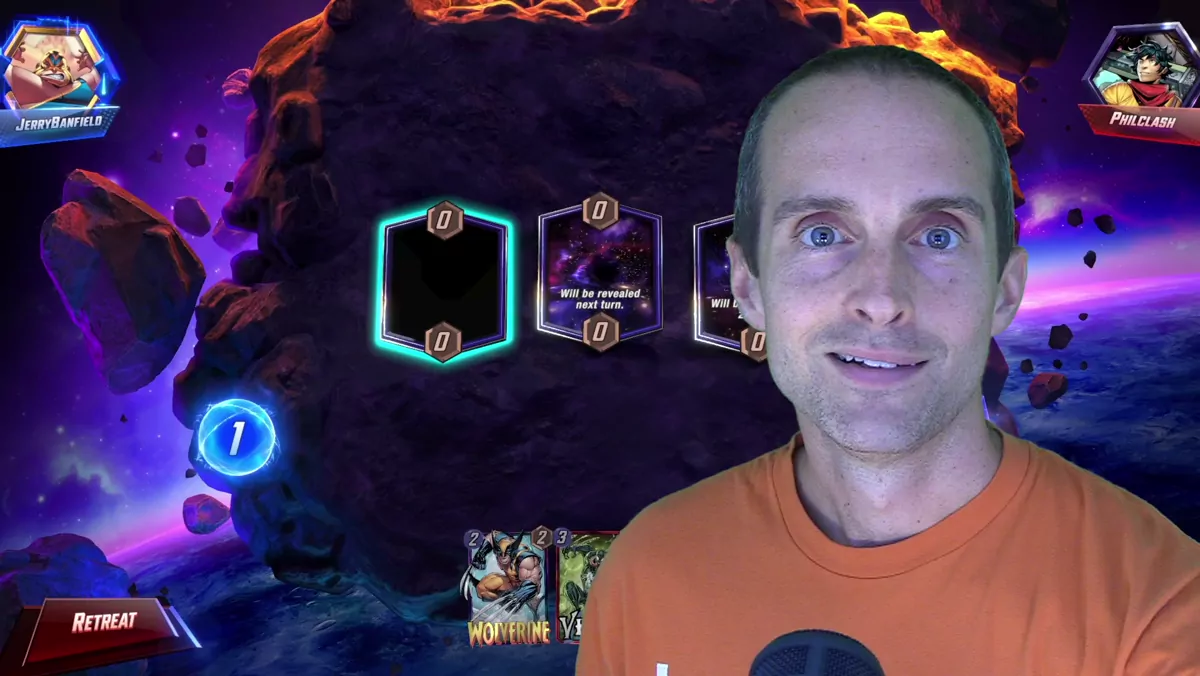
Are competitive video games like Marvel Snap self-sabotage, zero-sum games where I'm essentially wasting my time, and where I'm either the winner and I'm triumphing, or I'm the loser and I'm feeling bad? Or are video games like this character building, a good spiritual practice to help you get to know where your life is at?
I've been debating this so much in my head lately, because I often enjoy playing Marvel Snap. I've spent thousands of dollars to collect the cards in it. I'm up in the 70 to 80 rank, up close to infinity at the maximum rank tier. I've enjoyed a lot of card games and competitive games in the past, but I'm also big into self-improvement, making the life of your dreams, and optimizing everything. And I've been thinking: if I play Marvel Snap, or if I play a competitive video game, is this purely a zero-sum game where either I win and it's good for me, or I lose and it's bad for me?
The night I lost eight cubes and felt awful
Like last night, I lost an eight-cube Marvel Snap game right before bed and I felt awful. I felt, man, you're so dumb for losing that. That was so annoying. That set me back on my quest to get to infinity rank, the highest rank. And I'm thinking: is this conditioning my brain to think zero-sum, to look at other people as enemies that just need to be beaten, to look at situations as a me-or-them?
Because life definitely is not a zero-sum game. For example, if you help someone else out, you will feel good. The person receiving the help will feel good. And a third party watching you help another person out will also feel good. That means life is something cooperative, where we can help each other so much that we can't just sit and watch. I think that's a good thing: you can lift someone else up, and then somebody else will feel good watching you lift them up.
Then I compare that to playing something like Marvel Snap. This goes for any competitive video game, like Magic: The Gathering Arena, or any game you're playing where it's you against someone else, and there are winners and there are losers. Often it feels bad to lose, and it often doesn't feel as good to win. When I lose, I get a sense of inferiority: man, I suck, I should have played better. And when I win, I get a sense of superiority, which ironically can hurt my humility. To me, having great relationships with people is the foundation of a happy life, and the foundation of a happy life through great relationships is humility, where you and I are equals.
So with competitive gaming, like playing something like Marvel Snap, I've gone back and forth on it a lot. I'm wondering: should I just quit playing Marvel Snap? Is this something that is bringing the quality of my life down? Or is this helping me build character and build humility, seeing that I'm neither superior nor inferior to anyone else? I keep all of my gaming reflections like this together in my Games playlist if you want to follow how my thinking keeps evolving.
Checkers with my wife and daughter
To give an example, I've been looking at how my wife and daughter will play checkers together sometimes. Now, you would not look at that as a zero-sum game, because they have fun spending time together. When my wife and my daughter sit down to play checkers, there's going to be one winner and one loser most of the time, and often it's my wife who's the one winner and my daughter who's the loser. However, my daughter's learning. She's expanding her mind. She's eight years old, so she's learning how to play checkers. She's having fun playing checkers. And my wife and daughter are having fun playing together.
Therefore, it's not a zero-sum experience when my daughter wins and when my daughter loses. They still have fun together. So it's not an experience that is dependent on winning or losing in order to have value. Obviously, if you're playing video games and you're having fun with it, then that is a useful experience. But if I'm playing a game and I'm not having fun with it, and I'm not connecting with someone, then there's often a better experience I could be having instead.
The opportunity cost of playing online
What we often don't look at in life is the opportunity cost of everything we're doing. For example, the time I'm playing competitive video games is time I can't be doing anything with anybody else. And if I'm playing a game against someone else online, I'm not having the chance to really connect with that person. We are playing the cards together, but unlike when my wife and daughter play together and have fun with each other, I'm not actually getting to see this person I'm playing against. We're not getting to laugh together about how the game goes. We're not really able to connect and have fun the same way you could do in person. In fact, playing a competitive game online is blocking me from being able to have that experience with anyone else.
That leaves me wondering: what is the best use of my time? Is it worth my time to play a competitive game online? And if so, is there value in it? Because sometimes struggle and loss and losing can be very helpful with character building.
When losing builds character
I go around sometimes thinking I'm so much better than everybody else. And then when somebody scrapes eight cubes off of me in Marvel Snap, I don't feel so good. I'm like, well, I guess in this particular instance, I'm not better than this guy. This guy just beat me at Marvel Snap, and it doesn't feel too good.
Other times, really funny things happen. Like one game I played, the other guy plays Killmonger, blows a sure win, and loses four cubes because he throws away the game with that move, which actually ends up helping me more than it ends up helping him. So in that case, I get a laugh and the game was good for me. But what about him? In other words, if you combine my experience plus his experience, is it zero-sum? The joy and the laughter I get from watching him make a bad play, if he wanted to win that was a bad play, and the joy I get from winning, if you put that together with his experience of losing, is that zero-sum?
Because I don't want to take time in life to engage in zero-sum activities. Not just because, to me, it's kind of a waste of time in the first place, but in the second place, it's also programming me to think zero-sum in other areas.
Does it program me to think zero-sum everywhere?
After all, if I'm playing Marvel Snap, I'm trying to beat people in Marvel Snap. Or like when I used to play Call of Duty Warzone, I was focused on trying to beat people all the time in Call of Duty Warzone. If I'm putting all this time into playing a game where that's the world I'm in, then how am I going to operate the rest of the time? Am I going to look at my marriage as a zero-sum marriage, where either I get what I want or my wife gets what she wants, where my wife is essentially the other player in Marvel Snap, and I have to get my way and get my eight cubes out of her? That leads to self-pity and bad relationships, where you're not satisfied because you look at your relationship as a zero-sum game, and it's not satisfying.
So I really don't know on all of this. I'm sharing these thoughts to try and talk these things out and get some more clarity, because I'm wondering where the best place is to find joy. I have a desire to play Marvel Snap and to collect the cards. But at the same time, I'm wondering about the cost. If you're wrestling with the same kind of question about a game or a habit in your own life, you can schedule a one-on-one call with me and we'll talk it through together.
My history with addictions and pointless mastery
I've also had a lot of addictions in the past: a gambling addiction, alcoholism. I've seen how the things I end up putting my time and energy into, like alcoholism, or playing Call of Duty zombies, often just seem to drain me. I pour my energy into things that I then look back on and think, man, I wish that instead of being one of the best Call of Duty zombies players in the world, I had learned how to make music. Because who cares whether you're one of the best Call of Duty zombies players in the world or not? It seems kind of pointless to be one of the best Call of Duty zombies players today.
So I'm on a quest to get to infinite, the highest rank in Marvel Snap. But is that worth the cost I'm paying? Is there something better I could be doing with my time? I know a lot of people playing video games are not up for a discussion on the meaning of life, and are not thinking about this. That's just kind of the way I played video games a lot of the time, too. I was just blindly dumping my time into things like games, kind of mindlessly trying to earn rewards, maximizing how high of a rank I could get in the game. I very often wasn't thinking about the long-term impact of that, like: okay, if I do this for ten more years, where's my life going to be?
So today I'm glad I'm thinking about these things, and I'm encouraging you to think about these things as well, because some of these kinds of questions are some of the most meaningful and impactful things we can consider in our lives. A lot of the ways I've made massive improvement in my life have come from looking at questions like this, like: how can I contribute most to the community today? Thinking that way, instead of thinking about how to level up in Marvel Snap, ends up making the difference between selfish, self-centered thinking, where it's all about me and trying to be a superior ego, and contributing to the community. That makes a huge difference. I spent so much time in the past just trying to do things like win a video game, get a higher score, be a higher rank, and now it all kind of looks pointless. I was one of the best Star Wars Force Commander players in the world, and now it's like, who cares? Nobody even plays that game anymore. Winning Marvel Snap games too often feels like that.
It's like, okay, I win eight cubes, I make a really smart play to ruin the other guy's strategy, and I triumph. But then right after this I play another game and, if anything, I feel worse. I feel worse on the eight-cube losing end than I feel good on the eight-cube winning end. So yeah, it was awesome to win that game, but as much as it sucks to lose, I wonder: is there something I could do besides play Marvel Snap where there would be more joy and more contribution to the community? I dig into exactly that question in the story of spending $2,000 on Marvel Snap and finally quitting, and even in why starting a brand-new game is the hardest thing in gaming for me.
Is making videos about it just rationalizing?
In some ways, even making videos about Marvel Snap is kind of rationalizing. Well, I put this time and money into this game, so if I make videos about it, then it's worthwhile. But would I play this game and try to get the rank if I couldn't make videos about it? I know my mind has been telling me this is a lot of work, and maybe a long, rambling reflection that's not making any difference and not making a positive contribution.
But thinking about things like this, being retrospective, considering our contributions to the world and the community, considering what we're doing with our time, these are valuable things to think about. I hope this has been useful for you to consider where you stand. If you're just beating other people at a video game, is that really the right thing to do? Is that really a worthwhile use of your time? And if it is character building, is there a better way to do that same character building?