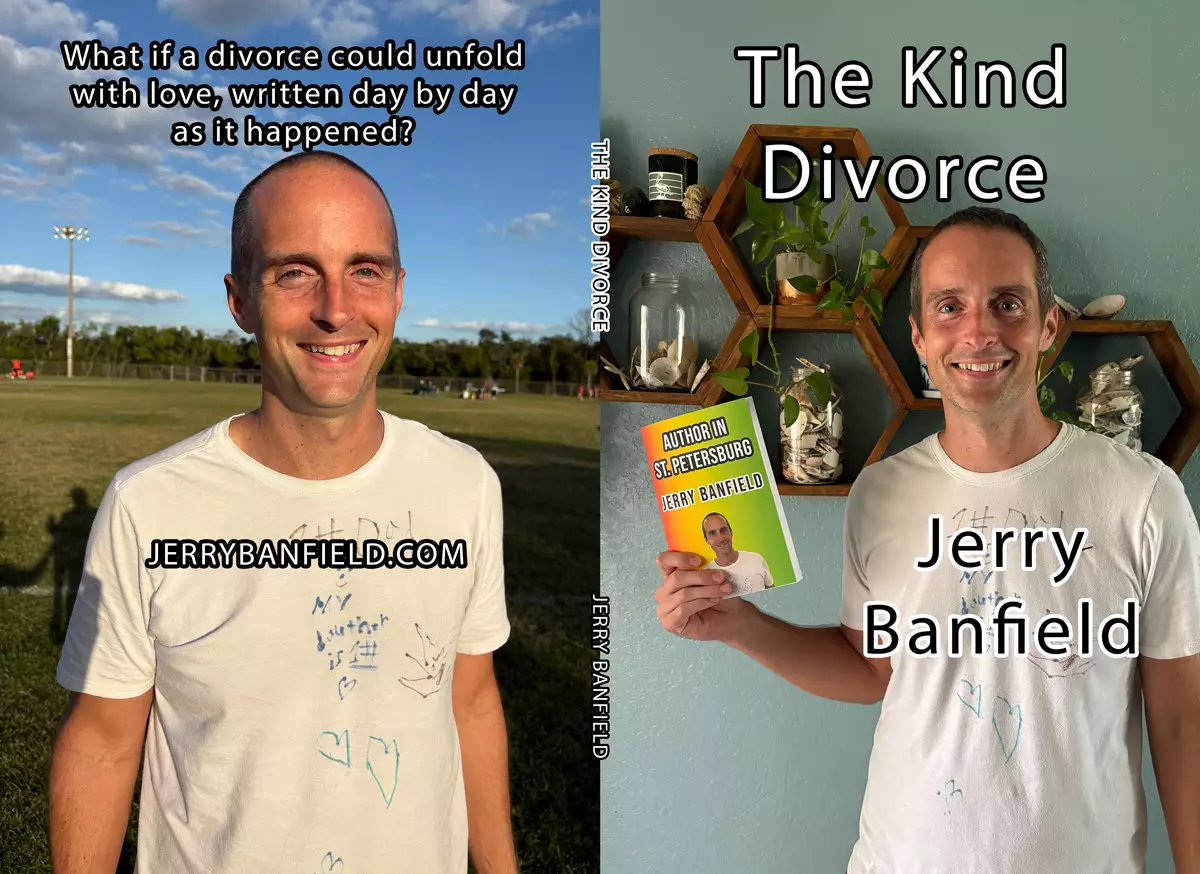
This is my journal entry from September 16, 2025, part of my daily autobiography The Kind Divorce — my real, unedited days, published in order.
After massage school today, I found myself questioning everything—my decision to enroll, the direction of my life, and whether any of this makes sense for me. I’m so effective when I work with my mind that it feels almost absurd to dedicate this much time to training my hands. I keep wondering if I’ll ever be an effective massage therapist, or if this path is just a detour that doesn’t fit who I really am. Seven more months of school feels like a long commitment when I’m unsure whether it’s truly worth it.
The day itself was fine. We started by going to the park for a walk to get some movement in before class. Then we returned to learning the basics of massage and focused on draping. That part was more challenging than I expected, especially given how many massages I’ve received and how quickly some of my classmates picked it up. It was humbling. Still, I reminded myself that while they might have an easier time with physical technique, I excel at memorizing anatomy and understanding the body’s systems. Everyone brings different strengths.
After class, I drove to the tire shop to get one of my tires balanced. It had started vibrating after being repaired a week ago, but thankfully they fixed it for free. While I waited, I began reading a book I’d bought months ago called Can You Catch a Cold? The timing felt perfect, since just yesterday my instructor dismissed any questioning of germ theory during lecture, insisting that “the science doesn’t support it.” He wasn’t open to debate, which only made me more curious. This book, on the other hand, challenges that entire framework. It’s packed with scientific arguments suggesting germ theory might be deeply flawed or even irrelevant in explaining illness.
The author points out that many diseases once thought to be contagious—like scurvy and beriberi—turned out to be caused by nutritional deficiencies. For centuries, people believed scurvy spread from sailor to sailor, when in reality it was nothing more than a lack of vitamin C. Because they clung to the contagion theory, they failed to solve it for hundreds of years, and countless sailors died of something that could have been prevented with a few oranges or a splash of lime juice. Looking back, it seems ridiculous that anyone could have believed such a thing, yet I wonder what ideas we cling to today that future generations will laugh at.
In the book’s introduction, the author also describes people who live in complete filth—never bathing, rarely washing their hands, eating whatever food they find—and yet they remain perfectly healthy. If germs alone caused disease, their survival would be impossible. It’s fascinating to read something that so directly challenges mainstream science, and it’s opening my mind to possibilities I hadn’t considered. If you love thinking this way too, you can schedule a one-on-one call with me and we’ll dig into these kinds of questions together.
Part of me wants to hand the book to my instructor and ask him to read it, though I doubt he’d be open to it. Still, I’m grateful for the curiosity it’s awakened in me. Whether I stay in massage school or not, at least I’m expanding my understanding of how the human body—and perhaps life itself—really works.
After getting the tire balanced, I stopped by VisionWorks to finally buy a new pair of glasses—something I hadn’t done in sixteen years. I’ve been wearing the same pair since 2009, and with all the driving I do these days, it seemed time for an upgrade. My current prescription is minus one, which has always felt a bit too strong, so I went in hoping to get something with a little less correction. What amazed me was that, after all this time, my eyesight seems to have held steady. The optometrist confirmed that my vision hasn’t really changed in sixteen years, which I found encouraging.
What has changed, though, is me. Sixteen years ago, I would have walked in, followed directions, and accepted whatever they told me without question. This time, I couldn’t help but examine the entire process more critically. When they asked me to cover one eye and then the other, I noticed right away that my vision was dramatically better when both eyes were open together than when tested individually. I could read the 20/40 line with both eyes, but only about 20/60 with one eye at a time. To me, that means my true vision is 20/40, not 20/60, since I almost never use just one eye in real life.
I also questioned the testing environment itself. The room was dimly lit, with only a single fluorescent light and no windows, and I couldn’t help but think that measuring eyesight in a dark, artificial setting doesn’t reflect how people actually see in the real world. I see much better in sunlight, where my eyes feel alive and relaxed, compared to the dull glow of that exam room.
When the doctor came in, I asked how long it took to become an ophthalmologist. He said four years of post-bachelor’s schooling, and when I commented that it didn’t sound too bad, he didn’t seem thrilled by my tone. I told him about Can You Catch a Cold and used it as a bridge to question the assumptions in his own field. I asked him why alternative approaches like eye exercises weren’t taken seriously and whether he’d ever seen peer-reviewed studies on them. He said that if such studies existed, maybe he’d consider them valid.
That’s when I countered: who would pay for a study like that when there’s so much money to be made selling glasses? And who would publish research that undermines an entire industry built around corrective lenses? The question seemed to make him think, though it also made him visibly uncomfortable.
He tried to prescribe me a slightly stronger correction than I had before, but I pushed back and asked him to lower it to –0.75. I explained that too much correction doesn’t feel good to me—that while the world looks sharper, it also feels forced, unnatural. The lenses that made things crystal clear actually strained my eyes, as if they were overcompensating. What felt best was a nearly imperceptible blur, just enough clarity without overdoing it, allowing my eyes to relax instead of constantly adjusting to an artificial level of precision.
I left feeling proud of myself for questioning the process and advocating for what felt right in my body. Sixteen years ago, I would have blindly trusted the experts. Today, I’m awake enough to observe, ask questions, and challenge what doesn’t make sense. It ties perfectly into what I’ve been reading—that the most powerful thing we can do is stay curious, pay attention, and never stop questioning how the world works. If you’re at a crossroads like I was that day and want to think your own direction through out loud with someone, you can book a private call with me and think it through with me there.
After getting the prescription, I bought some glasses with the total coming to $530—which, thankfully, I can pay from my health savings account. The store was running a buy-one-get-one-free promotion, so I walked out with two pairs. Still, what a racket. The frames probably cost five dollars to make, and the lenses maybe twenty or fifty at most. The markup in that industry is absurd. Yet I’m still grateful for the gift of sight—that something as simple as a pair of lenses can make the world so sharp and vivid again.
Not long after, I got a text from a friend asking if I wanted to play tennis. I dropped the kids off with my mom—they love spending time with her—and headed to the tennis club. The guy I played with, a friend, absolutely crushed me a year ago when I first started learning. Back then, I could barely return a ball, and his level of control and precision felt worlds ahead of mine. This time, things were different. Over the past year, I’ve practiced relentlessly, while he’s been traveling and hasn’t played as much. Our styles have diverged, too. He focuses on form, always trying to hit the perfect shot. I focus on results. I’ll swing wildly, improvise, hit whatever it takes to win the point—even if it looks ridiculous. Sometimes those unexpected, chaotic shots are the most satisfying.
We ended up tied at 6–6, then played a tiebreaker that I won. The victory felt incredible, not just because I’d improved enough to compete with someone who used to destroy me, but because I played freely and joyfully. I could sense his frustration that his timing was off, and I had empathy for that, but not so much that I held back. I’ve learned to balance compassion with competitiveness—to honor my own growth without dimming it to make someone else comfortable.
That night, after I put the kids to bed, I felt a wave of gratitude wash over me. I actually cried for a few minutes, just thinking about how lucky I am to have them, how much I love them, how perfect our little life together feels when I really stop to notice it. I made sure to tell them that, too—to let them know how deeply they’re loved.
Later, I spent some time editing I Was Famous on the Internet and realized I might need to split it into two books. I already have about 90,000 words of raw transcripts, and instead of cutting too much, it might make more sense to publish two shorter volumes. I also got some positive feedback on Author in St. Petersburg, which meant a lot. I’ve given away about ten copies now, and I had a bit of a vulnerability hangover earlier this week—doubting whether I’d shared too much, whether it was too raw. But hearing from a reader who said they were enjoying it lifted me up. It reminded me why I write—to connect, to tell the truth, and to let my real life be seen.
If you connect with how I live and think, you can follow the rest of my days on YouTube in my Life playlist.