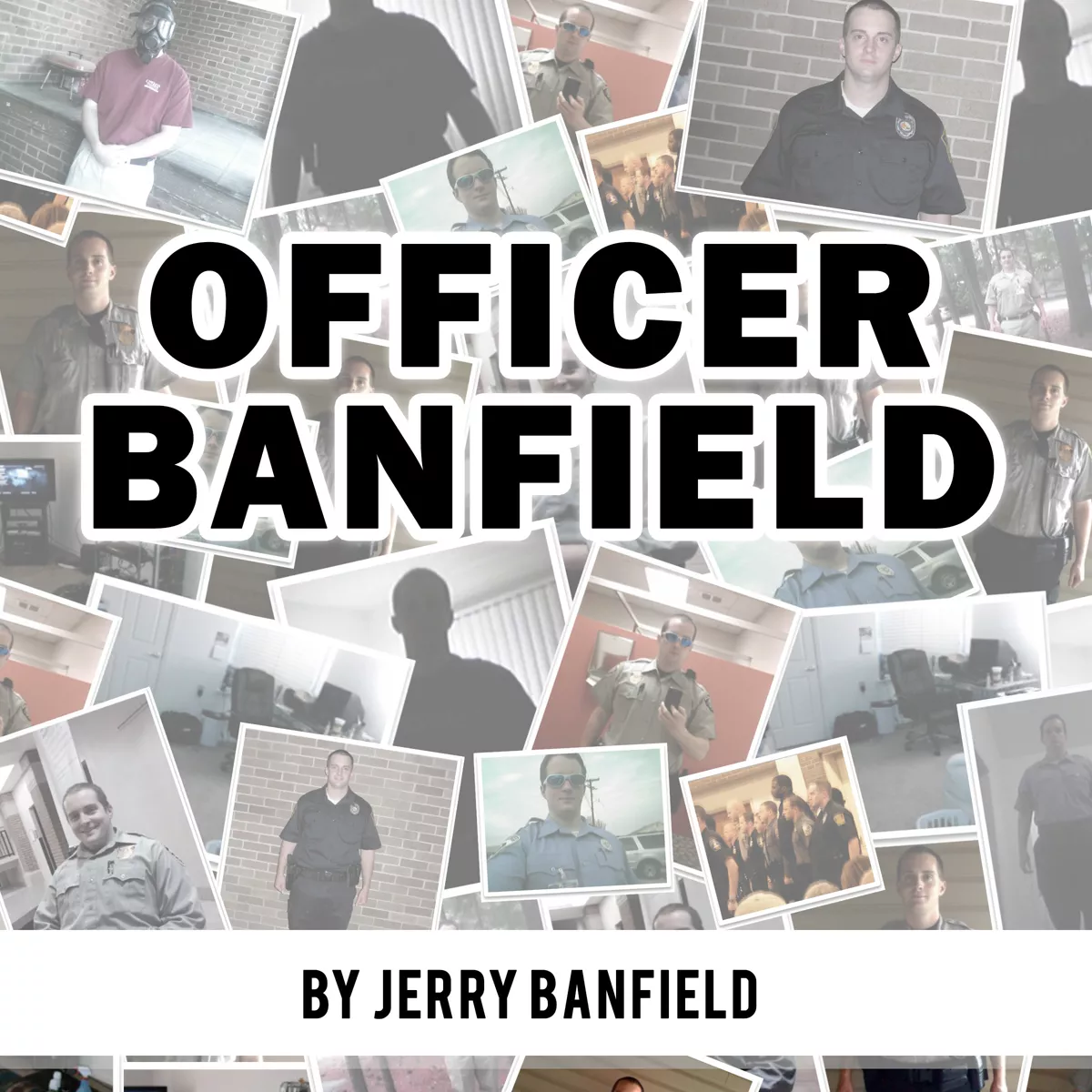
This is an excerpt from my memoir, Officer Banfield — the honest story of my years as a corrections and police officer, hitting bottom in alcoholism, and the long road to recovery.
The South Carolina Department of Mental Health Public Safety division, or DMH for short, hired me in June 2008 to be a law enforcement Officer 1, or more simply a police officer with statewide jurisdiction focusing on South Carolina's mental health facilities.
These are places where a judge could send you before trial if you did something really crazy like murder your child. The judge could put you in a mental health facility before trial or in some cases, the sentence or the insanity plea could result in being sent to one of these incarcerated mental health facilities where you did not have the ability to just leave at any time.
I imagine there are some other ways you could go there, but those are the ones that I'm most familiar with. My job as a transport officer was to take those who were locked up in the facilities from place to place in terms of where they needed to go by law.
For example, there was a young man in a Charleston mental health facility who needed to come visit his attorney up in Columbia, South Carolina. I drove down from Columbia, picked him up, drove him back to his appointment, took him to lunch at McDonald's drive-through, and then took him back down to the mental health facility in Charleston, then drove back to Columbia, South Carolina.
That was an example of one day of work at DMH as a police officer once I got out on my own. Another day's work often would be just patrolling and if there was nobody who needed to go anywhere, the day would just consist of patrolling, checking doors, responding to burglary alarms, and helping
any of the mental health units who called for help.
While the majority of officers at DMH were stuck working in a unit, I was extremely grateful to be in the transport division because I actually got to have a patrol car and be kind of out like a real police officer on a daily basis instead of again being stuck in a unit all day like at the Department of Juvenile Justice.
However, I would get to go into the units whenever a unit needed help.
For example, a fight would break out in the unit, the officers in the unit would say, "Anyone available, will you please come help us? We got a fight in progress."
Then the transport officers that were nearby would come over there and assist, and then if someone needed to be taken away, we would take them out of the unit and put them in another unit as needed.
That is the basic job description of the Transport Division I was assigned to, which was an awesome place to work within DMH. I think that was the best assignment I could have possibly gotten. I'm very grateful for that today.
I worked at DMH until approximately April of 2008 when I was hired by the University of South Carolina Police Department as a law enforcement Officer 1 there.
I'm very grateful DMH made it so easy to step into my dream job at USCPD. I remember a corporal at DMH saying that working at USCPD was an absolute dream job because you got to patrol the campus and hang out with all the college kids.
You got access, arguably, at the time, to the best gym in the state of
South Carolina where you could go work out whenever you wanted to,
along with free access to a bunch of university events like football games if you went there while you were working, or were on overtime there, and things like "Disney on Ice," which you could actually work overtime and make great money along with getting to see the event.
Maybe that's the day where I remembered that I wanted to apply to USCPD. Maybe that corporal helped me to want that job at USCPD again, and maybe he made that possible.
I had originally applied to the University of South Carolina Police Department at the same time as I applied to DMH. However, DMH had hired me and agreed to send me to the police academy when USCPD managed to give me a callback.
I was just about to go to the police academy at DMH, and therefore, I decided it probably wasn't a good idea to go interview with USCPD at the time because I was just about to go to the police academy and I knew once I got through the Academy, it would be much easier to get a job anywhere else.
Plus, I felt a great deal of loyalty at the time to DMH for hiring me and I felt they deserved my service at least for a while, if not indefinitely, for giving me the chance to actually be a police officer there.
As such, I actually turned down an interview with USCPD for that exact reason right when I was about to go to the police academy, but I would keep that in mind for my future job opportunities.
This chapter details my time and stories from the police academy graduation around October 2007 through my time as a certified police officer at DMH up until April 2008 when I moved over to USCPD.
We will start then after I graduated from the police academy. The first
thing naturally was field training.
You get assigned to an F.T.O, a field training officer, generally a corporal, a sergeant or veteran officer in the department who then trains rookies to go around and do the basic job functions and be comfortable as an officer that can go out on their own.
If you have seen "Training Day" with Denzel Washington, it is kind of like that, except a lot less exciting. You don't go around murdering people and dealing drugs and all that crazy stuff, at least at the departments I worked at. Maybe that still goes on in other places, it's probably based on some kind of a true story.
Field training at DMH was really smooth. I got assigned with a white female sergeant, which stands out because most of the officers at DMH were not white females. There were a few white male officers and most of the officers were either black men or a couple of black women, but the majority was black men.
Therefore, the one white female sergeant was maybe one of the only ones at DMH at the time, and I mentioned that because it was a big issue for her.
She felt, and frequently talked about, that she was discriminated against because she was a white female officer. What I saw was a positive or rather negative feedback loop going on. She felt she was discriminated against, so she acted out of that feeling that people weren't treating her right.
Therefore, the way she treated other people was less than ideal for cooperation, and then the way they treated her back as a result of her having treated them that way was confirming what she saw.
I noticed that she had to work both Thanksgiving and Christmas while as a brand new officer, technically I worked Thanksgiving Day, but I had time. I had several days off right after Thanksgiving, so I was able to go home and be with my family at Thanksgiving.
I also managed to get Christmas off by some miracle or because I asked for it as well, while she ended up working both the holidays and frequently complaining that she was discriminated against because she was a white female.
One of the commanding officers was a black man and the other one was a Latino man, both of whom I was extremely friendly with. They were very nice to me and thought very highly of me. Another officer said that they were a little scared of me because I was so smart and had things so well together.
I'm grateful I found a wonderful experience. I did not see any discrimination myself, but this female sergeant I was assigned with felt there was a lot of it, and to me, a good life lesson, what you see is all there is. If you see a world of discrimination, hate and bias, then the problem with that is you often act out of that worldview, and the actions you take out of that worldview confirm what your worldview is. If you're ready to shift the worldview you've been living out of and want someone to think it through with, you can schedule a one-on-one call with me and we'll look at it together.
It is hard not to treat other people with what you see yourself. When you see a world full of hate, discrimination and bias, that is an internal reality and often means you act out of hate, discrimination and bias yourself, and therefore, get it back.
That's not to say that there is no real discrimination in the world. That's not to say that certain real estate agents, if you are a certain race, may steer you to a certain neighborhood.
Sure, there certainly are some differences, but there are a lot of
differences and there are all kinds of discrimination in life. I've often been frustrated with what to me has appeared to be gender discrimination.
For example, recently in Alcoholics Anonymous, seeing how men are supposed to work with men and women are supposed to work with women, and I say, "Why?"
I see young girls who go around hugging pretty much everyone, but me and any other young guy who might be attractive, and that's discrimination to me, and yet I realize again that's my own bias and my own expectations that I should get the same treatment as everyone else when sometimes I'm not in the same position as everyone else.
What if it makes a young girl who is newly sober uncomfortable to be close to a young and attractive man?
That's not the same as giving an old lady or an old guy a hug where the attraction may not be there.
You see, I'm not dismissing that some things do happen because of your race or your gender.
I'm saying that this is a great example of how your own worldview ends up screwing you over and confirming exactly what you think. If you suspect your own worldview might be quietly confirming exactly what you fear and you want help seeing it clearly, you can book a private call with me to talk it through.
I mentioned that because there is a lot of issues and talk in law enforcement about discrimination. Whether it is within the department in terms of officers and how they get assigned as this was a case where it wasn't involving with the general public at all, this was simply an internal thought of discrimination, and then the issue of officers discriminating against people they are actually policing on.
From what I saw, most officers are generally very fair in their policing, except when it comes to who you know and what your status is. In this way,
I saw a ton of discrimination, especially going forward, not that much at DMH because almost everyone we interacted with was locked up, but to me, the most real discrimination I saw was in your status, who you are in life. If you don't know anyone and you are not important politically versus you do know people and you are important politically, that's the most discrimination I saw. But again, was that me or was that actually there without me?
I don't know. The stories will tell you.
Anyway, after this tangent on something that I hope you might be thinking about if you are considering going into law enforcement or you have studied a lot, I hope that was useful.
The bottom line is that I had a great time doing field training with the sergeant. I really liked her. I thought she was an awesome sergeant to get started with doing my training and to get to know the department, and at the time I just dismissed most of her bias thing as she was just creating this and bringing this on herself, and that was the majority of things she complained about.
So, outside of complaining about that, she was really helpful on taking me around, showing me what to do, explaining how things worked, and telling me all I would need to potentially know in order to work at DMH.
She was about my mother's age. She had some kids herself and I enjoyed hearing about her life. I enjoyed working with her and I was fully prepared after a month of training with her to go out and work effectively on my own. She did a great job getting me ready to go out on my own and it was funny, she even had high expectations for me. Even though she felt she was subject to bias, she felt that they would take really good care of me and that I had a great career to look forward to at DMH.
After about a month of working with her, she signed off that I was ready to go as an officer on my own, that I had completed field training and I was out on my own.
I also took some rides around with other officers to get to know some alternative points of view and I rode around with a corporal a lot because sometimes we didn't have enough police cars for everyone to have their own car. But most of the time, I got to have my own car.
I also had another corporal I rode along with a lot, sometimes the sergeant wasn't working, therefore, the corporal would take me around while we were on field training still.
He showed me a lot about the department and left me feeling really comfortable. I remember one Saturday, we went out to Taco Bell to lunch together. I remember getting connected with him and hearing about his life. What stood out, I remember at the time thinking it was just crazy that he would give 15% of his income directly to the church that he was a member of.
I thought at the time, "What a waste. Why would you do that? That's 15% of the money and you don't get anything back out of that."
I see today with going to Alcoholics Anonymous every day and putting a little money in the basket every day, and with donating thousands of dollars to other online streamers, I see that giving is a huge part of happiness, that even a little bit of charity in my life goes a long way to feeling good about the kind of person I am.
Now I see his wisdom in giving the 15% of his earnings automatically directly to his church and being so involved in his church.
He also invited me over to his house a couple of times to play "Madden"
and we had fun doing that. He had a beautiful home with a wife and a child at the time. I think he has got a couple of children now.
If you connect with how I live and think, you can follow the rest of my days on YouTube in my Life playlist.