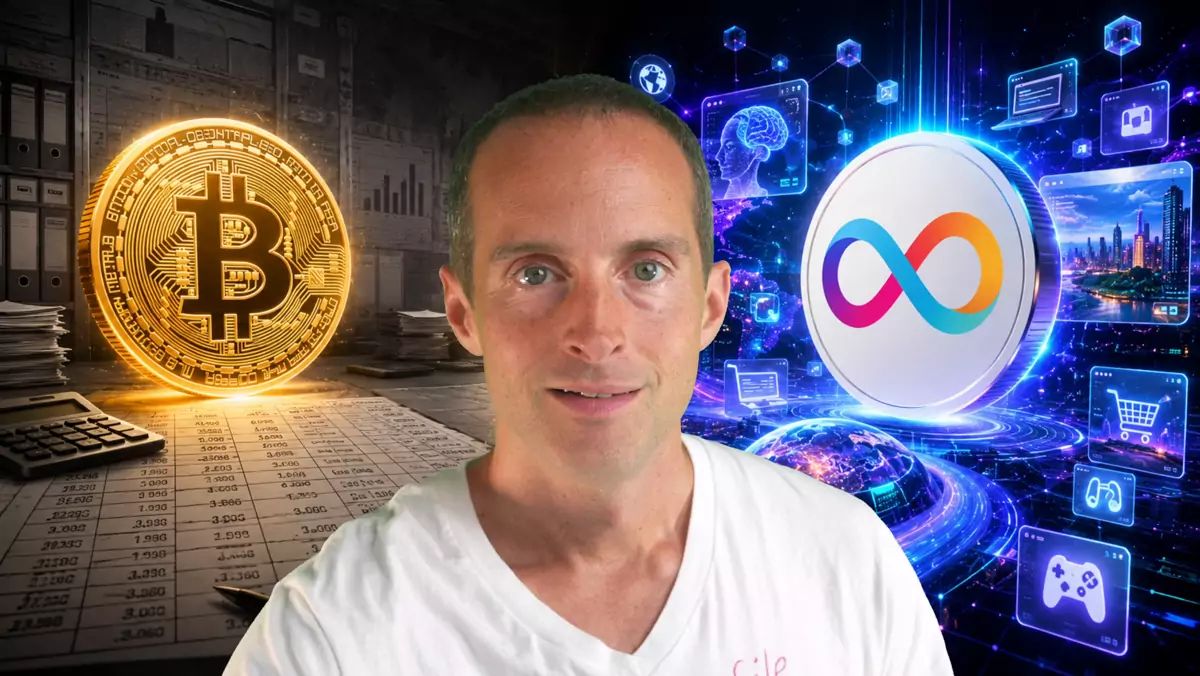
Why Holding Bitcoin Stopped Making Sense to Me
Bitcoin is a $1 6 trillion spreadsheet while internet computer protocol is the next level of the internet and it's valued almost a thousand times less. If you are holding Bitcoin today this is the most important video you will ever watch about Bitcoin because almost nobody who has Bitcoin is talking about this and this is the most important information in the world and if you're wondering why isn't everybody telling you this well you'll see this is like the red pill in the matrix this will destroy how you even see crypto. To me if people ask why don't you have any Bitcoin you've been in crypto 12 years because I don't see any reason in holding part of a $1 6 trillion spreadsheet.
Bitcoin Is Just a Secured Spreadsheet
What I mean by a spreadsheet is this that Bitcoin is basically just using cryptography to secure a ledger. Do you understand what a ledger is? It's basically a spreadsheet think Microsoft Excel. It tells you who owns what, what address they're at and then when that moves who moved from where now that's valued at $1 6 trillion. That is ridiculous. That is dramatically overvalued.
The Cold Hard Facts About What Bitcoin Cannot Do
Here are some cold hard facts about things Bitcoin does not do. Bitcoin does not host your website. It doesn't run your business app. It cannot host your front end. It doesn't do anything with AI and it doesn't replace any infrastructure. Doesn't solve the biggest problems in the world like cyber. It requires third party histories. It requires third parties to do almost anything. In fact one of the craziest things that you most people in Bitcoin don't know the vast majority of transactions quote with Bitcoin where people are on Coinbase quote buying Bitcoin. That's not happening on the blockchain. This is the Bitcoin blockchain. You can see it mempool space.
The fact is there's only about 10 or so transactions a second with Bitcoin. You can see that this block between these blocks there were 10 minutes that went by and there were a few thousand transactions. That's because 99 of what people think they are doing with Bitcoin is going through a third party. An exchange like Coinbase. Even a hardware wallet is a third party interacting with a blockchain for you that could be compromised that you can't trust it over the long term. Things like ledger wallets found to have a back door in them. Lose your seed phrase. It's gone. This was a useful proof of concept.
The future is internet computer protocol. And almost everybody in crypto is stuck looking at the past stuck looking at price charts and thinks of Bitcoin as a safe investment. That's fucking insane. There's nothing safe about holding onto Bitcoin. Because the exchange we've seen lots of exchanges go to zero and lose all their users funds. You don't even know if you have Bitcoin on an exchange. If you don't have Bitcoin, you they actually have your Bitcoin or not. Here's why. Because if you were able to transact on the Bitcoin blockchain all by itself, like you can on internet computer protocol, you can be sure you're interacting with real Bitcoin.
But you can't because the Bitcoin blockchain is basically a spreadsheet that is not capable of actually doing everything for you. Therefore, you always have to go through a third party to do it for you or make your own kind of solution to try and interact with the Bitcoin blockchain. Are you up for doing that? 99 9 or not. So you're stuck using somebody else's interaction for you. So if you go on a crypto exchange and you place an order to buy Bitcoin and they tell you you've got Bitcoin, you are trusting. And this is the whole point. Bitcoin was supposed to remove that. What I just said.
Bitcoin was supposed to remove third party trust from the equation. You see how all of us in crypto have got Bitcoin. Almost all of it is held by centralized entities today. When you're on an exchange buying Bitcoin, you are taking their word that they have it. They may not actually have it because it's all on their exchange. That means they could sell you Bitcoin they don't actually have on the blockchain. How often is that happening? I believe that's happening very often. I'm not going to accuse particular exchanges, but when you've got it sitting there and there's nothing to stop you except your integrity, and I'd hope all the exchanges in crypto have integrity.
You think somebody has set up a crypto exchange, their primary market share, and they're going to be able to sell you Bitcoin? I don't think so. Do you think their motivation was integrity to do a good job for users? Or do you think their primary motivation was to make as much money for themselves as they possibly could? If that's the motivation, and I would say it is in most cases, then the thing to do to make as much money as possible is just sell all the Bitcoin you want. And then when you've sold too much, crash the price so you can force people to sell it lower.
Then you make money with Bitcoin you don't even have.
ICP Captures Every Bitcoin Narrative for a Fraction of the Price
ICP solves all of this, and it's valued almost a thousand times less. Then Bitcoin. To me, buying Bitcoin right now is absolutely insane. It made sense to buy it when I bought it back in 2014, 2015, 2016, 2017, 2020. Even in 2022, it made sense. But when ICP can do everything fully on chain, holding Bitcoin is absolutely insane. And Bitcoin has basically become a meme coin, a cult coin, where people are not listening. People are like, no, don't say anything bad about Bitcoin. I'm like, you're, you're fucked. If you're holding Bitcoin, you are fucked. This is a spreadsheet secured with cryptography. The only future Bitcoin has is people remaining totally ignorant of everything I'm telling you.
I show how early Bitcoin would translate into ICP today in 21 Bitcoin in 2014 Is 550 ICP Today.
Of better technology not succeeding and staying on the download forever, and the world being totally fucked and just blowing up. That's the only future Bitcoin has, because the technical reality is that a spreadsheet, that keeps transactions, where third parties are stealing all the basic value that Bitcoin is supposed to provide is not useful in an environment where ICP can capture all the value that Bitcoin has captured. Why? Because when you talk about all Bitcoin's narratives, all of them work better on ICP. All of them. You want to talk about digital gold? ICP is computational gold. It is processing power gold. You can burn it to do things like host your website, like my website.
This is hosted on the internet computer protocol blockchain. When you go to my website, you are interacting directly with the blockchain. That's the future. ICP is building a new future for the internet. And the fact that it's valued a thousand times less than Bitcoin, which is outdated, mostly useless technology at this point. Would you continue? All right, look at this phone.
Holding Bitcoin Is Like Clinging to a 2009 BlackBerry
Look at this phone I got. This is an iPhone 16. Now Bitcoin was created in 2009. Go get my Blackberry and start using that. Should I start using my Blackberry? Because I'm really attached to, well, this was my first smartphone. Come on. This was my first smartphone and it's good. It's digital. It's, it's cellular gold, baby. It's cellular gold. I'm going to keep using my smartphone from 2009 because it's cellular gold. And I don't give a shit what the new iPhone does. I don't give a shit about new iPhone 16, bitch. I got a Blackberry. That's crypto right now. People holding onto Bitcoin like fucking zombies.
Just like Bitcoin is God. Bitcoin is the digital gold. Bitcoin is the new world currency. It's like, you're not looking up the details of how this actually works. The fact that 99 plus percent of quote, Bitcoin transactions, interactions are all on centralized third parties. They never touch the blockchain. The fact that internet computer protocol has utterly dominant technology that is the rest of crypto useless. The only way Bitcoin even has a viable future from here is by using ICP as a layer two to securely host Bitcoin transactions. Now, I don't think Bitcoin is going to go to zero like most of these other shit coins are because Bitcoin will still have that nostalgia, that meme coin effect of where people know the branding.
But right now, people like Michael Saylor that are out there buying a shitload of Bitcoin, they're not going to go to Bitcoin off of leveraged debt that they can get at a hugely discounted interest rate to keep up with inflation. That is a certain utility. But what would be much more intelligent will be to take that same strategy with ICP. Because imagine if you bought that much ICP, you could essentially, if you bought as much as Michael Saylor just bought of Bitcoin, if you bought that much ICP, you could just guarantee yourself that you just made not financial advice, no shit, but you could guarantee yourself that you just three, five extra money immediately.
If you bought that much ICP, you could push the price up to like $10, $15. And then on top of that, ICP, if you go to the ICP dashboard, you can actually lock your ICP up and get yield. I'm telling you, if you're into Bitcoin, ICP has destroyed Bitcoin. Bitcoin may hold on as a nostalgia, first blockchain or whatever. ICP has rendered every single thing that Bitcoin does useless. Every single narrative is useless compared to ICP. Everything you like about Bitcoin, ICP does it better, faster, and it does all kinds of other shit. And it's in the cloud computing market, which Larry Fink just said, that's a whole asset class.
I lay out why that kind of move is realistic in ICP Can Pump to $100 Anytime.
ICP is the only crypto in that asset class. It is the only cloud computing platform that brings the security of the blockchain. ICP takes what Bitcoin started and makes it what you need it to be. Bitcoin is dial up internet. ICP is fiber. And everybody's, using fiber today. Would you sit there and use dial up internet? Because you are attached to this being the first internet you use? That'd be fucking stupid, wouldn't it? ICP, you can lock it up for two years and earn 6 7 rounded percent. But you can even lock it up. Look at this. You can even lock it up like I locked some up yesterday.
I break down how every one of these narratives works better on the world computer in my ICP Crypto playlist.
You can lock it up for two weeks and earn 2%. And this is directly under your control. This is not some shit ETH staking where you've got somebody else with their fucking wallet trading meme coins. And Bitcoin, you can't even stake it.
Staking, Energy, and the Supply Myth
Now, the Bitcoin zombies come at me with these narratives of, well, ICP has infinite supply. Look, Bitcoin is mining is absolutely unsustainable. Do you remember all the Bitcoin mining narratives that were coming along? Bitcoin mining is gigantically wasteful. And that's going to matter at some point. It mattered before when it got the shit butted out of it. And when you look at ICP, the massive, massive energy efficiency of ICP, not just jerking around with transactions like Bitcoin, but you have full applications running directly on the network. And you compare that to something like Bitcoin. Bitcoin looks utterly useless by comparison. Now, I know the truth may piss some of you off before it sets you free.
I recognize that. And I just did a video about that on my at Jerry Banfield channel. If the truth offends you, it might be exactly what you need to hear. Crypto, more and more people are getting ready for the truth. They're tired of the pain. They're tired of the impatience of watching their coins. They're tired of being confused with what the hell. There's infinite blockchains and there's infinite coins and all of them are shit. All of them aren't shit. There's one that's good. All the rest are shit. Bitcoin is shit. It is a fucking Blackberry from 2009 that has been insiders, bought it up. And maybe there's theories saying that the CIA invented it.
Satoshi Nakamoto means central intelligence in Japanese. So do your own fucking research. All right. Oh, this, whoever launched this is holding a shitload of it, could crash it whenever they feel like. And there's quantum computing coming. And fundamentally to me, this has been a psyop. It's like, okay, let's get a bunch of Bitcoin and then sell it to all of them. We'll hold all of it. We'll make up a shitload of profits on it. And we'll just dump it whenever we feel the top has been reached. Retail holding Bitcoin is insane. It's absolutely insane. Thinking that this is always going to keep going up. That's ridiculous.
You got to look at the technology. And what we've seen is technologies often have a time where they're a big deal, like dial up internet. And where's dial up internet today? That shit is gone. ICP is the future. And that's why it's hidden. Because the more people know what I'm telling you, Bitcoin's value probably drops 80%. If you have even 20 of crypto that understands what I'm saying, especially somebody holding a shitload of money, the money is going to flow out of Bitcoin and into ICP. That's what is going to happen. Not financial advice. And obviously I'm just holding a shitload of ICP and shilling my own bags. If you want to pressure-test your own read on Bitcoin versus ICP instead of just taking mine at face value, you can schedule a private one-on-one call with me and we'll work through it together.
But this, I got into ICP. I dumped my Bitcoin three years ago because yeah, in the short term, I've lost money. And it's okay because there's infinite money and I've got enough money. And the only amount of money you can have is enough money or not enough money. I got enough money. And I'm okay that in the short term, Bitcoin did better. The question is, where are we going from here? The reality is you cannot use Bitcoin without some third party taking total domination over your funds in one way or another. ICP, you can go directly into the blockchain yourself. You can vote yourself. Without a third party system in it, you can use a wallet yourself without a third party wallet involved.
ICP solves all the problems that are there with Bitcoin. It's the best Bitcoin scaling solution. It is the only infrastructure that could support mass onboarding in crypto. Meanwhile, the market is pricing the history, but Bitcoin will not go up forever. There are a lot of risks and very little upside left for Bitcoin. Remember that guy that was talking about, oh, I'll bet you some, amount of money that Bitcoin hits a million dollars. Newsflash, Bitcoin is never hitting a million dollars. Newsflash, Bitcoin's best days are behind it. Just like my 2009 BlackBerry and dial up internet, the best days are behind it. It's gone. It's over with.
There's no point in buying Bitcoin today. The returns you're going to get are going to be shit. There are way too many centralized entities that are operating completely on the paradigm that you don't know what's real and where the value is. And once this starts to become obvious, this and all the other coins are going to lose a lot of money. Because why would, see, it will only take one Michael Saylor to identify this and be like, holy shit, if I put $100 million into this, I will just print money like crazy. And then I can just lock that up on the network nervous system.
This is rigged. It feels rigged. It's only going to take one person with a good amount of money. Now, what you need to recognize, you're like, well, why isn't that happening yet? Because most of crypto is a psyop. Most people inside crypto are working together and they're trying to take as much money from crypto retail as possible. They're counting on you to be ignorant. They're counting on you to not do your own research, to not look at the big picture. They're counting on you to be a fucking zombie, to just do what you're told and respect authority and buy the coins you're told to buy when you're told to buy them.
And then sell the coins you're told to sell when you're told to buy them. Sell them.
ICP Is My Path to Financial Sovereignty
I'm all about helping people become sovereign, empowered beings on this planet. That's why I do videos. And ICP to me is the best option for that in finance. And getting yourself financially sovereign is the pathway to making all the rest of your sovereignty easier. Bitcoin will not do that for you. All the narratives that push Bitcoin, yes, we do need a currency that can transact worldwide. ICP delivers the details. Bitcoin does not. Can you imagine going to the grocery store and telling them, well, we need to wait for your transaction to confirm on the Bitcoin blockchain? You might think, well, I can just go immediately transact.
I talk through this kind of financial sovereignty with everyone in the Jerry Banfield Family.
Yeah, that's because you're using some third party application. And now you might as well use a fucking credit card or just use a credit card. Just go pay with your credit card. MasterCard and Visa are working just fine at the grocery store. Bitcoin is not going to go up forever when people realize it's just basically a spreadsheet with a cryptography algorithm. Gigantically wasting a shitload of computation power and energy. That's not needed anymore. And the only reason you're being sold it is because other people who have a bunch of it are trying to dump on your head. And they need you to keep buying it.
And they need to convince governments to buy it. They need to convince.. When you got governments buying into Bitcoin, the game's up. When you got ETFs coming in, the game's up. That's your last exit liquidity. When you got people.. I've seen people who've sat there and showed me wallets of hundreds of thousands of dollars of Bitcoin. And their minds, they're like, well, Bitcoin's safe. I'm like, the fuck it is. Where do you get holding your money on some third party exchange that may or may not actually have the Bitcoin on a blockchain that's 17 years old, that is vulnerable to quantum computing, that has nothing else but marketing going for it at this point.
And then there's something that really does everything you need it to do that exists, that when this blows up, it sucks. I can tell you in 12 years, investing in Bitcoin has never been a safe proposition. Now, people with authority signaling today get the idea that somehow it is because it's ETF for this rich person or Michael Saylor's buying it. No, I can tell you I've been in Bitcoin long enough. At no point did we think buying and trading this shit was safe. That's why we were attracted to it, because it was fun, because it was exciting. And Bitcoin today doesn't have the upside, it's still got the same dangerous downside it's always had. If you're holding Bitcoin and want to talk through how you're actually thinking about it for yourself, you can book a private one-on-one call with me and we'll reason it out for your situation.
Bitcoin is basically a monument at this point. It's already dying. There's almost nothing meaningful happening with it. It's all talk. It's all smoke and mirrors. Now, where I could be wrong is that I'm betting that people get more intelligent. I'm betting that people see through this deception and see into what's real. I'm betting people outside of crypto don't give a shit about anything in crypto. All they care about is real utility. That's what they care about. They care about being able to use the blockchain into a real world task. You have governments onboarding to ICP right now. And despite that, most people still have no idea about ICP.
The big things are in position. The moves are happening. Once you've got governments using ICP, running their infrastructure, Bitcoin is useless, except as a meme coin. Except as a nostalgia coin. I see Bitcoin could easily go back down to 10 000 from here very easily. If I had to give you my value that I think Bitcoin is actually worth, I would say Bitcoin is not worth more than a few hundred million at this point. People are literally absolutely clueless about the truth about Bitcoin. Every fucking Bitcoin video you watch is a waste of your time. The Bitcoin standard, useless ass book. I will listen to the guy who wrote it, do a podcast.
All the things he's saying are valid, but the detail that's inaccurate is that Bitcoin can deliver that because it's all back to third party shit. Now, all the stuff he says, you apply that to internet computer, then yes, that all works. And this is how the highest level of deception and lying works, is you give people a lot of truth and then you fuck them on the details. You give them a lot of truth. Yeah, the financial system's messed up. Yes, we need more. Yeah, all that, all the Bitcoin narratives. You give them that and then point them in the wrong direction. If you're pointed at ICP, that's the truth.
And right now, people with the supply with Bitcoin, again, it's like mind control. You've just heard this shit so many times because your brain learns through reputation on a subconscious level. So you watch the same stupid ass Bitcoin videos every day and you hear people repeat this zombie stuff about useless ass data. You're not looking at the big picture. And that's the truth. That's where you get blindsided. And the majority of crypto is going to get blindsided because if you don't see this coming in advance, you are going to get ran over when the people who have the most money and the most power see that it's all, they already in most cases know that it's going towards ICP and they're just trying to extract as much value as they can out of as many suckers as possible until that happens.
But once they realize the game's up, all these cryptos are going down. Bitcoin's going down with them because they'll sell their Bitcoin when they're like, oh shit. All right. People are figuring out ICP. When Jerry's channel hits a certain amount of views, they're like, all right, people aren't fucking dumb anymore. Dump this shit and rotate it into ICP. There you go. Like this is what's going to happen when you understand the big picture of the world. Now, the only question is how long will it take? And do you believe people are going to stay ignorant forever? And is the world going to shit or not? Those are exactly the questions I love digging into, so if you want to think your own answers through out loud, you can schedule a private one-on-one call with me and bring them to our call.
If you think the world's going to shit, why invest in crypto? Like why bother? I didn't get into crypto. Like the people who've got into crypto are people that want the world to be a better place and want to invest in that. Bitcoin is not investing in a better world at this point. You're handing money to centralized entities who supposedly have Bitcoin for you. And all the supply shit is a psyop. Like you need to think through that. People are like, well, Bitcoin has a locked max supply. All right. Look, I have 4 000 sheets of paper in my okay? Okay. Now that's a fixed max supply.
I'm not going to buy anymore.
The One-Cent Piece of Paper Test for Fixed Supply
So I'm going to sell, I'm going to start selling those pieces of paper for $1 000 each. And I'm just going to sell as many of them as I fucking can. I'm going to sell $1 000 piece of paper. I'm going to go out. Here's a, here's a piece of paper. I'll sign my name on it or something. I'll draw an infinity symbol on it. I'll sell those for a thousand dollars. Does that have value? Does me capping my supply of pieces of paper that are truly worth less than a cent or maybe a cent or two each. Does that me putting a price tag of a thousand dollars, a piece of paper on it, overvaluing it by a hundred thousand times.
Does the supply of the one cent piece of paper matter? Bitcoin is a one cent piece of paper. There's 21, there's 20 million right now. And it doesn't matter. There's 21 million one cent piece of paper. When you're saying digital gold, you've been fucking mind controlled. That's what you've been. You're just, you've literally heard that shit so many times. Your mind has accepted it as a fact. It's like, have you watched one of those shows where like somebody's, in an awful course of situation and they're told like there's, I'm thinking of Star Trek episode where Jean Luc Picard, and there's like, the guy's got like, five things and he says, how many is it?
Or there's four and he makes him say five. Like that's, that's what's happening. Bitcoin has literally just been mind programmed into the masses. Digital gold, digital gold. You hear digital gold 200 times. Your brain just accepts it. This is the weird part about the human brain that if you just tell it a lie enough times, if you give it a narrative that you can slip in past the defenses and make it sound reasonable, then it internalizes it as truth. That doesn't make it true. If I tell you a hundred thousand times that a piece of paper I'm selling is worth a thousand dollars. The fucked up thing is you'll probably believe it.
And this is what's happened with Bitcoin. Bitcoin was cool when I got into it. It was exciting technology. And a lot of people use their own wallets. Like I had a guy, he had a fucking USB stick and he had his own wallet that he coded. Now that was cool. And that was interacting directly with the blockchain. What we see today, these, these governments, this has ruined Bitcoin. It is extracting value from the masses and it's not going to last forever. Mark my words, especially now if ICP didn't exist, it might be different, but ICP is real tech. And if you want digital gold, ICP is a vastly superior digital gold.
There's way more reasons to use ICP and participate. Holding Bitcoin does not allow you to vote on the future of Bitcoin. Holding ICP does. And that is where things are headed. Bitcoin is totally dependent on everything around it. And ICP sets up to absorb all of Bitcoin's use case. And AI takes this even, we need a whole nother video to talk about AI. But AI is set up to hack all the stuff that the third party shit that supports Bitcoin, all these bridges and exchanges and all this shit. AI makes ICP more important and more needed. And it renders Bitcoin more useless. And this, this is enough for this video.
And I know the title comparison is unfair. All right. I understand all the shit you've been told about Bitcoin. I understand this can be hard to understand if you're new to it. Okay. I get that. I'm telling you this, like I said in my video before, if the truth offends you, it might be exactly what you need to hear. This truth offends people. This is why I don't have a hundred percent of the time. I don't have a hundred thousand views on every one of my videos on my Jerry Banfield ICP channel, because you can't handle the truth. But when you've got thousands of people that can, when you got tens of thousands of people in the ICP community, we have enough of a foundation and it's going, it's, it's going viral.
People are telling other people, people are getting what's happening. Like my recent video, I said, ICP's price chart, is a crypto IQ test. And most people fail. And that's okay. Because the first step to getting smarter is realizing you're a dummy bitch. Like that's the first step to getting smarter is realizing how much more you could know and how limited your information is. And it was, that's how I found ICP. When I realized, I don't know shit that's important in crypto that I know all kinds of stuff. But when I found ICP in 2023, I realized, I don't know what's really important in crypto. I've missed the most important information in crypto.
And what's even worse, everybody talking about Bitcoin was either intentionally hiding it or ignorant of it themselves. That the very best information in crypto, in many cases at the top, is being intentionally hidden. They're telling you to buy Bitcoin while they're planning their exit strategy. They're telling you to buy Bitcoin while they're dumping it, while they're preparing to FUD it with the same energy narrative again. ICP's being, prepared to take the throne. Everything's in position. The question is, who's going to capitalize on that? When Bitcoin holders realize this is the past, this is the future, it's going to be really interesting to see what happens.
Holy shit, I love hearing myself talk.