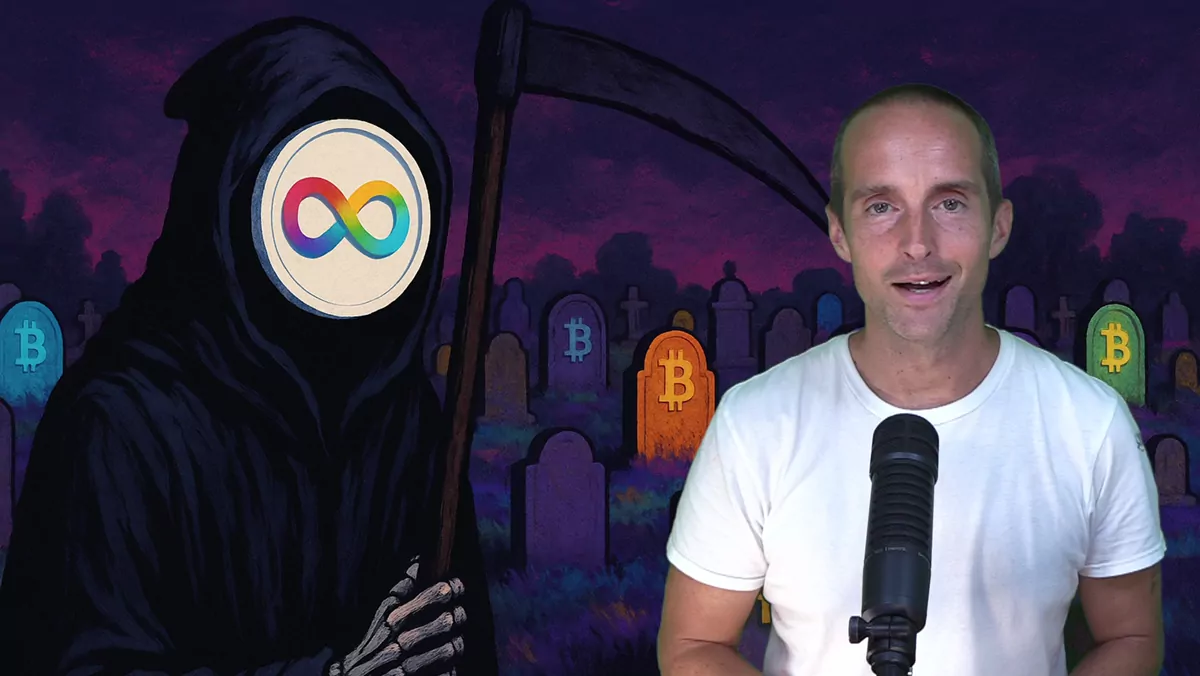
Hi, I'm Jerry Banfield. I'm going to explain to you how Bitcoin is a lie, crypto is fraud, and ICP is the only thing that's real. This will come as a shock to a lot of you, and I'll try to be as kind and compassionate as possible while I walk you through each step of what I'm saying. I'm going to encourage you to look up everything I say for yourself, to double check all of it, and to really understand the big picture of crypto, because in my experience crypto is one of the most dangerous things you could possibly invest in today. It's drastically overvalued. It's not well understood.
If I were you, I'd probably be asking: well, what do you know? Who are you? I have been one of the top crypto YouTubers for years. I recently deleted all my other YouTube channels and started fresh because I've been so disgusted with the reality of being a crypto YouTuber. I'll explain more about that in a minute. I'm only making this because a friend told me her dad is considering buying some crypto and would like help with it. These days I only create content for my friends, their families, and my local community in St. Petersburg, Florida. So this is designed to help a friend's father understand what I know, and from there decide whether he really wants to buy more crypto or not.
The bigger picture: profits over people
To begin, I need to explain some concepts that sit outside of crypto but belong to the bigger picture, and that will help you understand why we're here. The bigger picture is this: in capitalism, the system we're in, profits are generally prioritized over people. That means making money and generating income is often more important than the actual outcomes from that activity. Take healthcare. Healthcare is an industry that is massively profitable and that also, in my view, keeps people sick.
I'm not a doctor. I'm not a financial advisor. This is not financial advice or medical advice. This is my experience and what I've seen from the inside of being one of the top crypto YouTubers in the world, from looking at what other people are doing, and from someone who was very sick a decade ago. I saw that the healthcare system totally failed me, that I had to find and learn all the ways to be healthy on my own, and that the information I needed to be healthy was, in my experience, intentionally suppressed. Because if you knew some of the things I've come to believe about being healthy, it would eliminate massive profits. I've come to believe there are free cures for fatal diseases. There are free cures. There is a way to easily prevent all 15 top causes of death, and I'll go more into that another time. There are books written by medical doctors. There are studies that show exactly how to do this and how to take care of yourself. I am in the best health I've ever been in, and it's because I've unplugged from the healthcare system.
Now imagine that cryptocurrency is much worse than the healthcare system. At least the healthcare system is making some effort to serve a real need. Cryptocurrency, by comparison, is to me almost completely ignorance, greed, and intentional exploitation of the masses. Once you see the big picture and then look down into the details, I believe this will be very obvious to you.
The 95% truth and the 5% lie
You might wonder at this point, why does what I'm saying sound so much different than what other people are saying? Am I completely dismissing all the positives about crypto? Absolutely not. I understand that probably 95% of what you hear about Bitcoin as an alternative currency, and all the narratives that go with it, has truth to it. In fact, the narratives are very real and very important. Where you're being misled is in the tiny details.
If you've studied human psychology and propaganda and how to control people, the most effective way to control people is to tell them 95% of the truth and then keep secret the 5% of the details that is the lie. Think about it in terms of food. If I gave you an apple, or a piece of candy or ice cream or whatever your favorite food is, and I put some tasteless, odorless poison in it, you wouldn't have any idea you were being poisoned until you ingested it and felt the consequences. I say to you that this is the state of crypto today. Many of you see on the surface the opportunity to make money, and there are definitely opportunities to make money in crypto.
And here's the worst part about crypto. I've made a fortune, hundreds and hundreds of thousands of dollars, on crypto myself. But my audience collectively has lost millions of dollars. My audience has lost much more money than I've made. The question I have for you is: who profited from that? Who profited? I profited by telling my audience things, and then I get paid, but my audience loses money. This is the world of crypto. Influencers who are getting paid to tell you certain stories. Bots that are pushing certain coins and certain narratives. Influencers who've said anything to build an audience, who then take money to promote the biggest projects. The biggest projects often cheating at a level that would disgust you if you saw it the way I've seen it. And then utter confusion and ignorance in the masses.
The one exception: Internet Computer Protocol
What I have now is clarity. There's only one crypto that to me does not fit into the rest of all that, and that's Internet Computer Protocol, or ICP. I used to be very bullish on Internet Computer Protocol because, in what to me looks like lies and misdirection, ICP is the real deal. It gives me what I really want out of crypto. Its market cap is about a thousandth of Bitcoin's. And yet the rest of crypto seems to make an effort to intentionally suppress Internet Computer Protocol, because in my view it is real. It is the truth. It gives you what you actually want. It fully fulfills the narratives you hear in crypto, because it's the only thing that does that. The rest of crypto is, I believe, very threatened by it.
For example, if you were being unfaithful in your marriage, anyone who knew about it would be very threatening to you, because they have knowledge that could wreck your life. And once you understand ICP, it makes it much easier to understand the rest of crypto.
So let's talk about Bitcoin first. I'm not going to name any other names besides Bitcoin, because Bitcoin has an anonymous founder and I'm fairly safe attacking Bitcoin directly. Some of these other projects have teams of people and lawyers who, if your voice gets big enough, will go after you and try to silence you in one way or another, get your videos taken down, sue you. That's what a nasty environment this is. So I'm going to avoid mentioning any other coins in particular. But what I'm telling you is that everything I'm saying about Bitcoin applies to every single other crypto.
I've researched thousands of cryptos since getting into Bitcoin and altcoins back in 2014. I've researched thousands of altcoins. There's only one, ICP, that does not meet what I'm saying to you. And unfortunately ICP has performed poorly since I started covering it. Why? Because all the profits are being made selling people things that are fundamentally worthless and tricking people into buying things that are basically useless and cheap to create. When you have ICP, if people understand ICP, the entire rest of the fraudulent system is threatened.
It's the same as healthcare. If you know how to prevent the top 15 causes of death, and if you know what I've come to believe, that the majority of surgeries are nothing more than a placebo effect, then the system has a lot to lose from you knowing it. In my experience, when you compare surgeries to a placebo, doing a sham surgery is often just as effective as doing a real one, and the body heals itself despite most surgeries instead of because of them. Once you see that level of information, the healthcare system has a lot to lose from you understanding preventative care and how to take care of yourself. And the cryptocurrency system has a lot to lose from you understanding what Internet Computer is and seeing that it's the only crypto that actually does all that you think the rest of crypto does.
So I'm not going to come around and hype Internet Computer up all the time anymore either, any more than I'm going to be online talking about all this alternative healthcare. I'll talk to people in person about these things, but the system is rigged against you if you're doing that online, just as it's been rigged against me.
What I already agree with about crypto
Let's begin with Bitcoin, and let's talk about the 5% lie that almost everybody has been universally fooled by. First, let me address the 95% so you know I'm very aware our financial system has some very serious issues. I'm very aware that we need a peer-to-peer currency where you and I can transact directly. I'm very aware that we need a currency that could be global. I'm very aware we need to send cross-border payments. I'm very aware of the use of DeFi and how much opportunity there is there. I'm very aware of the chance to buy and sell things like NFTs and to sell on marketplaces that aren't centrally controlled.
I'm very aware of how inefficient the banking system is, and of the fractional reserve banking system that leads to us depositing our money in the bank and then the bank doing whatever they want with 90-some percent of it. Collectively they generally only have less than 10%, sometimes less than 2%, of all our money actually available to be withdrawn at any given time. I'm very aware of all these things. I'm very aware that holding crypto is like having digital cash. I'm very aware of the narrative that Bitcoin is digital gold. I'm very aware of all the positive things you've heard before.
The question you might want to ask yourself is: what do I know that you don't know? What have I seen that you would like to see? That's what I'm going to tell you about. And you can replicate this research very easily using ChatGPT by asking the right questions. If you'd rather not sort through all of it alone, you can schedule a private one-on-one call with me, and we'll work through these crypto narratives together and figure out the right questions to ask before anyone hands over a dollar.
What Bitcoin actually is
Let's look first at what Bitcoin actually is. In the simplest terms, Bitcoin is basically a spreadsheet secured by cryptography. What does that mean? In even simpler terms, it's like a spreadsheet that has math problems to secure it. That's what the Bitcoin blockchain is in the utterly simplest terms: a spreadsheet secured with math.
Now, does that sound like something that should be worth $2 trillion? It does not sound like something that should be worth $2 trillion to me personally. To me, it's overvalued by at least a thousand times. Bitcoin is a prototype. Bitcoin showed us what could be done with an internet payment system where you can have a publicly viewable spreadsheet, or blockchain. A blockchain is really just a spreadsheet like Microsoft Excel or Google Sheets, where you have accounts and balances and transactions. That's all it is. The blockchain sounds mysterious and advanced, but that's all it is. It is a database that says this address has this much Bitcoin, and this address sent that Bitcoin to that address. Very simple, very easy to understand. All of you can understand a spreadsheet.
How Bitcoin and cryptography actually work
What's cool about Bitcoin, and about crypto generally, is that it uses math to allow you to do transactions publicly. If the entire thing wasn't secured by math, anyone could just go in and update the spreadsheet however they wanted. What we generally do in our financial system is rely on so-called trusted third parties that access and manage our financial spreadsheets. Our existing financial system is just a bunch of spreadsheets with balances on them: Jerry Banfield's bank account has this much money in it, and then you have a centralized party that controls access to that record. The revolution with Bitcoin is that you can use math to control access instead. That math is what we call cryptography, and the shortened version of cryptography is crypto. All of these other blockchains are built on the same basic idea, that you use cryptography.
So what is cryptography? Cryptography is just math equations. A private key is, for the most part, just 256 zeros and ones in a row. You feed that into an algorithm and it is able to create a transaction. By holding the private key, you are able to modify the spreadsheet using math, which is really cool.
Now, does that sound like something that should be valued at $2 trillion? In my view, no, because the reality of Bitcoin today is that most people transacting, or "buying and selling" Bitcoin, are not actually doing what they think they're doing. I say transacting instead of buying and selling and speculating and leveraging and all that, so let's just say people transacting Bitcoin today. The majority who think they're transacting Bitcoin are not actually interacting with the blockchain. That, the way I see it, is the 5% lie that takes down and eliminates the value of the 95% hype.
On Internet Computer Protocol, you are able to actually fully interact with the blockchain without going through a third party. That is what crypto really needs to do. It has been very hard to achieve, and as far as I can tell nothing else does it. That's why, to me, Internet Computer is the only real thing in crypto. In my opinion, everything else is lies, and a lot of it is outright fraud.
Bitcoin is underpowered for real mass adoption
If you didn't quite understand what I said, let me deepen the explanation. The Bitcoin blockchain itself, and you can look this up, only does about 10 transactions a second. Keep in mind there are 8 billion people on Earth. If the narratives for Bitcoin were accurate, you would need a blockchain capable of transacting about 80 billion transactions a day, assuming around 8 billion people would transact financially about 10 times a day, which is probably a minimum of what you'd need. Think about how many things you buy every day, how many things you might sell, and how many transactions require multiple parties involved.
Ten transactions a second is about 36,000 transactions an hour. Over 10 hours, that's not very many transactions, is it? In 10 hours, that would be less than a million transactions a day, and you need 80 billion transactions a day. The way I see it, the Bitcoin blockchain is underpowered computationally by at least 100,000 times what it would need to be in order to handle real mass adoption. And some would tell you that's just to send transactions.
Here's the real lie that everyone hyping Bitcoin up either is ignorant of, or knows about while holding the Bitcoin. In my opinion it functions like a Ponzi scheme where they want you to buy the Bitcoin from them so they can make a profit off of it. How do you actually create a transaction on the Bitcoin blockchain? Most of you would have your money on a crypto exchange, and then you would withdraw it from the crypto exchange. This is where the problem comes in with everything in crypto: 99% of crypto transactions are actually conducted on a third party's website.
Who really holds your Bitcoin
Now, that might sound like it's not a big deal to you. You might say, "So what? I'm on this crypto exchange, I give them $1,000, and they say I've got $1,000 of Bitcoin in my account. I don't see the problem with that." The problem is the crypto exchange is holding the actual Bitcoin. You don't have the actual Bitcoin in your account. If the crypto exchange allows you to actually withdraw the Bitcoin off the exchange into your own wallet, then you do have true ownership over it, but only if your wallet will allow you to directly interact with the blockchain without a third party involved. Again, in my experience, only Internet Computer Protocol actually does this. No other blockchain is computationally powerful enough to do it, and I'll explain why in a minute.
The fact is the Bitcoin blockchain was created more than 15 years ago. As of 2025, that's around 16 years ago. Think of the Bitcoin blockchain in terms of raw processing power. Think of your computer or your phone: how much the computer can process determines what you can do on it. The Bitcoin blockchain does very little computation. Basically all you can do is send transactions, or put little runes or little JPEGs into the blockchain. And there's only around three megabytes or so of space in an entire block of Bitcoin, which is mined every 10 to 30 minutes. That's a tiny, tiny amount of space, given all the hype and narratives about Bitcoin being an alternative reserve currency.
The other crypto blockchains besides ICP all have the same basic issue: the blockchain itself is not computationally powerful enough to do hardly anything besides send transactions. And even to send transactions, for the most part, you need third-party software or a third-party website. Even hardware wallets are third-party wallets that have third-party applications, and in most cases you can't even verify if those are secure or whether there's a backdoor where they could steal your crypto. In some cases there've been big outrages when people realized the hardware cold wallet they have has a backdoor the maker can get into, supposedly to help you recover your crypto if you lose it.
So right now, the reality is that outside of ICP, everything in crypto involves using third-party tools, websites like crypto exchanges, and wallets to make transactions on blockchains for you. To some of you who don't understand the infrastructure of the internet, which is most of you, you might not see why that's a problem. With that in mind, I need to explain how the internet is built, because if the idea I'm giving you were super simple, everybody would understand it. It is a simple idea: all other blockchains besides ICP are basically the easiest, simplest blockchain people could create, and they made them as fast as possible.
Bitcoin was a prototype, the rest is hype
Bitcoin was a prototype. It truly was the most advanced thing in the world at its time. But almost everything since Bitcoin has been a group of people trying, with as little effort as they could manage, to crank out a blockchain they could then monetize and make a bunch of money off of. In my view, everything in crypto besides ICP is blockchains that are basically useless to humanity, that hardly have any more technical capabilities than Bitcoin. And yet people have made these things collectively worth hundreds of billions of dollars, and then there are all these narratives around them.
In order to understand this, you need to understand at a basic level how the internet is built. The internet is built from a series of computers. Many of them you'll call servers, and servers are just computers, very similar to the desktop I'm recording on or to your laptop. They have a processor, they have a hard drive, a graphics card if you're trying to render, and an internet connection. So the internet is created by computers that are just made up of processors, motherboards, and circuitry hardware. You run software on those computers, you connect them to the internet, and you create protocols, standardized sets of software or operating procedures or ways the hardware works, to connect everything together.
The problem with the entire infrastructure of the internet right now is that it is inherently insecure, because when all is said and done, you can just get onto any of the computers, go into the operating system and into the root, and take control of the computer or wipe it. This is why things like viruses and malware are such a huge problem. This is why companies spend huge amounts of money trying to secure this insecure internet infrastructure, because the software is running directly on the hardware and there are all kinds of ways to exploit that. This has been the same setup for the internet for decades.
The decentralization narrative falls apart
The big hype about blockchain is that blockchain is secure and tamper-proof because it's secured by math, and the Bitcoin hype will tell you this means Bitcoin is decentralized. The problem with the reality of these narratives about decentralization is that they're quickly proven false. For example, last I checked, there were two Bitcoin mining pools that control the majority of Bitcoin mining. In my opinion, that's not decentralized when you've got two entities, which likely have one person at the head of each. That means if I wanted to control half of the Bitcoin mining hash rate, there are two people I'd need to talk to, two people I'd need to bribe, two people I'd need to threaten, and I'd control the majority of Bitcoin mining hash rate. If you extend it to the top five Bitcoin miners, you can have utter dominance. So that's not secure, and in my view all the other cryptos have the same problem with this. Even ICP has the same basic issue. So the infrastructure, even at the level of the protocols themselves, is generally not meaningfully decentralized.
If you go into the Bitcoin supply, for example, you hear how decentralized Bitcoin is, but look at the supply and you'll find that less than 1% of the wallets hold the majority of Bitcoin. I would say that's the same as the existing financial system we have. When you're hearing these narratives about a Bitcoin standard, Bitcoin as digital gold, and a new financial system, consider this: it operates like the old financial system. You need centralized third parties like exchanges to buy it. You need centralized third parties like wallets or exchanges to hold it for you. The mining is down to two to five people who control it. And the supply is in the hands of less than 1% of all the Bitcoin wallets. That sounds a lot like our existing financial system, doesn't it? Where the 1% have the majority of the wealth, where centralized institutions and third parties control money, and where there's a handful of people you could talk to in order to change the world. Doesn't that sound like exactly what we've already got?
And that's not even considering what I'm about to tell you. The key detail of all of crypto being a fraud, and Bitcoin being a lie in my view, is predicated on understanding what I just said and then combining it with this: Internet Computer Protocol is the only blockchain where you can go directly into the blockchain yourself without using a third-party wallet, web browser, website, or crypto exchange. With all the others, you have to use third-party stuff, and the third party in many cases is the first party, whoever the developer of the blockchain is. On Internet Computer Protocol, the blockchain is so powerful that it can actually host entire websites directly on the blockchain. Bitcoin cannot host a website.
Why most blockchains can't actually run anything
With Bitcoin, it would be difficult to even put a single phone photo on the Bitcoin blockchain, and if it could be done at all it would be extremely expensive. The Bitcoin blockchain cannot serve web. And to my knowledge, no other blockchain can serve a website either, because these other blockchains don't have enough processing power and were never designed to do simple things like serve websites. So the reality of interacting with every blockchain besides Internet Computer Protocol, and even the reality when you're buying Internet Computer Protocol on an exchange, is that you are going into a centralized third party to do your crypto transactions. That means those transactions don't even necessarily happen on the blockchain. In most cases, they do not happen on the blockchain.
What really happens when you buy crypto on an exchange
I mentioned this earlier, so let's go into detail now. If you go to a crypto exchange website and give them $1,000, then take that $1,000 and place a buy order for Bitcoin or for any other crypto, including ICP, their interface will tell you that you've got that Bitcoin or that crypto in your account now. Some of the worst environments, I'll say, do not even allow you to withdraw the crypto off the exchange. But with many of the crypto exchanges, when you go buy $1,000 worth of Bitcoin, your account now says you have point-whatever Bitcoin. Then if you go to withdraw the Bitcoin, you have to have your own wallet that is not on the crypto exchange to withdraw it to. The fact is, most people buying crypto do not withdraw the Bitcoin. They give the exchange the money, and the exchange says on their website, which has nothing to do with the blockchain itself, that you now have $1,000 worth of Bitcoin.
The problem with this is that you don't know if the Bitcoin you supposedly have actually exists on the blockchain at all. Here's how that works. Because you're not using the blockchain directly, you are inside a third party's website or mobile app, same difference. They theoretically have the Bitcoin that is for sale on their website, and they have the private keys for that Bitcoin and any other crypto. The problem is what we've seen happen with a lot of exchanges, what I suspect is happening with many exchanges today, and what is likely to continue happening as long as the public is unaware of this, which right now most are.
How double-selling works
Here's how crypto exchanges work. Let's say I have one Bitcoin, which is a hundred and some thousand dollars today. I send the crypto exchange my one Bitcoin because I want to sell it. I then go on the crypto exchange and sell the one Bitcoin. I had that Bitcoin in my wallet in theory, and I sent it to them. Now it's in their wallet, and they have the private key that controls it. When you go on there and buy that one Bitcoin, it's still in their wallet, unless you withdraw the Bitcoin off the exchange. Do you see any potential problems with that setup? What's to stop the exchange, when I put one Bitcoin on there and create a sell order for it and you buy that Bitcoin, from putting up a second sell order for the same Bitcoin I deposited? Then they sell the Bitcoin again to another person who buys it after you. I've put one Bitcoin on the exchange, but now there are two people who each think they have one Bitcoin. Because you're not actually interacting with the blockchain, exchanges can get away with this.
This is why these ETFs were blocked before, the electronic trading funds or whatever you want to call them. This is a big reason they were blocked, because stopping that kind of dishonesty is very difficult. The only way you could stop it is if there was some transparent way that everyone on the exchange could have verifiable proof that every single bit of Bitcoin and other crypto the exchange says you hold actually exists, if everyone could simultaneously have real-time proof that the exchange actually has exactly that much or more in their accounts.
What I see is an opportunity for exchanges to basically print as much money as they want by double, triple, 5x, maybe even 10x selling. What happens when you put your money on an exchange and I put my crypto on the exchange, and instead of just selling one extra Bitcoin for a total of two, the exchange sells 10 Bitcoin total? I deposit one and put up one sell order, and the exchange puts up nine more. Now people have collectively bought 10 Bitcoin, but there is actually only one Bitcoin on the exchange. And as long as those people can't withdraw the Bitcoin, the exchange can get away with doing this.
Combine fake selling with price manipulation
Now combine that with the fact that the exchange can manipulate the price. The exchange can intentionally sell more Bitcoin to buyers when the price is high. This is why almost all the crypto news and almost everything you see people talking about is fueled to encourage short-term trading, to encourage people to buy high and sell low. When the price is high, selling fake crypto is extremely profitable. The way you get away with it is you sell all kinds of fake crypto at the top, then you crash the prices and get all the people holding the fake crypto to dump it back to you.
For example, in the last bull market, a bunch of people bought a lot of Bitcoin at around $50,000. Then a lot of those people sold it at $40,000, $30,000, $20,000, and so on. If the exchange fake-sells a bunch of Bitcoin at $50,000 and then accepts fake buyback orders to buy back the fake Bitcoin it sold in the first place, you see how that works. The exchange sells a bunch of fake Bitcoin for $50,000 that they don't really have, then they buy the fake Bitcoin back for $40,000, for $30,000, for $20,000. And when they think the price has hit bottom at, say, $16,000, the exchange buys a bunch of real Bitcoin to load up and prepare to do it all again.
From what I see, this is what's happening all over crypto. There are tools like leverage trading and options trading that support this. When you combine selling fake crypto with leverage and options trading, you can financially engineer the prices of certain cryptos to be artificially high, or, like Internet Computer, artificially low. Do you see what a bad system this is? For insiders, there's a massive opportunity to make money by being dishonest and selling crypto they don't have.
Even the honest exchanges profit from churn
Beyond that, I would say most crypto exchanges are dishonest. Most don't have the crypto they say they have, and they're doing things with it that, if you saw what they were doing, you'd pull your money off there immediately. However, there are likely some honest crypto exchanges. Even those exchanges make money by having people trade as many coins as possible as often as possible. The exchanges that are being completely honest make money when you buy and sell coins, so they have an incentive to promote the idea of trading crypto, to promote the idea of buying the next meme coin, to promote cycles where you get people to buy and sell, because that's where the trading fees come from.
Something like Internet Computer Protocol makes exchanges broke, because if you just buy it, pay the one-time trading fee, and take it off the exchange, the exchange makes almost no money on that transaction. In fact, they would lose money if that's all that happened. Exchanges make money from having a bunch of people leave their crypto on the exchange and then trade, buy this, sell that, leverage this, options that. This is why across crypto you see so many people promoting the idea of crypto trading.
The copy-trading machine
As someone who was formerly a crypto influencer, I can tell you I got offers for $100,000-plus a month. All I had to do was tell you to go copy-trade me on a particular exchange. Copy trading is the most degenerate and nasty of the money-making influencing systems in crypto. You'll see plenty of influencers out there sending you to their copy-trading platforms. I saw the other channels doing this, and they told me, Jerry, with your audience, you can easily make 100,000 USDT a month. And keep in mind, that was for my audience. There were people with much bigger audiences than mine who are easily making millions of dollars a month.
From what I see, they're giving useless information to their followers. They're tricking their followers into thinking they have inside information, and there is some reality to that. When I talk about the crypto mafia in a minute, we'll get into that, which makes this even worse. They send all their followers to these exchanges, and when they place a trade, their followers automatically follow. So if they place a buy trade, the followers buy too. If they place a sell trade, the followers sell too. On the surface, this looks like easy money, doesn't it? But the reality is it's a shockingly exploitive system. If you're not on the inside, if you're not getting that $100,000 a month to show the coins, you're going to usually be on the losing side of the equation. If you're staring at one of these setups right now and want a straight, no-hype second opinion before you act, you can book a private one-on-one call with me and we'll think through your own situation together.
The "next generation" blockchains operate the same way
I'll continue talking about the technical difficulties that make Bitcoin and other cryptos absolutely unusable, because so far I've only covered crypto exchanges. That's the biggest problem, but deeper than that there's another problem. I've documented all of this, and I'd encourage you to look it up yourself. Ask ChatGPT these questions. Go see if you can verify what I'm saying.
The next part we need to cover is the reality of all the crypto applications that claim to be decentralized, built on all these other blockchains. I'm not going to name names to avoid getting sued and attacked by specific projects, because this is a systemic issue. These newer blockchains come out and say, we're better than Bitcoin, we're faster than Bitcoin. You can build a crypto game on our blockchain, you can sell NFTs on our blockchain, you can do DeFi and have smart contracts on our blockchain, our blockchain is faster and more powerful than Bitcoin, so invest in our blockchain. That's what they say. But the reality is that technically they operate almost exactly the same as Bitcoin. Yes, some blockchains do have significantly more computation power than Bitcoin. But these blockchains are still 10,000-plus times less powerful than needed to serve mass adoption, and yet they talk about onboarding billions of people. What's their plan for doing that? The same basic setup as a crypto exchange.
Let me explain the reality of playing a crypto game, which illustrates this beautifully. I played a crypto game, which I will not name specifically because they all operate like this. I got heavy into live streaming a crypto game on Twitch. I bought $10,000-plus worth of the NFTs.
What it actually takes to play a crypto game
I gave away thousands of dollars of the currency for this. The crypto game I tried was built on another project's Layer 2. They had their own coin, and as far as I know they still have it. They had NFTs to represent in-game assets. But here is the reality of actually playing the game. In order to play, you first had to sign up on the game's website with an email address. You then had to have a third-party wallet, which you had to sign up for and keep a recovery phrase for. Does that sound like something the masses could easily onboard onto? Not at all. So right there, I have already got multiple third parties involved, and I haven't even bought the coin yet or played the game yet. Just to play the game, you need to sign up.
Then the game itself is hosted on centralized infrastructure. And when these projects talk about IPFS, that usually comes right back to centralized infrastructure too. You can search Amazon IPFS and you will see that Amazon makes it very easy for people who want to run IPFS nodes to run them on Amazon Web Services. This picture gets darker and darker the more you go into it. You start asking, how rigged is this?
So when you are playing a crypto game, the actual game is hosted on centralized infrastructure and is completely controlled by the company and the centralized host. For example, if it was hosted on one particular company, and it does not matter whether that is Amazon, Google, or Microsoft, then that company could pull the plug on the game, and the game developer themselves could also pull the plug on the game. Then you have got the coin sitting on a Layer 2, which means if something happens with the Layer 1 blockchain, that could collapse the coin. And if something happens on the Layer 2 blockchain, that could collapse the coin as well.
Do you see it? The game itself is saying, "we are a decentralized game, this is true ownership for players." But when you dig into the reality, there are so many attack vectors. This is why some crypto games have been hacked for hundreds of millions of dollars, and that destroyed who? The retail investors who put money into buying those coins, proportionately more than anyone. Sure, the game developers lost some money on it, but they had already made a whole bunch of money on it too.
Why a crypto game costs more than a regular game
So the reality of playing this crypto game is that I have to use centralized infrastructure to sign up and play the game itself. I have to use centralized infrastructure again to sign up for a crypto wallet. Then I have to connect the crypto wallet with the game systems. And then I have to use another marketplace built on the Layer 2 to actually buy the NFTs. And then I have to connect all of that together just to play the game and trade the assets. Meanwhile, the game is telling everyone this is true ownership for players, and selling people that it is something different.
But the technical reality is that running a crypto game costs much more than running a regular game. It is much cheaper to just spin up a regular old game on centralized infrastructure using one of the large stores like Steam or Epic Games. It is much cheaper, much easier, much more cost effective, and much less risky to just put up a game that is totally on centralized infrastructure and takes regular old centralized payments with something like Stripe or PayPal. Do you see how the deeper you dig, the more problematic every single thing you have ever heard in crypto becomes? My goal by the end of this is to totally destroy what you think of crypto, because that is what has happened to me. I have been deep, deep in this, and almost everything is a lie.
When you ask the average person, and I tell them there is this crypto game built on this blockchain, the average person imagines that the entire game is on the blockchain, that the blockchain itself runs the entire game, that you could go directly into the blockchain to play the game and trade the assets, that it is all hosted there, and that if there is a DAO or voting, the voting actually controls the game. The reality is quite the opposite. In all the games I have seen, the token is worthless, because the token could collapse in a ton of different ways. The developers have full control of the game regardless of the token holders. The developers make decisions that aggravate the game owners. And if the developers do not promote the project, their expenses are so high that, unless they can sell a whole bunch of the coin, the game is going to go offline rapidly. The community and the player base will absolutely collapse.
That is what I have seen. With play-to-earn crypto games, the point where everybody gets ripped off is usually launch. All the insiders immediately dump their tokens as soon as the game launches, to all the retail investors who are excited about it. Then they keep dumping the entire time the game is out, and all the retail investors who buy, hold, and play the game are the ones getting ripped off. And you could extend this across every other area of crypto, to DeFi, to staking, to so-called decentralized exchanges. It is the exact same problem I have just described.
The one chain with the power to run things fully on-chain
The reason is that, outside of Internet Computer Protocol, no blockchain even has one thousandth of the power required to run something like a crypto game fully on-chain. From what I see, not one other crypto even has one-tenth of a percent of the power computationally. Think processors, graphics cards, memory, and putting all of that into one environment and one protocol to run it. Not one other blockchain even has one-tenth of one percent of the power and the setup necessary to actually run a crypto game fully on-chain. Internet Computer Protocol is the only thing that does. And you can see why this is a threat to everything else, because if developers know this is the one place you can actually build everything fully on-chain, then why would they want the much harder process of trying to build somewhere else?
Where this really becomes a critical issue is with security. Cybercrime is a roughly 10 trillion dollar problem in 2025, which is multiples of the entire Bitcoin market cap. Cybercrime is where you have got viruses and malware and hackers stealing money and draining our entire internet of trillions of dollars. The biggest hype and narrative I see is that blockchain can address the cybercrime issue. In my view, the only way to do that is to be able to put the entire infrastructure on the blockchain. That means you need to have the processing, the memory, the protocol, the crypto, and all of it. All the transactions have to be on one single infrastructure under one single protocol that ideally is controlled by one single DAO. Then you can take the properties of blockchain and get the security benefits of blockchain, and you can start to eliminate some of the worst problems in the world, like cybercrime. From what I have seen, Internet Computer Protocol is the only thing doing this today.
Why most altcoins are easy to make
Now, some of you at this point might be wondering, why is Internet Computer Protocol so good, and why am I saying these other blockchains are so bad? Isn't this just confirmation bias? Aren't I just pumping my own coin? I have researched thousands of altcoins over the last 11 years, so let me talk about how most altcoins are actually created.
Most altcoins are created as fast as possible, because the longer it takes to create your blockchain, the more money you have to invest up front just to get it online. Meanwhile, there are a bunch of blockchains with open source code, like Bitcoin. You can just take the existing Bitcoin source code and make your own blockchain. Some other blockchains, including ones near the top, are literally forks. A fork is where you copy an entire existing blockchain and then make changes to it. Most cryptos are nothing more today than a fork or a minor innovation over Bitcoin.
What is really hard to do is figure out how to put entire websites on-chain, to run AI models, to put gigabytes and even terabytes of data directly on the blockchain. That has been so difficult that, in my view, no other crypto team has successfully done it outside of DFINITY. It took DFINITY thousands of years of people's lives, that is hundreds of people working for years, to figure out how to do that, because it was a very difficult problem. By comparison, launching Bitcoin was very easy. It only took a couple of people to write some code and launch Bitcoin, which is why today I do not think Bitcoin is worth more than a few billion dollars. It is a prototype.
Bitcoin gives you an idea of what the blockchain could do, just like dial-up internet gives you an idea of what you could do on the internet. But as someone who played first-person shooters like Quake 2 on dial-up internet, that was brutal. Then you get fiber optic, and you are never going back to dial-up after that again. The rest of crypto is like dial-up internet. It gives you an idea of what the blockchain could do, but it is simply not powerful enough. The technology was not engineered up front to handle the internet.
We could all talk about where fiber optic internet came from. Perhaps some other species had already engineered that and we just took it from them, but that is a whole other story. Fiber optic internet is designed to send data rapidly at light speed and to send large amounts of data. Phone systems were not designed that way, and they simply could not be upgraded in any practical way to compete with something like fiber optic internet that had been engineered that way from the start. This is the same problem in crypto. Every other blockchain, you have got to look at what its primary goal is.
The real goal behind most of crypto
What I see is that the primary goal of almost everything in crypto is to make as much money for the insiders and founding team as possible. As much money as possible, as fast as possible, with the least amount of effort. That is why crypto is a field filled with so much greed. It attracts people who are greedy. Most cryptos are greedy, and the exchanges are greedy. They want to make as much money as possible, and they do not care about the consequences for their customers or the rest of the world, because their number one goal is profit. In almost every blockchain and almost every part of crypto, the number one goal is profit.
That ties back to what I said before about capitalism. In my view, the number one goal of capitalism is not people. It is not to have healthy, materially rich people. The goal of capitalism is to control people with profits, to use money and profits and wealth to control and dominate the masses. That, as I see it, is the purpose of capitalism. Now, it works better than some other forms of government, to be sure, but the dark side of capitalism is that the more money you make, the more power you can make. Money and power are completely tied together. And the way to make the most amount of money is to have zero integrity. That, unfortunately, is the reality.
Profits before people, and why crypto is the clearest example
If you want to make the most money, and therefore get the least power, by being willing to do absolutely anything to make that money, whether it be sacrificing people's health, their lives, or their financial well-being, you will generally be rewarded with the most money for acting that way. That, in my view, is why our world is so difficult today: profits consistently come before people. Under capitalism, profits equal power. And the way to make the biggest profits is to extract the most amount of money possible from people with the least amount of effort. Crypto, to me, is the absolute best example of this in the entire world.
With every other blockchain, even Bitcoin, the goal was to make the simplest blockchain possible, to build a minimum viable product, which in entrepreneurial and engineering terms means making a prototype, something that gets the job done as easily and quickly as possible. Think about early car designs. The attitude was, let's just get this car out there. It doesn't matter if it breaks down in 50 miles. Let's just get something out there to act as a proof of concept. My question is this: do you want to be traveling in a car that's a minimum viable product, the easiest thing somebody can throw together as fast as possible? Do you want to fly in a spaceship that's a minimum viable product? A lot of the early spaceships that companies made blew up. And some of the ones they made further on blew up too.
Me personally, I want to ride in and invest in something built properly. I obviously have done that. I still hold something like five, six, seven thousand Internet Computers at this point, even though I've sold some, and I've locked mine up for eight years. So this is where all my money personally sits. All the rest of crypto, in my experience, has taken the minimum viable product approach.
Two approaches if you had $100 million
Picture it this way, because this is what it looks like to insiders. Let's say I have $100 million and I see that crypto is booming. I see how well Bitcoin has done, and how well some of these altcoins have done. One approach I could take would be to do what DFINITY did with the Internet Computer: engineer the absolute most dominant technology that completely does what you need it to do, something you can reinvent the internet with. If I go research what that would take, it turns out it could cost $200 million and take years. So if I only have $100 million, do I want to borrow more money and invest in something that'll take years to build? In most cases, no, not if I'm selfish and profits are all I care about.
Let's look at another approach. I have $100 million. I can pay five people who know about crypto to take another blockchain and copy its code. I give it a name that's going to attract people and get them to identify with it. I change just enough so that I can promote it and say this is way better than Bitcoin. I copy the most advanced blockchain I can get a hold of, copy that code, make a couple of changes, and let's say that cost me a million dollars. So I've spent a million dollars to pay five people who really know what they're doing to copy code and modify the blockchain, and now I have my own blockchain. And guess what else I have? Ninety-nine million dollars.
So what do I do with this $99 million? I'll pay several million dollars to get my token listed on exchanges. I'll pay a few more million dollars to manipulate the price of my token, to create huge spikes in demand and to crash the price occasionally so I can buy back more of it. I'm going to spend millions more dollars to pay influencers to push my coin. I'm going to spend millions more dollars to pay projects to say they're, quote, building on my chain, even though my chain isn't that powerful because I just copied somebody else's chain.
So what you see on the outside is people doing great marketing for this chain. You see all these people who say they're building on it. And I'm also going to spend a few million dollars to manipulate the metrics. I'm going to pay networks of bots to push videos about my blockchain. I'm going to pay networks of bots to do artificial transactions on my chain. Then the people covering my chain, whom I've paid to cover it and whose channels I'm pushing with bots, are going to point to the metrics I've artificially inflated with those same bots. I'm going to pay people to put their money on the blockchain and give them a high APR for it, and then the people I've paid and am pushing with bots will use total value locked as a metric to prove how great my blockchain is.
Then I'm going to hold the majority of the supply, and I'm going to sell that supply myself. I started with $100 million, but if I've paid off the right people and used the bots in the right way, I'm going to turn that $100 million into billions of dollars for me personally and everybody I paid off. Especially when, instead of even using the $100 million itself, in many cases I pay people in the coin. So they're personally invested in getting the price to go up. I pay the exchange in the coin, so they're personally invested in the price going up too. And I tell them, hey, don't double or triple sell it until the top. Then we financially engineer the price up and up with artificial leverage and options.
Now, if you had $100 million, which of those two approaches would you choose? Would you be concerned with making something that was truly valuable for humanity? Or would you be more concerned with turning your $100 million into making yourself a billionaire who buys large objects, who gets a huge social media following, and who makes huge amounts of money off of their followers? I don't want to single anybody out here. But which one would you do?
Why almost everyone chooses the exploitative path
Clearly, the evidence is that 99.9% will choose to do the evil, exploitative way that I just described. Only a tiny fraction will actually try to make breakthrough technology. And the only reason they do that is because, in the long term, researching breakthrough technology should work to dominate the market. But almost everybody who's in crypto is greedy and short-term thinking. They don't care about dominating the market long term. They care about whether they can turn their $100 million into a billion dollars within a year or two, then dump at the top of the market and buy their next mansion, and then do five more projects with $100 million each to see if they can turn that into $5 billion.
Unfortunately, this is a reality I've seen from the inside of crypto. Almost every project, if you dig into the details of how it functions, is basically a copy of another project, which was basically a copy of Bitcoin with small changes. That makes logical sense when you consider that greed is the primary driver of creating blockchains. And now you've got meme coins, where anybody can just create their own coin. I've created my own meme coin. I disavowed my meme coin, then bought back into it, then sold it and got out of it again, because to me the energy of doing all these things is disgusting.
Crypto as junk food and the rigged matrix
Crypto is very much, for retail investors, a trap that's similar to junk food. If you're hungry, junk food can seem very satisfying. But when you keep eating junk food over and over again, you'll be poisoning the health of your body. Whereas, if you're not that hungry, junk food might tempt you, but things like fruits and vegetables may not even get you to want to eat them. So it's very easy to tempt you with junk food all the time. The junk food is poisoning your body on a small level. It's repeated small levels of poisoning over and over again, which then put you in poor health. And when you're in poor health, you won't be thinking straight. When you're not thinking straight, you won't think for yourself. And you'll then feed your money to the health care system.
You see how the entire system appears to be rigged completely against you, to constantly extract value from you at every single point in life. To me, that's what makes this whole reality fun. That's what drew me here. I'm like, what, I can help balance this reality? This reality that's so stacked against people, that's basically a matrix that drains all of you of your energy and meanwhile gets you to think it's giving you exactly what you want. Crypto is the worst matrix system I've ever seen in my life, and I've participated a lot in it.
Even talking about ICP became something that was disgusting to me. Because if I've told you once that this is the best technology in crypto, that by far it makes every other crypto useless, why do I need to tell you that every single day? But I got sucked into the matrix of content creation. It's a total matrix. There are bots that push certain narratives. On the platforms, once you get to a high enough level, you have to sign non-disclosure agreements and secret terms and conditions, and then you get extra algorithm push from doing that. If you combine that with the bots and saying what you're supposed to say, that's how you get to be a dominant influencer.
For me, I'm sober 11 years in Alcoholics Anonymous. I'm big into integrity and rigorous honesty, and I find the whole crypto system revolting. It's a system that, if I participate in it, leaves me disgusted with myself. But the problem is, when you're already disgusted with yourself and you're looking for a temporary way to feel better, junk is often a temporary escape. So many of you who are feeling broke are attracted to crypto because it looks like a quick fix.
How I got into this in the first place
I know, because how do you think I got into this? I got into this in 2014, when I was first getting sober and I was in the toilet. My finances absolutely sucked, and I was constantly addicted to everything. I saw crypto and thought, great, this is the get-rich-quick scheme I've been looking for. I bought Bitcoin at the top repeatedly and sold it at the bottom repeatedly. I managed to lose thousands of dollars buying Bitcoin when it was only a few hundred dollars, because I'd buy the hype at the top at 600 and sell it at 500. I'd buy back in at 400, sell at 300, buy back in at 450 and sell at 250, then buy back in at 170 and finally get some profits selling for 200. But then I had 60 or 70 Bitcoin back in the day. Why did I sell it? So I could make faster profits in other coins.
Today, the entire system seems to be completely rigged to steal from you. And in my experience, the only antidote to that is looking for the truth: your unwillingness to cooperate with having value extracted, and your willingness to take inventory of why you're really here. I talked to a guy in person who told me he bought a certain crypto. He was telling me how he put $20 into it.
The friend who thought a coin would 1,000x into a house
I had a friend tell me, "Jerry, when this crypto 1,000xes, I'm going to be able to use that to buy a house, or at least put a down payment on one." And I said to him, you do realize that based on the market cap of this crypto, this thing 1,000xing is nearly financially impossible? This was not Bitcoin. For this particular crypto to 1,000x, it would have to be worth more than all the real estate in the world combined. It would have had to be worth hundreds of times more than Bitcoin is today.
So where did he get that idea? He watched somebody on YouTube saying that crypto was going to 1,000x. And I know for a fact that the particular crypto he was talking about has armies of bots behind it. If you say that crypto is going to go to a high price, there are armies of bots that will push that video. The effect is that anyone out there saying that crypto sucks and is going to zero gets their voice silenced underneath all the bots pushing the hype videos.
And what then happens is you get people like my friend. This is a guy I know very much in person. He buys $20 of it. Now he's all hyped up on it, and he's telling other people about it, trying to get them to buy it too. Then I try to tell him about Internet Computer, and I think I even sent him $50 of Internet Computer, and it's like he can't hear what I'm saying. Why? Because I'm not promising him instant thousand-x returns. I'm not telling him how it's going to take over the whole financial system because everybody's going to use it.
But what I see when I look at those hype videos, the same hype videos he watched, is that somebody is blatantly and provably lying. They're bringing unrelated things together, stitching them into a narrative, bots are pushing that narrative, and vulnerable people who feel like they don't have enough in their life, who feel scarce, are the ones who get hooked on "this coin could 1,000x, let me put $20 into that." And of course, where is he leaving that $20? On the crypto exchange. So he doesn't even know if the crypto is actually there.
When a coin gets big enough to buy opinions
Meanwhile, this particular crypto has such a big market cap that the people behind it are in a position where they can bribe politicians. From what I can see, they can even influence the president of the United States to push their crypto. Now, I'm not naming names, because I can't show you a clear, documented chain-of-evidence proof on that. But when you see the president of the United States promoting certain cryptos, has the president himself been paid off? Probably not. Does the president have close friends and advisors who have been worked on specifically? Absolutely.
The bigger these crypto projects get, the more you can literally just buy everybody's opinion. And you can shut people up about the Internet Computer Protocol, which is exactly the entire state of crypto right now. That's why I'm not out here hyping ICP every single day. ICP has the best technology in crypto, in my view, and it's the only technology that does what crypto really needs to do. It's the only technology where you could have real mass adoption, instead of centralized third parties having everybody on their websites creating transactions on blockchains. And yet ICP might not succeed, because ICP is a couple to maybe $3 billion market cap, and it's going up against trillions of dollars of lies and fraud.
What we see is the same pattern with people's health going up against trillions of dollars of lies and fraud. Most people don't succeed in finding the information to make themselves healthy. Instead, they get sucked into eating junk food, which poisons their body. Then they get sucked into health care to treat that, which further poisons their body, which makes them feel worse and crave more junk food, drugs, alcohol, and things to numb the pain. The miracle is when anyone can escape this system, or even just see that there's something else out there.
The danger nobody wants to admit: you cannot truly own crypto
For crypto, even with something like ICP, there's even more danger than what I've already highlighted. Because with crypto, you can't actually really own crypto. I know that after all this, you're going to be like, what? Crypto is secured by math. But math is fallible. If you listen to mathematicians talk, they don't even agree on basic things sometimes. Should one plus one equal one, or equal two? Should one times one equal one? I don't know, maybe it should equal two. Math is very fallible.
Crypto private keys are something that can be hacked, that can be stolen, that can be cracked by quantum computers, that can be remote viewed, that can be guessed. For Bitcoin, for example, it's a 256-bit private key. When you create a Bitcoin wallet, let's say you actually use a third-party wallet instead of a third-party crypto exchange. Maybe you buy some hardware wallet, which is itself a third-party wallet. You're going between that wallet and the blockchain to access your crypto, which means if that wallet fails, you've lost your crypto.
But let's say for Bitcoin you're using the actual Bitcoin Core wallet. Then what you can do is generate random private keys in the Bitcoin Core wallet. With that private key, you'll have an address, and you can put the public address into a crypto exchange. The exchange, assuming they actually have the Bitcoin, can send you the Bitcoin. You put it in your official Bitcoin wallet, you run a node, and you can say, "I'm doing Bitcoin right. This is decentralization. This is not what Jerry's talking about."
But there are some problems with that. Number one, even if you're using the official Bitcoin Core wallet, last I checked that is a hot wallet, and things can change. A hot wallet can get hacked. If your computer gets hacked, that wallet can get hacked. A Bitcoin Core developer, one of the people in the world you'd think is most interested in keeping their Bitcoin secure, lost 100 Bitcoin out of their wallet to a hacker. So if you have a wallet, there are ways it can be hacked.
Even worse than that, nobody can help you recover it if you lose it yourself. If you have the private key and you lose it, nobody can help you get it back. Which is exactly why a lot of people just hold their crypto on exchanges. But what's going to happen is there are going to keep being more and more private keys that get lost. Crypto exchanges are not foolproof either. Crypto exchanges very easily could lose access, and probably some secretly already have lost access to some of their cold wallets. They won't tell you that, and they'll show it as proof of reserves, but one day when there's extra volatility or a real audit, you may find out that somebody lost the private key to this wallet. And all this crypto people think they have, the private keys are gone.
Even ICP can't escape the private key problem
So the private keys with crypto, even for ICP, are extremely problematic. Now, ICP has the best setup in the world that I've seen for keeping this secure, where you can use your own devices. But still, I just read a forum post, and I just got a text from a lady saying, "I don't know where my ICP is." And that's the same as if you lose your cash: it's gone. If you've got a few hundred dollars in your wallet and you lose it, say you lost it in the ocean so you can't just easily go get it back, it's gone.
But even more complicated than that, you cannot own numbers. So even if you are actually custodying the crypto yourself, which most of you aren't doing in the first place, this is a risk the exchange is taking that you're not considering. Exchanges themselves can lose access to private keys, or somebody can steal the private keys and steal the crypto from the exchange, hold the exchange hostage, or outright take it away. That has happened. This can crash entire cryptos, entire exchanges, even entire markets if it's big enough.
And believe it or not, some of these crashes may even be intentionally manufactured. The exchange themselves may sell out to, say, a crypto mafia entity. The exchange themselves might even take a bribe to sell their private keys to somebody. This is a dirty world. When you get into these amounts of money, absolutely insane things happen.
But the bottom line, in my view, is that you cannot own crypto for real. It is impossible to truly own crypto. Let me say that again in case it didn't sink in: it is impossible to truly own crypto. Why? Because private keys are just numbers, and you cannot own a number.
Why centralized systems quietly work, and crypto doesn't
Consider something like my Google account. I have a Google account and I have a password. I obviously don't own the password, anybody could just put the password in and sign into my account. So then I have two-factor authentication to prevent somebody from hacking and stealing my password and signing in. But I can't truly own my phone number either, someone could steal that. So then I have a passkey. And even if I lose my device and I lose my password, at least Google could help me get back into my account.
Especially somebody like me, Jerry Banfield. I could go to Google and say, hey, my phone got stolen, I lost my password, but I'm actually Jerry Banfield, here's my driver's license with my date of birth. And Google could go into their systems, change my password, remove my two-factor authentication, and say, here you go, Jerry, here's your account back. That's how our regular financial system works too. That's why our insecure internet mostly works, even though there are trillions of dollars getting hacked off it. You have these centralized entities that can play God over these systems and fix things for you.
With crypto, you do not have that. Even with Internet Computer Protocol, if you sign up for an internet identity, put it on your device, and get your 24-word recovery phrase, if you lose your device and your recovery phrase, you're finished. No one can help you get that crypto back. It's gone. Same thing if a crypto exchange messes up their recovery phrase, loses their hardware wallet, has it stolen, or has a fire. I'm sure they have a lot of failsafes, but nothing is perfectly failsafe. It is very easy to lose your crypto.
A lot of the value in something like Bitcoin exists precisely because so many people have lost it. Now, that might make you bullish at first, like, that's awesome, there's so much that's truly removed from the supply. But that is a massive barrier to entry for new people, and it keeps this system in place. Self-custody is so difficult that it actually encourages a system of big brother and big sister: third parties, centralized companies, banks, governments all saying, "We'll hold your crypto for you, just put your money on this exchange, we'll hold it so you don't lose it."
The projected dystopian path for crypto, as it looks to me, is that centralized custody is going to be how most people hold their crypto. And as I explained, centralized custody is open to double, triple, even 10x selling the same crypto. Centralized custody totally defeats the purpose of blockchain in the first place.
The promise of crypto versus the reality
The whole excitement about Bitcoin when I was in it back in 2014 was that this is something governments couldn't censor. It is a public spreadsheet that everybody can see where it is, and we can just pay and send money back and forth to each other. We can transact globally, and we can't be censored. But the fact is, if you're trusting centralized entities to hold your Bitcoin, you can be censored. You can very easily be taxed. You can be confiscated. One crypto exchange that I use just started this year reporting all your gains automatically to the IRS. It's kind of surprising they got away with not doing that for so long, but it's very easy to tax people on centrally held crypto.
Many people got into crypto thinking they could dodge the tax authorities, which I'm not encouraging, or they could get into sketchy things with their money, which again I don't encourage, because that kind of stuff leaves you feeling bad. In my experience, if we want to change the tax system, we should work together and do that financially and legally, through our established political system, not through people trying to use things like crypto to cheat it.
But if you've got everything held by centralized custody, you end up with a system where the entire value proposition of crypto has been compromised. The whole value proposition of crypto is that you and I can transact without a third party getting involved. The fact is, if I'm buying crypto on an exchange and sending it to you on an exchange, there are multiple third parties involved in that process. There's a crypto exchange, there's the environment where they host it, and any of those third parties can be compromised.
Why ICP comes closest to the original vision
In my view, ICP is the only crypto that even comes close to fulfilling the vision of a truly decentralized internet. Nothing else is within a thousandth of catching up to ICP computationally. I imagine it looks like there are other projects trying to copy ICP, because there are scenarios where the future of crypto is ICP. In that scenario, every other crypto is extremely dangerous, because, for example, ICP is the best way to scale Bitcoin to the masses.
Since Bitcoin transactions are expensive and take a long time and are difficult to self-custody, ICP, because it is a full-stack platform, actually has a full Bitcoin node integration. It is able to directly process Bitcoin transactions in and out on the blockchain and create transactions directly on the Bitcoin blockchain using its own blockchain. That means ICP has the best layer 2 for Bitcoin anywhere. When you get people into Bitcoin and then onto ICP, the new Bitcoin DeFi platforms, BitFi or whatever ugly name they're using for it, are building on ICP because it's faster, it's cheaper, and it's the best decentralization you can get.
Even ICP is heavily dependent on DFINITY. The critics of ICP will point out how centralized it is, but they won't talk about how centralized the entire rest of crypto is, and how ICP is the only thing that is even close to real decentralization in crypto. Nothing else comes close, because everything else requires a third-party website, internet provider, and host database. You can hardly build anything outside of ICP on the blockchain itself, which means the whole value of crypto is compromised.
You cannot own a number
All of this starts to seem irrelevant when you consider that math can't be owned. Let's say in a perfect scenario you are on ICP, you've got your wallet secured, and you've got your private keys. The ICP blockchain is secured with a single 256-bit public-private key, and it uses very advanced sharding, splitting all these different keys up so that no node has the whole thing and they have to work together. But even there, all I have to do is crack that 256-bit private key, and you're going to hope it has some centralization in it, because otherwise the blockchain's mine. With Bitcoin, you can see exactly what the public key is for the largest wallets. If one person out of 8 billion anywhere in the world cracks that private key, they have full control over the Bitcoin.
You cannot own math. You cannot own a number. All the Bitcoin private keys are is 256 digits of zeros and ones. You can't own a series of zeros and ones. You can hope to keep zeros and ones secret, but nothing stops people from guessing. In fact, there are websites today that go through and guess thousands and thousands of Bitcoin private keys every second.
Now, there are a lot of Bitcoin private keys with 256-bit encryption. That's two to the 256th, which is something like 10 to the 80-something power of possible private keys. That's like finding a single grain of sand in the galaxy. So it's not likely to be guessed. But here's the thing. Hackers can steal somebody's private key. Thieves can steal somebody's private key.
Extrasensory abilities and quantum computers
And there are extrasensory abilities. I'll put it this way without getting too deep: there are extrasensory abilities, remote viewing, psychic abilities. Even if you don't believe in these things, in my experience they are real. Even if 99.999 percent of the people who say they're psychics and remote viewers are frauds and fakes or inept at practicing these abilities, which the majority of people are, it only takes one person who's really got the gift to use it. I estimate there's a decent number of people on this planet out of 8 billion, probably thousands of people, that are capable if they chose to.
A lot of the people with these abilities would not choose to use them this way, but people can be coerced, bribed, or forced to. Sometimes that makes the abilities not work, but other times it can make them work better, unfortunately. It only takes one person to go in there and crack the private key for one of the big Bitcoin wallets or one of the exchange wallets using some of these abilities.
Or, if you don't want to get too woo-woo conspiracy, it only takes one person with a quantum computer that can go search in the realm of possibility instead of searching in hard reality. Today, cracking something like a Bitcoin private key would not be very useful with a regular computer, although you can use regular computers to guess thousands of Bitcoin private keys every second. I think some are even up to 10,000 or 100,000 Bitcoin private keys a second. But when you're working in numbers like 10 to the 80-something, it doesn't really matter if you guess tens of thousands or hundreds of thousands a second. The odds of you finding something are near zero, but they're not zero. Let that sink in. You literally could guess a private key to a big Bitcoin wallet. It is possible. The odds are close to zero, but they are not zero. And this same thing applies to every other crypto, unfortunately, including ICP.
With quantum computers, you've got to assume that what you are publicly aware of is way behind what's actually happening in the background. It would only take one person with control of a quantum computer to decide that they want one of these private keys, and they could even find one. For example, there are people who've lost thousands of Bitcoin, and the public key of that address is known. You'd only need one person with a quantum computer, where quantum computers can basically run through a huge field of possibilities rapidly. Most computers are either in a one or a zero state. That means in order to guess private keys, they have to guess concrete private keys essentially one at a time, although if they have multiple processors, you could make a bunch of guesses at once in theory.
Quantum computers, the way they work, are in a state of flux where you could essentially put an algorithm in and say, here's the desired output. The quantum computers are shifting rapidly between ones and zeros, so they're not even necessarily in one or the other. From what I've read, this helps you solve things, at least in theory. This makes it possible to crack things like encryption exponentially faster than you could with a regular computer that has to guess one private key at a time and would take forever to guess 10 to the 80-something private keys. But you could take a quantum computer, if it had enough qubits lined up, and I estimate that's close. I don't know if they've secretly got that, while publicly saying, oh yeah, we're not even close to that. Most of the crypto researchers say, oh yeah, that's not a worry. So what happens to Bitcoin when somebody uses a quantum computer to crack one of the private keys?
A house of cards
This is the issue with cryptos: you can't have real ownership. Perhaps at ICP they'll upgrade to an even higher amount of encryption that has no reasonable chance of being cracked by a quantum computer anytime soon and makes it even exponentially more difficult for psychics or whatever extrasensory abilities people have, which there's clear proof of, if you think that's crazy. From one angle or another, you've got to see how this whole system is a house of cards. The more you learn about crypto, the more it looks like a house of cards, and that's why it has extreme volatility on a day-to-day basis. Most people that are in crypto have a visceral knowing that this is a dangerous house of cards.
That's why a lot of people now just create meme coins and YOLO into a meme coin. They don't even want to bother investing in some of the more marketed, higher value blockchains or the best technology like ICP. It's like, why even bother investing in ICP when this whole system could go to zero? Why not just see if I can 50x my money today on a junk coin? But most of the time you're going to be distracted, and you're going to lose your money 99 times out of 100.
What you can't do in crypto is just invest and hope that by diversification you're going to win. You can't do that, because it's not true diversification if everything you're investing in is just like everything else. For example, if you invested in 50 companies that did the exact same thing in the exact same place, that wouldn't be diversification. That'd be insanity, especially if all 50 of those companies are competing over a limited amount of people. You wouldn't see that as diversified.
So when I did this before, before I understood ICP and the things I'm telling you, I bought 50 different cryptos and thought, I'm diversified. But I researched and realized I'm not diversified, because 49 of these cryptos are basically worthless and only one was worth anything. This is how I found ICP. I sought to learn which cryptos in my portfolio were actually the best. I found that some of the content creators I trusted, some of the people I'd been watching and supporting on Patreon, were people I could check on. When I did my own research and looked into ICP, it took me five minutes to prove they were blatantly lying to me. And this is not a case of ignorance. This is exactly the kind of digging I love doing, so you can schedule a private one-on-one call with me, bring whatever you're holding, and we'll pull up the data and think it through clearly together.
The data they leave out
Watch how the crypto influencers operate and you'll see a pattern: when someone benefits from a coin, they try to push out anyone who challenges it. "Oh, this person just doesn't know what they're talking about." You'll have content creators claiming they have the best data in the world, a huge private database that they don't share with anyone, and that this secret data drives their investing decisions. Then they'll run a comparison of ICP versus whatever junk coin they're shilling, and they literally just exclude the metrics you could look up yourself in five minutes or less at dashboard.internetcomputer.org. You can see plainly that the person is lying. They can't be that ignorant. They looked at the data, they saw it went directly against their point, and they dropped it.
Here's one example: ICP does more transactions than anything else in crypto, by far. The only cryptos even competing are ones that, from what I can see, are cooking the books, manipulating their transaction counts, inflating the blockchain with a bunch of unnecessary transactions that don't add any real value. ICP alone does more transactions than any other blockchain. The founder of DFINITY, Dominic Williams, says ICP does more computation than all other blockchains in existence combined. And yet many crypto YouTubers won't even talk about it.
So this is the system we're in. Even ICP, in my view the best of them, has serious flaws, and everything else is so much more flawed, dystopian, and risky than ICP. It's a bad system. To me, the only position that makes sense for most people, and this is not financial advice, is to simply not participate.
Taking inventory of why you're attracted to crypto
If you're wondering what the alternative is, the first thing I'd suggest is taking inventory of yourself. In my experience, the reason I was attracted to crypto in the first place is that I felt like I didn't have enough. My greed brought me to crypto, thinking I could get more by doing less. That's the mindset behind most of crypto: get more by doing less.
ICP doesn't fit that mindset. They've put in an incredible amount of research and money that no other project comes close to. No other project appears to put in even a tenth of what they've put into ICP, if not a hundredth. But the rest of these projects are created out of a greed mindset, that "I want to get as much as possible as fast as possible."
So if you watched a video and you're thinking about buying some of these cryptos, or if you already bought them without researching all this yourself, which is what most of us do, know that you're in good company. I didn't research any of this when I bought Bitcoin. I had a friend tell me about it and I bought Bitcoin right afterward. I barely even looked into it.
Forgive yourself first
If you're already holding some of these coins and you're horrified by what I've shared, congratulations: you have more of an open mind than probably 99% of people. One reason I deleted all my crypto channels is that I'm now focusing on creating content for the people I know in St. Petersburg, Florida, including this. This is for the people I know here who've bought crypto or are thinking about it, and I want to tell them, you all need to stop.
The first thing that will help, if you've already bought crypto, is to forgive yourself. To be honest and say, "I bought this without doing hardly any research. I saw one person talk about it. I looked at a couple of videos and a couple of websites. I took action without properly researching the environment I was getting into."
Compare it to wanting to move to a different city. Imagine you just told a real estate agent, "Yeah, just buy me a house anywhere in that city." Versus going to look at it yourself, doing the research into the schools, figuring out where you actually want to live. Most people approach crypto like the first version: they watch one video saying "this is a cool city to live in" and then tell the agent, "just buy me any house, I don't care what it is." That's how most of you are doing crypto investing, and that's how I did most of mine too.
So the first step is to get honest about it and forgive yourself. Realize, "Oops, that was a decision driven by greed, scarcity, and feeling like I'm not enough. I didn't research it." And then be grateful for information from somebody who's been deep, deep into crypto greed. I've probably made half a million dollars in crypto, and my audience has probably lost millions and millions of dollars in total. Certainly some of the videos I made, my audience profited from. But on many of them, people lost a lot of money. So this is part of my karma, to address what I've done and to try to make it even and feel right about it.
Invest locally, with people you can see
If you're wondering what's better, and Internet Computer sounds great to you, you could consider it. But here's the thing: I've come to believe that the ideal investing approach, most of the time, is to invest locally, with people you can see. Instead of investing in crypto, maybe you consider buying a house in your neighborhood and renting it out. Then you have an active investment you can see. You're a part of it.
The problem with crypto investing is that it's an abstract thing. And once you start, you'll usually feel that deep-down insecure, house-of-cards energy underneath it. So often in life, you make that first bad decision, you go through the gateway, you take that first smoke or that first drink. For me, I took that first drink of alcohol and it took 11 years to get sober. If I hadn't taken that first drink, I wouldn't have had to go through 11 years of suffering. With crypto, you buy that first coin and now you need to research it more, now you need to watch crypto videos. And unfortunately, what most people are doing when they watch is simply reinforcing the decision they already made.
This is why, to me, Bitcoin has become such a big lie today, because almost nobody holding it wants to hear what I just said. One reason I deleted all my crypto material is that I got tired of preaching to an audience that doesn't want to hear it, that doesn't want to hear that the whole system they're participating in is gigantically fraudulent. Almost nobody even cares to look for the truth, and the people who find it generally would rather keep quiet, make their money, and not tell you. And the few people like me who actually talk about it, what happens to us? Your channel gets attacked by bots. You have to worry about lawsuits. Some of these cryptos file fake copyright claims and take your videos down. People hate on you because you said their favorite coin is garbage. I've researched thousands of these, and they're all garbage except ICP, all of them. And even ICP has critical flaws, which I've described.
Enough is the magic
I've finally warmed up to myself on this. I have about five or six thousand dollars worth of ICP today, and I don't want any more. I've got enough. If I'm going to invest anywhere, I'm going to invest in my community, with people I know. I'll pay down my own debt. I'll buy a house. I'll buy a car for someone else and help them out. The idea with investing is that it's something really powerful, but to me it's most powerful when you use it to consciously create joy in a way you're actually involved in.
If you just want to make money without being involved in it at all, that's kind of a gross energy, isn't it? And that's what most people are doing today. Most people are essentially handing somebody else their money and saying, "Here, take all of it, I don't care what you do with it, just give me back as much as possible." Imagine doing that in your relationships. To me, the joy in life comes from investing with people I know, in places I know, building my community locally, where I get to really see the fruits of my investment.
Even with Internet Computer, my big problem is that I don't get to see the fruits of it. I'm holding a coin where most of the people who work on it are in Switzerland, or if they're in the USA they're scattered all over, in San Francisco, which is pretty far from St. Petersburg, Florida. The ICP community is mostly online. Hardly anyone in St. Petersburg has even heard of Internet Computer Protocol, and probably at least half of those who have heard about it from me. I would much rather invest in a way that creates community around me. One of my friends was dating a guy who bought a house that she and her girlfriends moved into, and it gave them a great community together. His investment made a real difference in the community.
If you're feeling in a scarcity mindset and you're disappointed because you thought crypto was going to fix everything for you, I have great news. Once you realize it's up to you to fix your life, and that when you're investing in crypto you're often looking for a savior, everything changes. I've done this so much with ICP, treating it as my savior, thinking, "I'll just buy this and it's my way out financially." What if instead you looked at it as wanting to give genuine value to humanity? To be of real service, not to the people who are greedy and exploiting and draining others, but doing genuinely useful work that uplifts people's lives. If you recognize that scarcity mindset in yourself and want to talk honestly about what's really driving your investing, you can book a private one-on-one call with me and we'll work through it as your own decision, not mine.
To me, investing and health have a lot in common. It's my responsibility to learn how to take care of my own health, because the professionals generally aren't going to tell me what I need to know, except for my uncle, who is a doctor and gave me the exact information I needed to be healthy. It's worked for him: he's worked for 50 years, he's in his 80s, and he's still in great health. That's unusual.
So I hope that sharing this information about crypto encourages you to think about how you can be responsible for your own finances in a way where you feel abundant, where you can work on your mindset. I'm really grateful for the time you've put in here, and I hope this has been useful. Obviously, this is not financial advice. I'm not a financial advisor, and I'm not a doctor either. I'm just a person who's extremely healthy, a person who has enough money today, and for that I'm extremely grateful. To me, the magic is having enough. I have enough money. I have enough crypto. I don't need any more.
Why I'm Stepping Away From Crypto
I don't believe the ICP price will ever go up, so I'm going to sell some more of it. I've got around 3,000 ICP locked for eight years, and that's enough. That's plenty. I'm going to take the rest of my money and try to help somebody in person, in my own community, and pay my bills and pay my debts. That feels like a far better use of it than chasing a number on a screen.
I hope sharing this is helpful if you've thought about investing in crypto, because what I want is for you to think again. In my experience it's extremely dangerous. I've tried to be as specific as I could be without putting myself in a position to get attacked, and honestly, things are even worse than what I've described here. I can only cover so much at one time. But the reality is worse than I've let on.
The Trap I'm Trying to Escape
The silver lining, to me, is that this is a game we've all chosen to play, like incarnating here on this planet. The fun, the way I see it, is getting out of this stuff, escaping these traps. Crypto is a gigantic trap. It traps people through feeling greedy. It traps people through feeling like they don't have enough. It traps people who are looking for a savior. And it traps enormous amounts of investment money into simply printing more for the people already inside, instead of putting $100 million into something that could genuinely do good in the world.
Imagine investing that kind of money in a way that advances our technology, helps more people have homes, or brings clean energy, whatever form that takes. For what it's worth, I don't personally think windmills are clean energy. I'm just saying it kills a lot of birds, so that doesn't read as clean to me. But that's a tangent.
This has been enough for me today, and I appreciate you reading all the way through. If you want to keep going on the topic, I've gathered more of my thinking in my ICP Crypto playlist, where I walk through more of what I learned the hard way. I love you each, and I'd genuinely love your feedback, especially if you know me locally here in St. Petersburg, Florida.