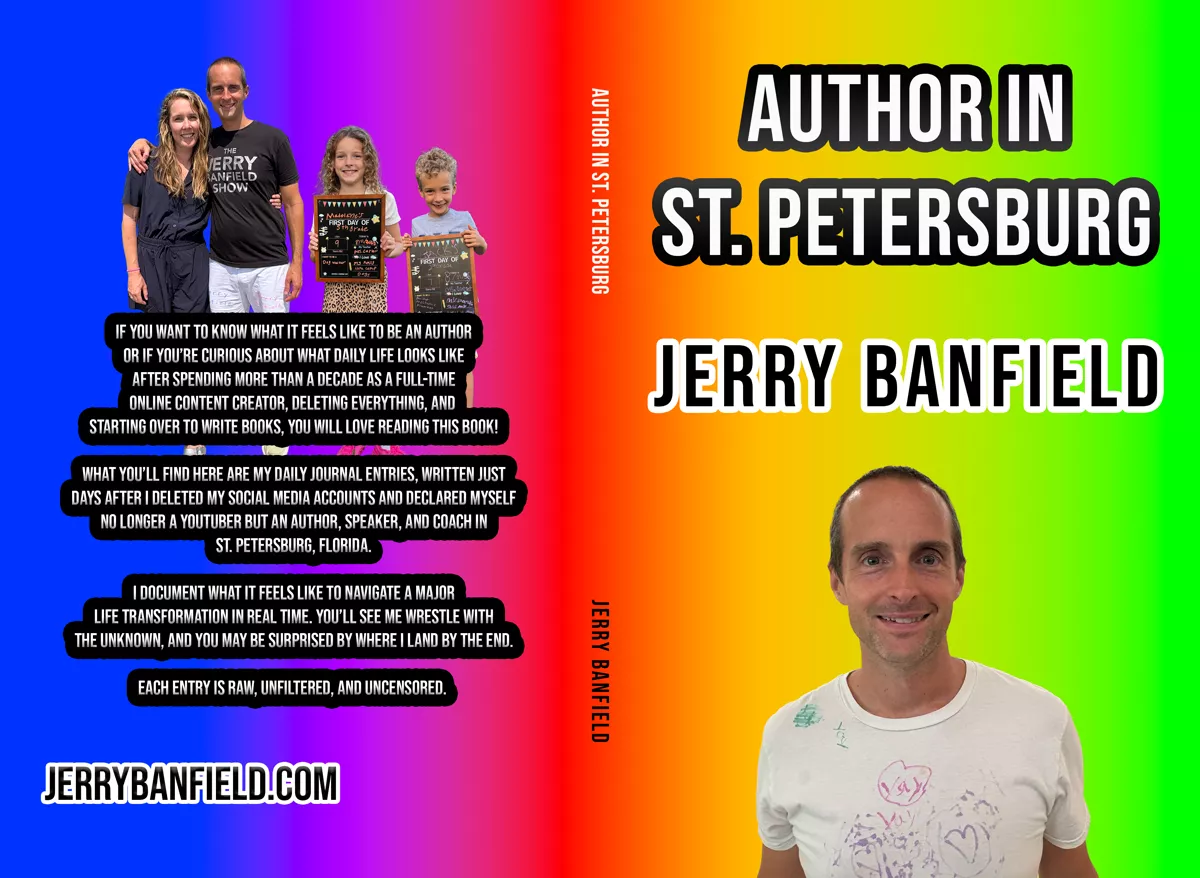
This is my journal entry from August 14, 2025, part of my daily autobiography Author in St. Petersburg — my real, unedited days, published in order.
This morning, I finished Liz Murray’s memoir Breaking Night, with only the acknowledgements left to hear. Last night, while walking my dog, I listened to the final hour and found myself in tears. I love stories about people who beat the odds, especially when those odds are as crushing as hers — two drug-addicted parents, homelessness, and a childhood where the future most people in her position face is simply repeating the same cycle. In her case, she broke it and became an inspiration.
Most of the time, people stay trapped in whatever they were born into. Yet sometimes, people flip the script completely — growing up in chaos and hardship only to build something beautiful, or coming from a stable, loving home and destroying it all. One of the things that struck me most about Liz’s story was the moment she recognized her own power over her life. She described looking at her blank high school transcripts after starting over. Until then, so much of her life felt like it was in other people’s hands — welfare offices, social workers, the possibility of being placed in a group home. Then she realized that if she could fill those transcripts with A’s, doors would open — college, opportunity, a life she could choose. Grades were impartial. They didn’t care about her past. They simply reflected whether or not she showed up and did the work. That awareness, that shift into this is what I can control — I love that.
I relate to that mindset. In my own way, I’ve struggled with feeling powerless, especially when I poured myself into YouTube videos and didn’t get the views I thought they deserved. That frustration was part of why I deleted my fifteen channels. I couldn’t control the algorithm or the audience’s response, but I could control what I created and how I created it. Writing these diaries feels so much better. They’re joyful, evergreen, authentic, and nourishing for me, whether or not anyone else reads them.
I admired Liz’s commitment when, at seventeen, she found an alternative high school built for students like her — kids the regular school system had failed. People advised her to skip the grind and just get her GED. It would have been faster; in a few months she could have been eighteen with a diploma-equivalent in hand. But she wanted a real high school education. She saw the long-term value: more work, more learning, a stronger foundation, and a sense of pride.
I’ve made a similar choice with my shift from videos to books. In the short term, I could earn more money and reach more people if I cranked out videos again. But look at where that path has taken me before — burnout, frustration, and a body of work that fades quickly. Writing books forces me to produce something useful and lasting, even if nobody ever engages with it. Just keeping this diary is therapeutic. I’m expressing my ideas in a way that has permanence, even if it takes years to reach the kind of audience my videos once did.
The real challenge for many of us is prioritizing the long term when survival is pressing on us in the present. Liz described the mindset of the ghetto: all that matters is what’s within arm’s reach. How do I eat today? Where do I sleep tonight? That urgency often leads to decisions that help in the moment but damage the future — stealing, lying, using drugs. I understand that thinking from my years with alcohol. When I felt bad, all I cared about was feeling better now. Tomorrow didn’t matter — until tomorrow arrived and I felt even worse, trapped again in the cycle of short-term relief and long-term damage.
I feel as though I’ve finally broken out of the survival phase in my business — the constant grind of needing views today, money this week, and quick wins just to keep going. For the first time in years, I can think in terms of decades. I want to set myself up for the next thirty or forty years, not just scramble to produce something that performs in the moment. The idea of holding a massage license and being able to practice for decades appeals to me deeply. If you’re ready to stop scrambling and start thinking in decades too, you can book a one-on-one call with me and we’ll map out that long view together.
Of course, in the short term, it’s daunting. Massage school will require tens of thousands of dollars and thousands of hours once I factor in both the classes and the driving. That means giving up time I currently spend on writing books, yoga, tennis, Alcoholics Anonymous meetings, and being with my family. I’ll have to make sacrifices in each of those areas to make room for school. Yet in the long term, the license feels worth it. I’m grateful we have enough in the bank to pay for it, and that I don’t currently have a flood of coaching clients demanding my time. Right now, I’m in a quieter season, focused on writing. I imagine that once my books have been out for a while, more people will want to work with me. When that happens, I want to be able to offer something tangible, hands-on, and deeply meaningful.
Life coaching alone can sound abstract — just sitting and talking. I imagine offering coaching during a massage session, combining both the physical and the mental work. That’s something I would personally pay more for if a therapist marketed themselves that way. To me, that combination is far more compelling than talk alone.
Breaking out of my own survival mindset made me connect even more to Liz Murray’s story. I cried hearing her describe her shift away from living day-to-day toward building a future. She recognized that if she wanted her life to improve, she had to change how she lived in the present. That struck me deeply.
One of the most beautiful parts of her journey was the way she asked for help. Many of us hate to appear needy. In her case, being homeless was something she often hid, because the law at the time meant that admitting it could land her back in a group home. It’s a clear example of how our systems sometimes incentivize dishonesty. When telling the truth has legal consequences, people will lie or stay silent. Online platforms amplify this problem with their own restrictions. YouTube’s terms and conditions ban entire categories of conversation — including some perfectly legal topics — which I’ve always found frustrating.
It’s always frustrated me that platforms restrict open discussion of legal, personal topics. Books, thankfully, offer a much freer space for expression.
What I love about Liz’s story is her refusal to let other people control her life. Yes, her classes were demanding, and she was homeless, but she found help everywhere. People with barely enough to feed themselves gave her food. Friends snuck her into their homes. Ideally, parents would have been openly told, “Liz is homeless, can she stay here?” but the reality is that there’s more than enough housing — my own neighborhood has empty homes everywhere. Homelessness exists not because of a lack of shelter, but because we aren’t working together and because people often hide their need.
I’ve learned that not asking for help can be as damaging as not offering it. One of my biggest triggers with my ex-wife used to be when there was an opportunity for me to help and she wouldn’t make space for it. She’d do everything herself, get stressed, push too hard, and end up in a bad mood — while I was in one too. It felt like she had deprived me of the chance to contribute and feel good about it. Something as simple as asking if I could pick the kids up from school could have changed the whole day. Over the last few years, we’ve worked on that dynamic, and it’s gotten much better. Helping others leaves both people feeling good, and it’s a gift when we allow others to give to us. If there’s something you’ve been carrying alone, you don’t have to — you can schedule a private call with me and we’ll work through it together.
My goal with these books is to share what I’ve learned and give others the chance to benefit from the knowledge that has changed my own life. I’m grateful for everything I continue to learn, and I want to pass that on because books like the ones I’m writing have shaped me in profound ways.
This morning, I woke up with a slight raw sensation in my throat again. I reached for Heal Your Body by Louise L. Hay, author of You Can Heal Your Life. That book’s central idea is that many physical symptoms stem from patterns of thought, emotions, and stored trauma in the body. By identifying and addressing those underlying causes — mental, emotional, and spiritual — the body often heals itself. Heal Your Body offers a reference list: each physical symptom is matched with a probable mental or emotional cause and an affirmation to help shift it.
I’ve used Louise Hay’s work to heal myself before. For example, I’ve had almost no coughing fits in the last six years, something that used to be a regular annoyance. I learned from her book that coughing can be connected to resistance to change. The suggested affirmation is simple: I’m willing to change. I’m changing. The first time I tried it, my coughing stopped almost immediately. Then came the clarity — thoughts surfacing about exactly what needed to change.
In 2019, I was in the middle of a financial disaster. I had borrowed over $100,000 and drained all my cash trying to start a platform to compete with Udemy, offering online courses with private label rights. I paid people to make courses, but they weren’t selling. My finances were wrecked. While I had mentioned borrowing money to my ex-wife, and she had been shocked at the scale of my spending, she trusted me because of my past success. The affirmation made it impossible to keep pretending. I had to tell her plainly: It’s not working. I’ve failed. Our finances are destroyed. I need your help.
That was one of the hardest conversations of my life. After years of earning hundreds of thousands in profit, paying for everything, and taking pride in providing for my family while working online from home for myself, I felt like a complete failure. Yet the debt had grown so large precisely because I hadn’t asked for help sooner. If I had spoken up a year earlier, in 2018 — when we had no debts, no loans, and a thriving business — our situation could have been corrected easily. Instead, I waited until we were buried in debt.
Once I affirmed that I was willing to change, I acted immediately. I told my ex-wife the full truth. She cashed out all her investments to cover minimum payments, I became accountable to her for my spending, and she began seeking freelance work. That was the turning point where things started improving.
Reading You Can Heal Your Life taught me to see physical symptoms as intelligent messages from the body, not random malfunctions to fight against. Most people treat something like a cough as an isolated nuisance. I see it as the body’s way of saying, We need to change something. In 2019, my body was tired of the constant stress over money, so it sent a signal that couldn’t be ignored. The body can’t fix financial chaos on its own — it can only alert the consciousness, the spirit, the mind running the show. My cough was my body’s plea for me to make the changes necessary to live better.
I’m grateful that I had read Louise Hay’s work and recognized those signals for what they were: not just symptoms to suppress, but signposts pointing me toward a better way of living.
This morning, I woke with that same faint rawness in my throat. Unlike yesterday, when I didn’t even bother to open Heal Your Body, today I went straight to it. In the section on the throat, she begins with a simple description: Throat — avenue of expression, channel of creativity. The accompanying affirmation reads: I open my heart and sing the joys of love.
That struck me immediately because last night, while listening to Liz Murray’s memoir, I felt a deep, almost overwhelming sensation in my throat. It was as if I were crying and holding back a massive ball of energy there. The affirmation felt perfectly aligned with that experience. Beneath the main entry, Louise notes: Problems — see sore throat: inability to speak up for oneself, swallowed anger, stifled creativity, refusal to change.
Looking back, I can see why I had so many sore throats growing up. The inability to speak for myself and swallowed anger were definitely part of my early life. Stifled creativity was a given back then; I wasn’t living as a creator. Refusal to change — also likely true at times. Today, I’m not entirely sure which of these applies. I feel I speak up for myself now. I hope I’m not stifling creativity, since I’m writing every day. Swallowed anger is possible, and refusal to change could still be there in subtle ways.
The affirmation for this is powerful: It’s okay to make noise. I express myself freely and joyously. I speak up for myself with ease. I express my creativity. I am willing to change. Reading that aloud feels freeing.
It’s interesting — knowing all this, sometimes I still delay looking for the solution. How often do we live with problems we complain about without actively seeking to solve them? Today I’m interested in solutions. I’ve had enough of this raw throat, and I’m grateful I can now experience symptoms in isolation. I no longer see them as illnesses to be packaged together.
In the past, a sore throat automatically meant fatigue, a runny nose, and coughing. I thought it had to be part of a cold or flu. Now I know better. Yes, those symptoms can occur together, but they don’t have to. Fatigue is separate from a sore throat, and one doesn’t require the other. I can have an isolated symptom that’s simply my body’s way of sending me a message.
Louise’s dedicated section on sore throats lists the cause as holding in angry words, feeling unable to express the self. The affirmation is: I release all restrictions and I am free to be me. Saying that feels liberating — like unclenching something inside. In my own experience, speaking these affirmations has sometimes eased a symptom noticeably in the moment.
Sometimes, because of momentum, the body takes longer to fully resolve an issue or illness — minutes for minor symptoms, weeks for deeper ones. When I applied this same approach to a minor ailment I’d had for weeks, it seemed to ease and then resolve over the following couple of weeks. The point isn’t to expect instant erasure, but to know you can make a noticeable shift right away.
These affirmations and this way of understanding the body’s signals are powerful tools. I’m excited to keep sharing them, because they’ve changed my life and I know they can change others’ too.
After more than a week of trying to find someone to help me move my window unit from one window to another, a handyman finally came over. I had found his ad in the classifieds of the St. Pete Beacon. When he arrived, he told me he didn’t want to move the unit today. Instead, he said he was confident I could do it myself.
That was not the help I thought I was looking for, yet it turned out to be exactly what I needed. I’ve been practicing being open to receiving help in whatever form it comes, without getting attached to the idea that it must look a certain way. If I had clung to the belief that someone else had to do it for me, I might have been frustrated when he left. Instead, I realized he gave me something better than physical labor — he gave me confidence. I already had the strength and technical know-how; what I lacked was belief in myself.
He told me to use a steak knife to cut through the spray foam around the unit. After he left, I laced up my shoes, grabbed a knife, sliced through the foam, pulled the air conditioner out of one window, and installed it in the other. I stood there afterward thinking, That man gave me the exact help I needed, and I hadn’t even known it.
It made me wonder how many times in life we already have the help we need right in front of us but dismiss it because it doesn’t match the form we expect. Sometimes other people see more clearly what we require. This man seemed to understand that all I needed was a small boost of confidence — and his willingness to say no to doing the work himself was also an act of self-respect. He didn’t feel like messing with a window air conditioner that morning, so he didn’t.
There’s a certain dignity in being able to turn something down without guilt. Many people would think you should never refuse when someone asks for help, but that’s not true. He came over for free, gave me guidance, and left me with the pride of having done the job myself.
It even made me reflect on marriage and sex. If my ex-wife says she doesn’t feel like being intimate on a given night, there’s a balance in how that plays out. I can call another handyman if one refuses a job. In a committed relationship, what I value most is real connection rather than a substitute for it.
Today, though, I felt a real satisfaction in moving that window unit myself instead of hiring someone — maybe even more than if I’d paid someone to do it.
This is the fifth part of my diary this morning, and I catch myself wondering who would want to read something this long. People often say a diary should be five minutes or a thousand words a day. I’m not sure yet what kind of book this will turn into, but I know I’m enjoying writing it. Thinking through these moments benefits me, and I believe it could help someone else too.
I’m grateful for how easy it is to dictate into my laptop’s voice memos and let ChatGPT clean it up. Who’s to say someone couldn’t enjoy listening to twenty minutes from one of my days instead of five minutes from four separate days? I may not know the exact help anyone else needs, but I can show up with joy — and maybe, just maybe, that will be the right kind.
If you connect with how I live and think, you can follow the rest of my days on YouTube in my Life playlist.