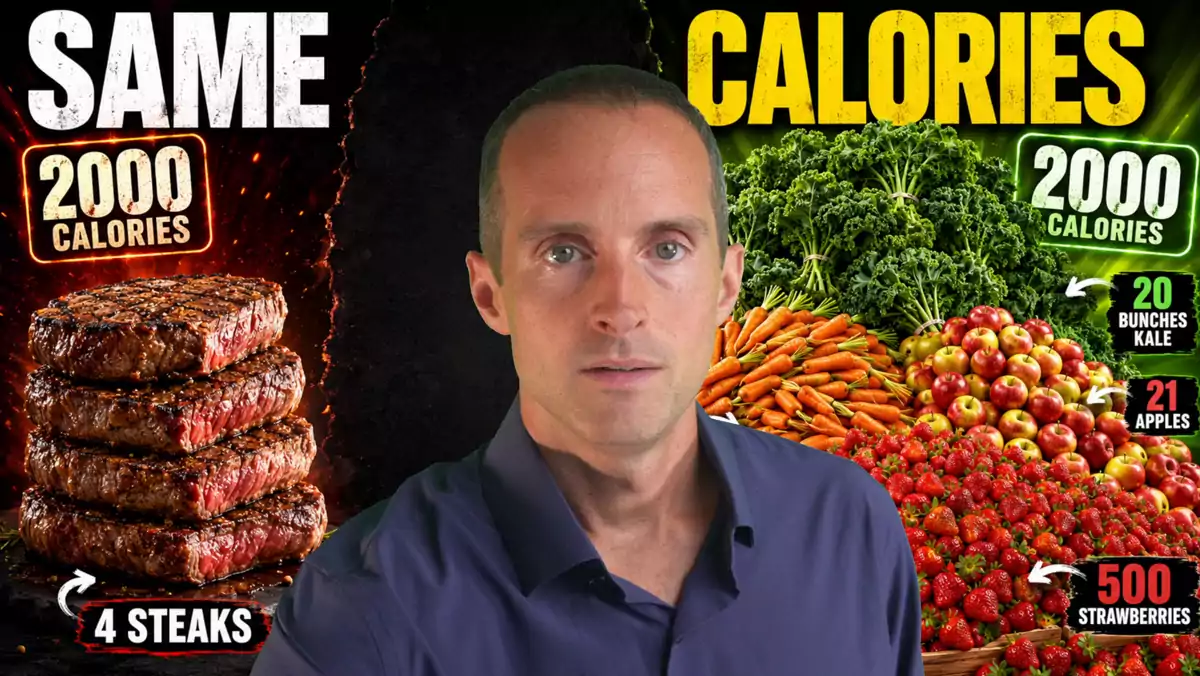
Let's look at calorie tracking versus plant-based eating — because a friend of mine is using MyFitnessPal right now, and what he's missing is how much food you have to eat with different foods and what that food actually does to your body. This is my opinion and personal experience, not medical advice.
The same 2,000 calories looks very different
I counted calories on MyFitnessPal back in 2015 and 2016, and it was hard. Picture 2,000 calories: you only need about four steaks to get there — but are you full after four steaks spread across a day? By comparison, 2,000 calories is roughly 20 bunches of kale, 80 carrots, 21 apples, or 500 strawberries. Whole plant foods fill you up effortlessly; eating only fruits and vegetables, you might even struggle to get all your calories because the sheer quantity and chewing fills you up. When I started plant-based, my mouth hurt from chewing so much.
Your body isn't a calculator
What calorie tracking misses is that what you put in your body matters as much as how much — like the fuel you put in a car. Citing the research in Dr. Michael Greger's books (How Not to Die, How Not to Diet, How Not to Age), the Panacea study found total meat consumption is positively associated with weight gain even after controlling for calories. In studies giving people the same calories of beans versus meat, the meat eaters gained weight on average and the plant eaters didn't. Different foods affect appetite, metabolism, gut, and hormones differently — so you can't just count calories, it's the kind of calorie.
What I do
I keep it simple: the more whole plant foods I eat — fruits, vegetables, nuts, grains, and beans, minimally processed — and the less meat and ultra-processed food, the better my body responds, and I don't need to track calories. I also pay attention to research on protein: animal and plant protein affect the body differently, and Greger argues a lower plant-protein diet is best for minimizing aging. I used to say I could never eat this way because I loved meat too much — literally days before I changed. Now I ask what the best fuel for my body is, and I'll eat boring plant foods to have a healthier body; I used to be 250 pounds, so I know what being overweight is like. After three years plant-based, my doctor said I was healthier than 90% of their patients. A tracking tool is a good first step, but if you want to go all the way, learn how the foods you eat actually affect your body — read the books from the doctor himself and do your own research. If you want to talk it through, watch my life playlist here.