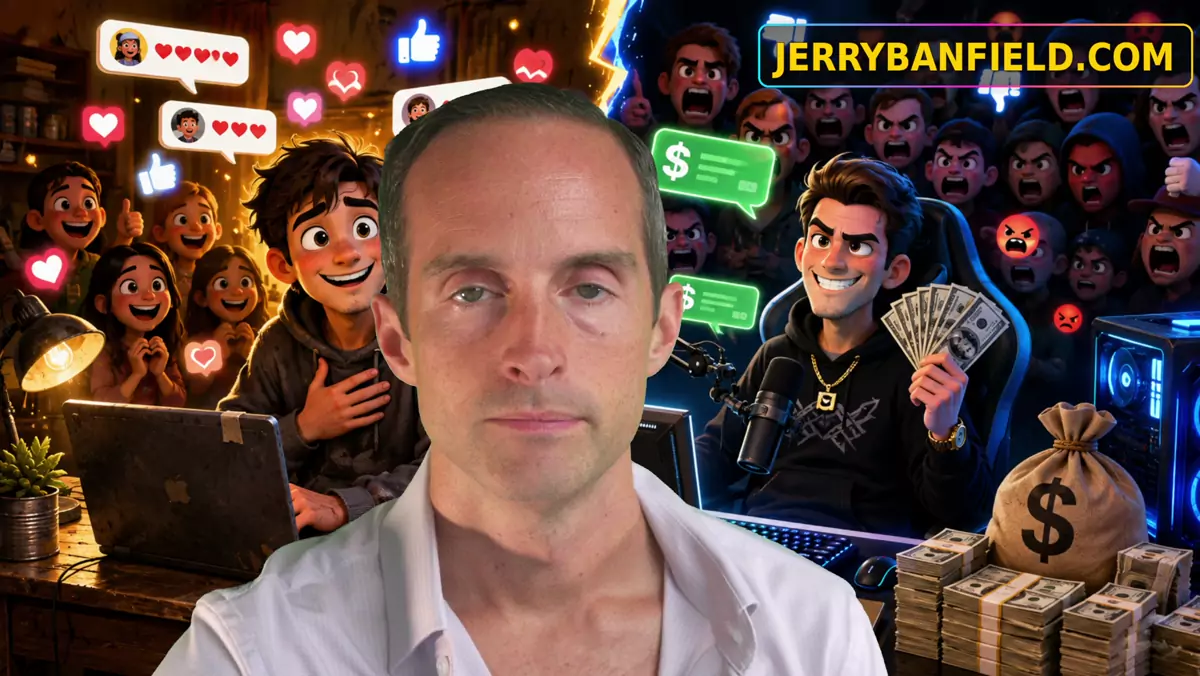
I've noticed something insane about being a content creator full time over the last 15 years. People often will absolutely love my work — until I start getting paid, and God forbid I then talk about it. They'll happily watch other people doing the same kind of work I'm doing and getting six figures at a company. They'll accept companies spending tens of thousands on analytics or marketing. They'll accept people like MrBeast, who takes millions and millions of dollars in sponsorships for his videos and then gives them well-done ad placements in the middle. But as soon as I start saying, hey, I don't want to just be a broke creator anymore volunteering my time, I'd like to get paid — people's outrage is insane.
For example, I've been creating videos about this crypto called Internet Computer Protocol. Just in the last week, I said: look, I'm not doing content that gets millions of impressions all over YouTube and X for free anymore, when the other people doing valuable work like I am are getting paid. The people that work at DFINITY are getting paid hundreds of thousands of dollars to do their job. I'm doing equally valuable work as many of them are doing, and the public thinks I should do it for free and scrape by. And this creates one of the nastiest incentives in being a creator: often, secretly getting paid — getting paid and keeping quiet about how you're getting paid and who's paying you — is one of the most effective strategies. I have several stories that are going to blow your mind about this.
The Broke Streamer Everyone Loved
When I got back on Facebook Gaming in 2020 and started live streaming again, I had run up a whole bunch of debt, and I was about as broke of a streamer as I had ever been. Meanwhile, years before, I'd had an incredibly fancy setup. I used to live stream in suits and costumes, and almost nobody related to me. People would watch, but almost nobody would donate or support me, because I was making hundreds of thousands of dollars a year online, I was open about that, and people were jealous. So nobody would donate or support any of my gaming streams at all, and I quit doing them. Then I came back after a year, and people really wanted me back. This time I had a ghetto camera and a ghetto streaming setup. I was on an Xbox One trying to play Call of Duty Warzone on a $600 used PC with a donated headset, a donated microphone, and a camera that had been used to film funerals. And people loved it. One time I got $700 in a single live stream in donations. People loved seeing me be a streamer who was broke, who they could identify with.
My friend on TikTok went off about this. He said: Jerry, this is what you need to realize about people on TikTok. People on TikTok are broke, angry, and lonely. Never tell them you're doing good, because they'll stop identifying with you, they'll hate you, and they'll stop watching you. Don't tell them how happy you are, or that your life's going good, or that you're in a relationship. Don't tell them anything good. You need to tell them things that make them angry, and things they can identify with — like, man, I'm struggling, I hate this — and they'll be like, yeah, I am too. It's a place for people to show up that are not having a great life, and then they spend a ton of time scrolling on this app to try and escape, and they don't want to find people who are different from them. They want to feel like they're in an environment with other people like them. And I was like, that's disgusting. Why would anybody want to create on these platforms?
But if you're creating content on these platforms, you need to realize who the main people watching videos are. Not just one video — who are the people watching a LOT of videos? Who are your power users on TikTok, on Instagram, on YouTube, on Facebook, on X? Most of the people putting in a ton of time — and therefore generating a ton of views and impressions, and doing the majority of the commenting — are often angry, broke, lonely, sad, sick, crazy, deranged, unhealthy people. Not everybody falls into that category, and not every power user falls into all of those. But that's your audience. People having an awesome life are generally not spending eight hours a day scrolling TikTok, or watching five or six hours of YouTube videos a day, or sitting on Instagram going through two, three, five hundred reels. Yes, there are reasonable, healthy people like me who go on YouTube and very intentionally watch content — but I don't generate that many impressions or views. I rarely comment. I'm mostly a lurker, and I'm extremely careful who I subscribe to and who I watch. And I deleted everything on YouTube and all these other platforms in 2025 because I was tired of this: if I act like some broke loser, everybody identifies and wants to watch, and if I want more views... and then once I level up my streaming setup, I generate huge amounts of haters and all kinds of crap. And God forbid I'm open about how I'm monetizing — people go nuts.
Charge Money and Watch the Community Turn
In 2020, when I was playing Call of Duty Warzone, I was getting huge donations — like crazy. I remember one woman who said she was enlisted in the Navy dropped $200 or $300 in donations in a single stream. Then that stuff stopped when I upgraded my setup, and then I started charging people $300 to play Call of Duty Warzone with me. The community turned against me and most of the donations dried up. The only tips I got were from people trying to get attention, essentially using me as advertising to promote their own streams. One guy concretely said this to me: he gave me hundreds of dollars in donations because he wanted me to promote his stream, and he sent me a box with cash money in it and a bunch of other cool stuff. And then when I revealed that I was now making like ten grand a month streaming, because I had such a big audience as a Facebook partner, this guy lost it. He said: man, I thought you needed my help. This is messed up. You've got more money than I do. And he turned on me and became one of my biggest haters.
Why People Turn: The 3-Pointer Problem
Why do people love creators until they get paid? A few different reasons. First: the people watching on the other side, especially the ones consuming all the time, often imagine themselves creating — or are posting themselves. They think, well, I'm creating videos too. Why should this guy get paid when nobody pays me for my videos? I'll make a basketball analogy. I went to the gym yesterday and made like four 3-pointers, but nobody paid me to go to the gym and shoot 3-pointers. Why? Because I'm not a professional. I'm not out there selling tickets to basketball games. But as a content creator, I AM a professional, and people watch me because my content is better than the majority of what other people are creating, especially creators who are not professionals. My content is very real, very raw, and it is useful for real human beings that don't want to be losers and don't want to think like everybody else. If you want to be intelligent and think above the majority, if you want to be a good person, if you want to be empowered and powerful and courageous and able to handle life like I can, and if you want to be a professional creator like I am — that's why people watch my content. I crank out a shocking amount of videos every day, and because I'm good at what I do, I do it fast, I communicate emotion, and I communicate clearly, I generate millions and millions of impressions every day. My numbers: 6.9 videos a day. 83 minutes of content a day. 733 videos published since May 2026. That's a professional.
And it's funny — when I started up again this year, in 2026, I used debt to buy the best camera I've ever filmed with and the best computer I've ever had, with a GeForce RTX 5070 graphics card that does a lot of valuable work in my computer. I started out telling people: hey, I need money. I just started from scratch, I'm borrowing money. And people really related to that and supported my content, especially in the ICP community — people were very supportive and shared my content. Then I said: look, I'm tired of doing this content and not making any money. I appreciate the few people who've supported me, but if I'm going to do this like a job and get results like it's a job, then it's time to get paid like a job. And people turned, absolutely went nuts, were total jerks calling me names. And what am I doing? I'm asking to get a paycheck for the job I do that's extremely valuable — while somebody else at DFINITY is getting a hundred grand a year to not do nearly as good of a job as I do promoting it. And I've seen it this year: I'm grateful I made over $3,000 in the last week, which is awesome. Now I can pay my rent this month without borrowing money. How nice is that?
So if you want to be a content creator, you need to face the reality that if you want to get paid, you're often going to need to do secret things to get paid. Remember the Warzone story? A bunch of other streamers were doing the same thing — secretly charging people in their Discord servers, on the down-low, via direct messages. And they were charging at least as much as I was, if not more, to jump into a single game. Meanwhile, I publicly showed that you could pay $300 and jump into a game, and I'd stream it, share it, and promote you as much as I could. The outrage was shocking. And it's irrational — people are like, that's messed up, you're getting $300 to let somebody play Warzone with you.
Crypto's Secret Shills
You see, most people watching on these platforms are not operating with a rational mind. Anything they identify with and feel jealous of, they're going to roast you for. So this promotes an environment where, if you're actually getting paid, you often need to operate in secrecy — which is gross, but it's the way most people are doing it. And crypto is one of the most disgusting areas of it. How many people have gotten paid secretly to promote coins and never tell their audience? They go out shilling all these coins, but they can't tell their audience — hey, I got a million dollars in this coin to tell you how great it is every day — because their audience would absolutely roast them and go off on them.
So I am comfortable finally facing this reality as a content creator, and you know what? I am going to be honest and transparent, first and foremost. You can see it all on my website: I've got a one-on-one call with me, I've got sponsored videos, I have coaching. Now, there is an exception to this to some degree: if you position yourself as a niche authority, people will often pay you — but then you are always going to get all kinds of haters and critics who disagree with you, who put you down, who roast your videos, who react to your videos, et cetera. And I've gone as far as just straight-up embarrassing myself to get views. You know what? I'll take the paycheck. I've made over $2,000 in the last week selling a video and getting a new channel monetized, basically off of embarrassing myself. As a professional content creator, that's just part of the game — just like a professional NBA basketball player: sometimes you're going to get out on the court and embarrass yourself, but you're going to get paid for it.
Welcome to the Dark Side
If you want to be a content creator, you should know this reality, because it's what a lot of people miss. When you first start off, you might feel like it's this dream. You start off as this broke content creator chasing a dream, and oftentimes a lot of people will support you at that point. But as soon as you start making some money and getting some serious views, a lot of the people who supported you early on will turn on you, hate you, stab you in the back, make posts saying you're a scammer — or they'll try to get you banned. From Udemy, successfully: this literally happened to me. When I started out on Udemy, I didn't have any money, and I got huge support. I gave away free coupons, and I was loved on Udemy — I had this huge following of people who loved me and loved my courses. But then I started showing everybody how much money I was making on Udemy — $10,000, $20,000, $50,000, up to $90,000 a month — and I got an army of haters along with the lovers, taking shots at me from every angle, all the time. Then one of them tricked me into making a course with her — she must have been insanely jealous. She tricked me into collaborating on a course, then stabbed me in the back and reported to Udemy that I was just using her course to make money. As far as I can tell, I didn't make any money off her course. I put two hours of videos that I filmed into her two-hour course to make it a four-hour course — I filmed half, she filmed half. I got banned on Udemy, and they cited her course, saying I had improper co-instructor relationships, which was blatantly ridiculous. But how do you think the trust and safety team felt about me? The trust and safety team was jealous as hell that I was sitting there making almost their entire yearly salary in a single month. The trust and safety team at Udemy hated me, and that's why they banned me when I didn't violate any policies.
So as a content creator, you should know: when you start out and it seems like people love you and you're chasing the dream, you're going to get a false optimism — and that false optimism will be destroyed, either when you run out of money and can't keep making videos that don't pay, or when you start getting some success. Welcome to the dark side, baby. Once you're in the dark side, you can't unsee how nasty this whole environment is. It's just the Matrix. But you know what? I still go into the Matrix. I try to wake people up in the Matrix, and it seems there's nothing better I can do with my life at this point. I deleted everything and took nine months to try to find out — nope. The best thing I can do is go into this matrix of content creators, with all these crazy, lonely, angry, sad people watching videos, and try to reach the few critical thinkers, the few people who are really alive, and be a genuine person who creates content and shares my dark side honestly. Everything I've learned doing this is in my YouTube Coaching playlist.
If you're a content creator, probably the best thing you could do with me today is schedule a call and talk with me about the reality of being a full-time content creator.
I've done this for 15 years, and I'm much more available and approachable than almost anybody else you'll find.