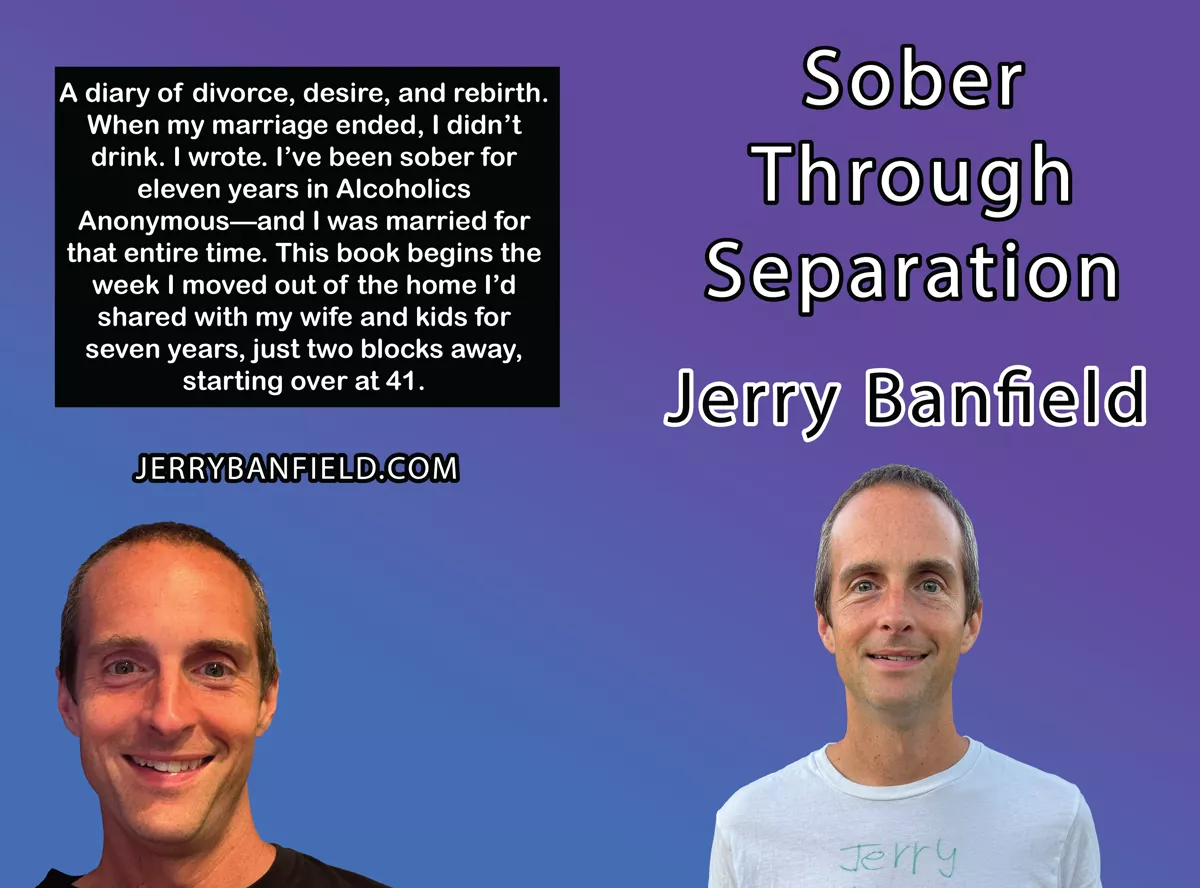
This is my journal entry from October 8, 2025, part of my daily autobiography Sober Through Separation — my real, unedited days, published in order.
Today, I’m moving out of the house I’ve lived in with my ex-wife and the kids for the past seven years. It feels surreal—part of me still can’t believe it’s happening—but there’s excitement mixed in with the disbelief. The hardest part of the move is maneuvering the king-size mattress two and a half blocks down the street on furniture rollers. My ex-wife and I have it standing upright, taller than both of us, and keeping it from sliding or falling takes constant effort. By the time we reach the new house, I’m sweating heavily, but relieved when it slides perfectly into the right back bedroom.
A friend shows up not long after, reminding me that he used to be a professional mover. He hands me a sturdier, higher-quality dolly and helps strap down the bed frame. With his help, I’m able to wheel it by myself all the way down the street and, just barely, through the front door. Getting that frame inside feels like the biggest victory of the day. Everything after that is just work—carrying boxes, loading and unloading the car, a few more trips back and forth until the essentials are finally in place.
By evening, I have enough set up to sleep in my new place. I wait until bedtime to say goodnight to the kids. I sing You Are My Sunshine, give them hugs, and hug my ex-wife too. I start crying as I say goodnight to my daughter, and the tears keep coming for at least twenty minutes. Memories flood my mind—my ex-wife singing her own lullaby to my daughter, something like, “I love you so, my sweetest love, my sweet love.” I think of my grandfather and another loved one who has passed, both of whom made much bigger moves than this one, and I feel their presence with me. I grab my T-shirt and use it to wipe my face, refusing to sniffle anything back; I’ve came to believe that’s how people end up congested and sick. So I just let it all flow, soaking the front of my shirt as every tear and bit of grief comes out.
I take the bag of cold food—lettuce and celery right on top—along with my shoes, load them into the car, and drive the two and a half blocks to my new home. There’s still a lot to do before I can rest. I stop crying when I get to my house and started to feel a bit excited about my new adventures. I change the sheets, spread the comforter I washed earlier, and start blacking out the windows. I’m used to sleeping in complete darkness, so I’ve brought aluminum foil and duct tape for the job.
ChatGPT warned me not to cover double-paned windows with foil because the reflected sunlight can heat them up and cause cracks, but I doubt that matters much here. The house is scheduled to be torn down soon anyway, and my landlords—who happen to live next door—told me they’re fine with it. It actually feels good having landlords who are personally involved and easy to talk to.
Before bed, I decide I’ll finally sign up for a dating app. I already have my pictures ready, and doing this feels like a symbolic step—proof that I’m officially single now. Having my own space, setting up my bed, and starting fresh tonight all make it real. I’m on my own again, beginning a new chapter.
After settling in a bit, I call my mom. She encourages me to come back down the two and a half blocks to visit, and I’m glad she does. The walk gives me a chance to breathe, feel the cool night air, and take in the full moon overhead. When I get to her place, she’s exhausted, so we only talk briefly before I head back. Still, seeing her helps—especially on a night like this. Earlier, my sponsor had called just to check in, wanting to make sure I was handling everything all right. I told him I was fine, and it’s true. Once I cried it all out at the old house, the heaviness lifted. The tears stopped when I stepped into my new place. It felt like I had finally grieved what needed grieving, released the old life, and opened up space for what comes next. If you’re grieving the end of something and want help making room for a new chapter, you can schedule a private one-on-one call with me and we’ll build that next part of your life together.
I’m excited thinking about the women who might one day share time with me here. I can already picture it—cooking together, talking late into the night, connecting deeply. But first things first: I need to finish setting up the bedroom. Sleep is sacred to me, and I can’t rest properly without darkness, so I start blacking out the windows. I go through almost an entire roll of aluminum foil, tearing and taping with precision, using plenty of duct tape to seal the gaps. When I’m done, the room looks like a reflective cave, and I’m satisfied. Then I move the bed into the back right corner, stretch the clean sheets across the mattress, lay the comforter flat, and admire how it all comes together. It finally feels like my space.
With that done, it’s time for the next step—getting on a dating app. I already have Bumble downloaded from earlier when I was still on Wi-Fi at my ex-wife’s. The internet isn’t installed here until tomorrow, so I switch over to mobile data and start setting up my profile. The process takes longer than expected—over twenty minutes of uploading photos, verifying my selfie, and filling out the prompts about interests, identity, and values. I skip the ethnicity question. I don’t feel like checking “white,” but “black” doesn’t fit 100% either given my appearance, so I leave it blank.
I’m grateful to have six good photos, most taken by my ex-wife: one of me petting the dogs, one holding my books, one from my trip to D.C., another on the tennis court that my friend took, one in front of the colorful rainbow wall at the yoga studio, and one with my YouTube silver plaque back in my old office. Together, they capture a pretty honest picture of me. Still, for a guy who loves talking about himself, I’m surprised how hard it is to answer some of these prompts. What’s a pro and con of dating me? What’s my idea of a good first date? I sit there thinking about it longer than I expected.
Eventually, I realize my biggest pro and con are the same thing: all the things I don’t do. I don’t watch TV, movies, or listen to music. I don’t play video games. I imagine some people will see that as boring—that I’m not the kind of guy they can just sit on the couch with, zoning out to Netflix. But that’s fine. I’m not interested in that kind of relationship anyway. Sitting silently beside someone while both of us stare at a screen isn’t connection—it’s isolation with company. I want something real, where we talk, play board games, or do something active together.
When I reach the prompt that says, “Instead of going out for drinks, let’s…”, I type in “do a yoga class or play tennis.” That’s my kind of date—movement, energy, something shared. Before I know it, it’s almost 11 p.m., my usual bedtime. I want to be up by 7 a.m. to be ready for the kids. But before I go to sleep, I take a few minutes to focus on manifesting the right woman. I figure one way to do that is to visualize her—someone whose energy I can feel even before meeting her.
I scroll through Bumble, looking for a profile that feels right, one I can focus on while imagining what it would be like to actually connect with her. It takes longer than expected to find one. Most of the profiles disappoint me. So many women have photos with drinks in their hands or mention not wanting kids, which rules them out right away. I also have to adjust my age range—at first the app keeps showing women in their fifties, which is fine in itself. If I weren’t hoping for more kids, I’d happily date a woman in her fifties or sixties who’s vibrant and healthy. But right now, I’m looking for someone between 18 and 45 who wants more kids.
Eventually, I find a profile that clicks enough to use for visualization. Lying there, I spend a few minutes focusing on what it would feel like to have that kind of connection in real life. Some people might find that strange, but I see intentional visualization as a powerful form of manifesting—it’s worked for me before, and I trust it will again. I’d rather channel that energy consciously toward what I want than repress it.
When it’s over, I feel calm, grounded, and ready to sleep. It’s been an emotional day—moving out, saying goodbye, crying, setting up a new home, and opening myself to new love. But lying there in the dark, in my own space for the first time in years, I feel at peace. If you’re moving through a separation that’s reshaping your whole life and want to talk it through with someone who has been there, you’re welcome to book a private one-on-one call with me.
These dating apps are relentless about pushing their premium upgrades. Every few swipes, another screen pops up urging me to pay for better results, faster matches, or unlimited likes. It’s absurd how much they charge—some of them are asking $30 a week. Thirty dollars a week just to talk to people online. But then they bait you with “save 70% if you pay for three months upfront.” I catch myself thinking, Do I really need three months of Bumble Premium? Probably not, though I might think differently tomorrow. For now, I’ll sleep on it.
Afterward, I shower and get ready for bed. Unfortunately, the room isn’t as dark as I’d hoped. The aluminum foil blackout job isn’t perfect—tiny cracks let thin slivers of light through. I’ll need to patch them up tomorrow. My usual sound machine app isn’t working either, so I’ll be sleeping in silence for the first time in years. It’s strange, but fitting somehow. A new home, a new chapter, a different kind of night.
Let me rewind to earlier in the day, before the move. The morning started as usual. I took the kids to school, then headed to the tennis courts to meet my friend. I decided to open the match playing like I had with my friend a few days ago—smashing every shot, swinging for the fences, and missing a lot. My friend made it clear that wasn’t his idea of fun, so I reined it in. I shifted into a more balanced rhythm—still aggressive, but focused on keeping the ball in play and stretching my limits without losing control.
Right before we started, I took my shirt off. The two guys on the next court had the same fair skin as me and were both shirtless, so I figured, why not? I’ve been wanting to work on my tan anyway, and I can feel how sunlight charges me up. My friend snapped a picture of me for my dating profile just before I went shirtless—he tossed a ball, timed it perfectly, and caught me mid-swing. The form actually looks decent, at least to anyone who isn’t a coach. The intense concentration on my face is hilarious, but it’s a great shot.
My friend won the first set 6–3, which isn’t bad considering I started down 0–3. In the second, I came out on fire—won the first three games, leaving my friend serving at 0–3, totally surprised. But he loved it. He’s competitive, and when we first started playing a year ago, there wasn’t much competition between us. Now we’re neck and neck. He clawed back to 3–3, but then I caught a streak and closed it out 6–4.
That led us into our first third set in a long time, and thankfully the heat wasn’t unbearable today. Playing shirtless definitely helps regulate my temperature, even though I have to be careful about sunburn. We started at 8:30 a.m., so I figure the exposure won’t be too bad. Every water break, I cover my shoulders and head with a towel for a few minutes to give my skin a rest.
The third set turned into a battle. It reached 5–5, and somewhere around the midpoint, frustration gave way to something else entirely. My mind stopped churning, and I dropped into a state of deep presence. Everything slowed down. I could feel the gritty texture of the tennis ball in my hand, notice the fuzzy hairs against my fingertips. My awareness shifted to my feet grounding into the court, the rhythm of my breath, the feel of the racket slicing through air. My mind was empty—no overthinking, no running commentary, just total focus.
In that state, I played my best tennis. I wasn’t worried about the score or what my friend was doing. It was pure motion and instinct. My friend could sense it too—he looked surprised as I kept landing shots he didn’t expect, but he also stepped up his game. We both started playing some of our best tennis ever in those last few games. The rallies were long, fast, and balanced with a mix of brilliance and mistakes from both sides.
Eventually, my friend took the third set 7–5. We were both drenched in sweat but proud of the match. It felt like we’d pushed each other to the edge. He said he made too many errors, and I laughed, telling him, “Not enough, actually. If you’d made a few more, I would’ve won.” I admitted I made too many myself. We laughed about it and agreed it was one of our best matches in months.
Afterward, my friend opened up a little about his personal life. I appreciated that—he’s listened to me talk about mine endlessly, so hearing him share felt like a deepening of our friendship. It was the kind of morning that reminded me why I love tennis so much: the competition, the connection, the moments of silence where thought disappears and you’re just there, alive in the rhythm of the game.
After tennis, I get in the car and optimistically call the St. Pete Utilities Department to see if I can finally get through to start my water service. Every other day this week, the line’s been impossibly long. Either I couldn’t even get into the queue, or I realized I didn’t have two hours to sit around waiting, so I hung up. But today, to my surprise, it says there are only two people ahead of me. I stay on the line, and right as I pull back into my ex-wife’s driveway, a man answers. I feel almost starstruck—like I’ve finally reached someone famous, impossible to contact, in high demand.
I tell him I need to start my water service at the new house and transfer my ex-wife into the account at her place. He says she’ll have to call separately to handle hers, but he can help me right now. Twenty minutes later—after he runs through research on the property, checks my credit, and pulls up my customer history—he tells me I don’t need to pay a deposit since I’ve been a customer for years. The water will be on tomorrow. I hang up feeling triumphant, relieved to tell my new landlord that both the electric and water are now officially in my name. Once the internet’s installed tomorrow, I’ll be fully moved in.
To cool off, I take a cold shower. I’ve found that rinsing with cold water after getting a lot of sun dramatically reduces the risk of burning. It makes perfect sense—if the skin’s overheated, cool water draws that heat out. I also make a point not to use soap after heavy sun exposure. When I was a teenager, I handled sunburns in the worst possible way. I remember spending two straight days at a pool, constantly reapplying sunscreen, then going home and scrubbing myself raw in hot water with soap to wash it off. By the second day, I had second-degree burns and blisters across my shoulders. Lesson learned: if you get too much sun, just rinse with cold water and skip the soap. Today, I rinse my shoulders and face clean, wash my hair with shampoo, and step out feeling fresh and cool.
After the shower, I make a huge salad—leafy greens, crunchy vegetables, everything fresh from the fridge. I’ve burned a lot of calories and want to replenish properly before sitting down to finish I Was Famous on the Internet. I’m determined to publish it today. The next few days will be swallowed by moving and settling in, and once I submit the manuscript, it can take weeks before the printed copies arrive. I can order single books for $13 like anyone else and get them in a day or two, but the bulk author copies at $4 each usually take weeks. All the more reason to get this done now.
I go through the manuscript line by line, tightening the final details. The book runs 159 pages, and I’ve included my website eleven times with various calls to action—inviting readers to reach out if they want to talk about video game addiction, helping their kids off devices, marketing their business locally, or just asking personal questions. Everything points to scheduling time with me in person through my website, which for now means coming right to my house.
By 2 p.m., I’m proud to have the manuscript fully submitted to Amazon, complete with the book details. The only piece left is the cover. I download the KDP template, open the PNG file in Photoshop, design the cover, export it, and upload it—only to realize the colors are completely off. After thirty minutes of troubleshooting, I finally figure out what happened: I used the PNG template instead of the PDF. That’s what worked last time for Author in St. Petersburg. So I start over, opening the PDF and rebuilding the design by copying everything from the PNG version. It’s tedious work—pasting text resizes inconsistently, the alignment shifts, and the font scale keeps changing because the canvas sizes don’t match.
Before I know it, it’s time for my AA meeting, and I have to leave the cover unfinished. I head to the meeting—it’s all guys again, just four of us total: me, two men with a couple years sober, and one brand-new guy. I read a full three-page story from The Grapevine since we’ve got plenty of time, and then we go around sharing. The focus is on helping the newcomer hear something useful. The other guys and I talk openly about our experiences, hoping he takes something from it. We finish with another, shorter story—this one about the power of prayer and meditation—and wrap up around 5 p.m.
When I get home, I go straight back to the book cover. I rebuild and export version after version—what must be the tenth by now—and finally, when I upload it, the colors display correctly on Amazon. I submit the final file, officially publishing I Was Famous on the Internet. Within 24 to 48 hours, it should be live and available for purchase. I hope the cover’s right this time, because I’m pretty sure changing it requires submitting a whole new edition. Maybe next time I’ll order a proof copy before setting it live—but for now, I’m all in on this version. With that done, I shift my focus back to moving—closing out one chapter and stepping fully into the next.
If you connect with how I live and think, you can follow the rest of my days on YouTube in my Life playlist.