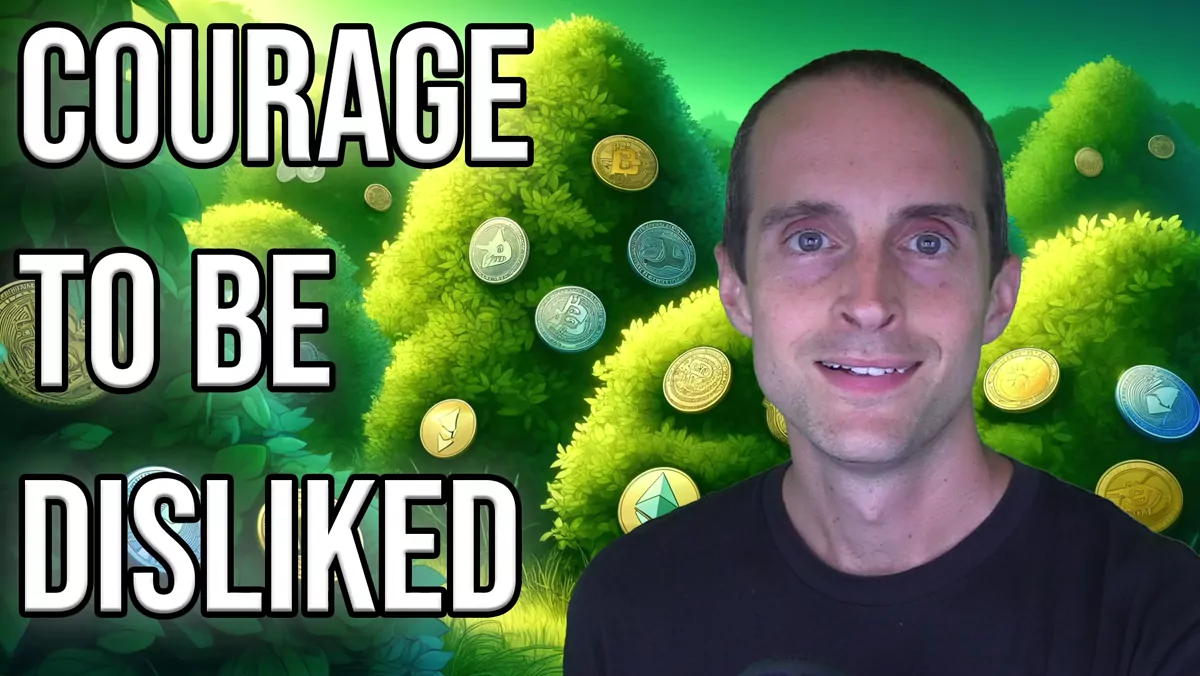
I no longer make crypto videos about what to buy, and I regret most of the ones I made. For roughly two years I promoted coins I had doubts about, and some I believed were junk, because the hype brought views and the views brought money. If you came here because you want to understand how crypto influencers operate, or because you feel burned by one, this page is my full account, and the posts below it are the record.
The short answer to why I did it is that crypto content is rewarded for approval, not accuracy. In The Courage to Be Disliked in Crypto, written in May 2024, I said that nearly every video I made was a search for approval, and that a video about the price got the most views while teaching the least. That is where my view has landed: I only want to make videos that will still be worth watching ten years from now, and I will not film one unless I am 90 percent confident it will matter that long.
The earliest story is in How Crypto Made Me Feel Like the Villain, an excerpt from my memoir. I made hundreds of thousands of dollars promoting different coins over about two years. My pattern was to make videos saying I was all in, then sell and make another video saying the coin sucked and I had been wrong. The hype pushed prices up, and when I got out, I moved on to the next one. Steem was the one I stuck with for a year. I hyped it as the next Bitcoin, and I later saw in the team's transactions that they were dumping millions of dollars' worth into every promotion push. The price fell to under 5 percent of its high, and some of my followers rode it to near zero.
The second story, in How I Hyped Crypto I Knew Was Junk, is about my return. In December 2022 I launched a new crypto channel, and within three months it had tens of thousands of subscribers. The method was simple. Every day I bought $50 of a cryptocurrency and hyped it, saying things like "this one is going to 10X." When I made a price-surge prediction with a high price on the thumbnail, bot networks would swarm it, and real people would follow. The industry calls the most effective approach community farming: rotate through communities and tell each one its coin is about to explode.
The pattern that bothered me most was how people reacted when I was honest. When I criticized a coin, the algorithm buried my video and viewers turned on me. When I made the same price prediction again, it got traction. The more genuinely helpful information I put out, the less people wanted to watch it. I also saw other crypto YouTubers do the same thing. One I knew was offered more than $100,000 to promote a token I considered a scam. I told him so. He promoted it anyway and avoided talking to me for months.
The 2024 video is where I named the problem. I wrote that I had been a complete part of this, so I was not pointing fingers. I went back over the last couple of years of my videos and found that in nearly every one I was seeking approval. Almost all of my crypto videos, I noticed, were watched only in the first 24 to 48 hours. So I stopped making them for the views.
The decision had consequences. I stopped covering new apps and new coins, and I stopped chasing the news on the Internet Computer. Other creators already cover ICP developments every week, and I did not want to compete with them. I also said my ICP research is done, so I am content to wait. I said I was taking this approach across all eight of my YouTube channels.
The lesson I took from all of this is that approval never satisfies. In the 2024 video I wrote that no matter how many views, coins, or sponsorships a creator has, it is never enough, . I now try to make videos because they need to be said, the same way I do the dishes at home because they need doing. Use that standard when you watch anyone else, including me.
Below this opening you will find a contents list and then the three posts in full, newest first. For the research side of this, read how to research a crypto before you buy, and for the tactics I have seen other creators use, see every critique I have made of crypto YouTubers.
If you are holding a coin because someone online told you to, you can get a personal video review from me at https://jerrybanfield.com/review/.
On this page
Every post I have written on this subject is below in full, newest first, each under its own heading.
- How Crypto Made Me Feel Like the Villain (October 30, 2025)
- How I Hyped Crypto I Knew Was Junk (October 30, 2025)
- The Courage to Be Disliked in Crypto (May 3, 2024)
How Crypto Made Me Feel Like the Villain
Originally published October 30, 2025.
This is an excerpt from my memoir, I Was Famous on the Internet — my honest story of 14 years of internet fame and what it really cost, and why I deleted it all to choose real life.
Reborn in Crypto
After testing more than a hundred ways to make money online and a wide variety of content, I found that crypto videos on YouTube, Facebook, and Twitter were the best opportunity moving forward. I threw myself into crypto with the same mindset I had as an instructor: I wanted to win, to be number one, to maximize sales. I made hundreds of thousands of dollars promoting different coins over the next two years. Whenever I thought it was the right time to buy, I made videos hyping them up and saying I was all in. Then, when I decided it was time to sell, I would make another video saying the coin sucked, that I had been wrong, and I was getting out. The hype raised prices, and when I exited, I moved on to the next one.
Steem was the one crypto I stuck with for a year. That’s when I saw, once again, the same ugly truth I had seen at the top of other industries. At a high enough level, integrity disappeared. It was all about paying people off, bribing influencers and insiders to do what you wanted, while insiders keep this activity hidden from the public. I made waves in the crypto world by being flagrant and open about what was really happening. I openly engaged in some of the same bribery that everyone else was doing behind the scenes. The very people who were doing the same or worse behind closed doors publicly roasted me because I exposed what they wanted to keep hidden. I became an easy scapegoat.
Finally, the ugliest truth hit me when I realized that core team behind Steem, Steemit Inc, was about to rug pull in the summer of 2018. I could see it in their transactions and I could feel it in my experiences meeting them in person. Every time I promoted Steem, the team dumped millions of dollars’ worth as the price pumped. They clearly didn’t believe in their own project. I eventually realized they were lying and cheating everyone. I called it out right before it collapsed and unlike Udemy, they had no ability to defend themselves from my criticisms.
Just months after hyping Steem as the next Bitcoin, the price began crashing to eventually less than 5% of what it had been at the high. Unfortunately, many of the people who followed me didn’t listen when I admitted I had been wrong and said I was selling everything. Some of my followers rode it all the way to near zero and lost tens of thousands of dollars hoping things would turn around. I even hooked one of the other top crypto influencers when the Steem price was at its highest and it looks like he lost millions of dollars just before getting arrested for promoting some serious crypto scams like BitConnect. Thinking through your own crypto convictions, instead of riding someone else's hype to the bottom, is a big part of what we talk about together inside the Jerry Banfield Family.
Crypto Collapse and the Failed Business Dream
An annoying thing happened after I sold all my crypto. For the first time, my integrity hit me so hard that I felt like I was a bad person. In the first years of creating online, I had convinced myself that I was a virtuous person trying to help everyone, and anything bad that happened to me was because I was the victim of other people’s greed and cruelty. With crypto, though, I saw that I had been the maker of the madness. I was the one who got people excited about these cryptos, and I was the one who led them into a trap where they ended up wrecked. This was before hardly anyone else was even talking about crypto on YouTube. I had been one of the very top crypto YouTubers, and in 2018 I quit after seeing how disgusting it all was.
That decision left me with nothing to do. I had already quit gaming in 2016 because I hated League of Legends so much and my viewers hated if I played any other game. I also felt like when I was gaming, I was wasting my time and not doing anything truly useful. For the first time, I had wondered what my life would be like without gaming. The energy I had once put into gaming went into crypto, and from there into music.
By 2018, after just a year and a half of making music, I had composed 70 different songs and was live streaming my music production on Twitch. I had previously found success there by building a following through video games like League of Legends, but my music streams were absolutely dead. I went back to gaming in June 2018 after seeing that Facebook was launching a gaming platform with the hope that maybe this time I could achieve my dream of being a professional gamer.
At the same time, I was weighed down by guilt over everything I had done with crypto. I felt like such a loser, even though anyone looking at my bank statements and the money I had made would think my life was going great. On the inside, though, I was starting to feel the consequences of what I felt I had done to other people. Even though I had personally profited greatly and made sure what I was doing was 100% legal, others had lost a lot of money investing in cryptos I once promoted, and I felt bad about that. If you're carrying something similar — looking successful on paper but uneasy underneath — you're welcome to schedule a private one-on-one call with me to talk it through.
When you feel bad about yourself, you will often gravitate toward situations that punish you, which is exactly what I did. I came up with what I thought was a great business idea—to compete with Udemy and create my own version of it, where people could sell private label rights courses. My name for the platform was Uthena named after the Greek goddess Athena.
After years of earning hundreds of thousands of dollars in profit each with my business, I had credit cards limits into the hundreds of thousands of dollars too and access to business loans for the same amounts. Just six years earlier, I had went off on my ex-wife because she was paying a few dollars a month of credit card interest on one of her cards. Apparently, I forgot all about this while I rationalized that if I wanted to earn big, I needed to be ambitious and spend big. I spent all the cash I had to hire freelancers to make online courses for me, just like the ones I had created on Udemy.
In creating my own platform, I saw how Udemy had exploited me as an instructor. I had brought so much value to them, and they had kept most of it. I was left with nothing, while all the people who discovered Udemy because of me were spending money with them instead of me. These realizations were my first awakening to what an exploitive environment the online world really is. I felt like I was nothing more than a prostitute working for a pimp on the corner—easily disposable whenever they didn’t need me anymore, whenever I didn’t produce what they wanted, or whenever I pissed them off.
I Deleted My Studio
By the fall of 2019, for the first time, I realized I hated my online business and wanted to do something in person instead. I had just quit gaming for the second time after a year of reclaiming my very enthusiastic audience on Facebook Gaming. Back in 2016, I had become one of the biggest gamers on Facebook—probably the number one gamer on the entire platform before I quit. At that time and all the way through 2019, it was incredibly difficult to monetize a following on Facebook gaming. Hardly anyone donated to streamers and there were no ads available to run on my live videos. It was almost impossible to get people to pay me for playing games, because many still had the sanity to see that tipping a guy just for playing video games didn’t really make sense. After quitting for a year and a half at the end of 2016, I had started up again for a year in 2018 and quit again in the summer of 2019 because of a lack of financial support and a desire to focus on my Udemy competitor. At this point, what was about to happen would seem unlikely based on what I’ve told you so far.
In December of 2019, after visiting a bankruptcy attorney and realizing I didn’t want my life story to include declaring bankruptcy, my first thought was to grind and hustle my way forward by creating online courses again, just without Udemy and without paying anyone else to make them. I cranked out a whole bunch of new courses in just a few months, but the effort burned me out severely.
By May 2020, I said to myself, this is it, I’m done. I had accumulated a studio packed with tens of thousands of dollars’ worth of computers, lights, cameras, and equipment. I dumped all of it for just a few thousand dollars locally on Facebook Marketplace. Meanwhile, everybody else was trying to get into the very thing I was walking away from.
In June 2020, I launched an in-person show less than a year after my first attempt to start an in person show led to an empty room. For a little while, I felt like I had clarity. I could see the world going insane, and it seemed obvious that moving everything online was exactly the wrong approach. I looked at all the stuff I had done online and saw it as a trap, a trick, where I had been used and discarded. The millions of followers I had meant nothing. It was easy for me to make no money at all, even with millions of people supposedly interested in what I created. There was no stability in it. I couldn’t depend on my following for income unless I constantly extracted from them by selling things like online courses, which I was exhausted from doing. On top of that, I felt guilty for how much I had already extracted through crypto, and that guilt made it nearly impossible to even sell to the people who still wanted to buy.
The brutal reality was that my in-person show in 2020 sucked. It was basically a YouTube video filmed in front of a live audience of around 20 people where I just talked, but I never really connected with anyone. I made no attempt to get participation from the audience outside of laughter. The more shows I did, the more people stopped coming. They realized they could just watch a video and have the same experience.
After just a few months of insisting I was never coming back online, I hit another low point. I had multiple shows where not a single person showed up, despite all my best online marketing efforts—running ads, posting videos, announcing I’d be live at a certain place. Nothing worked. I had millions of followers, but they were scattered around the world, and only a handful lived in St. Petersburg, Florida. The algorithms did a terrible job of reaching the people near me. Almost everyone who came to my shows was someone I had invited manually via text or Facebook message. All the videos and ads I put out locally did almost nothing to get people to show up in real life, although I do remember one or two people that came from ads.
Looking back, the biggest mistake I made in 2020 was that I didn’t delete anything. I left all those accounts with millions of followers sitting there. In the back of my mind, I knew that all I had to do was start posting again and maybe something would happen. Out of desperation, I did a Facebook live stream in August 2020, asking my followers what I should do with myself. The people who had missed my gaming streams for the past year begged me to come back and start streaming again.
My followers planted the idea that if I came back to gaming this time would be different. I remember the exact moment I could see what was coming if I went back into live streaming on Facebook. I was jumping on the trampoline in my house during a workout. In August 2020, I had no gaming systems, no PC, no cameras, no equipment—just one 5 year old laptop and barely enough money to make my minimum payments. I had not actually played any video games for a year and had told my ex-wife I was done for good the year before.
At the peak euphoria of the trampoline workout listening to some dance music, I had this clear vision: Call of Duty: Warzone was blowing up and if I played Warzone, I could finally become a professional gamer. The audience was there, the timing was right, and my dream was ready to become reality if I took the leap of faith which seemed large given my current life situation. I didn’t spend a single thought on what consequences that might be for anyone else. My mind was consumed only with the possibility of glory, fame, and money. After years of wishing I could be a professional gamer, after years of building an audience but making hardly any money from it, I felt like my chance had finally come to play a game I enjoyed and be financially supported in doing so.
If you connect with how I live and think, you can follow the rest of my days on YouTube in my Crypto Reviews playlist.
How I Hyped Crypto I Knew Was Junk
Originally published October 30, 2025.
This is an excerpt from my memoir, I Was Famous on the Internet — my honest story of 14 years of internet fame and what it really cost, and why I deleted it all to choose real life.
Realizing I Was No Different Than My Kids
I look at how powerful this effect is on children and how directly it shows up in their lives. After a year of watching how much better my kids’ lives became without devices, I kept rationalizing my own use. I told myself that I was an adult, so it was different for me. I justified playing video games because I did it for “work.” I rationalized making videos online the same way I rationalized that, as a grown-up, I had the right to do things I don’t actually engage in—alcohol, smoking, gambling. I put video games and content creation into that same mental category, telling myself I was responsible enough to handle it.
It was humbling to realize I wasn’t any better than the kids. The technology was ruining my life just as much as it was ruining theirs. The worst part was that I defended and rationalized it every single day. I listened to my mind tell me I was a tech slave, walking into my office, uploading videos, convincing myself it was meaningful. Yes, I made thousands of dollars, sometimes tens of thousands of dollars a month doing it. Yet was it satisfying? No. I felt drained after filming videos. Was my content good for people? I told myself it was, but deep down I noticed a painful truth: the more I put out information that was genuinely helpful, the less people wanted to watch it. The algorithms didn’t seem to push it either.
Real Learning, No Thanks!
I saw a huge divide between content that was genuinely useful—high-quality learning, true information—and the junk people consumed endlessly. One YouTuber with hundreds of thousands of subscribers and millions of views told me he thought his viewers were idiots. He even put things like “Hey, stupid” in his titles and thumbnails. When we talked, he said his viewers didn’t want to learn, didn’t want to think, and didn’t want to be educated. All they wanted was for him to tell them exactly what to do.
At the time, I resisted that line of thought. I didn’t want to believe it. Yet when I looked at my own results, I saw the same pattern. When I made videos titled “I Bought Some Shitcoin Today – I’ll Be a Crypto Millionaire Soon!” the views poured in. When I made videos teaching people how to do their own research, almost nobody was interested. The reality was jarring: people online aren’t looking to be empowered, and the system doesn’t reward empowering content.
If I put out content confirming people’s existing beliefs, the views would come rolling in. Whenever I promised that an investment was going to rise in value, people loved it. I could make the same basic video every single day, predicting the price of a certain cryptocurrency, and it would consistently get traction. The moment I criticized a coin or said something negative, though, people went off the rails. The reaction was extreme, like I had attacked them personally. When I tried to share genuine concern and point out that a lot of the information they were getting wasn’t good, the algorithm buried my video, and viewers turned on me, hating and unfollowing. What it felt like was that people wanted to be told exactly what to do, to have their preexisting beliefs reinforced, and nothing more. The audience didn’t support anything outside of that, and neither did the algorithms. Getting out of that trap and learning to think through crypto for yourself, instead of waiting to be told what to buy, is exactly the kind of thing we can dig into together when you schedule a one-on-one call with me.
I started noticing something even darker. There were massive networks of bots that pushed certain kinds of videos. If I made a video predicting a price surge for a particular shitcoin and put a high price on the thumbnail, the bots would swarm. That push from bots would bring in real people, who would then subscribe. As long as I kept saying that shitcoin was great and going up, the bots pushed again, real people watched, and the cycle repeated. In December 2022, I launched a new crypto channel on YouTube and quickly gained tens of thousands of subscribers within three months by following that exact strategy.
Every day I bought $50 worth of a cryptocurrency and hyped it up in a video. I’d say things like, “This one is going to 10X,” or, “This dollar coin could hit ten dollars, fifty dollars, even a hundred.” I noticed some cryptos had whole armies of bots backing them, and if I mentioned those, the bots lifted me. Others had massive organic cult followings, and the same thing happened if I reinforced their optimism. Then there were cryptos with no money, no community, and no push — those videos went nowhere. The most effective strategy was what the industry calls “community farming.” All I had to do was rotate through communities, saying each coin was about to explode. That’s how I grew my channel so quickly.
Many of the so-called successful crypto YouTubers do the same thing. They say exactly what their audience wants to hear, rake in subscribers, and then move on to the really big deals. Once your audience is large enough, projects start offering serious money to get promoted. One YouTuber I knew told me he was offered over $100,000 to promote a coin. He asked my opinion, and I told him straight — in my eyes the token was absolute garbage, a scam, and everyone who bought in was going to lose. He promoted it anyway, because the money was too good to turn down and avoided talking to me for months while he did so. His logic was simple: if people were dumb enough to lose money on it, that was their problem. That logic seemed to dominate behind the scenes. Publicly, influencers would never say it, though sometimes it slipped through, but privately the consensus was clear. Most of the viewers were ignorant, broke, fools being farmed for their time and money. As I see it now, this applies across all types of content and 99% of viewer behavior.
The Illusion of Online Success
I know how quickly the mind jumps to defend itself with examples that sound positive. You might say, “Jerry, I saw something on Instagram today that really inspired me,” or, “I watched a video on YouTube and learned something valuable.” That’s fair. I’ve learned plenty of useful things from videos online too. At one point, I even took a free course that claimed it would teach me how to make $1,000 a day on Udemy which I was able to do myself although the instructor struck me as a liar and a fraud.
His main system revolved around stealing content from North Korea, uploading it to YouTube, and monetizing it through a faceless channel. He admitted this strategy openly in the YouTube course although I imagine most students did not see through how sketchy it was. Since North Korea wasn’t likely to enforce copyright claims, he could get away with theft and claim he was making passive income. From my perspective, he never showed a shred of real proof that he earned what he bragged about and his system was not something easily replicated. Still, he managed to sell millions of dollars’ worth of his “YouTube success” course thanks to Udemy promoting it all over the place for him.
He leveraged his success in that YouTube course to create a course on how he made $1,000 a day on Udemy which I got with a free coupon when he launched it in the Udemy studio Facebook group. I believed that with my hustle and my good looks, I could double or triple what he was doing which is exactly what I did. I used a different kind of hustle built on my knowledge of online marketing and freelancing.
Instead of stealing content like he was, I hired freelancers in developing countries, paid them thousands of dollars to produce entire courses, and had them sign over full copyright ownership to me as a part of their work agreement. Then, I used my YouTube marketing and advertising knowledge to sell millions of dollars’ worth of those courses by sharing free previews containing just under half of the full course. With all the sales I generated, my courses dominated several huge areas on Udemy like hacking, marketing, and operating systems.
When I started to make more money than the instructor whose course I had taken, I started showing everyone exactly how I did it because I was proud and wanted to double down on my winnings to become the top instructor. On the outside, it looked like huge success with me showing screenshots making thousands of dollars a day in profit on Udemy. Yet the deeper question haunted me: what about the end user? This is the question almost nobody asks in content creation. Was it good for the average person—the mom sitting at the park, watching my gaming livestream on her phone while her kids ran around? Was it good for the grandmother searching for crypto information, only to land on videos artificially boosted by bots and designed to prey on her lack of technical knowledge? What it good for someone searching how to learn hacking to find my online course and then spend hundreds of dollars on Udemy courses that they mostly never watched a single video in?
What’s worse is how these platforms sabotage you in ways you don’t always see. The obvious ones are clear enough—spending hours watching someone else play video games you don’t even play yourself, or sitting through crypto hype videos that from my perspective were often based on lies and bribery. What isn’t as obvious is how supposedly “helpful” content, like Instagram clips about self-improvement or YouTube gurus teaching men how to live, also drags you down. If you feel that same drag and want to talk privately about your own relationship with these platforms, you can book a private call with me and bring it to our call.
For me, I’ve become so sensitive that even a little time on these platforms leaves me feeling depressed. It seems like many others are feeling that same anxiety and depression too. What might look good in the moment—an hour of scrolling or watching—doesn’t hold up when you separate it out from the rest of your life. The worst part is that you do not see how consuming all this content online sabotages your most meaningful real-life interactions. Let me give you an example that has taken me two decades to understand.
If you connect with how I live and think, you can follow the rest of my days on YouTube in my Crypto Reviews playlist.
The Courage to Be Disliked in Crypto
From my video published May 3, 2024.
I'm grateful I'm one of the few people in crypto who has the courage to be disliked, and I'm going to double down on that today, because this is what we really need in crypto. I'm reading a book called The Courage to Be Disliked, which has been extremely helpful for me, because many of us are hooked on what's called approval seeking. In content creation, especially in crypto, this is very toxic, because it results in a whole bunch of crypto videos where almost all of us as creators are just trying to make videos you'll click on, watch, like, and subscribe to. And that often means we're not saying what you really need to hear.
Often the things we need to hear in life to truly change, to learn, and to grow are disagreeable, and they'll even leave the person saying them in a position to be disliked. Like 10 years ago, when my wife told me she was going to leave me if I didn't get sober. That was a very important thing for me to hear, and it took a lot of courage for her to say it and to face my dislike. In crypto, we need as many people as possible who are willing to put up videos that people don't click on, and willing to say things that people don't like.
Why approval seeking is so toxic in crypto
Right now, what most of crypto is — and I've been very much a complete part of it, so I'm not pointing fingers — comes from how we're raised. We're raised in school to do what we're told and get an A on a test, and then go to a job and do what we're told and we'll get a pay raise and a promotion. We're always raised to do what we're told. Well, this is a problem when you need debate. And in crypto, we need healthy debate. We need people to debate coins, to really get in and research. But on YouTube, that's not rewarded, and on Crypto X that's often not rewarded either. What's rewarded is the same thing we were trained for in school: doing what we're told and getting an A on the test.
People want to know, okay, you bought 50 of these coins — what do you really believe in? And I realized that what I was doing as a creator was working well for me personally. I'd make a video saying I bought this many of this different altcoin, and then I'd get all these likes and views on it. But as an actual investor, in my experience, if you followed what I was saying, it was working very poorly. I'm grateful I had the courage to be disliked about a year ago and to stop doing that — something I went deeper on when I fired myself and quit crypto hype for real education. And today, I'm doubling down by being even more willing to put out videos where it's okay if they don't get clicked on.
The desperation to get the views up
I've found as a creator that every time I publish these crypto videos, there's just this desperation in me to get the views up. I've been doing that for a long time. And when YouTube tells me a video isn't getting as many views as usual, I just feel hurt. Then this desperation comes up to want to say anything — to put anything in the title, anything in the content of the video — to get you to click on it, to like it, to subscribe, and to keep coming back. And to me, as a creator, that's repulsive. As a viewer, I don't want to watch other people who do that. I want to watch people who are creating for the joy of creating, because it needs to be done.
I've often felt disgusted with myself as a creator. I recently looked back over the videos I made for the last couple of years, and the main problem I identified is that in nearly every video I put up, I was constantly seeking approval. I was constantly looking for views on it — even the videos I put up that were critical of other altcoins. I was still seeking approval, the instant gratification of putting up a video and having it get views. Even if people dislike it, at least it gets watched. When you're a creator, there are really only two states: people watching you or people not watching you. And not watching you is its own kind of dislike.
What I see is that the one thing I can do is really lean into sharing what I need to share as a creator, versus sharing anything just to get you to click on a video. That is such a huge difference. It's a really important difference. It's all the difference in the world, because I can't stand giving out the same crap. It's ridiculous how anytime I put out a video talking about the price, I get so many views, so much approval. And yet I look back, and all those videos I did were a waste of time.
Only making evergreen videos from now on
After 13 years and thousands and thousands of videos on YouTube — most of which I've deleted, because they're no longer watchable today — I don't want to look back 10 years from now and find I just went down the path of constantly seeking approval, over and over, with every one of my videos, and then have almost nothing I'm proud of to show for it. I went into this more in why I deleted 500 crypto videos from YouTube. So starting today, as I'm filming this, I'm only filming videos that are evergreen — that will still be worth watching 10-plus years from now. I won't film a video unless I'm 90% confident that, 10-plus years from now, that video will still be just as relevant to you as the viewer as it is today.
I've noticed as a consumer of content that a lot of what I watch was created 3, 5, 10-plus years ago. I'm listening to Deadmau5 songs he made 12-plus years ago, and listening to audiobooks that were written sometimes 100 years ago. And as a creator, I'm disgusted with all the videos I've made that there's just no point in watching today. Who cares about watching some crypto video from 2017 that was talking about current events? Yes, there's a very, very limited historical interest in old crypto content. But I've put up the videos and I've seen the data: almost none of my crypto videos get watched after the first 24 to 48 hours. So going forward, I'm only making videos where it doesn't really matter how many people watch them when they come out, because you can keep watching them indefinitely.
I know some of you aren't going to like that. Some of you want me to talk about things that are extremely relevant right now. You want me to cover new apps, new coins, and new things happening on ICP. And I'm not going to do that anymore, because that's not what's needed from me.
Why I'm not chasing what's happening right now on ICP
I look around at the collective — blockchain pill, Bobby O, Cityscape — and they're doing a great job putting out Internet Computer videos that are relevant, talking about exactly what's happening right now. I don't feel my contribution is needed there, because there are other people doing essentially the same thing, and I don't want to compete anymore. If you want to see what happened this week on Internet Computer Protocol, blockchain pill does a video every week covering the major things that happened. I only want to give information that's good indefinitely. You can find the ICP videos I've made in that spirit in my ICP Crypto playlist.
I've been trying to do this over and over, back and forth. Every time I've tried to give out more quality crypto investing information, and the YouTube analytics immediately after release didn't look good, I've consistently gone right back to instant gratification. It's important, both as an investor and as a creator, to stop focusing on instant gratification. In my experience, this is one of the main things that sabotaged my crypto investing in the past: by consuming all these short-term, what-is-happening-right-now videos, you get impatient. Whereas I've done enough research on Internet Computer Protocol that, in my opinion, all I need to do now is just wait. The research is done, everything's in position, and I think it's unlikely anything is going to come up that really changes my picture of it. Yes, I'm still reading and listening to what's new. But I want a crypto channel where, 10 years from now, the people who come to it are still interested in what I said now. That means filming completely different kinds of videos. And it means being okay that if all you want is instant gratification — this-is-what's-happening-now price talk — I'm not having that anymore. What's important is to make sure you're giving what you really need to give.
Why approval seeking never satisfies
If you're thinking, well, why is approval seeking such a problem — what does it matter? We've been programmed so hard to just do what we're told, submit to authority, and please people in positions of power. Even with God — to live your life for God so that God approves of you. But to me, the real God is love, and it doesn't matter what you do, you're loved equally. The challenge with approval seeking is that you'll often find that no matter how much approval you get, you'll be unsatisfied. That's been a huge issue for me. And it's clearly an issue for other crypto YouTubers too, where no matter how many views they get, no matter how many coins they have, no matter how many sponsorships they get, it's never enough. There's always another coin. There's the infinite grind of putting videos out, the same things over and over again, and there's just dissatisfaction underneath everything. I wrote more about that pattern in the huge lies crypto YouTubers are telling you.
So I want to create videos from a place of knowing I'm doing valuable work. When you know you're doing something valuable, you don't need praise for it. What happens for me is that when I don't get the views or the money I want from my crypto channels, I don't want to do them anymore — and that's the sign you're doing it for approval. I don't want to do crypto videos for approval. Many of the people you follow in crypto, if you stopped watching their videos and their metrics went down, would stop making videos. You can see how, in bear markets, lots of creators quit right before — because their views went down, their money went down, so they stopped making videos. What I'm paying attention to is making videos that feel good for me to make, because they need to be said and because they're relevant.
Doing the dishes: doing what needs to be done
If you want to put this in a very practical context, think of it this way. I do 30 minutes to an hour of dishes almost every day in my house. And I don't need anybody to say thank you for doing the dishes. They were there, they needed to be done. I don't want my wife to do them, because she has enough other stuff to do, and the kids aren't ready to do them yet. I do the dishes because they need to be done. I don't do them for anybody to thank me, or to appreciate or approve of me. I do them because I don't want a house full of messy dishes. So I don't need someone else's approval, congratulations, a pat on the back, or an award, because I'm doing what needs to be done. And when you're doing what needs to be done, you don't need other people to applaud you for it.
With the videos I'm creating each day, I'm seeing the absolute clearest thing I need to do is give what I see needs to be given — to give because it's the equivalent of doing the dishes. This is what needs to be talked about today in crypto: how almost all of crypto is an approval-seeking feedback loop, where almost everybody who's talking is just trying to get your approval and your attention. Almost everything being said is from that point of view. So if you're not consuming with that in mind, you're being misled very consistently.
What needs to be said in crypto today
I'm really proud today, because this is what I really wanted to talk about. And if people don't like it, that's okay. There are other people who will be desperate for you to like their videos, listen to what they say, and put the watch time in, and they'll do anything to say what you want to hear. But I don't care about saying what you want to hear. I care about saying what I need to say and share. I'm listening to all of you, and based on what I'm hearing from you, this is what needs to be said.
We need more creators who are willing to show up. Bobby O is a great example of this — show up, say whatever he has to say today, regardless of whether people like it or not. And I'm grateful that I'm leaning into that too. I'm very excited to take this approach across all eight of my YouTube channels now and see where it goes. If you enjoyed this, you can watch my newest crypto videos in my Crypto Reviews playlist.