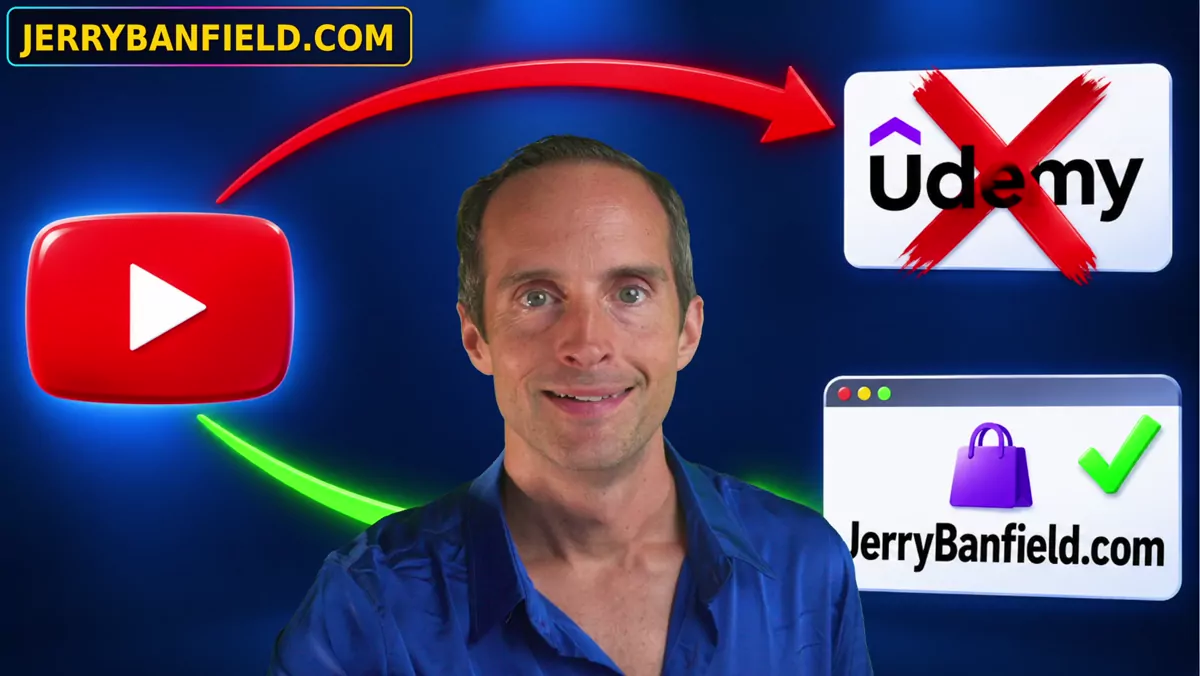
Udemy banned me in June 2016. I had made more than $600,000 on the platform in about two years and was one of its best-known instructors, so the ban hit hard. Looking back now, the ban was only part of the problem. The bigger mistake was that I sent nearly everyone I could reach to Udemy instead of to a site I owned, and when Udemy closed my account, my customers stayed behind with them.
Here is what I think about it now. Udemy was a real opportunity, and I would have been far better off treating it as one channel among several instead of the whole business. I was banned over a mix of things: incentivized reviews I paid for, and a co-instructor who complained after I added two hours of video to her course and promoted my other courses to her students. I was not blameless, but by my account I was also not treated fairly, and the Trust and Safety team had not asked me for my side before shutting the account down.
My view changed over time, and the posts show it. In my 2024 Udemy story I laid out the whole arc: a Facebook marketing course I gave away for free until Udemy featured it, a hacking course made by a freelancer I paid, Google ads on the Udemy search term, and a remarketing affiliate system. At that point I still treated the ban mainly as an injustice, and I wrote that I would never sell an online class again. In my 2025 memoir excerpt I was more candid about the review system and about how I reacted when Udemy's staff pushed back.
In my June 2026 video on what I would do differently, I stopped focusing on the platform and started focusing on my own behavior. The ideal approach would have been to take it easy: teach a few courses, publish steadily, and stop trying to be the number one instructor. The number one rule for me is fun. The pressure to keep selling courses is what made the work stop being fun.
The lesson I take most seriously is in my September 2026 video on the ban. Udemy kept my customers after the ban, and the same pattern repeated on Teachable, Thinkific, Steemit, Skillshare, StackCommerce and Facebook Gaming. Some of those platforms cut off my reach, some demonetized me, and some crashed or held onto my customer data. If I had sent people to jerrybanfield.com for those ten years, I estimate I would probably have tens of thousands a month coming in now. That is an estimate, not a number I can prove.
That is also why I am rebuilding my own site. jerrybanfield.com is becoming a store and community where my courses, coaching, comedy and games sit in one place, and where YouTube, TikTok, Facebook and X all send people. I am building it on the Internet Computer (ICP) because I want something that is reliable and hard to hack, not something I vibe coded on a tool that might break. This is a reversal of what I wrote in 2024. I now sell another course, hosted on Thinkific, and I plan to put all of my products in one store. The reason I changed my mind is the one above: I want the customer relationship to belong to me.
The posts below run newest first. The 2026 posts are the most current, and the 2024 story is the longest, with the most detail on how the courses were made and sold. If you want the story of why I stepped away from live streaming, read why I quit streaming. For the same lesson about owning my content, read why I keep tearing down my channels.
On this page
Every post I have written on this subject is below in full, newest first, each under its own heading.
- Udemy Banned Me. They Kept My Customers (September 25, 2026)
- What I'd Do Differently With Udemy, Facebook Gaming, and Crypto (June 17, 2026)
- How I Became a Top Udemy Instructor and Got Banned (October 30, 2025)
- My Udemy Story: From Top 10 Instructor to Banned (February 12, 2024)
Udemy Banned Me. They Kept My Customers
From my video published September 25, 2026.
In 2014, I found a new platform called Udemy for hosting video courses. Over the next two years, I would go on to make millions of dollars in sales on Udemy, and they would pay me over $600,000 for doing so. At the time, for a couple of years, it seemed like everything was going awesome. I'd finally solved my biggest problem: how to make money online.
I brought all kinds of people from YouTube to buy my Udemy courses. I went off on YouTube, and I had hundreds of thousands of subscribers. I had more than 50 courses on Udemy and hundreds of thousands of students. I gave out free coupons everywhere, all over the place on YouTube, and everywhere else on Facebook. I ran Facebook ads. I brought hundreds of thousands of people to sign up for Udemy.com for the very first time and to make their first purchase.
Everything was great from my point of view. I was following all of the policies. I was aware of every policy, and I was collaborating with other instructors. I was teaching people how to do what I was doing on Udemy.
The Email Out of the Blue
Then in June 2016, after zero policy violations all year, Udemy suddenly sent me an email out of the blue saying my account had been terminated. They didn't say anything publicly as to why. They gave me two reasons that felt arbitrary to me.
The first was that a small percentage, maybe three, four, or five percent of my reviews, came from questionable sources out of thousands of reviews. They said some of them came from Fiverr, and so I must be faking my reviews. I said no, people are selling free coupons to my course on Fiverr. Here are the actual gigs where people are selling my courses and then giving people a free coupon to them.
The other reason was that they said I had improper co-instructor relationships, because one woman complained after she invited me to join her course. I added two hours of video content to her two-hour course, so it became a four-hour course with each of us teaching half. I then sent a promotional announcement to all my courses promoting all my other courses, which included promoting her course to all my other students, the hundreds of thousands of students, via email. She then got 50% of the sales from that. And she complained that I had tricked her, and that I was just using her tiny little amount of students on her course to try and promote my other courses to.
From my point of view, Udemy wanted to ban me at that point anyway, because I was a big voice on the platform, probably the biggest voice. I believe the people on the Trust and Safety team were jealous of me showing how I was earning $80,000 to $90,000 a month, basically their whole salary in a single month. I developed a bunch of haters from people being jealous and taking shots at me. So Udemy banned me.
The Same Mistake for a Decade
But the reason I'm telling this story is because content creators are consistently making the same mistake I made on Udemy, and I kept making that same mistake again after Udemy for the next decade. For the first time ever, I'm finally able to stop what I experienced as this awful pimping of me out as a content creator. I was able to get traffic back in a day on YouTube, and I still am.
What I would do is, instead of sending people to jerrybanfield.com, which I owned, I would send people to Udemy. I would send them to Udemy.com because I was depending on them for a positive reinforcement loop. I'd get traffic by putting up free previews of my courses on YouTube and advertising them. Then I'd send those people to Udemy.com, where they'd buy my video courses. And the more my courses sold from my YouTube viewers, the more my courses would generate additional sales on Udemy.
It seemed like the perfect positive reinforcement loop at the time, because I didn't have that loop on my own website. If I sent somebody from YouTube over to my own website using some platform like Thinkific or Kajabi, or Teachable (I don't even know if they all had those back then), then I wouldn't have that positive reinforcement loop where I'd get more buyers because of the platform itself.
So I focused so much on the fact that I could make much more money in the short term by sending people to Udemy. Never mind that I couldn't practically sell the courses for higher than $10 on Udemy, and I was so frustrated by that. I was so focused on it. I had Google remarketing ads and an affiliate program. In the short term, I was making big money selling on Udemy, much more than I would have made on jerrybanfield.com.
And I tested it. It was much harder to make sales on my own website than it was on Udemy, because they're the ones that had venture capital funding, a very professional interface, a thriving marketplace, and a bunch of customers. That made people trust them. And the more my courses sold, the more they ranked in Google search and got found organically too. So Udemy, in the short term, seemed like a great idea at the time, especially when I was getting $80,000 to $90,000 a month paychecks, and generating hundreds and hundreds of thousands of dollars in sales on the Udemy platform to get those paychecks.
They Kept All My Customers
But then when they banned me, they kept all my customers, and I got nothing. For 10 years now, all my customers, all the people who found Udemy for the first time because of my YouTube videos, are still there, unless they opted out or closed their account, which I'd guess 99% of them didn't. They're still sitting there, adding value to the company at Udemy. At least some of the ones I've talked to went on to spend thousands and thousands more dollars with other instructors on Udemy, some of whom Udemy probably banned too and kept the customers anyway.
So in my experience, I got pimped out by Udemy. Even though in the short term it seemed like a good deal, over the long term I realized I should have sent people to jerrybanfield.com.
But I kept making this mistake again, because 10 years ago it was too difficult to build out your own course hosting platform. I tried building out my own version of Udemy called Uthena. That didn't work well, because having something kind of like Udemy meant trying to pay tens of thousands of dollars to get it professional, pay for the higher hosting, pay to get courses, and promote it. It didn't work as well, being impersonal, when it didn't have giant venture capital funding behind it. I also tried just my website, jerrybanfield.com, but in the short term the sales were so much smaller, and the user experience sucked compared to having something better.
Everywhere I Sent People Instead
I couldn't find a solution I was happy with. I tried Teachable. I tried Thinkific. I tried building my own version of Udemy called Uthena with a higher-level Thinkific plan. I tried sending people to Amazon Video On Demand. There are so many places I've tried sending people over the last 10 years.
I went all in on a crypto called Steem, and I sent everybody to my Steemit blog for a year. Then, from my experience, the team rug pulled the token and crashed the whole platform. I sent people over to watch me on Twitch, hardly made any revenue from that, and wasted a ton of time. I sent people over to my Uthena platform, and I was getting some good sales there, but I tried to make it too much like Udemy instead of just Jerry Banfield. It was mostly Jerry Banfield stuff that sold, and I thought, why am I putting all this effort into these other instructors and their courses when I mainly sell my own stuff?
Then I tried other course platforms, putting stuff on Skillshare. That was a giant waste of time. With StackCommerce, I missed some of the best opportunities. Then I got so frustrated that I deleted or quit doing my business online and started an in-person show. That didn't work. So then I got on Facebook Gaming, and I sent everybody from YouTube and everywhere else over to Facebook Gaming. Then Facebook Gaming demonetized me. So I focused back on YouTube.
Then I started selling another online course, hosted this time on Thinkific. But again, even though it's much more control, they still have all my customer data.
Content Scattered Into Oblivion
In the meantime, all my old videos have broken calls to action: old videos sending people to a Facebook Gaming page that I deleted, and to old courses that I don't have anymore. Now my content is scattered all over into oblivion. I have all these old Udemy courses that were filmed just for Udemy, and they don't work very well on another platform because I talk about Udemy and show the Udemy interface so much. All this time was wasted creating content that was easy to take down or that got stuck when I switched away from the platform.
I had hundreds of thousands of subscribers on YouTube, and I sent them all over the place all the time. So then they got burnt out, and they didn't even know where to go. They stopped watching. They felt like YouTube was just a means for me to get them out and send them somewhere else. My YouTube channels went down.
Then I got into the crypto ICP. I sent everybody to the ICP token, ICP token. People were buying the ICP token. Then I was promoting projects on ICP, and from my point of view, a lot of these other projects were ripping off all my viewers.
A Consistent Pattern for 10 Years
I see a consistent pattern for 10 years. I've been generating an audience and attention. I've been delivering huge value. YouTube gives me about half of the ad revenue it generates and keeps full control over the platform. So far, YouTube has been the best out of any of the platforms about keeping me online over the years. And yet YouTube doesn't have the level of monetization I need to be a full-time creator.
I get hundreds of thousands of views every month, and people sent almost a thousand dollars in Super Chats in the last month. But I need about 10 grand a month to be a content creator living in St. Petersburg, Florida, as a single dad: to pay my taxes, to pay my rent, to get a massage once a week, and to buy groceries, and then to occasionally have a little bit of money left over for something else.
Once in the last 10 years, that something else has been the strip club. I did a live stream documenting that on my Jerry Banfield channel called I'm 200K in debt and I spent $2,200 in VIP. So occasionally there's a decision like that, and I was a hundred percent sober for it too. However, most of the time, my spending is what I think of as totally reasonable.
What If I Had Built My Website the Whole Time?
I stand here now thinking, man, 10 years ago it didn't seem like a good idea to send people to my website and to focus on that, because the income was so much smaller. But what if, for 10 years in a row, I had built and built and built my website and sent people to my website the whole time? What if I had only put my courses on my website and sent people there for the entire time? How much money would I be making every month now? I estimate I'd probably have tens of thousands a month coming into my website now if I had taken that strategy 10 years ago. This is the trap so many content creators get into.
The newest hot thing to send people to is Skool, but I don't trust Skool. I haven't been able to wholeheartedly promote Skool because I know Skool could be the next Udemy. I could very easily get banned off Skool, not even doing anything wrong.
Or Skool, the platform, could shut down, or anything else could happen. On Skool, I have to kind of play their game, form a community, and sell how they want me to sell. I can't really offer everything I want on Skool. For example, I want to offer very dark, crazy standup comedy. I can't put that on Skool because it risks getting my entire account banned. So I can't send everybody to my Skool. I can't do paid calls on Skool. I can't launch video games on Skool.
AI Finally Made It Possible
I'm so grateful that AI has now made it possible for me, as a solopreneur, to finally build my website up to do whatever I want. I needed this 10 years ago, but I've got it now, and that's what I'm doing.
Looking back at getting banned on Udemy 10 years ago, it's amazing. It almost didn't matter that I got banned on Udemy, because every other platform has essentially been the same way. Either the algorithm on that platform died and left all my viewers no longer seeing my videos, or I got demonetized but could stay on the platform.
The biggest mistake I've made as a creator for the last decade has been not having one platform that I send everybody to all the time, with everything I want on it. In the past, it was too expensive to set that up and to build out a custom solution. Although looking back now, I probably could have just spent several hundred thousand dollars to get jerrybanfield.com built up as an everything platform, and it would have been worth it in the long term.
In 2016, when I still had all that Udemy money coming in, what if, instead of spending it investing in cryptos and investing in a course platform for others, I had just put everybody, all the time, into one website? What if I had used all these content creation platforms, YouTube, TikTok, Facebook, to always send people to my website? Then I would be in an amazing position today. And that's what I'm doing going forward.
What's on jerrybanfield.com Now
AI now allows me to build my own website, and it's just amazing all the stuff that's on jerrybanfield.com now. This is just an initial basic build-out, but I've got thousands of blog posts on there. I've got a leaderboard for people who've spent money. I have Stripe payments. I've got crypto payments. I have AI games that I've made. I have a community chat. I have user profiles. I have affiliate marketing.
I'm in the process right now of scaling this up to where jerrybanfield.com is a full-fledged e-commerce social media platform with direct messages, notifications, physical products I can sell, digital products I can sell, and services I can sell. Instead of sending people to Skool, over to Acuity, and to Cameo, then trying to have people schedule a call on my website, and instead of sending people to Audible and Amazon, every single thing, all my courses, everything, will be in one single spot.
For the first time, I'm going to be able to have one single destination and promote it on YouTube, Instagram, TikTok, Facebook, and X. Every single platform will always send people to jerrybanfield.com. Then I can finally sell everything I have to sell: comedy, games, books, courses, coaching, community, tips, shirts, and anything else. My videos, outfits, experiences, anything I want to sell, I can put on there.
It's built on ICP, which, if you check out my Jerry Banfield Tech channel, is the essential piece of this. I'm not vibe coding this on Lovable or Replit, because that wouldn't be reliable for building something advanced in e-commerce, where everything needs to work, the backend needs to be perfect, and it can't be easily hackable.
Getting Off the Platforms That Keep Your Customers
I've realized one of the most valuable things I have to show other creators is how you can get off all these other platforms that, in my experience, are pimping you out, stealing from you, keeping your customers after they ban you, and doing anything they can to get you to send your audience directly to them. In the meantime, I believe you are very likely going to be left with nothing over the long term, like I was, as they use you and move on.
If you want help with this, jerrybanfield.com is there. I've got an email address sitting there now.
At some point, we're going to have a course up showing the essential technical details of how to do this.
In the meantime, I would just go schedule a call with me. Right now it's still on Acuity Scheduling, but I'm going to build this out so you can buy a Zoom call right on my website.
I'm really excited about this change. To me, this is the biggest change I've needed to make as a content creator. People are afraid of AI right now, and a lot of things are difficult. Content creation is hard right now, especially with all this AI content, but AI is also finally giving me the ability to make my content creation sustainable.
The Dream
In the ideal version of this, at some point, I will be able to create content only on jerrybanfield.com, and I won't need to make content anymore on YouTube, Facebook, X, or Instagram. I will just have such a big audience coming straight to my website that I can publish directly to my website with no third-party crap in the middle. That's the dream.
It's finally technically possible today, because of AI, for solopreneurs who don't have a whole bunch of money to spend to build up their own custom platform. If you're a creator working through the same questions, I share a lot more about this in my Content Creators playlist.
I invite you to go to jerrybanfield.com and keep an eye on it. I'm building heavily right now, and it's going to evolve a lot over the next few days. I invite you to follow me everywhere and join me on this journey.
What I'd Do Differently With Udemy, Facebook Gaming, and Crypto
From my video published June 17, 2026.
I had a big breakthrough today. I've been a YouTube creator for more than a decade, and I've also been on Udemy, on Facebook Gaming, and in crypto, and in all of those places I've had huge success. But at the same time, I've consistently felt like a failure. I've tried so hard and I've succeeded so much. I got to be a top 10 instructor on Udemy. I got to be a top 20 Facebook Gaming partner. I got to be one of the top YouTubers in the world for crypto. I've had so much success, and then it all just comes toppling down. It's so frustrating. I've been thinking, what do I learn from this? Because I keep feeling like it's all not enough, like I'm wasting my time, like I'm not doing anything useful, like everything is for nothing.
I was laying in bed thinking about all of this last night, and I remembered a video that Kobe Bryant did. Kobe said failure is not real, that it's just learning opportunities. So I asked myself, okay, what do I learn? What exactly do I take from all of my experiences? And what I came to is this: the ideal strategy for me with Udemy, Facebook, crypto, and everything else I've done, including gaming, would have been to just take it easy. Instead of over-optimizing, instead of going insane and feeling like I had to be the number one Udemy instructor, the number one crypto YouTuber, the number one Facebook Gaming partner, the ideal approach this whole time would have been to take it easy.
What "Take It Easy" Actually Means
What do I mean by that? When I got on Udemy, the ideal strategy for me would have been to just teach courses and put one out occasionally. We don't need to be a top Udemy instructor. We don't need to get first place. At the time, I was so concerned with trying to earn ten-plus thousand dollars a month, a thousand dollars a day. I told myself I needed to be the top Udemy instructor, dominate all the others, be this big important famous man. But look at me now: I got banned. And one of the reasons I got banned is that approach. I doubt I get banned if I'm not taking that insane, push-hard, dominate-everyone-else mindset.
Some of the things I did on Udemy came straight out of that mindset. I did incentivized reviews, where I'd pay people to review my courses. Udemy said they were cool with that at the time, but then they changed their mind. It poisoned my foundation on Udemy. By taking that do-anything-to-win approach, by obsessing over needing to win, needing to dominate, needing to be number one, I put all this time and energy into Udemy and I did make over 600,000 dollars there from 2014 to 2016. And then what happens? I get banned, and it's like I lose everything.
In the short term, I used to look at instructors who only made a couple of thousand a month on Udemy and think they were busters, that they were lame, that they sucked. I figured if you were actually good, you'd be cranking out all this money like me. But now a lot of the instructors who used to look up to me to learn how to do Udemy have out-earned me. They're the ones who have made much more money than I have. A lot of them never made as much as I did in a single month, but they did it for longer. They made money on Udemy for five, ten years. And I'm like, man, I need to take some lessons from that.
Consistency Over Domination
What I want for my business now is this: I don't need to dominate and be number one. What I want is to be consistent over a period of 5, 10, 15, 20 years. I don't want to constantly be trying to dominate and get first place. The cost of acting like that, the cost of over-optimizing, is that you lose everything or you get burnt out. With Udemy, I got banned. With crypto, I went all in and I got burnt out. I got burnt out doing crypto YouTube and I quit on my own. I sold everything and I quit.
If I had kept doing crypto YouTube, I'd by far be the number one crypto YouTuber, and I wouldn't even have had to do it every day. I wouldn't have had to grind it out. I literally could have just made a couple of crypto videos a week. Imagine if I had made a couple of crypto videos a week from 2014 until now. But in 2014 I was too obsessed with doing Udemy courses to focus on crypto. And then once I finally did get into crypto, I went all in on it. Again, I go all in. I get insane and I'm grinding out video after video. My audience that was there for gaming, for Udemy, for music got sick of me doing crypto, and I put my audience off by doing constant obsessive crypto videos for two years. Then I end up quitting crypto anyway for years. Then I'm all into music. Then I go all into gaming. Then I quit gaming and I'm trying to make a business.
A lot of people teach you to pick a niche, optimize, pick a niche, go all in. But the problem I've found with that approach is that what you really need to do is think about long-term sustainability in most areas of life. A lot of these motivational gurus say hustle harder, hustle more, hustle stronger, do more, do more. In my experience, that doesn't tend to work very well in the long term. Now I'm obsessive in a different way: I want to think about what's going to work long term. I keep being tempted to do short-term optimization. Hey, just play Warzone solos every day. But that's not fun. Just do crypto videos every day. But that's not fun. Just review cryptos and go all in on crypto. That's not fun. Just do music then. I don't want to just do music. I don't want to just do crypto.
The Never-Enough Mindset
Look at what I did with Facebook Gaming. I got banned from Facebook, demonetized from Facebook Gaming. Why did I get demonetized? Because I was constantly being as sensational as possible. I felt like I never had enough views, even though from almost anybody else's point of view I was really successful on Facebook Gaming. But for my obsessive, dominating self, it was never enough. I really want to get out of this never-enough mindset and have it be enough. I want it to be enough, and to just enjoy what I'm doing.
When I first started on Facebook Gaming, I was having fun. But then it got to be not fun as I obsessed over views and felt like it wasn't enough, as usual. Once it got to be not fun, everything went downhill from there. And the more it got to be not fun, the more I kept trying to get views and money. That's the optimization trap again. What if I just went forward and didn't optimize? The ideal scenario a decade ago is that I just make one Udemy course a month and I don't try to sell it hard. Instead, I made 10, 20, 30 courses, and I made 190,000 dollars in one month on Udemy. And then I was banned shortly after that, because I was obnoxious. I was everywhere. I was utterly dominant.
When you get that level of attention, you get higher scrutiny, you piss people off, you create resentment in people. The Udemy policy team sitting there hearing me brag about making almost 100,000 dollars in one month, when that's as much as they make in a whole year, sure, they have an incentive to shut me up and to come up with a policy violation. On Facebook Gaming, they didn't like what I was saying, and they chose to take it really negatively, not asking questions, just demonetizing me right away. Why did I keep ending up in those situations? Because I always felt like it's never enough. I never had enough Udemy sales. There were months I felt really good, like yeah, I'm crushing it, I'm making big money. But then the next month I'd feel like crap when it went back down.
Getting My Time Back
I was so obsessed with doing Udemy that I could hardly do anything else. I tried doing some Facebook Gaming streams a little bit, but I couldn't focus on them because I was absolutely obsessed with trying to get money on Udemy. But then, ironically, when I get banned from Udemy, it actually leaves me feeling better. It's like, dang, now I've got time. Now that I've been banned, I actually have time to do more, and it's really good. In some ways I'm so glad I got banned from Udemy, and I'm so glad I got demonetized on Facebook Gaming. But I don't want to go through that stuff again. From now on, I want to set things up to be ultra-sustainable, so that in the future I don't need to get banned to get my time back. I just want to be sustainable.
To me, the ideal scenario would have been to do Udemy but sell a course every month. Do Facebook Gaming but just do a few streams a month. Don't stress yourself out. Don't get all upset. You don't need to take over and be number one. Just do a few gaming streams a week. Do a few Udemy courses a month. Do a few crypto videos every week. Don't sweat it. Don't make it so everything you do is Udemy, or everything you do is Facebook Gaming, or everything you do is crypto. That's where I went wrong, and I'm still tempted to go wrong again, feeling so frustrated like I need to optimize everything.
I've come to believe that if I just stay consistent, have fun, and don't over-optimize anything, everything is going to go super well for me. Imagine over the next decade I do crypto videos, I do gaming live streams, I do music, I do motivational talks. I could even make an online course or a community if I want to. Imagine if over the next decade I don't have to deal with getting banned, or getting burned out again, or demonetized again.
The number one rule is fun
So that's where I'm at today. What do I actually need? I need to just enjoy where I'm at and not over-optimize. Enjoy where I'm at, have fun, and do whatever is fun every single day. To me, the number one rule is fun. When I look back at what went wrong on Udemy, the honest answer is that I stopped having fun. Creating online courses was a blast originally, but it stopped being fun the moment it turned into pressure. It became, "Hey, Rob's making more sales than you are, man. Come on, you need to get another course out, and another, and another." Suddenly there was no time to stream, no time to talk crypto, no time to do YouTube, and the only thing I was supposed to do on YouTube was sell courses. It stopped being fun the instant I started over-optimizing.
That's the pattern I keep noticing in myself. When all I did was Udemy courses, or all I did was Facebook Warzone streams, or all I did was retro games, I made the thing not fun anymore. So my lesson to myself is simple: stop making things not fun. And the way you do that, in my experience, is you stop optimizing.
Why optimizing usually backfires
The crazy thing about optimizing is that it's usually a short-term move dressed up as a long-term strategy. We tell ourselves, "Well, you just need to pick a niche. Pick a niche, optimize around that niche, and things are going to work out really well for you." But we rarely take the time to think it all the way through. If you commit to a single niche for ten years, are you actually going to still want to do that niche in ten years? Are you going to still want to make those videos a decade from now? A lot of the time, our optimization doesn't take the long-term consequences into account at all. It's optimized for this month and blind to the next ten years.
That's exactly why I want to remember this today: don't optimize again. Just have fun. Fun is all that really matters. If I can stick to having fun, things are going to go great. And if I can't have fun, then there's genuinely no point in optimizing, because optimizing without enjoyment just means I'm not enjoying my life. If I'm not enjoying my life, what is any of the optimization even for?
Freedom is the whole point
I know myself well enough at this point to say it plainly: I'm not going to have fun if I'm obsessed with optimizing. What I do have fun with is freedom. When I give myself freedom, that's when I enjoy this. One of the best parts about being a YouTuber, a streamer, whatever it is I am, is exactly that freedom. So one of the most important things I've come to believe I can't do is lock myself into one specific niche anymore. The thing I need to protect is sticking to having fun.
I'm really grateful for the chance to remember this message. I'm glad I haven't quit, no matter what's happened along the way, and I'm glad I'm still here. I want to keep reminding myself of this, and if you've found something similar in your own creative journey, I hope you'll help me remember it too. If you want to see more of how I think through this stuff, I share a lot of it in my YouTube Coaching playlist. Don't optimize. Just have fun.
How I Became a Top Udemy Instructor and Got Banned
Originally published October 30, 2025.
This is an excerpt from my memoir, I Was Famous on the Internet — my honest story of 14 years of internet fame and what it really cost, and why I deleted it all to choose real life.
Top 10 Udemy Instructor
Of course, I quickly discovered one of the harsh truths of online business. On Udemy, reviews were the biggest barrier to success because their poorly coded interface asked people to give both private and public feedback on a course. This led to a very low rate of reviews and made competing with existing courses insanely difficult even if your course was infinitely better. Giving away free coupons was an obvious strategy that often backfired because a lot of ungrateful people left one-star reviews, and competitors sometimes used the free coupons to sabotage my ratings and promote their courses in the reviews. I figured the only way to even the playing field was to offered incentivized reviews where I literally paid people to take my courses and leave a review. I thought I made it ethical by never telling them what rating to give.
When I asked Udemy’s team about my incentivized review system, they told me this was perfectly fine. They even pointed out that the top instructor on the platform was running a similar system and making tens of millions of dollars. With Udemy’s blessing on my incentivized review system, I’d launch new courses and immediately pay for 20 or 30 reviews within the first week. These reviews gave my new courses a huge boost in ranking and shredded all the competition.
I had no problems with this review system when I personally hired every freelancer and read every review. I eventually got too overworked and outsourced handling the paid reviews to a friend that I was paying $5,000 a month to help me with my online courses. While his work uploading my courses to StackCommerce singlehandledly returned me hundreds of thousands of dollars, his execution was sloppy managing the review freelancers. He hired people too fast and was not taking time to analyze their reviews resulting in obviously suspicious reviews filled with spelling errors and the same names across many courses. The competition I was destroying went through every review, screenshotted them, and reported me to Udemy. Unlike all the other top instructors, I was very open about what I was doing, and that openness turned into my downfall. Udemy chose to remove hundreds of my reviews including both reviews I had paid thousands of dollars for and hundreds of legitimate reviews from loyal followers that watched all my courses from free coupons.
From my perspective, the biggest mistake I made wasn’t the incentivized reviews themselves. If I had kept my mouth shut, everything would have been fine, but instead, I called Udemy out publicly for letting the top instructor cheat the review system on a far larger scale. He had ten times as many incentivized reviews as I did, yet none of them were removed despite a lecture in the very beginning of his course explaining how he would give students free web hosting for a year if they left a review on his course. I checked the course a month later and the free web hosting offer was gone. After I embarrassed Udemy publicly, their new trust and safety team privately made it clear they were coming for me even though I had zero policy violations.
That’s when I realized something important about the online world. Many rules aren’t designed to keep people safe or to ensure fairness. They’re designed to keep honest people from getting ahead. In fact, some rules seemed intentionally set up to be broken. Breaking them was proof that you were willing to do whatever it took to get to the top. The unspoken rule, though, was that you had to keep your cheating and rule breaking secret. You could never let the public see what you were doing. It was a harsh lesson, like something out of The Matrix. The rules weren’t there to be followed; they were there to be bent and broken.
After decades of video games focusing on being number one and doing anything to win, I took this mindset with me to Udemy despite their warnings. I pushed into every gray area I could find, although I was very careful to know every policy and never break one. For example, I joined Udemy’s affiliate program, put remarketing tags on my courses, and ran ads directly on keywords like “Udemy” in Google AdWords. That meant when you searched Udemy, you’d see an ad leading to my Udemy course link. When you clicked, I got a remarketing cookie, and from there I could run display ads following you everywhere online. The beauty of this setup was that if you bought any course on Udemy—whether it was mine or not—I got a percentage. I also built out my email marketing and created more courses than any other instructor. From December 2014 to June 2016, I made over $600,000 on Udemy in less than two years. Only a handful of instructors earned more than this during the same time period, and I was on my way to passing them all despite nothing but hostility from Udemy for the last year.
While I was on Udemy, I was consistently experimenting with other content such as live streaming games so that I could continue to expand my course offerings. I consistently sent people off Udemy to my YouTube channel and Facebook page to make sure if I was banned I could keep some of my audience. I would film long inspirational videos on YouTube and then blast them to hundreds of thousands of Udemy students. Then, I would experiment with all kinds of videos on my YouTube channel to see what stuck including a lot of gaming videos that viewers from Udemy mostly ignored. I had my studio setup to record my gameplay which I would then use to create highlight videos and upload to YouTube. One of the main games my friends wanted to play in 2016 was League of Legends even though I was terrible at it. If you would have told me at the beginning of 2016 I would be grinding League of Legends every day by the end of the year, I would have been horrified. Sorting out which of these constant content experiments are actually worth repeating is so much easier with someone doing it alongside you, so if you want that, you can book a private call with me and I'll share everything I've learned about it.
The League of Legends Coach
In the spring of 2016, I hired a League of Legends coach for what seemed like another throwaway experiment. Back then, almost nobody was paying for coaching. It was a niche idea, something only the most hardcore players considered. I found a coach who charged thirty euros for an hour session—an amount I could easily afford with my Udemy money. He was happy to get the work, and I figured it might make an interesting video.
I streamed the session live on YouTube without expecting anything unusual. I had done countless other gaming videos before, and most got the standard trickle of views. But this one was different. The title had a hook people hadn’t seen: “Can a Pro Coach Help Me Get Out of Bronze in League of Legends?” It combined a specific champion, the concept of professional coaching, and the relatability of being stuck in bronze rank. It clicked with people in a way none of my other videos had.
When I was live, nothing special happened. There were 2 to 5 viewers concurrently for most of the stream and less than 100 views when it ended. Over the next few weeks, YouTube slowly started scaling the video to more viewers. After a month or two, YouTube starting pushing the video hard resulting in tens of thousands of views a day. By then, I had given up on League of Legends as a game I would never been good at and that was not fun. Meanwhile, the video went on to earn 800,000+ views and millions of impressions. This single video on demand from my live stream built an entire League of Legends audience on YouTube without me doing anything.
The unintended side effect of that first video was on the coach himself. During the stream, his Skype account accidentally popped up on the screen. Almost immediately, he was bombarded with requests from viewers desperate for coaching. At first, he was angry that his privacy had been exposed. He didn’t even want to talk to me again. Later, when he realized just how much demand was out there, he saw the opportunity. By the time I asked him for another session months later, his rate had jumped to 300 euros an hour.
I refused to pay that much and instead hired another coach. I went back to League of Legends just for the views but the magic never repeated. I spent thousands of dollars on coaching and in game items while playing almost every day. A few videos did well—one even hit a hundred thousand views—but most only got a few thousand. Collectively, the new coach’s sessions might have added up to the numbers of that one viral hit, but it wasn’t the same. The views were scattered and inconsistent. There was no breakthrough, no second lightning strike. If your own views feel that scattered and you want help finding what's actually repeatable on your channel, you can set up a call with me and we'll dig into it together.
The truth is, even when those videos were doing well, I hated playing League of Legends. I had put hundreds of hours into it, and I still sucked at the game. Unlike Call of Duty, where I had real skill, or real-time strategy games, where I could hold my own, League of Legends felt like a constant uphill struggle. The mechanics never clicked, the grind frustrated me, and the matches left me feeling drained instead of excited. Yet here I was, building an entire audience around something I didn’t even enjoy. Millions of people watched me play a game I could barely stand. That contradiction ate away at me.
That coaching session taught me more than anything else about the fragility of success online. A single fluke—timing, title, novelty—can catapult you into the spotlight, but it doesn’t last. You can pour in ten times as much effort afterward and never see the same result. That was my story with League of Legends. One breakout video, and then a slow slide back into obscurity, all while forcing myself to keep playing a game I secretly hated. I ended up quitting gaming for the first time because I hated League of Legends so much … but before I talk more about that, first, we need to circle back to Udemy.
Banned and Confused
In June 2016, Udemy made a dumb ass policy change that prevented instructors from selling courses for under $10 which put the instructor community into a rage. I was one of the loudest critics and showed instructors how to sell free coupons on their own website for less to get around this idiotic policy. Meanwhile, I began helping instructors with shallow courses improve by having them add me as a co-instructor to their already published course. After they added me, I would add a minimum of 3 new video lectures and begin cross promoting all my courses together to hundreds of thousands of students resulting in more sales for everyone. It only took one butthurt and jealous co-instructor to complain to Udemy that I had tricked them into adding me onto their course just so I could send promotional announcements. This gave Udemy the exact ammunition they would use to take me down, especially when combined with my lambasting them over the $10 minimum price policy.
In the middle of June 2016, after not hearing from the trust and safety team for almost a year, I got an email suddenly banning my entire account for “severe” policy violations. The email specifically said they were banning me for two violations. One included statistics showing that less than 10% of my reviews had come from questionable sources such as Fiverr where people were selling access to free coupons to my courses. The other violation was for “improper co-instructor relationships.”
From my perspective, it was obvious bullshit. I had been extremely careful not to directly violate any policies. While I knew I was working in every gray area I could find, I was very intentional about not breaking the rules outright. The trust and safety team even admitted that the violation on the reviews was clearly ridiculous and easily explainable because I gave so many free coupons away. Even more ridiculous, the co-instructor that stabbed me in the back said she felt awful about the situation and would try to help fix it which reminded me of the kind of alcoholic that would steal your wallet and then help you look for it
Clearly, Udemy wanted me gone and they held all the power. Nothing had to be reasonable or justifiable. When they banned me, I was deeply hurt and shocked given how hard I was trying to follow all the official policies, and I had no violations. Any other instructor would have got a warning in this instance. The trust and safety team had not asked me one single question before banning my entire account despite me being the most well know instructor on the platform. Udemy’s actions outraged the instructor community which created the first time I got a taste of going viral.
I had been banned for being too open, too honest, and too much of a personality on their platform rather than for any real violation. Many other people saw this, and it was a brutal but eye-opening lesson. What I saw was that on these online platforms, the terms and conditions don’t matter. The team behind the scenes is all-powerful. They can and will do whatever they want. From what I’ve observed across many platforms since, many platforms allow certain insiders to blatantly violate the rules while punishing others who simply send messages they don’t like—even when those people don’t break the rules at all. Udemy was the first time I experienced this directly in my face, but it would not be the last.
After the Udemy ban, I felt lost, betrayed, guilty, remorseful, shameful, and resentful. I thought of suing them nearly every day but my ex-wife being an attorney finally talked me out of it saying that I would never win against a corporation with that level of funding and power. I experimented with everything I could online—gaming, live streaming, trying different hustles. The League of Legends stream was going viral right after I got banned from Udemy but the money streaming video games was nearly non-existent in 2016.
If you connect with how I live and think, you can follow the rest of my days on YouTube in my YouTube Coaching playlist.
My Udemy Story: From Top 10 Instructor to Banned
From my video published February 12, 2024.
I want to tell you how I became a top 10 Udemy instructor in 2015 and 2016, and then ended up getting banned from Udemy, which went viral and stirred up a lot of conversation. One of the most noteworthy things I've done in my time as an entrepreneur online has been my success on Udemy. It was my first big success, and it was the first story people really got to know at a big level about what I did. It's a huge part of my journey to be here with you today as a full-time creator. In order to tell my Udemy story, I need to put everything else in my life in context as well.
If you haven't heard of it, Udemy is a platform for online on-demand courses, where you can go buy an online class on almost anything and watch the videos. There are hundreds of thousands of instructors on there now. I was a top 10 instructor in 2015 and 2016 by the amount of money I was making for myself. My final revenue report showed I earned $663,378, and that's just my part. I made millions of dollars in sales on Udemy.
How I found Udemy on the Warrior Forum
Here's what's amazing. I discovered Udemy on the Warrior Forum back in 2013 when I was posting these video tutorials I was making on YouTube. I posted a video giving away my very best business secret for free. At the time, I was making most of my money online as an entrepreneur selling Facebook marketing and advertising services.
In 2011, I started a business online and started a YouTube channel. I got really inspired when I met my wife, and that inspiration pushed me to start making YouTube videos and to build a business. I tried to sell t-shirts, I tried to help people with video game addiction, I tried all kinds of stuff. Facebook marketing was the first thing I really latched onto, because so many people wanted help with it. Facebook had just launched the pages feature, and all these people were trying to get likes on their Facebook page, and nobody could figure out how to do it. I figured out how to do it.
At first, I was buying likes on Fiverr, but those were just bots. It was a terrible experience, and they were always lying and cheating you. So I, as far as I know, was one of the very first people in the world to figure out that if you really wanted cheap likes on your Facebook page, you would run ads in all these developing countries. These were really low-cost ads. My record, I think, was getting a thousand likes or more for a dollar directly through Facebook ads. I could prove that I was paying Facebook and they were showing the ads and driving the likes. I had this big breakthrough where I could guarantee people I could target them by specific country. I could get cheap likes in the USA by creating ads that people would hit the like on. My biggest business secret was using those Facebook ads and targeting all these developing countries.
I put out a YouTube video telling everybody exactly that. I did a live stream showing exactly how I did it. This destroyed my existing business, because as soon as all my previous clients saw it — some of whom had paid me thousands of dollars to guarantee them things like 100,000 likes on their Facebook page, which I could often get for less than half of what they paid me — they realized they didn't need me. I had always guaranteed it would all be through Facebook ads, and I could prove in their Facebook page analytics that it wasn't dirty Fiverr bot traffic. (Although Facebook itself appeared to be doing some kind of fraud with bots on their own ads, but that's a whole other Veritasium video.) I put my biggest business secret out for free on YouTube, and it destroyed my whole business system. I thought the transparency of showing my system would make people really want to work with me. Instead, it left people feeling they didn't need me and they could do it themselves.
So how does this relate back to Udemy? What happened was, I shared this on the Warrior Forum, and it went crazy. People were just blown away that somebody actually shared this hard-won secret directly, for free. The Warrior Forum shared and promoted my post, and the video got tens of thousands of views. It was the first successful piece of content I ever created on YouTube. I did several more follow-up live streams. Eventually, someone on the Warrior Forum said, "This is really good information, you should create a Udemy course." Or they asked, "Where can I buy your course to get the more in-depth material?" And I said, "I don't have a course. What do you mean, sell a course?" They said, "Well, go make a course on Udemy, I would buy it." That's how I originally found Udemy.
One of the biggest things in life is your attraction point, or what you're looking for. As an entrepreneur since 2011, I'm always looking for opportunities. More specifically, I'm looking for opportunities to be useful to other people. You have to be specific, because if you're just looking for opportunities to make money, some of those opportunities mean you rip people off and trick them out of their money. Other opportunities mean you provide something really useful and valuable, and then people reward you financially by buying your course or watching your video.
Giving the course away for free until it became the best
I found Udemy at the beginning of 2014, right when my dad died and I was in the middle of my alcoholism. I took 12 hours to make a Facebook marketing and advertising course. I filmed all the videos with a cheap microphone and a cheap webcam and uploaded them. Initially I tried to put a YouTube tutorial into Udemy, and they rejected that. So I took 12 hours in a single day to film an entire course for Udemy, and they approved that one. I was all excited, and I absolutely could not sell it. I was so extremely disappointed and disgusted. I ran Facebook ads, I showed my results, I mentioned it in YouTube videos. I made three sales in my first several months trying to sell my course.
At the same time, I got sober, which was a huge turning point where I decided to change my life for the better and do whatever it took to have a better life. My will to live came up. Right about that time, maybe April 2014, I got so disgusted with my inability to sell my Udemy course that I literally started giving it away for free. I created all kinds of free coupons, and almost nobody was even taking them. So I ran Facebook ads to my course with a free coupon link, and that worked. My course got thousands and thousands of students, but I made no money off of it at all. I started getting some reviews on the course, and some of them were critical. That gave me a clear view of exactly what people wanted me to add. I made the course better and better.
As I got sober, I wasn't poisoning myself with alcohol and losing 40 hours a week to either drinking or hangovers — or, when I wasn't drinking or hungover, cramming a week's worth of work into one or two sober days. All of a sudden, I had all this time and energy. I made the course way better, I was giving it away for free, and it kept getting all these reviews. Then, in June 2014, Udemy picked up the course because it had become the best Facebook marketing and advertising course on the platform. They put it in one of their promotions, which made me $1,000 in a single month in July 2014.
I was looking for opportunities, and my existing business had collapsed due to my alcoholism. I realized Udemy was where the future was going. If I would just commit to Udemy, I could make a full-time income there and wouldn't have to do anything else. I had never made $1,000 a month before. I'd put a ton of work in to get to that point, but once the course was up there and just cranking out that $1,000 a month with almost no additional work, I thought, "Oh my God, I was barely trying and I made $1,000 in a single month. I bet if I really tried, I could make over $10,000 a month."
From then forward in 2014, I dropped everything else I possibly could. I dropped clients and started cranking, putting more and more effort into the Facebook Udemy course. I created a couple of other courses. I had a month where sales went downhill and they stopped promoting my course. I'd made about $1,000 in July, about $1,200 in August, about $1,500 in September, then only about $600 in October, and then around $1,600 again. That motivated me to work even harder to get the course to the top of the game for the big Black Friday, November sales. I made thousands of dollars in November, and I thought, "I've made it. I've barely tried, I barely know what I'm doing, and if I can make thousands of dollars in a single month, all I have to do is go all in on this and I'll crush it." When I saw the final November sales, it was around $5,000 to $6,000. At the time, that was a fortune to me. (To make that now, I have some months where I make way more than that without doing anything, because the price of ICP goes up — I've had months where I made almost $100,000 — but at the time, $5,000 or $6,000 was a fortune in one month.)
Going all in: two videos a day
In December 2014, I decided I was going to go all in on Udemy and pour my heart and soul into it. I set a simple goal: just do two videos a day. That's all you do, two videos a day, every single day. That's over 700 videos in a year. I actually ended up averaging like four videos a day, and I ripped courses out. This is the same publish-relentlessly habit I still believe in — if you want to see how I'd apply it now, I'd tell any new creator to publish one video a day to win long-term.
By a year later, my income in December dipped down a bit after the big sales. But I'm always looking for opportunities. I looked at Udemy and realized that after getting to the very top with Facebook marketing and advertising, Udemy wasn't that competitive, and there was a lot of money to be made. I could easily take the top of several other topics. I also found a course from a guy named Alan Hill, who made a course called "How I Make $1,000 a Day on Udemy," and he gave it away for free. I watched all of it, even while I was driving — I wasn't looking at it most of the time, but I was listening in the background. I ripped through his course as fast as I could.
Alan was maybe in his 40s or 50s at the time. He was bald, he wasn't that good-looking, and he didn't have that engaging of a personality. I looked at him and said, "If this guy can make $1,000 a day on Udemy, I am absolutely certain I can do at least $2,000 a day, if not more. I guarantee I can do double what this old buffoon does." From there, I had both the inward drive and the outward proof, and I went hard on Udemy.
Conquering Udemy with freelancers and a hacking course
The biggest area I saw to conquer was to find in-demand topics and crank courses out on them, and to make my own versions of other people's courses. Other people's courses covered topics like YouTube, so I made a YouTube course. Even though my course wasn't as good as some of theirs, the idea was that if you'd taken my course on Facebook and you liked me as an instructor, you could also learn YouTube from me. So I cranked out courses on everything I knew.
Having done a lot of hiring of freelancers, I also knew I could hire people to make courses for me on in-demand topics. I could pay them to give me the course and the copyright, and I could upload the courses as my own. That's where I really ripped and went nuts on Udemy. My biggest area of success was a technical topic called Wireshark, which had no good course on Udemy at the time, and Udemy's data said it was an in-demand course people wanted. I paid a freelancer in Eastern Europe maybe a thousand dollars to make a course and give me copyright. He had a nice Russian accent, which was great for networking and hacking. I threw it up on Udemy, and the sales instantly started ripping.
So I realized I could go for a bigger audience. I paid him to make a 12-hour hacking course, and I probably only paid him four or five thousand. At the time, I was borrowing that on credit cards and business loans, because I was that sure. My approach was, I'm either going to absolutely destroy my entire finances, or I'm going to rip and be the number one instructor on Udemy. I believed in myself and I borrowed every dime I could get my hands on. I paid as many freelancers as I could — tens of thousands of dollars to make online courses. This one freelancer absolutely killed it. He made a best-selling hacking course, a best-selling Linux course, and a best-selling Wireshark course. I cut him in on the revenue share, giving him about 20 percent of the revenue in exchange for answering questions, and that was huge money for him in Eastern Europe.
Then I made a "How I Make $1,000 a Day on Udemy" course off the back of my success with these other courses, and I kept making courses on all kinds of subjects myself. I eventually got that hacking course up to 20-plus, then 24-plus hours. I put a ten- or eleven-hour preview video on YouTube. I ran Google ads that were unskippable in some cases and ran up huge amounts of watch minutes, which ranked the video number one. If you searched for a hacking tutorial, I ranked it number one, and the sales went absolutely nuts. I made over a quarter million dollars just on that hacking course alone, off of YouTube and Google ads.
From that success, I became "the Udemy guy." I was telling other Udemy instructors exactly what I was doing — how I was hiring people in these countries to make courses on these topics, and how I was running Google ads. I set up a remarketing affiliate system, too, where if you ever went to any of my course landing pages, I barraged you on Google and all across the Google Display Network with an affiliate code that would send you back to one of my courses. If you bought any course on Udemy within seven days, I'd get 50 percent of that, plus a cut of the revenue if it was my course.
Becoming the Udemy guy
My success on Udemy snowballed into these other course platforms, and you couldn't go on Udemy without seeing my courses. The Warrior Forum had me on for a session and put it out to all their members via email about my Facebook course. I got offers from all these other platforms to put my courses on them. I hired my friend and paid him five thousand dollars a month to put my courses on other platforms. I put them on StatCommerce, which was selling them on sites like CNN.com and Entrepreneur.com, and that was raking in all kinds of cash. I also put a bunch up on Skillshare, which was a big waste of time, but at least people still found me there, and I put them a few other places.
By June 2016, Jerry Banfield was everywhere in online education. I was a massive deal. That was kind of my downfall, because I got to be obnoxious. When I told everybody how much money I was making, it aroused huge feelings of jealousy from some of the staff at Udemy, who were looking at this in-your-face instructor making videos. In some of the months in 2016, I made close to one hundred thousand in a single month. By the time they banned me, my slow months were a thousand dollars a day, and when the sales really came in, I'd get up to two, three, four, or five thousand dollars a day.
I was in your face. I had YouTube videos everywhere. I was advertising on the official Udemy search term. To be fair, I was aiming to be the number one instructor on the platform, and I was doing anything I could within the policies. But I was in a bunch of gray areas — advertising on the Udemy search term, using the remarketing and affiliate program. They changed a bunch of policies based on stuff I was doing. And I was telling everybody how to do all of it, too. (Looking back on the whole arc of making and losing this kind of money — twice — is its own story; I became a self-made millionaire twice and lost it, and Udemy was the first time.)
The incentivized reviews war
Eventually I pissed off the Udemy team pretty significantly. The first thing that set them off was when I discovered that the very number one instructor on the platform — and quite possibly several others — was getting courses ranked so high above everyone else by doing incentivized reviews. At the time, when you took a Udemy course, it was hard to get reviews. I gave away thousands of coupons to my course and I'd be lucky to get a couple of reviews. The number one guy on Udemy had a review system where he would give you a year of free web hosting if you left a review on his course. He was in the number one topic of web hosting and website development, and he was destroying all the other instructors with this incentivized review system, which also had an affiliate marketing system built into it. He was absolutely wrecking, but that was kind of a dirty system.
I looked at that and thought, "Oh, so this is what it really takes to win the game. You need to do incentivized reviews to get to the top." So I had the friend I was paying five thousand a month hire a team of people to review my courses. I would pay them twenty dollars and give them a free coupon to the course, but I told them to do an honest review — so if they hated the course, leave it one star. This one lady I paid twenty dollars left a one-star review, and I thought, "Nice, I'm not hiring you again." But everybody else would just drop five-star reviews all over the courses. For some of them, it was super-easy money: twenty dollars to click, leave a review, and ask, "Can I get another one?"
My friend got a bit sloppy. When I did this initially myself, I was pretty careful, so it didn't look blatantly like I was incentivizing a bunch of reviews. My courses got some extra reviews, and it ranked them higher. I had a call with a Udemy staff member where I explained exactly what I was doing, and I wish I had recorded it. She was very carefree about it and said, "That's fine, that's no big deal." But I got to be so popular that I released a brand-new course and immediately shredded the competition with seven to ten five-star reviews within a day or two of release. Then Udemy took down hundreds of my reviews — everyone that had come from Fiverr, and some genuinely organic reviews from free coupons, too. They took off hundreds of my reviews. There had been an uproar among Udemy instructors about my reviews crushing the competition, so a bunch of people complained, and Udemy took my reviews down. They didn't take any other action at all — they just took the reviews down and didn't even say anything to me.
So I posted and made a big deal of calling out Udemy for allowing the top instructor on the platform to do an insane amount of incentivized reviews, which they were officially sanctioning in his course. I made a big stink of it and made them look really stupid, all while owning exactly what I was doing myself. They got really pissed off at me for that. This was around mid-2015, when I was really starting to blow up on Udemy.
They were really angry at me for calling out the top instructor and making it very clear that nobody was doing incentivized reviews on anything close to the scale he was — what I was doing was nothing compared to him, and they were extremely aware of it and allowing it. Shortly after that, he removed the free web hosting from his course. From that point, there was a group of Udemy staff who didn't like me. Anytime I did any little thing, they would harass me about it, threaten to ban me, and give me a policy violation on something — like sending out an email — that nobody else would have gotten a violation for. I only ever got one official minor policy violation, in the fall of 2015. For the whole review situation in 2015, they gave me no policy violation; they had no strike system for any of it.
How I got banned
Udemy was going through a hard time in 2016. I had laid this whole foundation: I'm going to do anything to get to number one, even if it means crushing my competition, using unfair business practices like incentivized reviews, being blatantly obnoxious, and endlessly seeking attention. Then, in 2016, I started partnering with a lot of co-instructors. My last scheme to take over Udemy was this: a lot of instructors had made garbage courses, two hours long, without very good substance. I would come in and say, "Look, add me as a co-instructor, give me half the revenue, and I'll double the length of your course. I'll film two more hours of video for it. We'll do a 50/50 split." That was completely within the policies.
This one single person had a worthless course on digital marketing, and I put two hours of concrete, nice tutorials into it. Then I would send promotional announcements to all of my students across all of my courses, every week or month or however often they let you. This one lady turned me in to Udemy and said I was violating the marketing practices — that I had her add me onto her course, and whatever else she could say to try and get me in trouble. I had no policy violations on my account at the time. Within a day or two, Udemy banned my entire account, with no policy violations at all, for something that would have been a minor offense for anyone else. Nobody else would have gotten banned. I was not violating that particular policy one bit. I was perfectly within the rules to join a course as an instructor and film two hours of video to take a two-hour course to four hours.
I realized it didn't matter. It wasn't about the policy. It wasn't about following the rules. They could do whatever they wanted. It didn't matter that I was in the right — at least in the sense that I wasn't blatantly violating any policies, even though I was in a lot of gray areas they didn't have policies about. But they banned me. I remember getting the email. They just took my entire account down: no strikes, no warning, no questions, no call within a month or several months. They didn't want to hear my side of the story. They just took my entire account down, all of a sudden, when I thought everything was fine.
The Udemy community went off. I went viral on it. There were a lot of instructors who were really pissed off, but they were scared to say anything. Some instructors left the platform or stopped creating. And there were instructors who hired me secretly and, to this day, still don't want me to disclose that they're working with me to dominate Udemy. I just got to be too big of a personality. I was too callous about everyone else's feelings and completely obsessed with my own success and my own results. And I was extremely transparent about all of it. Any one of those single areas — if I had just not been completely transparent, or if I'd been more considerate of everybody else — I probably wouldn't have gotten banned.
Why I'm grateful I got banned
I was really butthurt about getting banned from Udemy. I was so mad, absolutely disgusted. I felt it was unfair. I was talking to my wife's attorney, trying to ask her how we could sue them. She told me I shouldn't, that they were a big corporation and there was no way it would work out. I was also really mad at myself. I felt like Udemy was the opportunity of a lifetime, something that would never come again, and that I'd really messed my whole life up by getting banned. I felt both that I had contributed to it — which I absolutely did — and that I was a victim of being treated unfairly, which there's validity to as well. After being banned, I was just full of anger and I felt really lost. That's when I started really getting heavy into crypto and gaming.
At the time, I just wished I could get my Udemy account and all my money back. But now, looking back, I'm really grateful that I got banned. If I were still making $100,000 a month on Udemy, I wouldn't have grown and developed and had all these other experiences and matured as much as a person. I might never have gotten much into crypto or gaming. Some of the people I've mentored on Udemy for a long time make so much money there — some of them started out making nothing, hired me at hundreds of dollars an hour to coach them, and absolutely destroyed it. Some of them have made more money than I ever made on Udemy, because they applied what I taught and put their effort into it, and it worked for them. But some of them have been stuck doing only Udemy, because it makes too much money for them to spend much time on anything else.
In retrospect, I wouldn't have gotten to have my whole experience on Facebook gaming if I'd kept pouring everything into Udemy. I've seen some of my friends get stuck there — there are things they ought to do, that they have the money to do, but they just can't let go of making so much money on Udemy every month. So this has actually been really good for the path of my life. If you want to hear how I'd approach all of it now, I've laid out what I'd do differently with Udemy, Facebook Gaming, and crypto.
At the same time, it's clear to me that I didn't value being on Udemy that much. Part of me really did want to get banned and didn't like having everything so easy. Because if you want to have a really high opinion of yourself, just have loads of money, attention, and applause thrown at you, and you'll find that life can become pretty meaningless and pointless pretty quickly. It's like, well, there go all the struggles I had, and now everybody loves me, I'm just awesome, I have everything to show for it, and the things most people are trying to do come easily to me. It was a great experience, but it was also a learning experience in the sense that I can tell I didn't really care about being on Udemy for the long term. My mindset was so short-term: I've got to get to the top because it's not sustainable. I clearly didn't believe I could just keep teaching on Udemy and keep being on Udemy.
If I'd wanted to take a more steady approach, what I would have done instead is just teach the courses I knew about, keep learning other things, occasionally put courses up, and be happy earning a lot less money while enjoying the chance to learn things and teach things.
Why I'll never sell an online course again
The best part about being banned from Udemy is that I now have a commitment to put all my content out there for free. I blew up my YouTube channel while I was on Udemy, and I'm not going to do that again. One of the reasons my original YouTube channel got so few views is that I got all these subscribers by selling them Udemy courses, but they didn't really care about my content. I made all kinds of different content and used my YouTube channel simply as a means to build my Udemy business. Since I got banned, and since I tried other ways of selling courses, what I've come to is that I want to always create content for free. Any videos I make, I want available for everybody for free. I don't want to charge people for my videos. I want to teach so that anyone — wherever you are in the world, whatever your income — can watch my videos.
The worst part about being on Udemy was that I was constantly selling, and the masses couldn't see me. People couldn't go in and buy my Udemy courses even though they were discounted to $9. Most people in developing countries cannot get $9 together and then have a credit card or debit card to sign up on Udemy and buy a course. But most people can access something for free, like YouTube. That's the best part of not being on Udemy: as long as I was on there, free content didn't mean much to me, but now I love that everything I create for videos is available totally for free. I will never sell an online class again, and I'm grateful for the journey on Udemy.
It's a great story. It's one of my most known stories, and I wanted to go really into detail on it. Thirty minutes obviously isn't the whole story, but you get the picture. If this resonated with you and you want to keep up with how I think about creating now, you can follow along in my YouTube Coaching playlist.