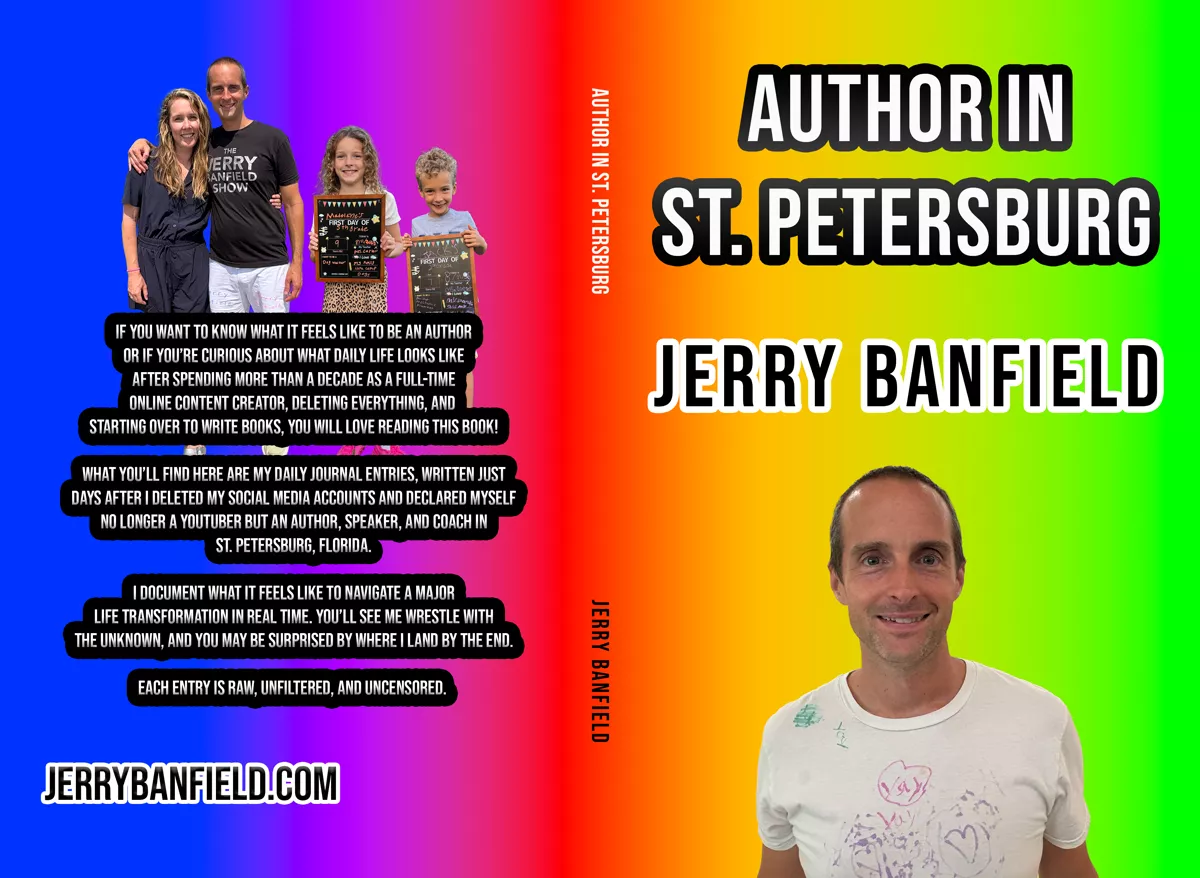
This is my journal entry from August 16, 2025, part of my daily autobiography Author in St. Petersburg — my real, unedited days, published in order.
I overate again last night and ended up feeling painfully stuffed. I talked with my mom about it, and I realized what I need to focus on today is simply slowing down while I eat. Much of my overeating seems to come from rushing through meals. If I give myself time to chew, pause, and actually taste the food, I’ll feel full in a healthier way without pushing myself into that uncomfortable place.
Yesterday was a big writing day. I worked heavily on I Was Famous on the Internet and brought the manuscript up to more than 12,000 words from just a few thousand the day before. At first, I felt proud of the progress, but then I noticed something unsettling. Twelve thousand words in and I was still only halfway through my childhood. None of the material about actually being famous online had even begun. At that pace, it would take 20,000 words just to reach the point of creating my first YouTube channel. That realization forced me to face an important truth: I had gone too far into the weeds with childhood traumas and backstory.
I spent much of the day cutting thousands of words, deciding that those stories belong in a different book. This project needs to stay focused. Readers picking up I Was Famous on the Internet are there for the rise and fall of online fame, not to be dragged through every memory of my dad’s harsh discipline or other painful parts of my childhood. Those details are valuable, and I’ve explored them thoroughly in Speaker Meeting 2017. I see now that those details don’t belong in a book meant for a general audience that I’d like to be able to hand to anyone without hesitation.
It was difficult to hit delete on thousands of words I had poured myself into, yet it was also liberating. Editing reminded me that this book doesn’t need to be a sprawling, overwhelming tome. I’d rather create more focused, shorter books that people can actually read, instead of massive 500-page bricks like Officer Banfield or Speaker Meeting 2017, which can intimidate readers before they even begin. I’ve learned that writing with restraint — choosing where to funnel my creativity — can be just as powerful as pouring everything onto the page.
The diaries are different. Here I want the raw, unfiltered flow of my life, free from the pressure of trimming or censoring myself. This is the place for every tangent, every confession, every repetition. When I run these entries through ChatGPT for light editing, it trims a few dozen to a couple hundred words from each thousand, cutting down on the most obvious repetition. That level of editing works here. I still get to preserve the authenticity of the moment while avoiding redundancy when I eventually publish them.
As an author, I’m constantly negotiating the line between raw honesty and audience readiness. I want books that dig deep into addiction, trauma, and sexuality, but I also need at least one that doesn’t overwhelm or repel the very people I’m trying to reach. I Was Famous on the Internet can be that book — an accessible gateway into my story. Those who want the darker, more triggering details can find them in other works. For now, I’m learning that sometimes the most valuable act of creativity is knowing when to stop, cut, and refocus.
After cutting so much material from I Was Famous on the Internet yesterday, I found myself wondering if I should be doing the same with these diaries. Should I go back and strip out some of the more controversial or deeply personal discussions, like the one about abortion? Does including those conversations make me look like an awful person? Am I sharing too much of other people’s private lives in the process?
I’m amused by how effortless it feels to write these diaries compared to the work of writing I Was Famous on the Internet. Putting together a topic-based book requires organizing events, sticking to a theme, and shaping a specific storyline. That feels daunting at times, whereas here I can simply speak freely about where I’m at. Some people live by the philosophy that life is only valuable when you’re tackling hard things — that if something feels easy, then you’re being lazy or taking a shortcut. I believe in balance. That’s why I do both. These diaries are easy and natural, a raw outlet for my creativity, while the internet book challenges me to focus and grow by resisting the urge to wander off into endless tangents.
The two practices complement each other. Without the diaries, I’d probably struggle more with the book or avoid it entirely. Writing freely here warms me up. After pouring out my daily thoughts for 20 minutes and thousands of words, I can shift into a tighter mode, focusing on one story. To me, this balance is ideal — an easy, natural flow paired with an area that stretches me. Life is about integration, not compartmentalization.
This balance extends into how I think about massage as well. Right now the physical and mental are often separated. Many people get massages in silence, lying there with no conversation. That made sense when I was new to massage, but today it feels incomplete. I want the deepest possible connection — one that combines physical touch with meaningful dialogue. To me, a massage without conversation can feel impersonal, like a stranger rubbing my body. It doesn’t bring me bliss or any kind of deep zen state when done week after week. If I were getting one massage a month, maybe that would be enough. I see an opportunity for something much more holistic: massage combined with coaching, where physical and mental presence meet. If you crave that kind of depth and real connection in your own life, you can schedule a private one-on-one call with me.
Not everyone agrees. I sent a message to a girl recently about this idea, and she said she only wanted to lie quietly during massages. She preferred to look someone in the eye and talk outside that context. Her perspective is valid, but I suspect she hasn’t experienced what I’m describing. It’s easy to dismiss something you haven’t tried. It reminds me of Henry Ford’s famous point that if he’d given people what they asked for, he would have built faster horses. People thought they needed speedier horses because that was the form they understood, when what they actually needed was transportation. The car solved their real need in a way they hadn’t imagined.
That’s how I view this approach to coaching and massage. People say they just want quiet relaxation, but I believe many don’t realize how powerful it can be to combine touch with deep conversation. They’ve never experienced it, so they don’t even know it’s possible. Of course, this approach isn’t right for everyone. Some may be perfectly satisfied keeping massage and coaching separate. Still, I see an opportunity to stand out by offering something no one else in my area does. There are already plenty of life coaches and plenty of massage therapists. The world doesn’t need more of the same. What it doesn’t have — at least not here — is someone willing to integrate the two while also publishing books and public speaking.
I can picture the clients clearly: people with money who crave connection, who would happily pay $300 or $400 for a session that nourishes both body and soul. That’s the direction I want to pursue.
I feel grateful today for the chance to set a clear direction for my life. One of the greatest opportunities we all have is to recognize the many possible paths ahead and then choose the one that feels not only joyful but also genuinely useful to others. For a long time, I hesitated with massage because I looked at how everyone else did it and thought there wasn’t a need for me. I felt the same way about making videos online — why bother when I was just repeating what so many others already did?
What excites me now is creating something that stands apart, something that exists only if I make it happen. If you want the deepest connection possible in St. Petersburg — through books, public speaking, life coaching, and massage — you’ll come to Jerry Banfield. No one else here will combine all of those into one offering, at least until I show them how. That integration has real value. My vision is for my books to do much of the work of bringing clients to me, while coaching and massage allow me to really get to know my readers. Change often starts with one person doing something differently and then showing others how. I believe massage therapy, approached holistically, can be a major tool for anyone interested in wellness.
I know many people in this area who want to help others through holistic practices. Yet from my perspective, if that coaching or guidance isn’t paired with a physical practice, it rarely stands out. I’ve noticed this pattern in my own experiences. With my hypnotherapist, for example, our conversations were good, but what made her special was when she actually guided me through hypnosis. With massage therapists, I enjoy the talking, but the unique power comes when the conversation is paired with the hands-on work. When it’s just coaching or talk therapy, something feels absent — like it’s only two people sitting across from each other exchanging words.
That’s why I’ve never felt much pull toward traditional talk therapy. Many people go simply because they need a safe space to vent, but I see what they’re really craving: connection. In a world flooded with voices — videos, podcasts, books, endless content — what’s missing is genuine two-way connection. Physical touch offers a profound way to create that. Yet touch without conversation can feel shallow, just as a massage without words often feels transactional, like I bought a temporary, impersonal connection.
It’s similar to intimacy. Sharing love and deep connection with a partner feels incredible. Earlier in my life, intimacy without real connection left me feeling hollow. The difference wasn’t the act itself but the connection, or lack of it. Massage and therapy work the same way. What people truly hunger for beneath all the sessions, the self-help, the wellness routines, is connection to another human being and, through that, to feel a part of something larger than themselves.
I’m grateful that my vision isn’t confined by other people’s expectations. I can imagine possibilities that others don’t see. Most massage therapists don’t stand out because they all present themselves the same way. I’ve searched online for local therapists, and almost none of them even have a personal profile. They work under someone else’s umbrella, stripping away their individuality, turning the work into something impersonal. If I saw a therapist advertise that they could also offer life coaching and meaningful conversation, I’d be their client immediately.
The personal connection makes all the difference, not only in massage but in nearly everything. I want deeper relationships with the people who grow my food and with the authors whose books I read. That’s what I love about being a local author — my books give me a way to form a personal bond with my readers. With massage, I can take that further, creating the deepest connection an author might ever have with someone.
I can imagine someday charging $500 or more for a 90-minute coaching and massage session. That vision excites me because I personally would see immense value in such an experience, and I trust there are others who might feel the same. I wouldn’t need many — just 10 or 20 people a week who wanted that level of connection. If you’d value going deep one-on-one with me right now, you can book a private call with me and we’ll dive into whatever matters most to you.
I love how alive my imagination feels. It’s one of my greatest gifts, and I believe it’s one of the most powerful things I can offer others: the ability to expand their own imagination. That’s what I hope my books, especially these diaries, will do — open your mind to what is possible.
If you connect with how I live and think, you can follow the rest of my days on YouTube in my Life playlist.