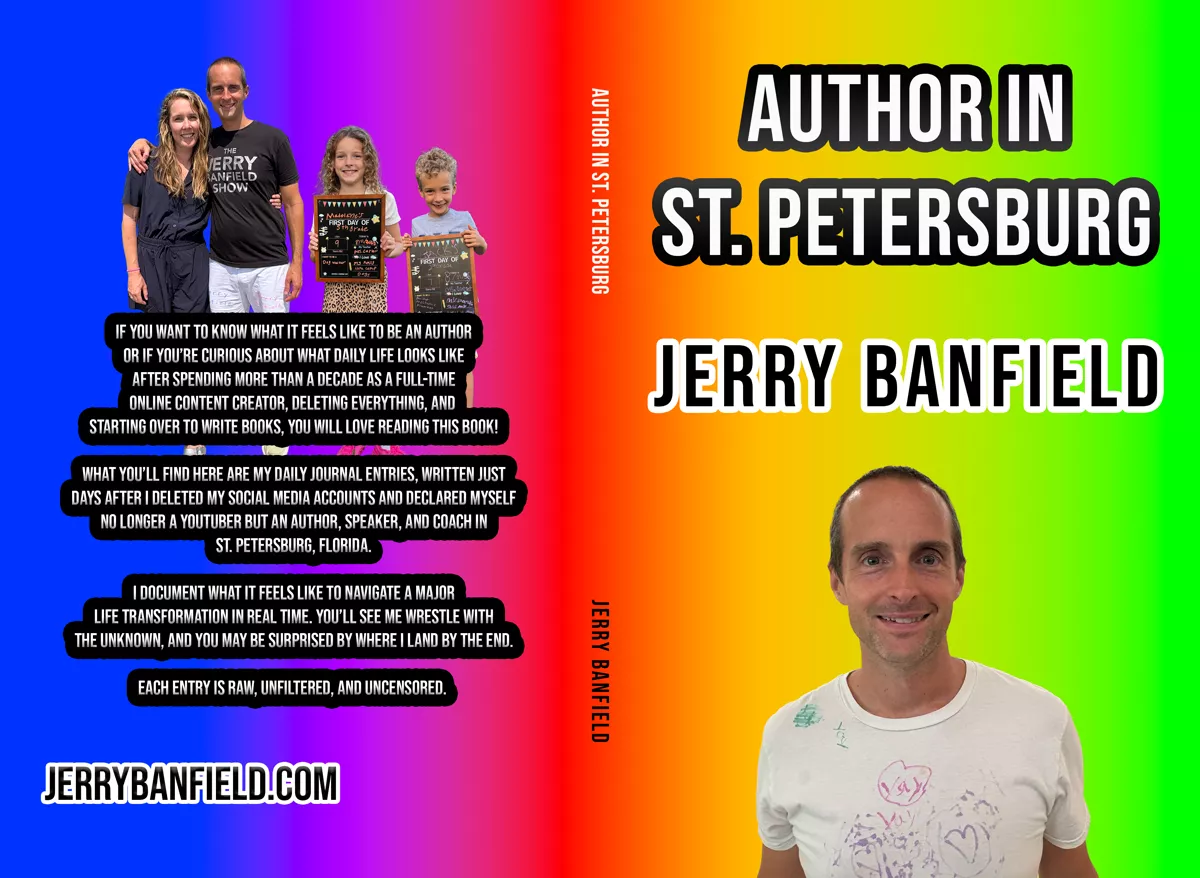
This is my journal entry from August 22, 2025, part of my daily autobiography Author in St. Petersburg — my real, unedited days, published in order.
Today I set up my office once again, this time in the master bedroom. Over the years my workspace has moved more times than I can count. It began in the second bedroom of an apartment when I started my business in 2011, then shifted to a dedicated office in Sarasota from 2013 to 2014. After that, I worked out of an extra bedroom in Sarasota until 2016, followed by two years in the master bedroom of our next house. From 2018 to 2024, I operated out of a shed in the backyard. Eventually, I moved into the walk-in closet of this house, which I jokingly called the “cloffice,” where I stayed for about a year before returning now to the bedroom once more. I’m not sure why I feel the need to recount my entire office history, but each shift tells a story of reinvention and survival.
The current setup has my stand-up desk, three monitors, and my streaming PC—the weaker of the two machines I used to own. I sold my gaming PC for just $300, which feels criminally low in hindsight, though I wanted someone else to get some use out of it. This streaming PC is nearly worthless today, but it works well enough for what matters most: narrating audiobooks and transcribing my old videos for turning them into books. I spent hours arranging, testing, and adjusting everything until it was right. It takes a peculiar skill set to envision how all these wires, monitors, and machines fit together, and I’m proud that it came out smoothly. I hope this is the last studio I’ll have to set up for a long time.
As I reviewed my old videos, I realized I have enough transcripts to create at least four or five books. That’s encouraging, yet also disappointing when I consider the thousands of hours and close to ten thousand videos I produced over the last decade. To think all that work may only yield a handful of books is sobering. At the same time, books endure in a way videos never do. They strip out the clutter and capture only the most valuable ideas. Looking back, if I had focused on writing books from the start instead of chasing online trends, I might have built a more stable career and a stronger presence in my community. The online success was exhilarating at times—earning nearly $100,000 in a single month, enjoying years with hundreds of thousands in profit—but today I have little to show for it. Now I’m left with a few hundred videos I can pull transcripts from and a couple of courses, hoping to carve books out of them.
The real lesson is about vision. For years I lacked a long-term outlook. I was simply surviving online—posting six times a day, experimenting with gaming, quitting, deleting channels, starting again, doing promotions like “Your Video Here with Jerry Banfield,” which brought in a little money but offered no lasting value. That’s how the online world seduces you: quick bursts of sales, instant validation, the dopamine rush of course revenue flowing in overnight. Yet a decade later, most of it is irrelevant. The majority of my tutorials and topical content no longer serve anyone. I don’t want to repeat that cycle.
What still feels valuable are the timeless videos—storytelling, AA talks, and book reviews. For example, my “AA Speaker Meeting: Celebrating Seven Years Sober” from 2021 and “Top 33 Health Books” video from 2024 still hold substance. Those can become evergreen books. I can create collections of reviews, like one focused entirely on health or another on conspiracy titles, or even a book summarizing the ones I found transformative. I recorded countless diary entries as well, which can flow naturally into memoir-style collections. I even made videos like “Healthy Coping Mechanisms for Men Facing Intimacy Disorders,” essentially a candid exploration of sex addiction, though the title was one I didn’t want to use on YouTube. Material like that could evolve into books on AA recovery, intimacy struggles, or personal growth.
This excites me because when I imagine seeing someone in person who’s struggling, I can hand them a book instead of trying to push a video link. That feels natural. Books are easier for family and friends to process than endless hours of video online. I’ve spent hundreds of hours listening to authors like Wayne Dyer and Eckhart Tolle, and when you really connect with a writer, you want to read everything they’ve written. I believe some people will do that with me.
For the first time in years, I have a vision that makes sense. It’s beautifully simple: write books and give massages, weaving coaching into the bodywork. All I need to do now is go to massage school, finish a couple of books beforehand, and then, once school is done, continue transforming my library of videos into dozens of books as well as dictating new ones. Long-term vision is everything.
This realization extends beyond my career. In my marriage, I often approached things with the same survival mindset I brought to online work. Today I recognize the importance of building character, addressing problems directly, and fostering gratitude in the present moment so my ex-wife and I can enjoy a lasting, fulfilling relationship. Whether it’s marriage, career, or personal growth, the same principle applies: focus on actions today that will set me up for success thirty years from now. For me, that means embracing the path of writing books and doing massage work rooted in connection and service. It feels like the right foundation for the life I want to live. If you're staring at your own years of survival-mode hustle and want help mapping a longer-term vision, you can schedule a private call with me and we'll think it through together.
I began the day as usual by taking the kids to school, though soon that routine will shift once I start massage school. From there, I headed to the tennis club to play doubles with the Friday morning group I used to see regularly. I had stopped playing with them last year because doubles cut into both my 9 a.m. yoga class and the 10 a.m. AA meeting, and I had been focusing more on singles. Today, though, one of the guys texted to say they would have to cancel unless I joined, so I agreed.
The lineup was one man close to my age and two older gentlemen, both in their seventies or eighties. We split the older players between teams and played two sets. Watching men in their eighth decade of life still able to move around the court and sometimes outplay me is inspiring. Still, I was frustrated with myself in the first set. Despite countless hours of coaching, practice, and hitting tens of thousands of balls since playing with them, I still managed to lose. I’m easily the most athletic and fit of the group, yet I made an embarrassing number of unforced errors. The one bright spot was my serve, which stayed consistent, and we regularly won the games I served. My partner, unfortunately, once double-faulted his way through an entire game, which didn’t help.
What bothered me most wasn’t just losing—it was being frustrated that I was frustrated. I caught myself thinking, “Come on, you’re out here to have fun. This is amateur tennis. Haven’t we gone through this enough times? When will you finally reach a place of calm acceptance?” I tried to refocus on the positives. In the second set, I was paired with the stronger of the two older men, and though the other side took an early lead, we fought back. I pushed hard at the end, and we won the set. My favorite moment came when I sprinted nearly a full circle around the court to retrieve a lob, then charged forward to crush a hard cross-court winner. Everyone applauded the effort, and I felt proud of that point.
The whole session felt less like competition and more like group therapy. Each of us wrestled with that inner critic whispering that we weren’t good enough. Both older men cursed their faulty play, while the younger man shook his head and groaned at his own errors. We laughed, cursed, and encouraged one another through the frustration. Tennis became a support group disguised as a game.
Afterwards I considered going to an AA meeting, since I didn’t go yesterday and I aim for at least five meetings a week. In the past week I had already attended several in a row, and I’ll probably go every day for the next five as well. Instead of heading to a meeting, I felt drawn to finish setting up my newest studio dedicated to writing and narrating books. My ex-wife had already cleared space so I could move in my standing desk and equipment. As soon as I started reconnecting everything, I realized how much joy that brought me. I’m grateful that I often ask myself what would feel most joyful in the moment—and then allow myself to do it.
I’m excited that these diaries are nearing completion because they will mark the true beginning of my journey as an author here in St. Petersburg. Years from now, I’ll be glad to have them, because what I regret most about the past decade is not keeping a daily record. Instead of making countless videos teaching people what to do or selling courses, I wish I had simply kept a diary or vlog every day. At least then I’d have a body of work worth looking back on, not just promotional clutter.
Now, when I reread these entries years from today, I’ll see what I’ve remembered and what I’ve forgotten, what lessons I’ve mastered and what challenges I’m still wrestling with. Just recently I watched a video from 2017 of myself describing how quitting video games was the hardest addiction of all. Yet a few months ago I pawned my consoles again, and in the years between I bought and sold them several more times. That cycle alone is proof of why long-term thinking is crucial.
If there’s one message I hope these diaries communicate, it’s to think as far ahead as possible. At the same time, life demands balance. It isn’t about postponing happiness until decades later but about living fully in the present while laying foundations for the future. Some might say, “What if I don’t have much time left?” Then at least spend today doing something that leaves a lasting impact—something that helps others long after you’re gone.
If you connect with how I live and think, you can follow the rest of my days on YouTube in my Life playlist.