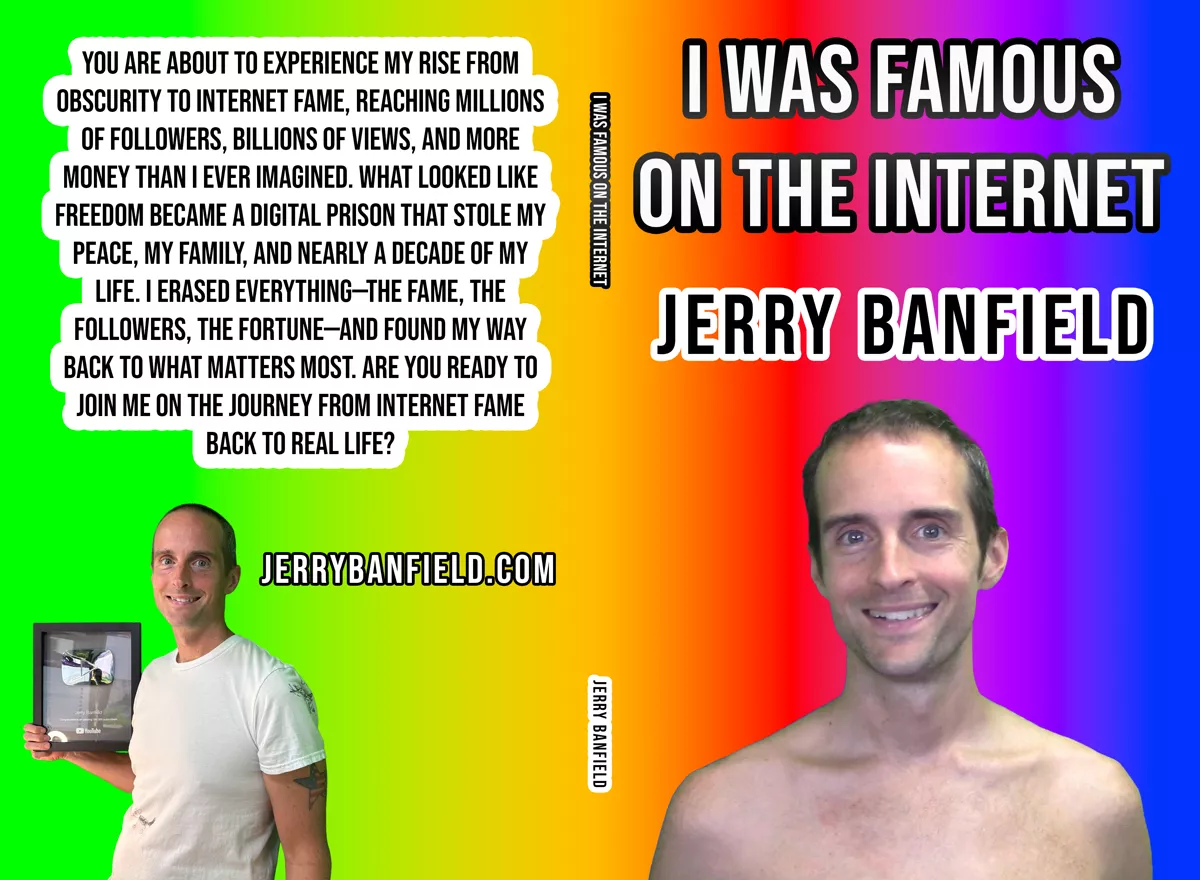
This is an excerpt from my memoir, I Was Famous on the Internet — my honest story of 14 years of internet fame and what it really cost, and why I deleted it all to choose real life.
Life Made Sense Again
I was amazed at how much better I felt the moment I deleted my podcast. For the first time in years, my life made sense. Before that, everything felt like failure. I had tried to build a successful career as an online influencer, and every single time I climbed to the top of something, it either ended in self-sabotage through burnout, or I lost my mind chasing the next level, or the platforms and algorithms took me down. Nothing had stuck. Nothing had lasted.
But once I deleted everything, the story flipped. Suddenly, all those failures, all those meltdowns, all those takedowns, they made sense. If the whole point of the journey was to reach a place where I unplug completely—and then help other people unplug—then none of it was wasted. It was all leading me here. That realization was one of the best feelings I have ever had. After years of believing my life was meaningless, of hearing my own family say I had pissed away every opportunity and wound up 40 years old with nothing to show for it, I finally felt the opposite. I had something to show for it. I had clarity. I knew what I needed to do.
The more I started talking to people in real life, the clearer the guidance became. I was shocked to feel such a strong desire to talk with others face-to-face. I remembered how powerful it had been in 2020 and again in 2024 when I unplugged for stretches of time. Back then, I noticed how much better I felt not listening to endless content online. But this time it hit me on a deeper level.
For years, I had justified all the time I spent on YouTube, Facebook, X, Twitch, Instagram, and TikTok as research. I told myself I needed to watch what was happening in the algorithm, to stay informed, to keep up with trends. That’s how I dominated Facebook in the beginning—I studied what was happening there. That’s how I made big money on Udemy—I watched the system closely. Same with YouTube and crypto, same with Twitch and TikTok. Always watching. Always studying. Always consuming. I didn’t see until much later how destructive it was to spend so much time watching other people instead of living my own life. It wasn’t just about wasting hours. It changed how I thought. It blocked me from wanting to connect with people in person.
Deleting everything changed that overnight. Suddenly I was eager, even desperate, to spend time with people in real life. No podcasts, no TV, no music, no video games. What do you do when you cut all of that out? I reached out to people who I thought could help me figure out what to do next. People with life experience. People who had walked other paths.
The first clear call to action came quickly: pawn my video game consoles. Even after deleting all my channels, I was holding on to the idea that I could just play games casually, without creating content around them. But I knew deep down that was flawed. I wouldn’t just play casually. I’d end up watching videos about the games, looking for strategies, dipping into the same cycle that always pulled me back into content creation. The consoles had to go.
In my conversations with people, I kept noticing how many of them struggled with the same thing I was going through. Parents, spouses, kids—they told me stories about how addicted their families were to screens, videos, and games. I heard repeatedly that this was one of the biggest issues in their lives. That’s when it clicked: my extreme journey could help people. Because I had gone all-in, further than most people ever would, my choice to unplug carried weight. I had deleted more, sacrificed more, given up more than the average person would even consider. That made me an example people could learn from. Because so many people I talk to are quietly fighting the same battle with screens in their own homes, and if you're one of them, you can schedule a private call with me and we'll figure it out together.
The more I talked, the more I wished I had something tangible to give people. Something they could hold in their hands. That thought brought me back to writing books. I met with a local author who also worked as a real estate agent, coach, and speaker. She told me that out of everything she did, the one thing that made people curious was when she said she was an author. That stuck with me.
I remembered that I had already thought about becoming an author before, back when I was considering what to do next. In 2024, I had failed at it. I told myself it was too hard, that it didn’t make sense compared to video. Now I looked back and thought: I should have taken that year to write books. If I had, I’d already have a dozen published. Imagine meeting someone and being able to hand them one of twelve different books on topics like sobriety or unplugging from technology. Imagine how powerful that would be as a lead magnet for coaching or speaking.
Books could do more than bring people in—they could help them. Someone going through what I went through could read my story, feel less alone, and then meet me in person to talk about it. That combination of being both an author and someone you could actually meet face-to-face felt like the path I had been searching for. From that conversation, it was obvious: being an author, a speaker, and a coach was exactly what I wanted to do. If you want to talk with me about deleting everything and being an author yourself, you will love booking a session with me at jerrybanfield.com.
Finding My Workflow as an Author
I love creating, and writing books feels like the purest creative outlet I’ve ever had. On Saturday, September 6, 2025, I spent hours dictating this very book, from the introduction all the way through to where I am now. That means I created two thirds of this entire book in one day although I have taken almost a month to edit it. My process is simple but powerful: I dictate into voice memos, then I run those memos through ChatGPT to polish them into readable writing. Over the last couple of months, I’ve worked hard to figure out the best way to be an author in 2025, and this workflow is the breakthrough. It takes what I’m best at—talking off the top of my head—and transforms it into something people can actually read.
If you want to hear about the beginning of my journey as an author, you can read Author in St. Petersburg, which documents my daily diary entries during the time I first started experimenting with books. Right after that conversation, I tried everything again—dictating, pulling transcripts from old videos, typing directly on the computer. The difference this time was that I refused to quit. Where I had failed before was simply in not trying hard enough, giving up too easily, and not finding a workflow that made sense.
The first big breakthrough was realizing I had to dictate. Dictating is lightning fast compared to typing. I hate spending an hour on the computer just to come up with 1,000 or maybe 2,000 words. In the last three hours today, I’ve probably dictated 20,000 or even 30,000 words, compared to the 5,000 or 10,000 I would have managed typing. What’s wild is that my dictation, once polished through ChatGPT, actually sounds better than the writing I do myself. It’s humbling, even baffling, but I’m grateful to finally have a system that lets me produce books quickly.
I had already drafted a book about technology addiction that got up to around 40,000 words, but it was a mess—diary entries scattered everywhere, no clear thread. It didn’t feel like the book I truly wanted to write. While experimenting, I asked ChatGPT for book title ideas, and one jumped out at me: I Was Famous on the Internet. The moment I saw it, I thought, that’s it. It sounded so good I assumed someone had already written it. I checked. Nobody had. This was my book!
Over the next month, I tried different workflows for it. At one point, I had over 100,000 words by pulling in video transcripts from the exact days things happened. For example, when I quit gaming, I grabbed the transcript of me saying it that day and dropped it into the manuscript as a diary entry. That draft spanned my entire life, from before I was born and choosing my parents, all the way up through the stories I’m telling here.
Eventually, I cut it down to around 50,000 words, but when I looked at it this week, I realized it was unusable. Too scattered, too chaotic, not immersive enough for someone who didn’t already know me. Maybe a hardcore fan would have appreciated the detail, but a normal reader needed a cohesive story. I had to accept the hard truth: I needed to dictate the entire book again, from scratch while maybe publishing the version with transcripts later.
That’s what I did today. So here I am, having dictated everything you’ve read in this book so far in a single day, while my ex-wife was out with the kids at the movies. I don’t even want to sit in front of a screen in a theater anymore. Instead, I stayed home and created a book. I’ve started giving out Author in St. Petersburg in person, and the responses have been incredible. I’m so grateful to have gone through the full arc of my story—how I was famous on the internet—and to now be shaping it into something lasting. We’ll see what else I can add that will truly bring it full circle.
Questions
Now that I’ve shared the story of how I was famous on the internet, I want to shift into answering the questions people usually ask about my journey online. One of the most common questions I get sounds something like this: Jerry, are you saying the people who work at all these tech companies are evil? Another version is: What can we actually do about this system we’re stuck in?
The first thing I want to make clear is that the most powerful belief I live by is this: I am the Creator of my reality. Truly, this entire reality is my creation. Yet one of the dominant messages the internet puts out is the opposite—that you are not the creator of your reality, that you are a victim, a prisoner, a pawn in a world run by someone else. Whether that someone else is portrayed as God, AI, corporations, or government, the story is the same: you don’t have control, you’re just surviving.
To me, the foundation of a better world is being sovereign beings, thinking for ourselves. And what I’ve seen from years of living online is that using the internet makes it very hard to think for yourself. It looks like there are endless points of view, but what you’re really being fed is a carefully curated narrative—and then a controlled opposition against it. It’s like elections. Both major political parties are essentially two sides of the same coin. There’s the illusion of choice, and yes, sometimes the outcome shifts slightly, but the deeper system remains the same. The rhetoric is different, the words are different, the emotional triggers are different, but underneath, the same control mechanisms are in place.
One of the realizations that helped me get off the internet was hearing someone say that the future is going to be divided between sovereign thinkers and people trapped in groupthink. At first, I felt reassured. I thought, I’m sovereign, I’m thinking for myself. Then it hit me. No, I wasn’t. I was just one of the herd, hanging on someone else’s words, listening to their ideas, shaping my reality through their lens. The truth was undeniable: if I wanted to be sovereign, I needed to unplug. If you're wrestling with what unplugging would actually mean for your own life, you don't have to map it out alone — you can schedule a one-on-one call with me and we'll talk through your own version of it.
I don’t mean cutting out the internet completely. I’ll talk later about the practical details—like how to promote yourself and do business locally without feeding these platforms. For now, I want to zoom out to the bigger picture. These systems, as toxic as they feel, are still our creation.
Take the big platforms—Facebook, YouTube, Instagram, TikTok. Why are they so powerful? Because billions of dollars poured into marketing them, making them dominant, and then cementing their dominance by buying out competition. Facebook swallowed Instagram. TikTok bought its way into cultural dominance with relentless marketing backed by staggering sums of money. These platforms didn’t become giants by accident. They became giants because people invested in them, because money fueled their rise. And where did the money come from? Us. The users.
Are some of the people running these companies into things we’d call evil? Sure. I’ve crossed paths with people whose worldview felt cold, manipulative, and destructive. But most of the people working at these companies are just regular people doing a job. They’re getting paid, feeding their families, surviving. That’s where the real problem lies.
In AA, there’s a line in the Big Book: “Selfishness—self-centeredness! That, we think, is the root of our troubles.” I see that everywhere in the digital world. People make moral compromises because their paycheck demands it. They take jobs where they do things they wouldn’t want to be on the receiving end of, because they need the money. That’s how good people become cogs in a system that others look at and call evil.
It was the same for me. Most people in my position wouldn’t have deleted everything. They would have just kept saying whatever they needed to say to keep getting paid. That’s what I see repeatedly online. Creators aren’t telling you the truth; they’re telling you what they need to say to survive and get paid. The platform employees are doing the same. The executives are doing the same. When survival and self-interest take over, the bigger picture gets lost.
The internet is full of people chasing material wealth, status, fame, views, prestige—all the empty numbers. Few are asking how this affects humanity. That’s the problem. That’s the trap. And that’s why, for me, unplugging was the only way forward.
If you connect with how I live and think, you can follow the rest of my days on YouTube in my Life playlist.