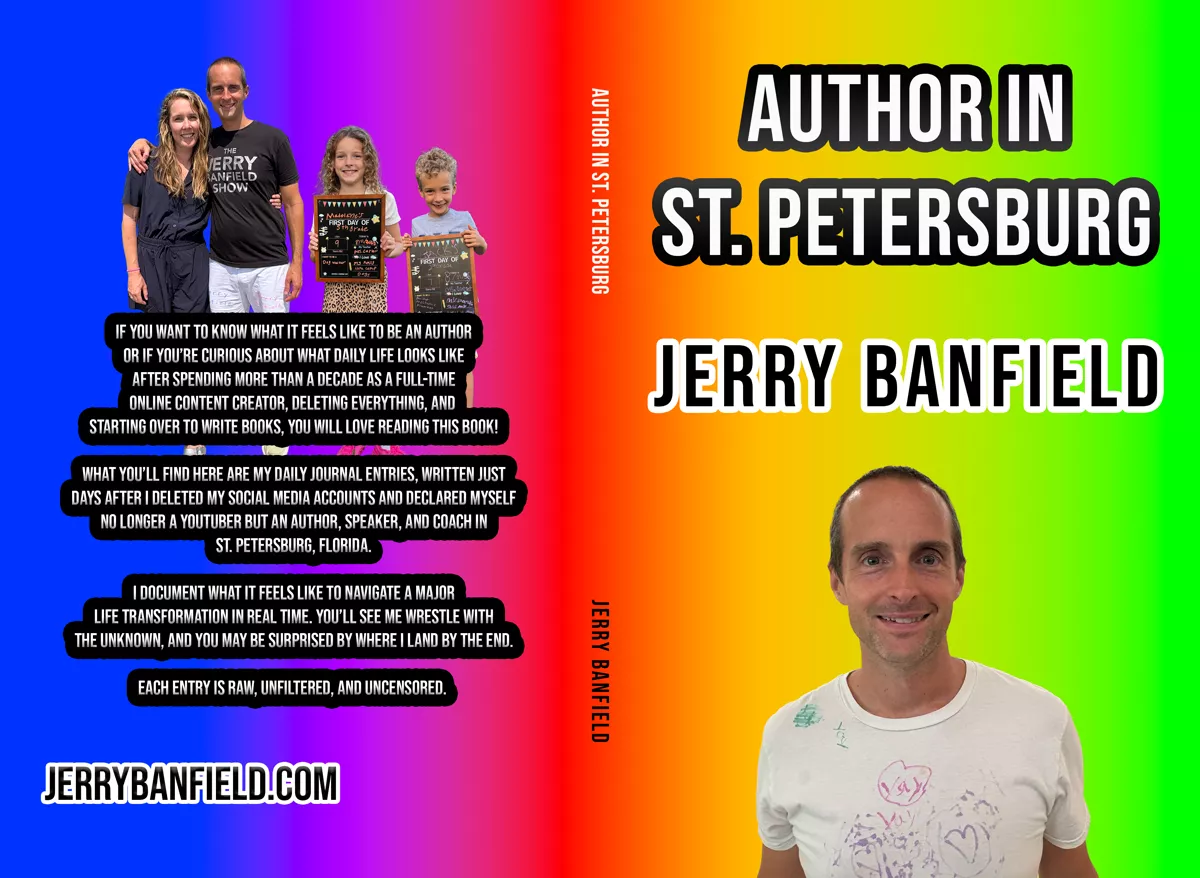
This is my journal entry from August 29, 2025, part of my daily autobiography Author in St. Petersburg — my real, unedited days, published in order.
Today I’m trying something different: dictating this diary entry while driving with my AirPods in. Yesterday was my daughter’s birthday. We ended the day with a delicious ice cream cake, and in the evening I played tennis with the boys, which was a wonderful way to close out her celebration while she enjoyed an evening with my ex-wife’s family. Last night, as I lay in bed, I had a flood of ideas I wanted to record, but I didn’t dictate them then. I’ll do my best to recall them now. What I feel I can offer most through these books is the gift of out-of-the-box thinking. I know that what I hunger for is exposure to new thoughts and fresh possibilities. Too often life feels like the endless recycling of the same ideas.
That is one reason I cherish the Seth books. I am currently reading The “Unknown” Reality, Volume One by Jane Roberts, the same author of Seth Speaks. These books stretch my mind with perspectives far beyond the conventional. I don’t mind the diary-like style or the inefficiency in the prose, because what I value most is the originality of thought. That is exactly what I aim to provide here as well. When someone reads my books, I want them to pause and think, I’ve never considered that before. That kind of mental expansion is the real treasure.
It’s important to begin with a vision of what you have to offer. I feel almost certain that no one else in St. Petersburg is writing daily diaries and publishing them. Probably not in Tampa either, or even across much of Florida. In truth, very few people in the world commit to publishing daily diaries. Most assume a book requires a singular theme or narrative. David Sedaris is one of the few who has published diaries that I have read, and his are excellent. That inspires me, yet I know I’m charting my own path.
Here’s one of the unconventional ideas I’ve been reflecting on. Recently, a friend told me about a heated argument they had with a family member who was upset about the latest widely publicized tragedy. I remember when I used to react the same way. During my streaming years, whenever a tragedy dominated the news cycle, many of my viewers would come into chat upset. I would get upset at them. I’d think, Don’t you see you’re being manipulated? You’re not thinking clearly. You’re letting your peace be stolen by something that doesn’t touch your actual life at all.
This morning, out of curiosity, I asked ChatGPT how many people are born and die each day. The numbers it returned—while not perfectly reliable—showed that roughly three to four hundred thousand people are born daily, and a few hundred thousand less die each day. What struck me is how much peace I now feel about both living and dying. The method of death no longer troubles me. What matters is perspective.
ChatGPT’s estimate suggested that about seventy-four percent of global deaths result from lifestyle diseases: heart disease, cancer, and related conditions. These are largely preventable or reversible with lifestyle changes. From the research I’ve read and my own experience, I’ve come to believe that a whole-food, plant-based diet and lifestyle play a powerful role in long-term health; Dr. Michael Greger’s How Not To Die explores the research in detail, and it aligns with what I’ve experienced. I believe many lifestyle-related deaths could, in theory, be delayed or avoided. We’re talking hundreds of thousands of lives daily, lost not to random tragedy but to people’s own choices—what they eat, how much they move, whether they smoke, how they handle stress, and so on.
In contrast, the events that dominate headlines—wars, terrorism, shootings, disasters—account for only one or two percent of global deaths. Yet these rare causes provoke the majority of people’s grief and outrage. Think about how backward that is. Roughly three-quarters of deaths are preventable, yet people hardly react to that ongoing, everyday tragedy. Instead, we pour our energy into outrage over the one or two percent.
This is personal for me. My father died at sixty-three from lifestyle-related conditions. I believe his choices around smoking, diet, and exercise shortened his life. That tragedy cut far closer to my heart than any news headline ever could. Yet I see now that even this painful reality is part of the bigger picture.
I’m grateful today that I no longer fall into most manipulation. My friend’s story about political arguments reminded me how easily people become distracted. I won’t waste my peace of mind like that anymore. When you zoom out, you see that overall, humanity is still growing. Every day, hundreds of thousands more people are born than die. If the goal is simply more human life, then we’re succeeding.
Still, this raises deeper questions: Should more human life even be the goal? With our current impact on the planet, can Earth sustain our expansion? If we lived with less destruction, perhaps it could support two or three times as many of us. Yet the way we consume resources and pollute ecosystems makes the answer uncertain. Sometimes I wonder if the Earth itself even wants more humans, or if the other beings—trees, oceans, animals—long for a reprieve. Reading Braiding Sweetgrass has made me reflect on this more deeply, reminding me to consider all life, not just human life.
From the broader perspective, much of what agitates people daily dissolves into insignificance. Some may accuse me of being numb, but I see it differently. I’ve been a police officer. I’ve seen tragedy firsthand. I know what it feels like to be haunted years later by nothing more than paperwork describing horrific acts. Just the written reports alone were enough to move me to tears. Drunk driving fatalities, robberies, violent crimes—I witnessed the reality behind the statistics.
Yet even with that experience, I’ve learned to hold a larger view. Unless a tragedy is directly in your life, there is no need to hand over your peace. We should instead be the change we wish to see, living differently and working together to help one another. That is the lesson I’ve taken from all of this: almost all of our suffering is preventable if we learn to cooperate. If you want to guard your own peace and be around people choosing to live differently rather than handing it over to the outrage of the day, you can set up a call with me and we'll look at it together.
After school yesterday, the kids and I were talking about Harry Potter. I commented on how rarely swimming pools appear in the series. In Florida, pools are everywhere, so the absence struck us as odd—especially since my daughter had just celebrated her birthday with a pool party. That conversation opened a doorway for me to share a different way of looking at stories. Many people assume the Harry Potter universe is fixed—what J.K. Rowling wrote is all there is. Yet after immersing myself in the Seth material, I’ve begun to see it differently.
I believe fictional universes are real on another level, and Rowling’s books are simply her personal snapshot of that reality. It’s like taking a photograph: one image of you in one outfit, in one place, at one moment. That picture captures only a sliver of your essence. Behind every photo is the full, invisible reality of your body, your life, your soul. No single photo can contain all of that.
The Harry Potter universe works the same way. Rowling’s books are one set of snapshots, one collection of angles on that reality. They are valid, but they are not complete. Other versions of that universe exist. Your own mind can tap into them, just as hers did.
This is one reason we love fiction so much: we intuitively sense that these imagined worlds are more than make-believe. They are alternate realities we can access through imagination. For example, in one version of the Harry Potter universe, the central child might be a girl named Hailey rather than Harry. In another, there is no Voldemort at all—perhaps wizards are not fighting for control of Earth but striving to conquer space. The variations are infinite. Each one is just as real as Rowling’s snapshot, just as a different photo of you is still you.
Children are naturally adept at this. They slip in and out of universes through play, creating entire worlds from their imagination. Adults often forget this ability. We lock ourselves into the notion that what has been written is final. Yet in truth, the possibilities are endless, and the mind is far more powerful than we usually allow ourselves to believe. That realization excites me. It reminds me of the vast creative potential within us all.
This morning I woke up buzzing with both excitement and doubt about starting massage school on September 8th, now less than two weeks away. The thought hit me hard: I can’t do this. The schedule loomed in my mind—five days a week, from seven in the morning until three in the afternoon. It felt overwhelming. Part of me thought it was ridiculous to even attempt, especially when I considered the training clinics.
At the Sarasota massage school, each student must complete sixteen five-hour clinics after school, providing massage to the public. From what I’ve heard, most of the clients who come in are in their seventies. That reality jarred me, because in my ideal vision, I pictured myself massaging mostly beautiful women and, on occasion, men with vibrant energy. I wasn’t imagining a steady stream of elderly bodies, skin loose and worn by time. The thought of working on them felt far removed from the fantasy that first attracted me to massage.
Yet when I calmed down, I remembered something essential: sometimes the true value of an experience lies in contrast. The experience itself might not feel desirable, but it teaches by comparison. A memory came to me of visiting my brother a year ago. During that trip, the atmosphere was tense and uncomfortable, and being in his house felt oppressive. Yet the visit still held value because of the stark contrast it provided. It reminded me of how different my own home environment is, how peaceful and sober my daily life has become. The contrast itself was a gift.
Massage school may serve the same purpose. Even if I find myself massaging people I wouldn’t normally choose, those experiences could heighten my appreciation for the sessions I do enjoy. They may challenge me to find meaning beyond preference and to connect with people simply because they are human beings in need of healing touch. In that way, the very thing I resist might become the most valuable part of my education.
I keep reminding myself that even the parts of massage school that seem undesirable will have value. Spending eighty hours massaging older clients with frail, smelly, or aging bodies will make me appreciate all the clients I dream of working with afterward. Without that contrast, I might not value them as deeply. I may even come to enjoy massaging some of those elderly clients. Their presence could teach me lessons I would not otherwise learn—lessons about compassion, patience, and the universality of touch. In that way, the experience may expand my horizons, break down my narrow expectations, and push me into new territory.
As I lay in bed this morning questioning whether I had made the right choice in enrolling, I realized that what I truly need is new experiences. Massage school will be exactly that. It will force me to learn anatomy, a subject I know little about. It will put me in daily contact with new people, many of whom I will spend significant time alongside. It will require me to learn something intensely physical, whereas most of my learning over the past decade has been purely mental. All of this will integrate with what I already know and create something powerful.
I am grateful for the opportunity, especially when I consider what I’ve read about dementia and Alzheimer’s. I once listened to a podcast describing a study where people with identical genetics and identical brain scans could live radically different lives. Some would exhibit no symptoms of brain disease, while the others would. The deciding factor was lifestyle. For me, that is an astonishing and hopeful truth. So many of us view genetics as a curse, a fixed destiny. Yet science confirms what my intuition has often told me: that the brain, like the body, thrives on challenge and novelty.
I used to rationalize my video game playing by claiming I was “keeping my brain young.” Learning new games, I told myself, kept my mind flexible. Perhaps there is some truth to that, but it pales compared to the real benefits of forcing the brain into truly uncomfortable territory—learning something wholly unfamiliar. Like muscles worked in new ways at the gym, the brain strengthens when asked to perform beyond its routines. Massage school will demand exactly that. It will push me into material and environments where I have little background to lean on. That struggle, science suggests, is precisely what staves off cognitive decline. Even if my genetics were to predispose me to dementia, consistent brain challenges can keep the symptoms from appearing at all.
That is an incredible gift, and it reframes massage school as one of the best decisions I could make. It’s not just a career move. It’s medicine for my brain, a safeguard against the stagnation I’ve seen in others. Those who succumb to brain disease often live lives of repetition—watching television, going to the same places, having the same conversations. They stop expanding. They stop learning. By contrast, I am choosing to throw myself into something radically new.
Of course, the resistance in me is logical. My ex-wife, for instance, often has a silent tantrum before her morning runs. She’ll wake at 5:30 a.m., angry that she has chosen to get up, even though she usually goes to bed early enough to be rested and often naps later. She’ll think, I don’t want to run. Why am I doing this? Yet once she finishes, she feels renewed. Massage school may be the same. I can imagine looking back one day, grateful for having gone through it, even if some of it felt difficult at the time.
I’m also excited about what massage school will allow me to offer afterward. I love the idea of exchanging massages with my therapist friends rather than paying for sessions. I love the thought of adding massage to my coaching tools, being able to help someone heal both physically and mentally. I like the idea of building a physically based, in-person income that combines with my writing and book publishing. Beyond that, I can already see the next step: yoga teacher training. Once I finish massage school, I’ll have an intimate understanding of the body. Pairing that with yoga training will deepen both practices, and I believe I’d enjoy yoga training even more with the foundation massage provides.
Looking back, I’m grateful I considered yoga training first, because it primed me for this leap. The arc of this diary book excites me. It began with me documenting the process of unplugging from the internet, and now it closes with me enrolling in massage school. That kind of journey, captured honestly, feels invaluable.
My dream is to continue writing like this indefinitely—publishing a book every month composed only of diary entries, with no agenda beyond sharing the truth of my life. Themes will emerge naturally, and I’ll shape the titles around them. Personally, I would love to read diaries like this from others—friends, family, people I meet in town. Not that I would read every single book, but the chance to know someone more intimately through their thoughts and experiences is something I’d treasure.
I hope my writing inspires others to do the same. Journaling like this is valuable for me and potentially for others. Creativity left unexpressed often festers. People carry unspoken ideas and desires that, when bottled up, can manifest in destructive ways—even in illness. I believe expression is a form of health. That belief makes me especially grateful for my own vitality today. Yesterday I spent three hours moving my body through tennis and yoga, and this morning I still feel energized.
Just before dictating this, I drove to the Toyota dealership at 7:30 a.m., where another lesson unfolded. A few days ago, I left there burning with irrational anger. I had just paid $4,000 for service, and because they didn’t automatically provide me with a $46 rental car, I left feeling cheated. Never mind that I hadn’t even asked for the rental this time, despite receiving it free on prior visits. I could have waited at the dealership, I could have asked—but I did neither. My outrage was irrational. Recognizing that, though, was powerful. Seeing your own irrationality breaks its spell.
Yesterday, when my ex-wife told me our 2016 Toyota RAV4 Hybrid was making another noise, my frustration boiled over again. I thought, You’ve got to be kidding me. After spending $8,000 at this dealership in the last two weeks, I have to go back again? Anger surged, but this time I handled it better. Instead of venting at management when they texted me for feedback, I called my service advisor, who has always taken care of me with professionalism and kindness. I explained the problem, and she immediately offered me a 7:30 a.m. appointment today.
When I arrived—early, at 7:28—she greeted me warmly and handed me the keys to a white Camry Hybrid rental, free of charge. She apologized for the inconvenience, assured me they would realign the wheel, check the noise, and even replace my wipers. The gesture shifted my perspective entirely. As I left in the rental, I laughed at myself. I must like being at the Toyota dealership, because it has been one of my most-visited places lately. This was the third time in two weeks, meaning six total trips back and forth. Instead of resentment, I chose gratitude. Gratitude that they are maintaining my car, gratitude for her care, gratitude even for the lesson in spotting my irrational anger. Everywhere I am, I remind myself, is a place I’ve chosen to be. That means even the Toyota dealership is, in some way, my creation. If you catch yourself handing your peace over to irrational anger and want to talk through what is really driving it, you can book a one-on-one call with me and we will work through it together.
After dropping the RAV4 off at the Toyota dealership, I attended my daughter’s Dolphin of the Month ceremony at their school, where one child from each class was chosen to be honored. The school brought them on stage, announced their names, and shared what each child wanted to be when they grew up. My ex-wife and I sat together in the audience, laughing and joking like the Muppet critics in their theater balcony.
After the third or fourth girl declared she wanted to be a veterinarian, I leaned over and said, “Who is telling all these girls they need to be veterinarians?” My daughter had wanted to be one herself for a while, and I had encouraged her to think carefully about what that really meant. My ex-wife shot back at me with perfect timing: “If it’s not one thing, it’s your mother,” since my mom worked in animal care and I even dated two women in that field back when I lived out of state.
At first my daughter’s reasoning was simple: “I love animals.” I reminded her that being a veterinarian doesn’t mean playing with healthy animals all day—it means treating sick and injured ones, performing surgeries, and sometimes euthanizing them. Loving animals is one thing; loving medicine is another. If she wasn’t interested in the medical side, she might want to consider other ways of working with animals.
She thought about it and considered a neighbor of ours who boards and walks dogs for a living. For a time, my daughter said she wanted to be a dog walker. Today, though, when she was announced on stage, her vision had expanded: she wanted to be an entrepreneur and own an animal shelter. That thrilled me. Owning a shelter combines her love of animals with her entrepreneurial spirit. Maybe she wants to be like her dad. The work might be heartbreaking at times, but the vision was bold and specific. I loved hearing it voiced publicly at school for the first time.
Another child, whose father once gave us several mulberry trees, said he wanted to be a hibachi chef. I laughed out loud. That’s the kind of clarity and originality I adore. One boy in first or second grade said he wanted to be vice president. My ex-wife quipped, “Why not president?” But the truth is, the vice presidency carries enormous power, sometimes as much as the presidency itself. I remembered all the talk during the Bush years that Dick Cheney was really the one in charge.
Listening to these kids, I felt proud of their courage to dream. Society needs people in every role, from vice presidents to hibachi chefs. Even jobs that seem menial, like janitors at Disney cleaning bathrooms, matter profoundly. Whenever I went to Disney I made a point to thank the bathroom staff, because their work created the environment for joy. Ideally, though, we wouldn’t need full-time janitors if everyone simply cleaned up after themselves. I often imagine a gift economy where everyone contributes joyfully, doing what they love, and everything gets taken care of that way.
That thought always leads me back to waste and trash. In kindergarten, I dreamed of being a garbage man because the trucks looked fun. As an adult, I wouldn’t want to do it full time. Still, I once got a glimpse of that reality when I hauled 15,000 pounds of my mom’s possessions to the landfill. I’ll never forget it. You imagine some sophisticated system at a landfill, but in reality, it’s just garbage dumped onto the ground, bulldozed around, compacted, and layered until it becomes a mountain covered in dirt. Watching it unfold was shocking. I think everyone should take a trip to a landfill at least once, to see where all our “stuff” ends up.
When my mom moved, I had only a week to clear out her storage. She had accumulated mountains of possessions—tens of thousands of pounds of books, mugs, tubs of stuffed animals, and old textbooks. Ideally she would have had time to donate, sell, or give away much of it, but she was locked in a survival mindset and didn’t make the time to even go through her house, let alone her three storage units. I did manage to drop off at least five car loads of items at thrift stores, but most of them didn’t want outdated textbooks or worn stuffed animals. In the end, I made many more trips to the landfill because that was the most time-efficient.
The saddest moment came when one of the plastic tubs of stuffed animals I had tossed—filled with Winnie the Poohs and Eeyores—got smashed open and pushed away from the main pile. They lay there the next day dirty, splattered with blood from other trash, abandoned in the open. The sight broke my heart. It made me think about how easily people get swept up in the euphoria of buying, whether at Disney or online, and how little thought goes into the full life cycle of those purchases.
For years, my mom shopped to soothe loneliness while living alone out of state. Thankfully, she has slowed down lately, but for years the pattern consumed her space and her finances. Seeing the landfill firsthand changed my perspective. Every item we buy required raw materials, labor, and energy to make, and for many of them the end of the story is just being crushed into a pile of garbage. It forced me to ask myself: Am I willing to buy this knowing it will eventually end up here?
I realized I had fallen into the same trap. In business I bought equipment and gadgets brand new, only to sell them later at a fraction of the price or give them away. I often told myself I needed the latest and best, when in reality a used version would have served just as well. I’m grateful I managed to sell about $1,700 worth of gear on eBay when I cleaned out my studio this month, but I had probably spent three times that buying new. Looking back, I see how unnecessary much of it was.
Today I buy less than ever before, though I still have room for improvement. Just recently I bought new massage sheets when, realistically, I probably could have found used ones. Massage sheets and linens aren’t typically items people buy secondhand, but I’m sure some massage therapist has donated theirs to Goodwill. I might look into that for the rest of my sheets. The important thing is that I am more conscious now. I no longer buy thoughtlessly.
Dictating this diary today feels much better than yesterday. Yesterday’s entry felt rushed, unfinished, anticlimactic. Today I’ve expressed more of what I needed to say, offered ideas I believe are worth sharing, and left behind a complete reflection. Sometimes I wonder if these diaries are worth the paper they’ll be printed on. Yet I know I would love to read someone else’s diaries like this, even just once. That thought reassures me that my writing holds value too.
Books, after all, are communal objects. One copy can be read by a hundred people. That alone makes the effort worthwhile. So I’m excited to finish and publish this diary. I don’t yet know what the next one will be titled, but I know I want to continue. I want to keep writing like this every day, capturing the ordinary and extraordinary moments of my life, so that others can read them and perhaps find something of themselves in my words.
If you want more of my books, you’ll find them linked on JerryBanfield.com. I will be here writing, documenting, and publishing for as long as I live. This book is over 50,000 words now, and I’ll stop here because I want it to be long enough to provide a full reading experience but not so long it overwhelms readers like my 526-page Speaker Meeting 2017 or my 690-page Officer Banfield. I’ll be publishing I Was Famous on the Internet next and hope you will continue reading with me.
If you want to meet up with me in person or send me a message, I have a phone number for you on JerryBanfield.com. Thank you for reading, and I hope to see you again in another book.
If you connect with how I live and think, you can follow the rest of my days on YouTube in my Life playlist.