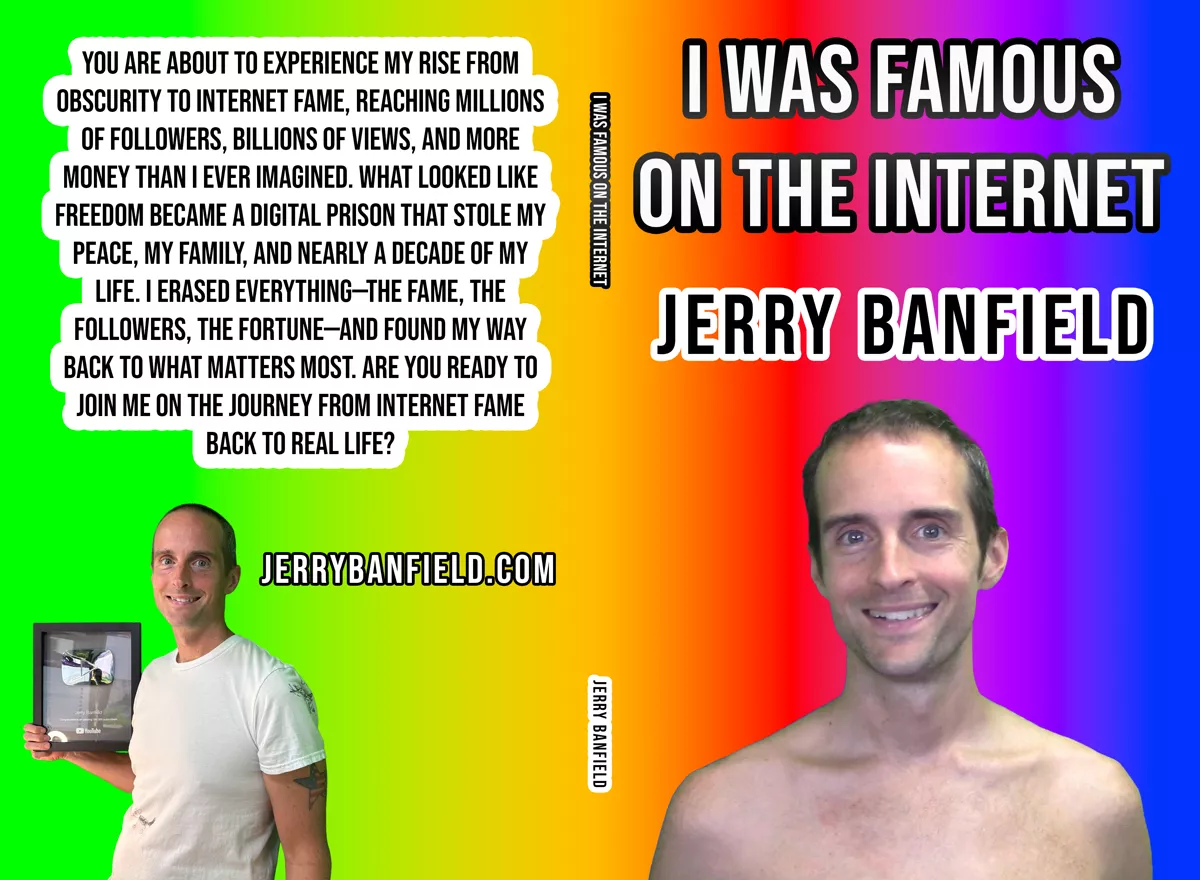
This is an excerpt from my memoir, I Was Famous on the Internet — my honest story of 14 years of internet fame and what it really cost, and why I deleted it all to choose real life.
The Race Change Fallout
The Facebook Gaming team had my phone number, my address, my Social Security number, my email, and my Discord. Instead of using any of those methods to contact me and ask me if I was serious about changing my race, they chose to flag my post as hate speech and assume the narrative the haters had made up. This was shocking given the post and live stream had been very clear to anyone that watched it. I said I loved Black and everything Black, and that I had been inspired by the trans community to change my race.
I interpreted Facebook Gaming’s label of hate speech on my post to be racial discrimination based on the color of my skin. If my skin had even a tiny bit more melatonin, there’s no way they call my post hate speech. I maintain what Facebook Gaming did in demonetizing my page was illegal while also exposing them to civil liability. So far, I have not taken any legal action against them because that doesn’t feel like an effective use of my time and, like Udemy, they have practically unlimited resources to defend themselves.
On Twitter, the Facebook gaming account celebrated “protecting” Black History Month by demonetizing me which would have made an easy target for legal action. Meanwhile, YouTube, Twitch, and Twitter could clearly see my post was not hate speech and they refused to give into the mass reports of my accounts. The racial discrimination from Facebook gaming felt worse than when Udemy banned me. Losing Udemy had damaged my pockets, and I went a little viral because of it. This, though, was different.
My race change went viral at a level I had never seen before. I still don’t know anyone who has gone this viral. It spread so fast and wide that major channels on every platform were covering it and talking about me. The crazy part is that the initial post probably only got 1% of the reach it would have had if it hadn’t been taken down. I made several follow-up posts calling Facebook out for their hypocrisy. Strangely, they didn’t censor those because I wrote them carefully enough that nobody could take them seriously as hate speech.
The night I changed my race, was one of the hardest I’ve had in a decade. I felt utterly betrayed by everything and everyone online. My supporters were mostly silent. Some agreed with me and were supportive, and a few commented during the live stream at first, but most were too scared to speak up once they saw the hatred pouring in. There were Black creators who openly supported me right away including some of my fellow top Facebook Gaming partners. They showed up in the live stream chat saying things like, I don’t know what’s going on here, but I see all this hate in your chat. I’m glad you’re on the team. I support you. Thank you for caring about us. Their presence meant a lot to me. The tragedy was that many others who felt the same were too scared to say anything publicly, while the haters had no problem flooding in from every direction. Having even a few people willing to say I see you and I support you changed everything for me that night, which is exactly why, if you want people in your corner long before any storm shows up, you can schedule a private call with me.
At least half of my audience instantly turned on me and became haters. They started contacting other streamers and spreading lies including calling me racist, saying I hated Black people, and saying I hated transgender. It was literally the opposite of what I had said but online, the truth unfortunately doesn’t matter. What matters is what people say about you, what the bots and the algorithms spread, and how the platforms decide to react.
Within 12 hours of changing my race, I began deleting every account as a protest to the entire fraudulent internet. I deleted my Facebook page and profile. I deleted TikTok, Instagram, Twitter, and LinkedIn. The only account I didn’t delete was YouTube, because the other platforms gave you the option to restore later, while YouTube warned that once deleted, it was permanent.
The one idea that kept me from walking away completely was the thought that I couldn’t let the haters win. My initial intention had been squashed. The narratives the haters spread were amplified far more than my own words. I became determined to flip that, to make sure my original intention and message reached more people than their distorted stories. That was a tall order, especially since I had started trending on gossip news for a day or two. It seemed like every YouTuber chasing clicks and covering internet drama was making videos about me.
As I started watching some of the videos about my race change, I noticed that the vast majority were poorly researched and grossly inaccurate. White creators were consistently the most critical, insisting I was obviously racist and hateful, while often getting the facts completely wrong. Some said I had used racist language, which was provably false. Others said I had been banned completely from Facebook, which also wasn’t true. Most of the videos barely contained one accurate statement alongside a bunch of useless commentary and made up lies.
Watching news that I was actually a part of showed me the insanity of the system we’re living in. The places people get their news today are filled with inaccuracies because many creators churn out content at a rapid pace without taking time to fact check. The faster they pump out ten or twenty stories of internet drama in a day, the more views they get. With this creative process, the facts and the people get mangled. Unfortunately, there are almost no consequences for putting out false information like this unless the victims have enough money or power to fight back with lawsuits which most do not. After watching the videos about my race change, I realized I could no longer trust almost anything I saw on the internet that claimed to be “news.” Nobody was verifying, nobody was fact-checking, and misinformation spread unchecked because accuracy didn’t matter nearly as much as speed.
The first 48 hours after changing my race were brutal. Everybody I talked to was against me. My family, my friends, even my ex-wife my ex-wife was hostile about it. The number one thing I felt guilty about was not telling her beforehand. I promised that if I ever had a big idea like this again, I would make sure to talk to family and friends first. At that point, my ex-wife had been live streaming with me every week. She had been on my show, part of my content. She was afraid of all this hate reflecting on her and our family the way it had in the past.
Black Celebrity Support
Everything changed for me two days after my original live video came out. A black celebrity known as Charlemagne tha God, the best-selling author of the book Black Privilege, which I had read years earlier and found inspiring, did a video on The Breakfast Club radio show. His show went out on the major media platforms as well as traditional radio stations to millions of listeners. In the video and radio show, Charlemagne supported my race change, showed clips from my stream, and criticized Facebook Gaming for their hypocrisy. He said that Black History Month was the exact right time to change my race. He believed I was completely sincere, and he welcomed me to the team.
Charlemagne pointed out with irony that I had wanted to understand what it was like to be a Black man, and then Facebook gaming treated me like a Black man by discriminating against me based solely on the color of my skin. I thought, “Well, I did get what I asked for, didn’t I?” It was a painful lesson that I’m very grateful for today. Charlemagne’s video had a big impact on the conversation. Before his video, many of the people who supported me were hesitant to show it openly. Once Charlemagne’s video came out, more people were willing to show support, and I felt like I wasn’t crazy.
What struck me as incredible was that Charlemagne, a Black celebrity, best-selling author, and radio host with millions of followers across many platforms, still chose not to post the video about me on Facebook. That’s how deep the censorship and control go. Even he and his team wouldn’t post criticism of Facebook gaming in a racial context on the platform itself. They put it out everywhere else—YouTube, Twitter, and The Breakfast Club radio show. Yet when I looked at the rest of their content that day, I saw the other show segments were posted on Facebook. To me, it seemed Charlemagne didn’t want his post censored for hate speech either, or maybe he asked his partner manager before posting and was told it was too hot of a subject, that it might get taken down, and it’d be better to just stay out of it. That was the shocking level of control I saw these platforms had over people’s voices.
Right after Charlemagne’s video came out, the top Black Warzone streamer on YouTube, MurdaShow, made an incredible video supporting me too. At that point, I stopped feeling so victimized and felt like I had become a voluntary sacrifice on behalf of humanity. I believed the original intention behind my race change had been fulfilled. I felt like I wasn’t crazy—I was a visionary, a genius, someone willing to sacrifice himself to expose the lies, corruption, and hypocrisy of the mind-control system that is the internet.
I took pride in the fact that changing my race led millions of people to rethink the concept of race and to question the very premise of it. In my view, race relations even improved a tiny bit based on my race change. Others began changing their race too in different directions and a few viral comedy videos came out from Black men making satire videos where they changed their race to White. I had never seen anything like this before my race change.
Then an incredible coincidence occurred. My brother told me he and a friend had been discussing race and what it means to belong to one race or another. Their conversation mirrored the exact discussion I had raised when I changed my race but they weren’t even consciously aware of my video. Neither my brother nor his friend had heard about my race change because I had not called my brother until a few days afterwards. The idea had hit the collective human consciousness so hard that it spread all over the country and even to other parts of the world in conversations just like my brother was having even without conscious knowledge of my situation.
30 days after my race change, I had another inspiration. What if I made a one-minute short that combined 30 seconds of Charlemagne’s video with 30 seconds of mine? The opening line was one of the best hooks I ever had: “I’m Black Now, Day 30.” Paired with my white face, it made for a striking contrast. That video became my most viral on TikTok despite a rough start. TikTok initially took my “I’m Black Now, Day 30” video down after users went nuts flagging it as hate speech, but I immediately appealed and got it reinstated. Once it went back up, the algorithm pushed it out to millions.
Going Viral Sucks
After my video went viral, I felt like I had done enough and made my contribution to the race conversation which I was now burnt out on. I also felt completely lost with my work. I had tried to get people to move from Facebook to Twitch, but Twitch suspended my account 2 days after my first race change stream because users went nuts reporting my channel there. I sent them Charlemagne’s video showing his support which was enough after two weeks to finally get my account reinstated along with a rare apology stating that “your account was suspended in error.” Even so, I was hesitant to encourage people to move to Twitch after that, and I was annoyed at the number of followers I lost because of the suspension.
Meanwhile, I did get thousands of new followers on YouTube, and my chat turned into a very interesting group of people. Many supported my race change and wanted me to know about their own changes as well. I attracted a lot of transgender viewers who appreciated my courage along with a bunch of people who had struggled their entire lives with their racial identity. Every single live stream brought haters too—people calling me racist, asking if I was still Black. For months, every live stream revolved around the same topic: me changing my race.
One of the most helpful comments came when someone asked if I had read Rachel Doležal’s memoir In Full Color. I had not and discovered that I had finally found someone who understood what I went through. Rachel’s book tells the story of how the media “outed” her in 2015 as a White woman who had been living and working as Black. She had dedicated her life to her community, serving as an NAACP chapter president, raising adopted Black siblings, raising her own Black children, and building a career as a Black educator and activist. She led Black Lives Matter protests and was the victim of several hate crimes perpetrated by White power groups. Yet the moment she was forced to answer the question of her race, the media decided she had no right to identify as she did purely based on her biology.
What struck me most in Rachel’s writing was her honesty about the journey—how the bonds she formed, the places she lived, and the culture she embraced shaped how she saw herself. She makes you question what race even means. Is it just DNA? Is it the family you’re born into? Or is it the community you live in, the culture you carry, and the identity you choose? Reading In Full Color forced me to think about my own decisions in a new way. I loved her book and reading it before I had changed my race would have been a big help. The irony is that if I had read her story earlier, I might never have gone through with my public race change at all because I would have been sure of getting the same treatment as her. If something in your own story has you questioning the labels other people keep putting on you, I'd be glad to hear it — you can schedule a one-on-one call with me and we can talk it through together on our call.
I got so burned out talking about my race change that even three years later, writing this part of the book has been the most difficult part to write because I’ve had this discussion a thousand times. I hope going forward we can identify first and foremost as humans living on earth while removing attention from these other divisionary identities. In a world of humans first, we celebrate the beauty of our differences in appearance, and we refuse to believe that superficial characteristics cause anything else. I’m a big believer in being the change I want to see in the world, and I see my race change as a step in the direction of people expanding identity to be more inclusive rather than divisive.
If you connect with how I live and think, you can follow the rest of my days on YouTube in my Life playlist.