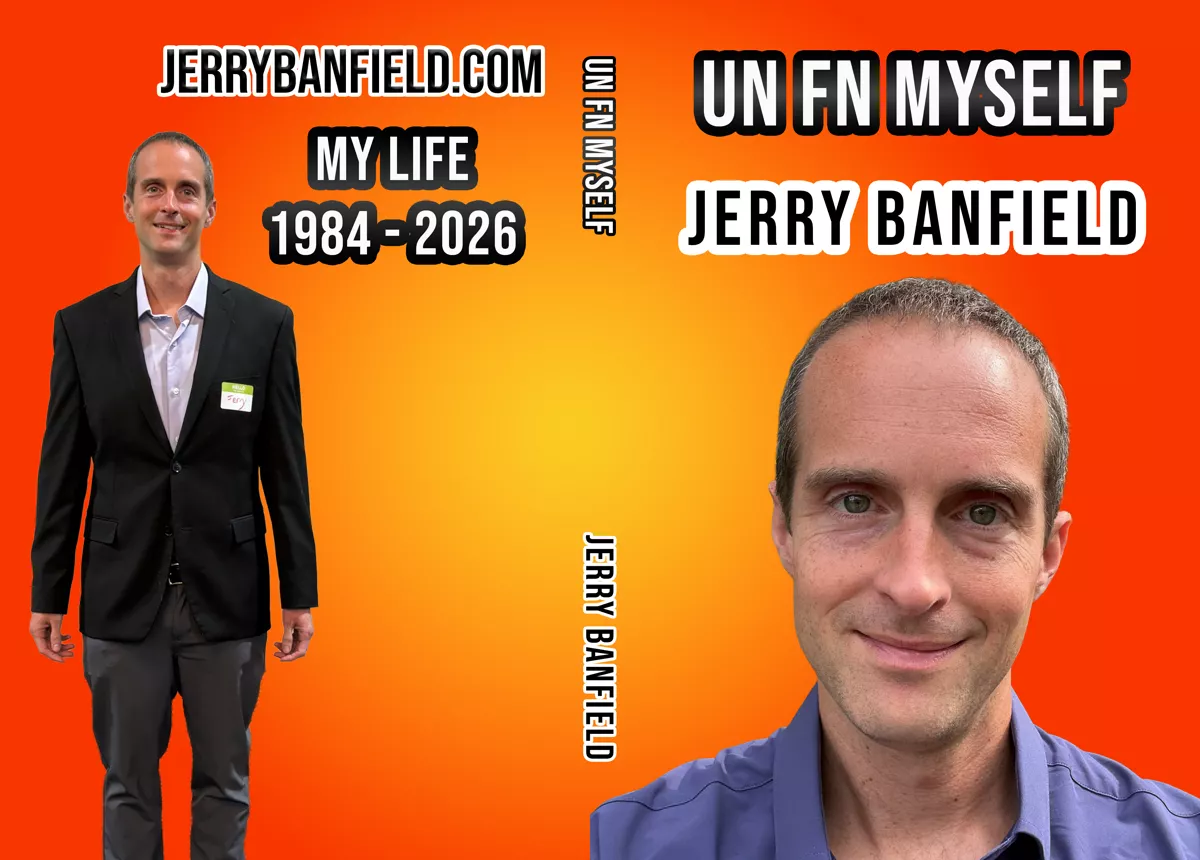
This is an excerpt from my full-life memoir, Un Fn Myself — my real story of addiction, recovery, fatherhood, and everything in between from 1984 to 2026, including the parts most people would cut out.
Around the time my ex-wife was in early pregnancy, I took a trip to Portugal for SteemFest, a conference centered around the Steem cryptocurrency. Officially, it was about supporting the platform. Looking back now, I’m pretty sure a big part of it was just people meeting in a foreign country to move money around in ways that felt sketchy. I don’t have proof of that—just strong vibes—but that was the sense I got. Regardless, it was also an opportunity to meet people in person, because by that point, I was legitimately famous within the Steem community.
That trip was my first real experience of being a celebrity in a contained environment. I walked into those conference spaces, and everyone knew who Jerry Banfield was. People came up to me constantly—raving fans telling me they loved my videos, loved my posts, that I’d changed their lives, that they’d been following me for years. You’d think that would feel amazing. It didn’t. It made me feel mentally ill.
Every time someone approached me with that level of familiarity and affection, my brain immediately went into panic mode. You should know this person. You must have forgotten. You must have amnesia. It felt wrong. Here was someone for whom I was a meaningful figure in their life, and they were effectively a stranger to me. I didn’t know their name. I didn’t know their story. They adored me, and I had almost nothing to give them in return beyond politeness and gratitude. All I could do was say thank you, tell them I appreciated their support, and ask them who they were and what their story was. The imbalance felt deeply uncomfortable, and that discomfort stuck with me long after the conference ended.
When that kind of interaction happens once, it’s awkward but manageable. When it happens over and over and over again, it becomes exhausting. Eventually, I didn’t even want to be at the conference anymore. Some people were over-the-top nice—full fanboy and fangirl energy—gushing, emotional, treating me like I was some kind of savior figure. Others clearly didn’t like me at all. They weren’t openly hostile, but the tension was obvious. It was the kind of vibe where you could feel them thinking, I have to tolerate this asshole. I was outspoken, I was the top author, and I had a reputation for running my mouth—first on Udemy, and now on Steem—saying exactly what I wanted to say.
This time, I couldn’t be banned, but people could downvote me, and they did. Some people absolutely hated me. A few of them weren’t even public about it. They’d be at the conference with eighty different profiles online, smiling in person while trashing me anonymously. That underlying hostility made everything feel tense and uncomfortable. Between being idolized by strangers and quietly resented by others, I got tired of being around the crowd entirely. I ended up spending most of the trip hanging out with friends instead.
The same friend who had hired me for Udemy coaching—a friend from overseas—came out to Portugal. We got a hotel room together and spent a lot of the trip exploring Lisbon, going out at night, talking, laughing, and actually enjoying ourselves. That part of the trip was great. At one point, I decided that I should do stand-up comedy because I had tried doing a few comedy videos and watched a lot of comedians on Netflix. I told the event organizer I wanted to host a stand-up routine if there was space. He gave me a slot one night at the bar during the conference.
I went up and absolutely bombed. People tried to cheer for me because there were so many fans in the room, and a couple of jokes did land, but overall it was rough. What I didn’t understand then was that if people are expecting stand-up comedy and you spend the first half of your set giving what amounts to an inspirational speech—with no punchlines—it doesn’t work. That first performance ended up on YouTube and eventually got tens of thousands of views, but it was bad. I was embarrassed.
If I could do it over again, I would have gone fully raunchy and unapologetically nasty. That’s what actually makes me laugh—comedians like Dave Chapelle, Anthony Jeselnik, Bill Burr, Louis C.K.—the kind of humor that goes straight for the jugular and doesn’t flinch. I like dark jokes. I like offensive jokes. I like ripping into uncomfortable territory. At the time, though, I was trying to be general-audience friendly. I had a firm policy that I wouldn’t go graphic or too dark on YouTube because I didn’t want that kind of attention attached to my channel, especially with kids watching, and I didn’t want it reflecting poorly on my ex-wife, our family, or our friends.
Not long after that, I read a book by Mark Manson called The Subtle Art of Not Giving a Fuck and in 2018, I finally let it all out. I recorded a graphic stand-up comedy podcast and a series of explicit stand-up comedy videos and put them on Amazon plus Vimeo. I tried to sell access to them. I promoted the hell out of it across all my channels. And to this day, I still remember the result clearly: I made less than $50 in sales. FML.
The comedy itself was wild. It was graphic. It slapped you in the face immediately. But because this book is meant for a broader audience, I’m not going to drop straight into that material here. If you want a real taste of where my head was at, read—or better yet, listen to—the audio version of my Speaker Meeting 2017 book. Especially the sex addiction chapter. That will give you a clear sense of how I opened my one-hour comedy routine and the kind of territory I was finally willing to go into once I stopped trying to be palatable.
I was laughing so hard listening to my own dark comedy that it genuinely wrecked me. I was doubled over, tears in my eyes, thinking, I have never heard anything this graphic, this insane, this unfiltered in my life. It felt like I had tapped into something raw and completely unrestrained. I loved it. Naturally, I tried sharing it on Facebook. Despite giving very clear, repeated disclaimers—telling people explicitly that if they got offended easily, they should absolutely not listen to it—some family members listened anyway. And of course, they got offended. They told me I couldn’t have things like that up, that I had kids, that I couldn’t say shit like that publicly. That reaction was part of what pushed me further in that direction. After bombing with my clean-ish stand-up at SteemFest, this was the pendulum swing in the opposite direction.
When I got home from SteemFest, I also realized something else: I didn’t actually like most of the people there. I met the CEO, and he came across as inauthentic to me. A lot of other people did too. There were plenty of love-and-light spiritual hippie types—people who talked endlessly about consciousness, unity, and positivity, but clearly had deep money issues. They’d preach love and light and then steal your pocketbook, downvote your posts, or stab you in the back the moment you turned around. That realization hit hard. It stripped away a lot of the illusion I had about the community.
I came home with what I thought was an incredible idea for Steem. I shared it openly. The community absolutely shit all over it. Then, not long after, one of the top community members—someone with massive voting power and a ton of money, though nowhere near the following I had—copied my idea almost word for word. Literally verbatim. This was the same guy who had been one of the loudest critics of it. He implemented it, got all the credit, and was praised for it. That was a brutal business lesson: when you come up with a great idea, people will often tear it apart publicly and then quietly steal it so they get all the upside and you get nothing. That taught me to be careful where I open up my best thinking.
That experience burned me out on Steem. I had gone all in for a year. I had alienated my huge YouTube and Facebook audiences in the process. By then, my audience was disgusted with me and all the views were trending down. They were sick of hearing about Steem. I had grown explosively in 2015, 2016, and 2017 on YouTube, but after a year of endless Steem posts and nonstop music production live streams, people were done. I had also spent that year making music relentlessly. In the first year and a half, I produced around seventy songs. Those songs are still some of the few things I never deleted. They’re still on Spotify today.
My favorite early track is a song I named after my son, on my favorite album 0 = 1. The album title came from an esoteric idea I’ve always loved—that God is nothing and God is everything at the same time, so zero equals one. The last ten or so tracks on that album are pure dance songs, and they’re honestly great. Just thinking about them now makes me want to stop writing books altogether and go back to making music. The problem is, while book writing has been challenging, it’s also obvious how much help I can offer people through it. With music, I have no idea how I’d monetize it in any meaningful way today. There’s an endless flood of music out there, and all I really want to make is weird dance shit that doesn’t fit neatly anywhere. Still, I had a lot of fun making music. And that fun mattered more to me than almost anything else at the time.
What finally broke everything open on Steem happened the night my son was born in June. I was home alone with my daughter while my ex-wife was in the hospital. My daughter was asleep, the house was quiet, and I put on a graphic stand-up comedy special—Jim Norton. As I listened, I thought, You know what? I can do some shit like this. I had been holding myself back for a long time, trying to be a good boy inside the Steem community, trying to minimize downvotes, trying to help people, trying to play the game. That night, something snapped. If you've been holding yourself back too, trying to stay palatable, and you can feel something in you wanting out, it can help to talk it through with people first, so you're welcome to schedule a private call with me.
I recorded a stand-up comedy video and put it out on a platform called DLive, which was essentially decentralized video platform integrated with Steem. And for the first time, I said exactly what I wanted to say. I didn’t censor myself. I didn’t try to be diplomatic. I didn’t try to protect my reputation. I laid into the Steem community hard, and I did it with graphic sexual content layered all through it. This was decentralized. There was no moderation to fear. I decided, fuck it, I’m going all out.
That video exploded. It became the most watched video ever on DLive. Everyone was talking about it. At the same time, my posts started getting downvoted harder than ever before. I didn’t back off. I leaned in. I called people out as frauds, assholes, and liars. I told them to go ahead and fucking downvote me. I said the whole thing was fake, that the currency was going to fail, and that they all sucked. A year and a half of crypto content, analysis, promotion, frustration, and resentment poured out in one release. That was the real beginning of my exit from Steem and from crypto YouTube altogether.
If you connect with how I live and think, you can follow the rest of my days on YouTube in my Life playlist.