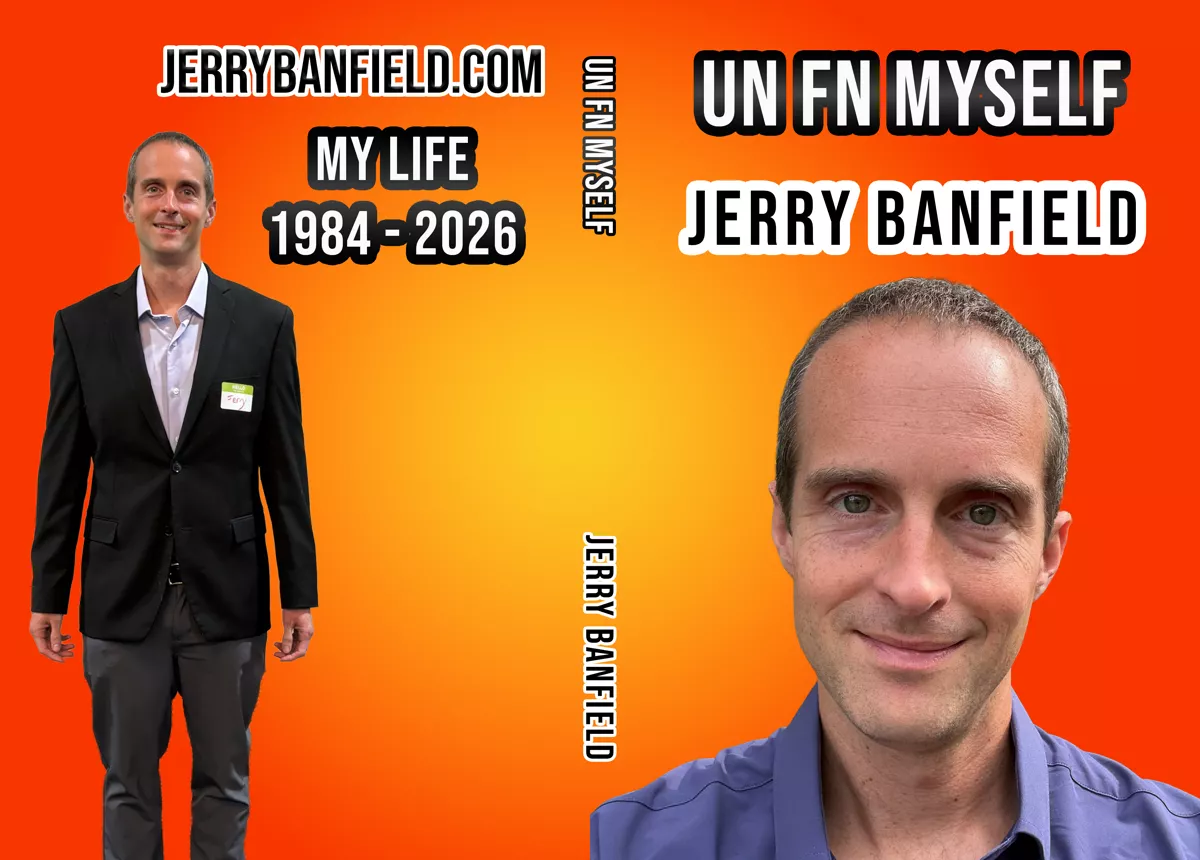
This is an excerpt from my full-life memoir, Un Fn Myself — my real story of addiction, recovery, fatherhood, and everything in between from 1984 to 2026, including the parts most people would cut out.
My daughter was born in August 2015, and that was an incredible time. The joy was real—about as much joy as I imagined having a baby would bring—but I was surprised by something I hadn’t expected. I didn’t feel an immediate, overwhelming bond the moment she was born. It felt more like meeting a brand-new person for the first time. There was love, but the connection took work. The baby was also frustrating. My ex-wife did almost everything, and we asked for almost no help, which in hindsight was insane. The very first night we were home with my daughter, my ex-wife tried to put her down in a crib without swaddling her, just dressed in a short-sleeved outfit like tiny shorts and a shirt. No blanket, nothing. Then she was confused about why the baby wouldn’t sleep and concluded that my daughter just wouldn’t sleep in a crib. So one of us ended up holding her all night.
Once we realized we had a baby carrier and figured out that she would sleep in it, I took the night shift. I’d stay up until three or four in the morning with my daughter in the carrier while my ex-wife slept. I worked on my videos during those hours. I literally filmed Udemy course videos with my daughter strapped to my chest. I also played Call of Duty with her in the baby carrier. Sometimes she’d wake up and start getting cranky while I was in the middle of a kill streak, and I’d make her wait until I finished. One night, I had her in a Snuggabunny while my ex-wife was out working out, and I let her cry for at least twenty minutes before I attended to her. I remember thinking she was kind of a needy baby. I was sitting right next to her, playing video games with a friend, saying things like, “Sorry, the baby’s crying. I don’t know why she’s so needy.”
That thought horrifies me now. At the time, nobody had taught me how to take care of a baby, and I genuinely believed things like, yeah, she needs to learn to wait a minute. I was still half in my own head, half in my old habits, even though I was sober. And yet, despite all of that, I really did enjoy being a father. Even with the mistakes, the exhaustion, the cluelessness, there was something deeply meaningful about being there, about showing up, about not drinking and not disappearing. For all my flaws in those early months, I was present in a way I never could have been before.
We took my daughter to the mall, trying to do normal family things, but our marriage became unstable at different points during that period. The baby changed everything for my ex-wife in a way that completely disrupted the dynamic we’d had before. For most of our relationship, the focus had been on me. My ex-wife paid a tremendous amount of attention to me and was deeply emotionally invested in my needs, my moods, my struggles. After the baby arrived, that attention quite naturally shifted to my daughter, and suddenly I was in second place. I didn’t handle that transition gracefully.
Our intimacy changed too, and I handled the loss of attention badly. I struggled with that gap between expectation and reality, especially while trying to adjust to being a new father, staying sober, and managing everything else in my life. It felt like multiple losses stacked on top of each other—attention, intimacy, control—right at a time when I was already stretched thin.
At the same time my daughter was born, my mom was having an incredibly hard time. She was angry that she couldn’t come stay with us, and on top of that, my grandmother—who my mom was very close to—had just died. My mom spun out. Not long after, she decided to go riding at night even though she knew it was a bad idea. She did it anyway, and it ended in a bad riding accident that nearly killed her.
She was alone when it happened and barely managed to call for help, and my brother ended up coordinating with paramedics from a distance to get to her. The accident put her through months of hospitals and rehab getting put back together.
Just as things were starting to stabilize, she had more complications. They put her in a nursing home, where she was miserable. She wanted me to visit her, and when she asked, I told her flat out that I wasn’t coming. I told her I had a newborn baby and that I was providing all the income for my family. I told her it wasn’t my fault she got hurt. Riding that night was her decision. It was irresponsible. I didn’t have time to visit her, and I wasn’t going to rearrange my life around it.
What made it more complicated was that I had just been in Michigan for my grandmother’s funeral not long before my mom’s accident. I had flown up for a couple of days, seen my family, and then flown back. My mom had actually been there shortly before my grandmother died. From my perspective, she could have come to visit us instead of isolating herself and spiraling. I told myself that she chose not to, that she got angry, and that she could have avoided the accident altogether. In my mind at the time, I wasn’t going to cosign her choices.
So that was 2015 for me. On the surface, I was wildly successful on Udemy, making more money than I’d ever imagined. I had a new baby I genuinely loved. Underneath that, I was navigating a strained marriage, unresolved resentment, and a deeply complicated relationship with my mother, who was falling apart while I refused to show up. It was a year of growth, yes—but also a year where my blind spots were still very much alive.
By 2016, my mom completely spun out. She went into a severe mental-health and medication crisis. I was incredibly codependent with her at that point. I was talking to her on the phone for about an hour a day, trying to be there for her while also trying to get her to get her shit together. Eventually she left the nursing home, but the crisis followed her home. The whole thing was a nonstop crisis loop.
Dealing with her was dragging me into a dark place of my own, and that scared me. I started asking everyone in AA for help, and the consistent message I got was that I needed to set boundaries with my mother. So I finally did. I called her by her real name instead of “Mom,” which absolutely infuriated her. She went on a long tirade about how selfish I was, how I hadn’t done anything for her, what a terrible son I was. I told her that was enough. I told her I wasn’t going to talk to her again until she got her shit together. I told her that her life was hers to live however she chose. She had done her part as my mother. I didn’t need her for anything else. And then I said goodbye and hung up. Learning to hold a boundary like that without losing myself took a whole community of people around me, and if you're trying to hold a boundary like that, I'd love for you to schedule a private call with me.
She sent me a few nasty text messages afterward, which I ignored. We didn’t talk for a couple of months. Thankfully, her sister came down and stayed with her for a while and helped stabilize her. After that, my mom reached out to me, apologized, and said she wanted to reconnect. We talked and worked on setting some boundaries. I told her I didn’t want to be called names and I didn’t want to be expected to do things I hadn’t agreed to do. She told me she didn’t want me constantly trying to fix her or tell her what to do, that she was a grown-ass woman and didn’t need my help. I said, good. If you don’t need my help, then I’m not coming to visit, and I’ve got plenty of things to do here. That was the first time our relationship felt even remotely sane.
After that, I hit a bit of a sweet spot. Things were going really well in AA. My body was getting healthier too. In the first few months of sobriety, I had lost around twenty pounds and got back down to about 220 pounds. But then my weight loss stalled, and I was frustrated. I thought sobriety alone would take more weight off. Instead, I plateaued and still had a lot of extra fat. I remember thinking, I’ve got to go further. I’m still way too fat. There’s a lot more weight I can lose.
I started tracking everything I ate using MyFitnessPal. I kept up with personal training and was seeing a trainer a couple of times a week. She told me straight up that she could train me as much as I wanted, but eighty percent of how my body looked and felt came down to what I ate. She was in great shape herself and clearly lived what she taught, so I took her seriously, and her message stuck with me. If I wanted real change, sobriety wasn’t the finish line. It was just the starting point.
I took her advice seriously and decided I really did need to focus on my diet in a more disciplined way. I started reading books about food and nutrition, and most of them were complete garbage—thinly disguised sales funnels filled with nonsense designed to push supplements or products. Still, I did get one genuinely useful idea out of that mess: radical honesty through tracking. I committed to using MyFitnessPal to track everything I ate. And I mean everything. For a full year, if it had more than about ten calories, it went into the app. Every single day. Some days—like Thanksgiving—I ate close to 4,000 calories, and I logged all of it as accurately as I could. I made a simple rule for myself: you can eat whatever you want, but you have to admit it. You have to look at it. You have to see the calories and the ingredients and own your choices.
I did that for an entire year, alongside continuing to lift weights, exercise, and stay generally active. I also made some practical changes. I got a standing desk so I could stand while filming my videos. I still stand to record audiobooks now because it gives me more energy and presence, and it burns more calories. The first few weeks were brutal—my legs hurt constantly—but they adapted. Now it’s just normal. I’ve live-streamed for six or seven hours straight while standing. People ask me how I do it, and for me the answer was simple: my body adjusted. Standing worked for me once I stopped treating it like it was abnormal.
As I kept tracking my calories, something else became obvious. The food I was eating was loaded with garbage ingredients. I also noticed physical issues that hadn’t resolved with sobriety. I had these spots on my chest and back that had been there since I was drinking in 2013. I assumed they would disappear once I got sober, but they didn’t. That pushed me into trying elimination diets. One of them was ridiculous in hindsight: turkey, green peppers, and rice. That’s it. I ate only those three foods for three days. My body got physically ill, and I stopped immediately. I tried a few other elimination approaches, but every time I looked back at MyFitnessPal, all I could see was chaos—long ingredient lists, processed foods, things I didn’t understand. I felt overwhelmed and hopeless, like I couldn’t figure out how to clean this up enough to reach the next level of health. If you're stuck at a plateau like that and feeling hopeless about your own body, you can schedule a one-on-one call with me and we'll talk honestly through where you are.
That frustration started to bleed into everything else. I began spiraling about my diet and my body, feeling stuck. I responded the way I often did back then: by going nuts trying to make money and hoping that success would fill whatever was missing. I obsessed over my business constantly. Compared to drinking, this was a massive improvement—but it was still compulsive, still driven by restlessness rather than peace. By the middle of 2016, my first two years of sobriety had objectively gone very well. I had rebuilt my life in many ways. But getting banned from Udemy that summer, combined with spiraling about my health and feeling stuck physically, pushed me to another edge. It became clear I couldn’t just grind harder or optimize more. I needed to make deeper changes. I was at another jumping-off point, one where hitting the next level meant doing something fundamentally different.
If you connect with how I live and think, you can follow the rest of my days on YouTube in my Life playlist.