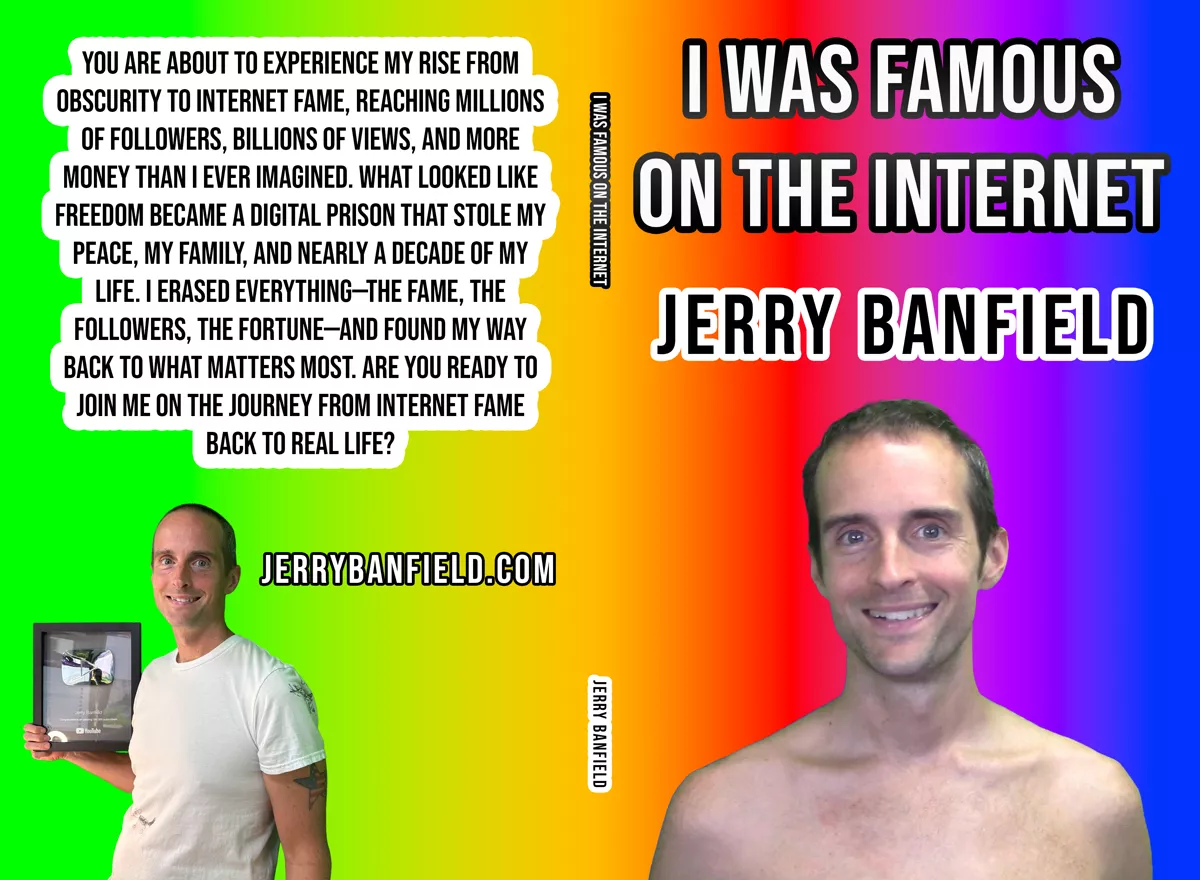
This is an excerpt from my memoir, I Was Famous on the Internet — my honest story of 14 years of internet fame and what it really cost, and why I deleted it all to choose real life.
Filling Time Without Screens
One of the next big questions people ask me is how I fill my free time without TV, video games, music, or endless scrolling. What kinds of hobbies do I pick up now? How do I handle boredom without reaching for a device? What does my daily routine look like? How do I track and limit my own technology use?
The big question for me is always: can I use something without being addicted to it? That’s the dividing line. With ChatGPT, for example, I can use it purely as a tool. I don’t get hooked on it. I don’t find myself craving to talk to it again. It does its job and I move on. For me, it’s a fantastic writing support tool, but it doesn’t pull me back compulsively. You might have a different experience, and in that case, limiting your use could be helpful. For me, though, it hasn’t been addictive.
The first thing I look at with any technology is whether it hooks me. By that, I mean does it keep me compulsively reaching for it. Apps like YouTube, Instagram, Facebook, TikTok, LinkedIn, Twitch, and X are designed to maximize your time on them. They hook you because that’s how they maximize profits. When I cut those out, I noticed that the rest of technology—things like Microsoft Word, Google Search, Google Maps, or even ChatGPT—are easier to use without falling into addictive patterns.
Now those hooks are gone, I have a lot of free time. Even though I never watched TV or movies addictively, I see that the opportunity cost was too high. They’re so stimulating that they make real life dull by comparison. As a kid, I remember watching Star Wars. It pulled me in so deeply that my own imagination no longer seemed fun, and school became boring next to those epic scenes. That’s why I don’t watch movies or TV today. I don’t have Netflix. I don’t even listen to music or stand-up comedy anymore, because they’re so stimulating that they make it harder for me to enjoy everyday experiences.
Without sensational media, the things that would otherwise seem boring—like reading a book or chatting casually with someone after yoga—become enjoyable. Talking with a regular person can be stimulating because I haven’t just watched a perfectly edited comedy special or a binge-worthy show. I haven’t filled my mind with someone else’s polished entertainment. I will still occasionally go in person to see a show, but I’m picky about where I go because I prefer not to be around alcohol. The same goes for networking groups. I’ll try them, but if I see that drinking is a big part of it, I usually don’t go back. Still, those experiences can be useful to try once.
Here’s what my daily life looks like now. I wake up around 7:00 a.m., help get the kids ready for school, wash the dishes, and have a Larabar or two for breakfast. Next, I drive the kids to school while listening to an audiobook, or sometimes I’d read a physical book before heading to yoga. At 9:00 a.m., I do a yoga class at my yoga studio. After yoga, I often meet someone for a massage, a coaching session, or have tea with a friend. If I don’t have something scheduled, I come home and work on my books for a few hours.
In the afternoon, I pick the kids up, usually calling my AA sponsor on the way or listening to an audiobook. Sometimes I just enjoy silence if needed. After school, I wash dishes, play with the kids, go to an AA meeting, play tennis, and/or visit my mom with the kids. Evenings are filled with helping put the kids to bed, walking the dog, making phone calls, listening to another audiobook, and editing my books. Finally, shower, reading, and sleep around 11:00 p.m.
With this schedule, nothing is overstimulating. My mind isn’t pulled into obsession. I’m not listening to songs that get stuck in my head and distract me from being present. I’m not reeled in by a TV show. Everything I do leaves me grounded enough to enjoy the simple parts of life—conversations, books, yoga, tennis, time with my family. You can be a part of that when you find a time to meet up with me at jerrybanfield.com.
Creative Outlets and the Freedom of Deletion
Sometimes I listen to an audiobook that pulls me in so deeply I rip through it as fast as possible. Most of the time, though, audiobooks give me a steady rhythm. They’re just engaging enough to hold my interest, but not so overwhelming that I am distracted. They satisfy my desire for new ideas, things I wouldn’t easily get just by talking to people. They help me learn and grow without overstimulating me or making me addicted. I’m not constantly reaching for the next moment to squeeze in more listening. Occasionally a book grabs me so powerfully that I must finish it immediately, but usually I move through them at a balanced pace, letting them fit naturally into my life.
What stands out in my routines is that I’m out in the world. I’m playing tennis, I’m at yoga, I’m going to AA meetings, I’m meeting people. I’m not just staying in my house all the time. That’s something I notice many people doing—they stay at home too much. Having a “third place” makes all the difference. For me, that might be the tennis club, a yoga studio, or the AA clubhouse. It’s a place that isn’t home or work, somewhere I can show up, connect, and belong.
There are so many hobbies you can pick up right away—tennis, racquetball, pickleball, basketball, etc. Sports are some of the greatest hobbies because they’re not only physically engaging, but they also open doors to friendships. I’ve made lots of friends at the tennis club, and we’ve talked often about how great it feels to bond around something active that doesn’t involve drinking. So many people set up their lives around a cycle of consuming media, working, and then drinking. That’s a formula for suffering. Building friendships around something healthy instead of drinking is exactly what I'm after.
I rarely get bored because I have outlets for my creativity. On a road trip this past summer, I went weeks without any outlet, and I could feel books bursting to come out of me every day. I always had something I wanted to say, something that needed to take shape as a book. Not everyone will have that same pull toward writing, but everyone needs some kind of outlet. It could be painting, knitting, woodworking, carpentry, or even organizing and rearranging a house. For me, writing is natural, but I’ve seen how others find creativity in different ways.
My dad created with his hands as a carpenter. Massage or yoga can be outlets too, a way of expressing creativity through the body. My ex-wife has taken to gardening recently, and I think it’s one of the best hobbies you can have. Gardening connects you with the earth, and it literally feeds you. Even if you live in the city without land, you can try hydroponics or potted plants. My ex-wife has plants all over the house, plus a garden outside. You can also get involved in a community garden. The church where I go to AA has a large garden outside that members maintain, and it’s an open invitation to anyone who wants to participate. Talking with people about their hobbies is a great way to discover possibilities you hadn’t thought of.
For me, hobbies and outlets guarantee I don’t get bored but then I have the opposite problem. If you gave me 100 hours a day, I could fill all of them. I’d play more tennis, take more yoga, write more books, go to more AA meetings, do massage school, take yoga teacher training, spend more time with my kids, build more friendships, and enjoy more romance. My biggest challenge is fitting what I want into the hours I already have, deciding what I truly want to do versus what I’d just like to dabble in.
Because of that, I don’t need to track or limit my technology use. It happens automatically. In AA, there’s a saying: if you’re trying to control something, you already have a problem. Whether it’s alcohol, drugs, plant medicine, or time spent on Facebook, Instagram, YouTube, video games, movies, TV, or music—if you’re trying to control it, then you’re already in trouble. The best solution in my life has been to eliminate all of those things entirely. If you're quietly trying to control something like that and it isn't working, you don't have to sort it out alone — you can set up a call with me and we'll talk through your own relationship with it together on our call.
That’s why I deleted everything online. Making that single choice eliminated thousands of smaller choices. Instead of constantly deciding what video to make, what to say, when to upload, or how to adjust my life to fit the algorithm, I made one decision and freed myself from all of that. Now I live in the simplicity of writing books. That one big deletion created space for everything else.
Real Life Is Better
This book is, at its heart, a message to content creators and consumers. I’ve lived every side of it—the obscurity, uncertainty, growth, viral highs, fake friends, huge paychecks, passive income, cancellations, the burnout, and finally the end. I’ve been the one on stage soaking up attention, and I’ve been the one erased overnight. After all of it, the lesson is simple: real life is better.
In real life, space is shared. Go to an AA meeting and you’ll see it—everyone takes a turn, everyone has their time. If one person tried to dominate every meeting, talking nonstop, the group would resent them and the meeting would fall apart. That balance—each of us holding our piece of the circle—is what humility looks like.
Online it’s the opposite. The system rewards people who hog all the space: the biggest voice, the loudest clickbait, the most exaggerated personality. The more you crush other voices, the more you’re celebrated. Millions of smaller voices are drowned out so that one channel can rack up views. And the irony is that most of those videos don’t even give people anything meaningful. They waste time, spread junk, and condition viewers to keep scrolling for more.
For years I believed I was helping people with my videos. I imagined that viewers walked away inspired, motivated, changed for the better. But the reality was often the opposite. My viewers were stuck in the same addiction I was—pulled into platforms designed to drain our attention, not enrich our lives.
If you’re creating content now, or thinking about starting, I hope you hear this clearly: the system is not built to support you. It’s built to use you and discard you. It will push you toward fakeness, reward you for sensationalism, and leave you unstable and disappointed. The same message applies for every minute you spend watching.
What saved me was leaving. When I stopped fighting for space online, I found space in real life—time with my family, honest conversations in AA meetings, and the simple joy of being present. Nobody can demonetize that. Nobody can cancel it. If you take anything from my story, let it be this: don’t trade your real life for numbers on a screen. Real life is better.
If you connect with how I live and think, you can follow the rest of my days on YouTube in my Life playlist.