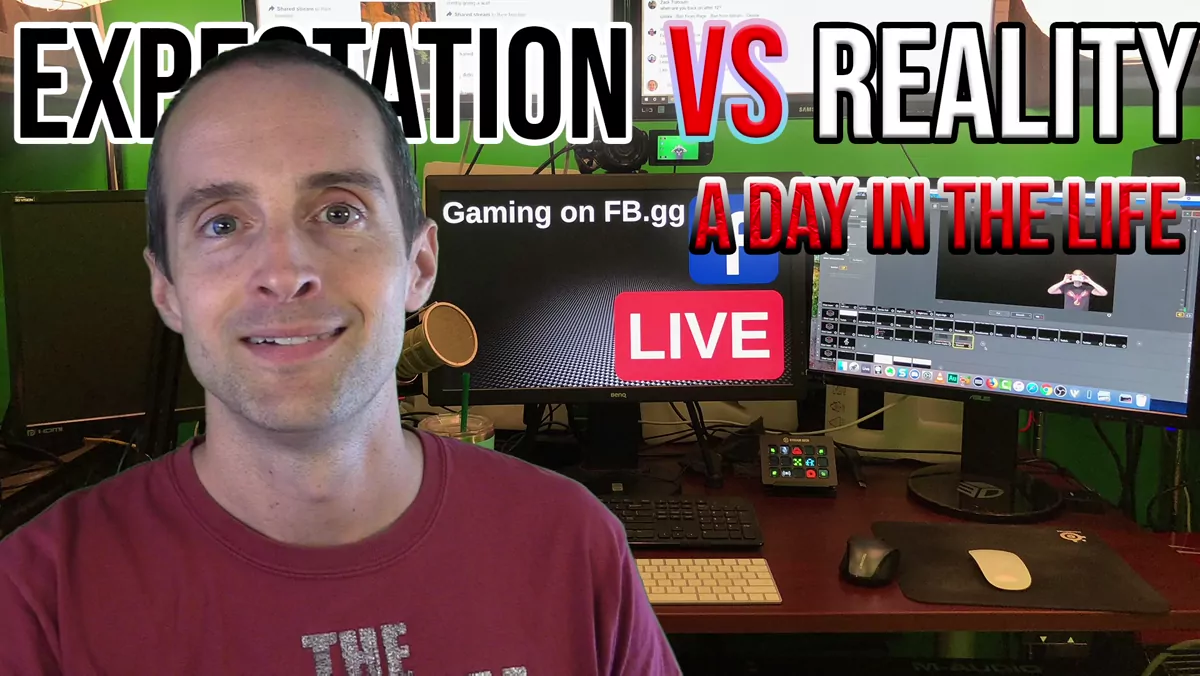
My friends, I was a professional gamer from 2020 to 2022, and I retired in 2023. I made over $100,000 in 2021 alone, and in those other years I earned my income primarily from gaming too. I want to give you a day in my life, and it's not at all what you'd expect. If you're thinking you want to be a professional gamer, or if you think gaming as a career or as a content creator is awesome, I hope you'll really read this, because you're going to be surprised.
I retired from gaming because I was really tired of it. In my experience, it's actually not very fun and fulfilling to do gaming as a job, because gaming as a job is much different than gaming for fun. So here's the average day in my life in 2021, when I was at the height of my popularity, with hundreds of thousands of people watching my gaming videos every month on Facebook Gaming, plus more on YouTube and Twitch. I was one of the top Facebook partners, and I was making an average of a little less than $10,000 a month throughout the year. Here's what I did.
An average morning at the height of my popularity
I would wake up about 7 in the morning and get the kids ready for school, or for preschool as the case was. I'd have a light breakfast, like a Larabar and some matcha green tea, and most mornings I'd drive my daughter to school, which was about a 40-minute round trip. Then I'd get home, and my wife would take our three-year-old son to VPK. That was my work time. I had about three hours, five days a week, and that was most of the time I had to do everything I wanted to do as a professional gamer.
That's one of the most amazing things about my story. Most people who are professional gamers are putting in eight to twelve-plus hours a day. I was only putting in an average of three or four hours a day. And I got paid to play with some of the best Warzone players in the world, like Legendary, who had the world record for kills. I was one of the very best Warzone solo players in terms of win percentages in 2021, and I did that in just three or four hours a day, which was incredible.
The way I did that was by being focused when I did it. I'd get prepared to do my gaming streams just by having my green tea and dropping my daughter off at school, and then thinking about why I wanted to do my stream and what I really wanted to communicate. My big purpose in doing my live streams, especially in 2021, was to help people feel better, to help people get out of their misery and their problems.
Most days I would play Call of Duty Warzone solos. In Warzone solos, at least in 2021, it was on Verdansk, 150-player maps. There was no anti-cheat software, which means you'd frequently run into cheaters, and the games would take about 30 minutes. I got to where in one live stream I could generally win one game most days, and some days I'd win four or five games. Some days I was winning half the games I was playing, and I'd get top 10 almost every single game.
The tube top, the camping, and crushing the Facebook algorithm
My thing that I did that got a lot of views is I would wear a tube top. On Facebook Gaming, you had to really get people hooked in the video right away, because your title and things like that generally wouldn't do as much. Whereas on YouTube, and Twitch is a different algorithm again. So I was able to crush the algorithm on Facebook Gaming. I'd put on a tube top where often you wouldn't even see me from the shoulders down, but it looked like I was naked. I actually was naked at first when I tried this strategy, but then I got paranoid about the camera falling down. So to get ready for gaming, I'd put myself in a pair of athletic shorts and a tube top, and I'd go on stream, and the clickbait worked. People would pour into my stream.
Then I would sit in Call of Duty Warzone, and I'd often try to avoid killing as many people as possible, and I would camp as hard as possible. So the angle of my gaming streams was different. I also allowed people to be as toxic as they wanted and say anything on my streams, which most people wouldn't do. That got Facebook to push my streams out absolutely viral, because somebody would see me in a tube top, they'd ask why I was wearing a tube top, they'd complain about my camping strategy, and then Facebook would put my stream out to all their friends, and their friends would come pouring in and join. If you want to see the whole arc of how that built up, I've shared the full story of going from a small streamer to a top Facebook Gaming partner, and you can find more of these gaming videos in my Games playlist.
Why professional gaming often felt horrible
It actually sucked a lot of days being a professional gamer. Take a note of how sensitive you are to criticism in your life. If somebody comes up to you and says you're stupid, you suck at the game you're playing, you are ugly, you don't look good at your job, there's something wrong with you, you're a pervert, you're a bad father, you probably have kids locked in the basement, now imagine having hundreds, and some days thousands, of those comments coming at you. That's why professional gaming often is actually horrible, because the people who watch professional gaming streams are often in that state of mind. And even if you have moderators, you'll see the comments lots of times before the moderators get rid of them.
So lots of days when I was on my live stream for three hours, either there weren't that many people watching, especially in the beginning, and hardly anyone was talking, and I'd feel irrelevant. Or, for most of 2021, there were a lot of people watching and just constant negativity and nasty comments, and I'd feel like I had to endure those. If I really wanted to go viral, ironically, the negative comments would get the people who really liked my stream to throw out huge amounts of money. So I very much played into that polarization, where the people who hated on my stream would just say relentless nasty things, and then someone who wanted to say "F you" to all the haters would throw out a hundred-dollar tip just to piss them all off. It was interesting. My live stream was a lot of drama every day.
It was really satisfying when everyone was saying I was a trashy Warzone player, that these cheaters and hackers who played were better than me, and then I'd actually win a game. And of course, then the haters would say, "Well, you got lucky, they sucked, you got a beginner lobby." There was never anything satisfying about shutting up the haters, which to me was a very difficult thing to deal with. It got to the point in the morning where I didn't even want to do my gaming stream. It got to feel like when I was a police officer, a similar feeling, where I was showing up to this stressful environment faced with all this negativity and nastiness, and from my mind's point of view, danger. Because sometimes the stuff from my live stream actually spilled over into other people in my life, with people threatening to call the police and sending these crazy messages. The drama and insanity of being a professional gamer is shocking if you actually get to a point where you've got a lot of people watching. It's surprisingly bad, and it's not unique to me. I've seen the exact same thing on many, many other people's streams. If you're craving the opposite of all that toxicity — honest, supportive feedback that is actually rooting for you to build healthier habits — I'd love to help you get there, so you can schedule a private call with me and we'll map out a saner way forward.
The emotional roller coaster of every stream
So often that three hours a day that I was a professional gamer on Facebook would really take all the energy out of me, and I'd get off the live stream feeling like I'd done an intense workout: stressed, aggravated, and annoyed. Occasionally I'd get off the stream feeling very triumphant. There was a day where people gave me $700 in a single three-hour live stream. I had been gaming and streaming a long time, since 2013, and I had waited about seven years at that point to have a stream like that. That one I cried on stream. It was really satisfying. So there were some awesome moments too.
But after I would log off my stream, I'd usually feel really burnt out and all hyped up, kind of similar to the feeling you might get if you did some drugs, like uppers, a little shaky. I'd get high during my stream sometimes too, all naturally, like winning a game right in all those haters' faces. But then I'd feel the down after having all those natural emotional dopamine highs from triumphing in the game. Some streams I'd win two games in a row and then nearly a third one, and it was an emotional roller coaster. After that, I'd need to go to the gym, and I'd need hours, usually, to calm down properly. I often would use the time to pick my daughter up from school, which was about a 40-minute round trip, as time to calm down and eat and relax.
I found that my shows would be more amped up if I didn't eat anything beforehand. I could come on kind of hungry and just really go nuts. Other streams I did more relaxed. After I'd pick my daughter up from school and come home, I'd mostly be around the house doing housework and helping out with the family and the chores. Our son would be there too. My wife was trying to work, because when I started trying to be a professional gamer, our financial situation was desperate. I've been a full-time content creator for 12 years now, and I'd had the worst business idea I ever had, that I sunk all my money into, which left us in a desperate financial situation, like borrowing money on credit cards to make minimum payments. So my wife had a job and a side hustle.
Balancing family, recovery, and the grind
So every day was a balancing act of trying to have one of us take the kids while the other one would work. For me, I looked at it like I needed to do the minimum as a gamer, the minimum that I could do and make some money, and get out there and carry a message of hope to people. Then as soon as that was done, it was, I need to be with the family the rest of the day.
At the time, I'd also go to an AA meeting every day around 5:30. So I'd pick my daughter up from school, I'd have a couple hours with the kids, my wife would usually work for a few hours during this time, and then I'd go to my AA meeting and come home. I'd often put the kids to bed so my wife would have more time to do her work or her exercise or whatever she wanted to do. Occasionally I'd take that time to edit raw footage and make a video, or do another live stream, but most of the time I only had about three hours a day to even get on and work.
Despite that limitation, I consistently would go to bed at 10 or 11 o'clock at night to make sure I could really get my sleep and rest up. Because if I didn't get the sleep and rest, then my live streams would be really crappy. I needed to have my full energy from a great night's sleep and from taking awesome care of myself with a whole-plant-based diet.
Taking care of myself to keep the streams alive
For exercise at the time, I was doing some of these workout classes and yoga, a few days a week. And I was making sure to get lots of sun, because I was streaming with my shirt off and a tube top. So I'd make sure I got nice and tan and looked good for the stream. I was in great shape. I had about the nicest abs I'd ever had, although the ones I've got now are pretty close. When you're on camera every day showing your abs off, it's good motivation to get out there and work out, do yoga, take walks, and be consistent with my exercise.
Lots of nights when I'd go to bed, I was pretty burnt out. Eventually I got to really resent that all I was allowed to play by the algorithm and the audience was Call of Duty. I remember going to bed some nights just being surprised that something that was too good to even dream of had come true, and yet it wasn't satisfying. I remember lots of times going to bed and waking up in the middle of the night thinking, I've got to do something else. I hate playing Call of Duty Warzone every single day. I'd lay in bed trying to figure out how I could keep doing what I was doing and actually enjoy it, because there was so much stress with it.
At various points I'd stand up while I game and while I film, to make sure I'm more interesting and energetic and animated. Sitting down is also not a good thing for you. I used to have a lot of back pain back when I sat down and played video games all the time, so standing is way better for my back. But I did pull my calf one time, because I'd been standing up so long and it was so tight, which is part of what got me into doing yoga to stretch more.
Why you can't take a day off
Sometimes I did do longer live streams, like six hours, but then I'd really feel gassed and burnt out, and often I'd need to take a day off. The trouble was, I didn't feel like I could take days off either. Because if I took a day off, my whole setup was primarily based on being live every day and getting money from ad revenue and from supporters and donations while I was live. So if I didn't go live, I didn't hardly make anything. And on Facebook, you could stop going live for a few days and lose a significant part of your audience as people moved on.
So I felt this lots of times at night. I would question everything. Some days I'd wake up like, screw it, I'm not going to do this anymore, I'm just going to play whatever game I want. Then I'd get on and nobody would watch, I wouldn't get any money, and I'd be so disgusted with the whole setup. I'd gravitate between quitting it all, like I had done in 2020 before I got into being a professional gamer. Back in 2020, I was filming a lot of online courses, and I'd sold all my equipment out of frustration and tried to make an in-person show, which didn't go that well.
That kind of grind is also why, these days, I'm careful about my relationship with games at all. I've come to treat video games like alcohol now, with real intention about when and how I play.
Why I finally quit, and why I'm glad I did
So I finally quit being a professional gamer, because in my experience gaming is a difficult way to make a living as a creator. Whereas making YouTube videos, especially crypto videos, is a very easy way for me to make a living as a creator. I can take an hour a day or less and film a crypto video every day, and that easily provides a full-time living, even being honest and turning down hundreds of thousands a month in sponsorships and all these other deals and affiliate marketing. If you're weighing whether to chase gaming or content creation as your own living, I'd be glad to give you honest personal feedback — you can schedule a one-on-one call with me and we'll look at your situation directly.
I'm so glad I did get to be a professional gamer, though. Today my life is a lot more relaxed and laid back. I still play games exclusively on Twitch, and I delete my live streams afterward, because it's inefficient to go through and watch somebody play a whole game on a live stream. It's better to just turn things into video. That same thinking is why I eventually shared why I'm quitting Twitch after nine years and reworked how I create. I deleted almost all my old gaming content off YouTube so I could start over, rethink things, and make videos that are sustainable going forward, not just grinding out Warzone videos. I am a full-time YouTuber and Twitch streamer still, and I love being a content creator. This is essentially chapter eight of my autobiography: a day in my life as a professional gamer. If conversations like this are the kind of thing you want more of, I keep them going for the people in the Jerry Banfield Family, where you can reach me directly and ask me anything you want about doing this for a living.