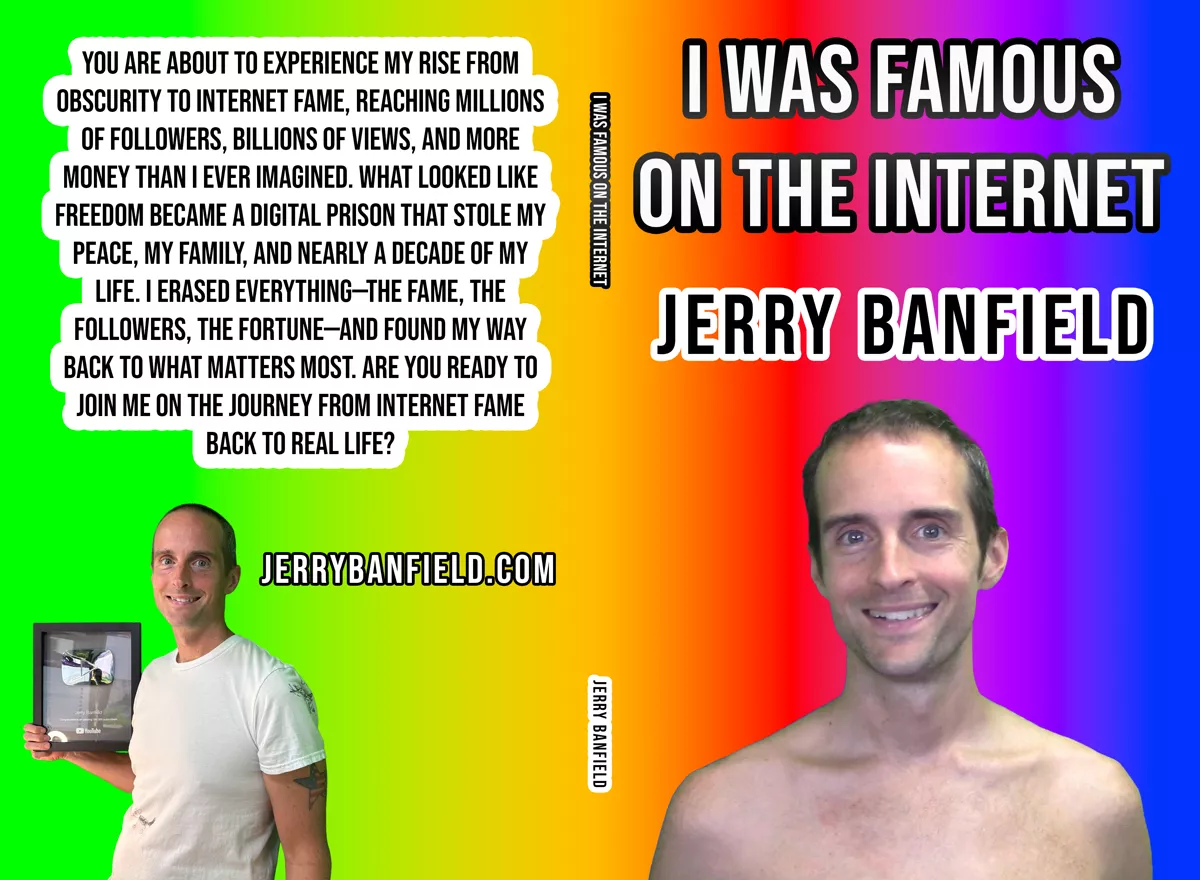
This is an excerpt from my memoir, I Was Famous on the Internet — my honest story of 14 years of internet fame and what it really cost, and why I deleted it all to choose real life.
Realizing I Was No Different Than My Kids
I look at how powerful this effect is on children and how directly it shows up in their lives. After a year of watching how much better my kids’ lives became without devices, I kept rationalizing my own use. I told myself that I was an adult, so it was different for me. I justified playing video games because I did it for “work.” I rationalized making videos online the same way I rationalized that, as a grown-up, I had the right to do things I don’t actually engage in—alcohol, smoking, gambling. I put video games and content creation into that same mental category, telling myself I was responsible enough to handle it.
It was humbling to realize I wasn’t any better than the kids. The technology was ruining my life just as much as it was ruining theirs. The worst part was that I defended and rationalized it every single day. I listened to my mind tell me I was a tech slave, walking into my office, uploading videos, convincing myself it was meaningful. Yes, I made thousands of dollars, sometimes tens of thousands of dollars a month doing it. Yet was it satisfying? No. I felt drained after filming videos. Was my content good for people? I told myself it was, but deep down I noticed a painful truth: the more I put out information that was genuinely helpful, the less people wanted to watch it. The algorithms didn’t seem to push it either.
Real Learning, No Thanks!
I saw a huge divide between content that was genuinely useful—high-quality learning, true information—and the junk people consumed endlessly. One YouTuber with hundreds of thousands of subscribers and millions of views told me he thought his viewers were idiots. He even put things like “Hey, stupid” in his titles and thumbnails. When we talked, he said his viewers didn’t want to learn, didn’t want to think, and didn’t want to be educated. All they wanted was for him to tell them exactly what to do.
At the time, I resisted that line of thought. I didn’t want to believe it. Yet when I looked at my own results, I saw the same pattern. When I made videos titled “I Bought Some Shitcoin Today – I’ll Be a Crypto Millionaire Soon!” the views poured in. When I made videos teaching people how to do their own research, almost nobody was interested. The reality was jarring: people online aren’t looking to be empowered, and the system doesn’t reward empowering content.
If I put out content confirming people’s existing beliefs, the views would come rolling in. Whenever I promised that an investment was going to rise in value, people loved it. I could make the same basic video every single day, predicting the price of a certain cryptocurrency, and it would consistently get traction. The moment I criticized a coin or said something negative, though, people went off the rails. The reaction was extreme, like I had attacked them personally. When I tried to share genuine concern and point out that a lot of the information they were getting wasn’t good, the algorithm buried my video, and viewers turned on me, hating and unfollowing. What it felt like was that people wanted to be told exactly what to do, to have their preexisting beliefs reinforced, and nothing more. The audience didn’t support anything outside of that, and neither did the algorithms. Getting out of that trap and learning to think through crypto for yourself, instead of waiting to be told what to buy, is exactly the kind of thing we can dig into together when you schedule a one-on-one call with me.
I started noticing something even darker. There were massive networks of bots that pushed certain kinds of videos. If I made a video predicting a price surge for a particular shitcoin and put a high price on the thumbnail, the bots would swarm. That push from bots would bring in real people, who would then subscribe. As long as I kept saying that shitcoin was great and going up, the bots pushed again, real people watched, and the cycle repeated. In December 2022, I launched a new crypto channel on YouTube and quickly gained tens of thousands of subscribers within three months by following that exact strategy.
Every day I bought $50 worth of a cryptocurrency and hyped it up in a video. I’d say things like, “This one is going to 10X,” or, “This dollar coin could hit ten dollars, fifty dollars, even a hundred.” I noticed some cryptos had whole armies of bots backing them, and if I mentioned those, the bots lifted me. Others had massive organic cult followings, and the same thing happened if I reinforced their optimism. Then there were cryptos with no money, no community, and no push — those videos went nowhere. The most effective strategy was what the industry calls “community farming.” All I had to do was rotate through communities, saying each coin was about to explode. That’s how I grew my channel so quickly.
Many of the so-called successful crypto YouTubers do the same thing. They say exactly what their audience wants to hear, rake in subscribers, and then move on to the really big deals. Once your audience is large enough, projects start offering serious money to get promoted. One YouTuber I knew told me he was offered over $100,000 to promote a coin. He asked my opinion, and I told him straight — in my eyes the token was absolute garbage, a scam, and everyone who bought in was going to lose. He promoted it anyway, because the money was too good to turn down and avoided talking to me for months while he did so. His logic was simple: if people were dumb enough to lose money on it, that was their problem. That logic seemed to dominate behind the scenes. Publicly, influencers would never say it, though sometimes it slipped through, but privately the consensus was clear. Most of the viewers were ignorant, broke, fools being farmed for their time and money. As I see it now, this applies across all types of content and 99% of viewer behavior.
The Illusion of Online Success
I know how quickly the mind jumps to defend itself with examples that sound positive. You might say, “Jerry, I saw something on Instagram today that really inspired me,” or, “I watched a video on YouTube and learned something valuable.” That’s fair. I’ve learned plenty of useful things from videos online too. At one point, I even took a free course that claimed it would teach me how to make $1,000 a day on Udemy which I was able to do myself although the instructor struck me as a liar and a fraud.
His main system revolved around stealing content from North Korea, uploading it to YouTube, and monetizing it through a faceless channel. He admitted this strategy openly in the YouTube course although I imagine most students did not see through how sketchy it was. Since North Korea wasn’t likely to enforce copyright claims, he could get away with theft and claim he was making passive income. From my perspective, he never showed a shred of real proof that he earned what he bragged about and his system was not something easily replicated. Still, he managed to sell millions of dollars’ worth of his “YouTube success” course thanks to Udemy promoting it all over the place for him.
He leveraged his success in that YouTube course to create a course on how he made $1,000 a day on Udemy which I got with a free coupon when he launched it in the Udemy studio Facebook group. I believed that with my hustle and my good looks, I could double or triple what he was doing which is exactly what I did. I used a different kind of hustle built on my knowledge of online marketing and freelancing.
Instead of stealing content like he was, I hired freelancers in developing countries, paid them thousands of dollars to produce entire courses, and had them sign over full copyright ownership to me as a part of their work agreement. Then, I used my YouTube marketing and advertising knowledge to sell millions of dollars’ worth of those courses by sharing free previews containing just under half of the full course. With all the sales I generated, my courses dominated several huge areas on Udemy like hacking, marketing, and operating systems.
When I started to make more money than the instructor whose course I had taken, I started showing everyone exactly how I did it because I was proud and wanted to double down on my winnings to become the top instructor. On the outside, it looked like huge success with me showing screenshots making thousands of dollars a day in profit on Udemy. Yet the deeper question haunted me: what about the end user? This is the question almost nobody asks in content creation. Was it good for the average person—the mom sitting at the park, watching my gaming livestream on her phone while her kids ran around? Was it good for the grandmother searching for crypto information, only to land on videos artificially boosted by bots and designed to prey on her lack of technical knowledge? What it good for someone searching how to learn hacking to find my online course and then spend hundreds of dollars on Udemy courses that they mostly never watched a single video in?
What’s worse is how these platforms sabotage you in ways you don’t always see. The obvious ones are clear enough—spending hours watching someone else play video games you don’t even play yourself, or sitting through crypto hype videos that from my perspective were often based on lies and bribery. What isn’t as obvious is how supposedly “helpful” content, like Instagram clips about self-improvement or YouTube gurus teaching men how to live, also drags you down. If you feel that same drag and want to talk privately about your own relationship with these platforms, you can book a private call with me and bring it to our call.
For me, I’ve become so sensitive that even a little time on these platforms leaves me feeling depressed. It seems like many others are feeling that same anxiety and depression too. What might look good in the moment—an hour of scrolling or watching—doesn’t hold up when you separate it out from the rest of your life. The worst part is that you do not see how consuming all this content online sabotages your most meaningful real-life interactions. Let me give you an example that has taken me two decades to understand.
If you connect with how I live and think, you can follow the rest of my days on YouTube in my Crypto Reviews playlist.