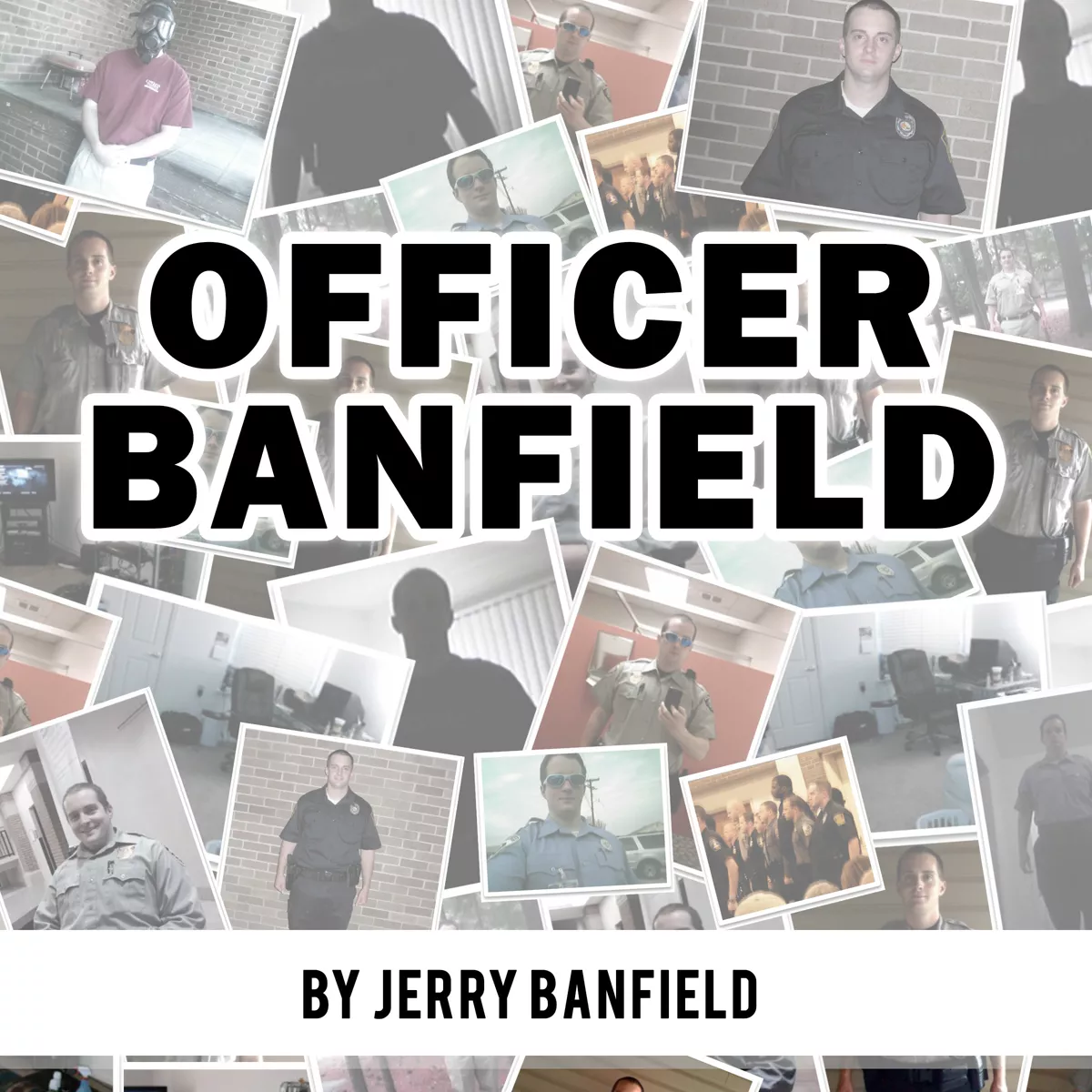
This is an excerpt from my memoir, Officer Banfield — the honest story of my years as a corrections and police officer, hitting bottom in alcoholism, and the long road to recovery.
So I left and went home, and then shortly after that, I hit one of the lowest, most hopeless points of my whole life. I didn't want to live anymore. I couldn't picture my life without my girlfriend, and there were so many unknowns ahead of me that I was terrified. I was full of pain, anger, resentment, and frustration, and I was mad at myself for being such a crappy boyfriend. I felt worthless and selfish and awful.
What I did with all that pain was the worst thing I could have done with it: I kept it a secret. I told no one. It was my shameful secret, and I buried it. I remember going out to the movies with my best friend that same day and thinking how absurd it was that life could just carry on, and how I wished I had had the courage to open up to him, because I'm sure he would have been a good person to talk to.
But I didn't. I kept my mouth shut.
I'm grateful I have the courage to talk about this kind of thing today, because I've learned we need to be honest with each other about it. What I've found is that the dark stuff we hide in shame is exactly the stuff that keeps coming back, and the dark stuff we finally bring into the light with the right person is the stuff that heals. I am grateful that the next time I hit a low like that, over the dispatcher, I actually talked about it with my dad, and once I talked about it, it stopped recurring. If you've been burying something in shame the way I did, you can book a private call with me — being honest with each other is exactly what these calls are for.
I hope that by being honest about it, I give you a little courage to talk about your own hard feelings with the right person. Not everyone can handle it; some people will panic. But find the one who can sit with you, who has the honesty to say they've been in a dark place too. When someone trusts me with how low they've been, I don't need any of the details. I just understand, because I've been there, and I know that talking about it is what lets you move forward and forgive that it ever happened.
I'm grateful that I got through that experience that happened while I was in the police academy. Getting through the rest of the police academy, there
are two different parts in my head. There is before the breakup and after the breakup.
After the breakup was characterized by a very strong focus on doing well in the police academy. While I had been kind of doing a police academy as a means to an end just to get to be a police officer, I really didn't want to fail it so I could be a police officer.
Once the breakup happened, I was really grateful for something to focus on every day and I paid very close attention to what I was doing in the academy. I started hanging out and trying to make friends with people a bit better, doing things like playing ping pong and talking with people.
I also had Jacksonville Jaguars season tickets. I was driving down to Jacksonville to go watch the Jacksonville Jaguars games with my season tickets, and then driving back on the weekends, and that also helped to pass the time because I was lonely in the police academy.
But thankfully, with that much to do and that much of a focus, it made it pretty easy to transition and to start being a little more comfortable with being single again and to enjoy my life, and appreciate the time at the police academy as something that was limited, that wasn't going to last forever.
I had a roommate who was a former pro football player. He was massive too. I think he was an offensive lineman and I enjoyed talking to him getting to know his life a little bit. We both worked at DMH together and we soon enough graduated from the police academy together.
I remember so much gratitude. My parents came to visit for my graduation and they came to talk to me after my breakup and everything. I was really happy to see my parents. They were both there for my
graduation, which ended up being a really rainy day.
The DMH did this ridiculous thing, I don't know for what reason they did it, but they would not give us any ammo for our gun until we had actually graduated.
What they had done so that we were prepared for graduation, there were just the two of us from DMH in the police academy, they had issued each of us our gun, but they hadn't given us any ammo. They told us once we graduated we could come to the department, then they would give us the ammo for it, which was really awkward because here I was in a police officer’s uniform with a gun and no ammo in it.
Now, especially when you have heard about cop shootings, imagine walking on as a police officer with a big ass bluff on your side, "Yeah, looks like I got a gun, but I don't have any bullets in this thing."
If someone takes a shot at me, "I'm just hauling ass. That's my strategy, it's to haul ass."
I went out to lunch with my parents too in the uniform. The gun with no bullets felt really awkward. Then, we did go to the department. Thankfully, they gave me some bullets for my gun, and then I was allowed to carry my weapon.
They had these weird policies about when you could carry your weapon off duty and various things like that, but I was able to carry it off duty sometimes. Then, I was ready to go to work and begin my field training at the South Carolina Department of Mental Health Public Safety division.
Thank you very much for enjoying my time here in the police academy with me. I hope sharing this has been really helpful for you. I hope sharing my honest experience with going through what at the time was the shortest
police academy, and might still be, out of any state in the nation. It was just nine weeks and I managed to turn it into an hour-long story.
It was fun.
The attrition rate was really high. The class I started with, I think anywhere from 20 to 40% of the people ended up failing out of the class by the time we got to the end.
I missed one of the most interesting stories that actually happened in the police academy. One of the very last things that we did in the police academy was this full training course where you have got live rounds in your gun and you are going through and shooting targets.
You are running around, and then you are doing this kind of live action police course. You run, you jump into a police car, you drive it, you hop out, you have got targets to shoot at and you have got instructors who are screaming in your face trying to distract you acting like maybe someone on the street would.
The idea is to simulate a stressful real-world kind of police shooting environment. Something that you might actually get into at work to simulate that and to prepare you for it. I went through it and it was pretty easy. I ran through, got in the police car. I remember people making fun of me for how I ran because this course was timed and it was competitive. I ran as fast as I could, hoped in the police car, jumped out, got my gun out, shot the targets and I just basically ignored whatever the instructors were yelling at me.
I grabbed on to the 150-pound dummy you had to drag. I dragged the dummy down, shot the rest of the targets and no big deal. I went and sat down in the bleachers and it went pretty smoothly.
I was sitting there in the bleachers with my friend.
This guy was over 300 pounds with massive muscles. He could just have snapped me in half if he wanted to. He was a former offensive lineman in the NFL, coworker at DMH, a fellow officer, and we were about to graduate together.
We had our bulletproof vests on at this point as well. We were sitting up in the bleachers watching other officers go through this course. We were watching and all of a sudden the instructor put his hands on the cadet, as you would say.
Now we were told very clearly before this, that if any instructor told you to stop or put their hands on you, you immediately had to stop. You couldn't continue with a live weapon and rounds. When an instructor put their hands on you, you had to stop. You had to do what the instructor said.
Now, if they were just yelling and screaming obscenities at you and acting like they were the public, then whatever, you continued through the course.
But if they told you to stop or if they put their hands on you, then you had to quit. That's what we were told.
This was confusing because the instructors were also acting. They were yelling, "You asshole. You shot that guy."
They would be yelling all these things to try to distract you as someone on the street might actually be doing in a similar kind of situation. Then one officer, one instructor and one cadet, all of a sudden we see this instructor put his hands on the cadet, and the cadet started fighting with the officer with the gun in his hand and the instructor took the cadet down onto the concrete ground.
Meanwhile, the cadet had his gun with live rounds in it and had his finger from what I saw inside the trigger. He was not pulling it obviously, but he had it inside. So all he needed to do is squeeze. The cadet was on the ground, the instructor was on top of him screaming at him. The cadet had his gun and it was pointing up at the bleachers right at us.
I did not take action first, but I saw my roommate who was 300 plus pounds, former NFL offensive lineman, and you wouldn't believe how fast he could move. He hauled ass off of those bleachers and I followed him because I was thinking, "If he's scared and running, I need to be running right behind him."
I remember running out of there as the cadet's gun was pointing all of us with live rounds and his fingers were on the trigger, as he was getting tackled and fighting with this instructor.
I remember thinking, "I wonder if this bulletproof vest will stop whatever is actually in his gun," because DMH had issued us vests that I think didn't stop 45 or 40 caliber rounds.
They went up to nine mil, I think.
I remember hoping that my vest would actually stop if I ended up getting shot.
All the cadets on the bleachers jumped up and hauled ass, and everyone ran outside very quickly. I remember crouching behind a dumpster right outside of the training room as they shut the whole course down and they took this cadet out of there.
Then, they had us write up an incident report on what happened. All of us that were there, that witnessed it, were then asked what happened.
I saw an interesting phenomenon happen where a lot of the cadets
started citing that this cadet was from a police department that had maybe 30 plus officers all in the academy at the same time. It was about as many as the entire rest of the class combined.
Apparently, this cadet told the fellow officers from his department and the people in the class that the instructor had just gone crazy on him and had just grabbed him out of nowhere and started fighting him and tackled him to the ground, that he didn't know what was going on and that basically, the instructor was completely at fault for what happened.
Meanwhile, the instructor had said something like he was screaming at the cadet to stop because I guess he was running around. I didn't see this part of it, but he was doing dangerous things with his gun.
I guess you were supposed to holster your gun before you ran and I guess the cadet maybe was running around with his gun un-holstered and out through the course.
It was something very dangerous like that and the instructor had been screaming at him, "Stop, stop, stop. Halt. Quit. Stop."
The cadet had just continued going through the course without listening to the instructor, at which point the instructor went hands-on as was explained. The cadet started fighting back, which under no circumstances were you supposed to get into a physical altercation with the instructor, and especially not hold your gun and be pointing it at your classmates.
The interesting thing is as they had us all write these incident reports down, they asked those of us that had witnessed it to write down exactly what we saw.
So, I wrote down exactly what I saw.
"I observed a cadet with a gun that was loaded, that he had just been
firing at targets. He was not listening to the instructor. The instructor was screaming, 'stop, stop, stop.' The instructor grabbed the cadet and tried to get him to pay attention. The cadet fought back against the instructor. The instructor tackled him. The cadet was then pointing his gun at all of us in the stands and from what I saw, his finger was inside the trigger guard.
Then, when I looked over and looked down the barrel of his gun in his hand, he did not have the gun in a safe manner without his hand inside the trigger."
That's what I wrote down. That's what I saw.
Now, I've seen when other people have witnessed things that two people may see the exact same thing at the exact same time and have two completely different stories.
But that's what I saw.
I wrote that down and I shared that basically like the academy instructor was just not being listened to. The cadet just went crazy and was confused and put all of us in danger with his gun, and I'm grateful no one was hurt.
I don't know if my incident report got out specifically or what happened, but after that I noticed it was as if the officers thought I was some kind of traitor or something. Maybe everyone else just minimized it and wrote down that either they didn't see anything or that nothing else happened. If you're carrying the weight of having told an unpopular truth, you can set up a call with me and we'll talk through where to go from here.
If you connect with how I live and think, you can follow the rest of my days on YouTube in my Life playlist.