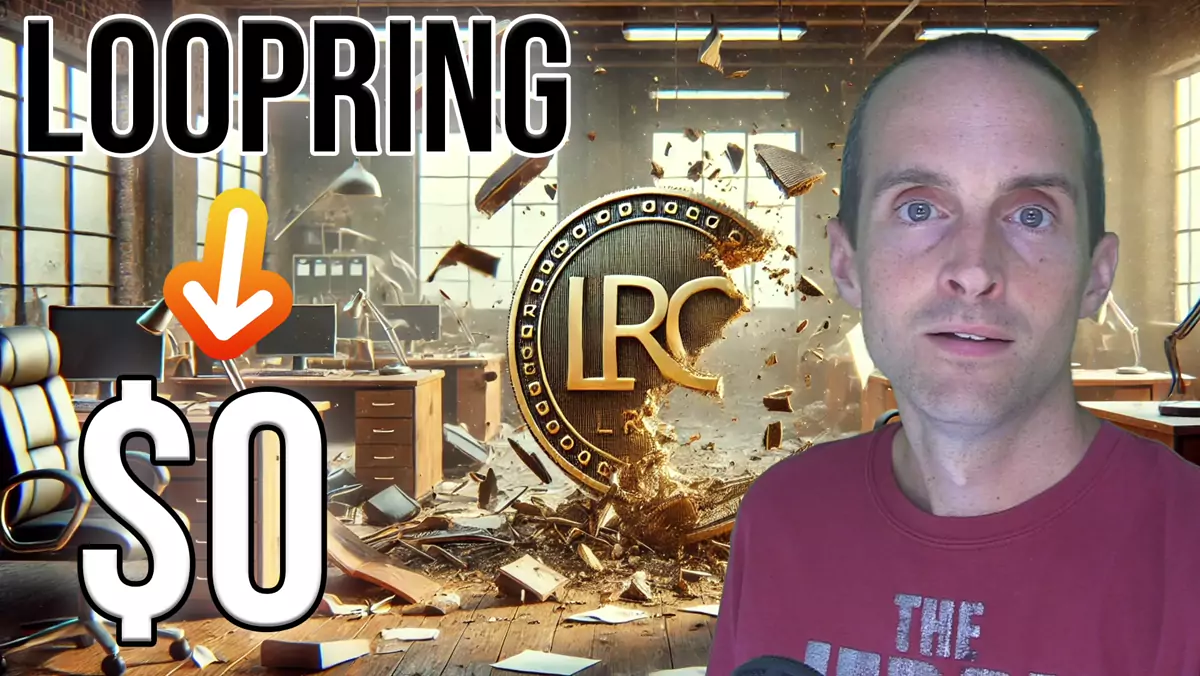
Loopring is a cryptocurrency that has already gone practically to zero several times now, and that looks like the future to me as well. You all have asked me to review this and to share why I think this is a cryptocurrency that there's no way I would want to hold. So I recorded my honest take. This is my opinion and my experience, not investment advice, but I'll explain exactly how I see it.
The price chart tells a familiar story
First off, looking at the price chart, most cryptos only have one decent bull run in them. This one actually exceeded expectations by having a second bull run, and I seriously doubt we get a third one that's better, because the market's so crowded. There's so much competition now. And what value does this have to offer? It has had a couple of speculative pumps, then done nothing. A couple of speculative pumps, then done nothing.
Over the last year, the price is actually down, whereas ICP, Bitcoin, and Ethereum have done much better. In the last year, this has actually lost money. And that's because I don't see any reason you'd want to hold this. So let's look at what it actually is.
What Loopring actually is: an ERC-20 token
Loopring is an Ethereum-based cryptocurrency token, which means it's just an ERC-20 token, and the foundation of the token is for building decentralized crypto exchanges. Now, this is problematic, though, because most people don't understand what it takes to truly decentralize a crypto exchange. So I'm going to explain it for you.
What you need to have a true decentralized crypto exchange is to have all of it fully on chain, because otherwise it's not actually decentralized. You're going through some centralized third party. If you're using Uniswap, you're going through Uniswap first to then swap Ethereum tokens, and that's not decentralized, because Uniswap can be hacked. Uniswap can ban you or block you. Uniswap is a centralized entity. Even though they have a token, it's on Ethereum. They can't actually do anything with the protocol using the token directly.
Why I think true decentralized exchanges are on ICP
So this means to me, anyone who really understands the future of decentralized exchanges is on Internet Computer Protocol. That's where you can have a truly decentralized exchange, and in fact, there are already several decentralized exchanges where you can actually do your entire swap completely on chain. The crypto maintains in your wallet, and not only that, but it's already directly integrated into OpenChat, which is like a Discord on ICP.
On OpenChat, this is much better than Discord or Telegram. I deleted my Discord and Telegram because this is so good, and because my community is not infected with bots all the time on it. And these swaps are fully on chain. The crypto stays in my wallet until the exact moment I swap it, and the entire system is decentralized. The website is hosted directly on the ICP blockchain with nodes that are voted in, and the crypto's in my wallet until the moment I want to swap it. I get a quote for what I want to swap for. For example, I could swap for the chat token. I click on max, I get a quote, and it'll do the whole swap for me, and it'll just drop right back in my wallet. Nothing is centralized the entire time, because this is integrated with an exchange called ICPSwap, which is on ICP.
ICPSwap has a token where the service nervous system has control, physically, by code, over the application. So this is the future of decentralized exchanges, where everything, all the transactions, all the action is on chain. This is a truly decentralized exchange, where, if I controlled 50% of the token, I could do whatever I wanted with this exchange. I could take over the entire website and the token supply. That's true decentralization. And when you compare Loopring to that, Loopring falls short.
The token hasn't changed, and that's the problem
Here's how this works. If you look at an article written three years ago now about the Loopring protocol, it says the Loopring protocol token has been a part of the protocol since its inception, and its design and usage have remained largely the same over time. Now, think about that. Its design and usage have remained largely the same over time. That means it's not innovating. It's not adapting, because it's a static token sitting on Ethereum.
Here's what you should pay attention to. While the protocol and products have made profoundly important progress, your coin does not own any of the protocol or the products. The protocol and the products are off chain, while your token is on chain. So all these tokens have the same basic problem unless they're a service nervous system on ICP. And the same basic problem is that your token remains largely the same over time. This is the same core issue I keep coming back to across my reviews, like my take on Chainlink (LINK) and why I think it's heading to zero as another Ethereum token detached from the protocol it serves.
Two kinds of ownership, and crypto's missing piece
There are two basic ways you can have ownership. One is ownership through violence, basically, where the law gives you ownership. And if the law is not upheld, there's violence to back the law. That's government. That's legal systems of control, putting you in prison if you don't comply with the law, or fining you. So there's ownership by violence, which is what you have if you own a stock: you have a legal right to a certain part of the company.
And then there's a second way of ownership, and that is physical control. So when it comes to my house, I both have legal ownership and I have physical control. I'm at my home, and I can call the police, or I'm physically in my house and I can control what happens in my house.
With crypto, the Loopring token on Ethereum gives you no legal control over the protocol or the products. You holding the token does not allow you to do anything to get a percentage of the protocol's or the products' profits. And because it's on Ethereum and not on Internet Computer Protocol, the token also gives you no ownership by physical control via code.
Now, on Internet Computer, when there's a decentralized exchange like ICPSwap, I do have that. If I held the ICPSwap token — and I'm very choosy about which tokens I put money into — I would have physical ownership by code, where my voting power plus everybody else's voting power controls the actual protocol, and all the profits generated from the protocol end up coming back to me as a token holder.
So regardless of what the Loopring team accomplishes, the protocol and the products are completely out of your control. It's possible Loopring could succeed — although based on everything I see, it's unlikely — but it's possible it could succeed and the token itself could fail. And that's most of crypto. And that's a huge problem. It's possible they could move the token onto Internet Computer Protocol and truly decentralize it. But unless they do that, they're in a position where others are already doing that. So if they tried to do it, they're pretty far behind what everybody else is already doing. If you want to see how I weigh this same on-chain ownership question across the whole market, I keep all of these honest reviews going in my Crypto Reviews playlist.
The on-chain transfers show no growth
If you look at the transfers on the token, this is better than some of the bigger market caps in terms of transfers per market cap. But what you'll notice is that if you look at the actual transfers of the token over the entire time the token has been active, there's been very little growth. If you look recently, it's a few hundred transfers a day, and if you go back in time to the bear market — 2018, 2019 — there's almost no growth. There's a little bit from the bottom around 2019, but it's basically not grown at all. This is clearly going nowhere. The raw transfers directly on chain show no growth. And so that looks like purely not the kind of thing I want to invest in. If you want help thinking through whether something in your own portfolio is actually growing or just bleeding sideways, you can schedule a private call with me and we'll look at it together.
On ICP, by contrast, you've seen all these new tokens launch on the launchpad. You've seen the number of addresses of holders consistently going up. You've seen the cycle burn rate is at all-time highs, which is unlike everything else. The cycle burn rate is the best way to measure ICP's growth, because that's like people paying their Amazon web hosting bill, which nothing else does. And this has gone pretty much constantly up on average for ICP's history. You've got these layer twos like Chain-key Bitcoin and Chain-key Ethereum. ICP's done nothing but grow and get bigger on average. Loopring is flat.
Where is the team?
And there's another problem. Where is the team for Loopring? If you look at the Loopring website and you click on the about page, where's the team? Who's building this? Who even is working on the protocol? It doesn't even show you who's actually marketing the products.
Compare that to something like Internet Computer. When I'm holding Internet Computer — and I've got 5,000-plus ICP — this is the largest research and development team in blockchain. There are hundreds of actual engineers and technical staff that are making breakthrough technology. You can see some of them. They're up on their app, they're doing a lot of stuff, and I'm like, well, this is a lot. That's why they're having presentations on things like verified credentials, which is a big deal. That one single thing — verified credentials on ICP — is, to me, single-handedly as big as all of Loopring. And that's just one thing that ICP is doing.
The holders, Binance, and the irony
So when you compare Loopring to ICP, the market cap on Loopring is smaller, but you have to ask, where's this going in the future? There are so many Ethereum quote-unquote DEXes, and there are real DEXes being built on ICP that use Chain-key Ethereum now. Those are growing rapidly. This is irrelevant and getting totally left behind. It's gone nowhere. It got some pump, but why did this even pump? Who even bought this? Who decided that Loopring was a great buy? Clearly whoever did buy it unloaded it, or investors got tricked into it and then got dumped on, which is sad.
There are a few hundred thousand holders on this, but this is an old token, and the top 100 holders have 76% of the tokens. There's tons of it sitting on Binance, just ready to dump — which is funny, because this is supposed to be a decentralized exchange, and yet you have much more sitting on Binance than being used on the decentralized exchange itself.
My verdict on Loopring
So Loopring, to me, is completely unimpressive. While it has a lower market cap than ICP, I think ICP will easily 100x-plus this. Loopring, to me, is unlikely to reach its last bull market top. Even a 10x, to me, would be overly optimistic for this next bull market. This is not an outlier. It's just another regular old crypto coin that's not impressive. That's my honest opinion based on what I see, and you can take it as exactly that — my experience, not a recommendation.