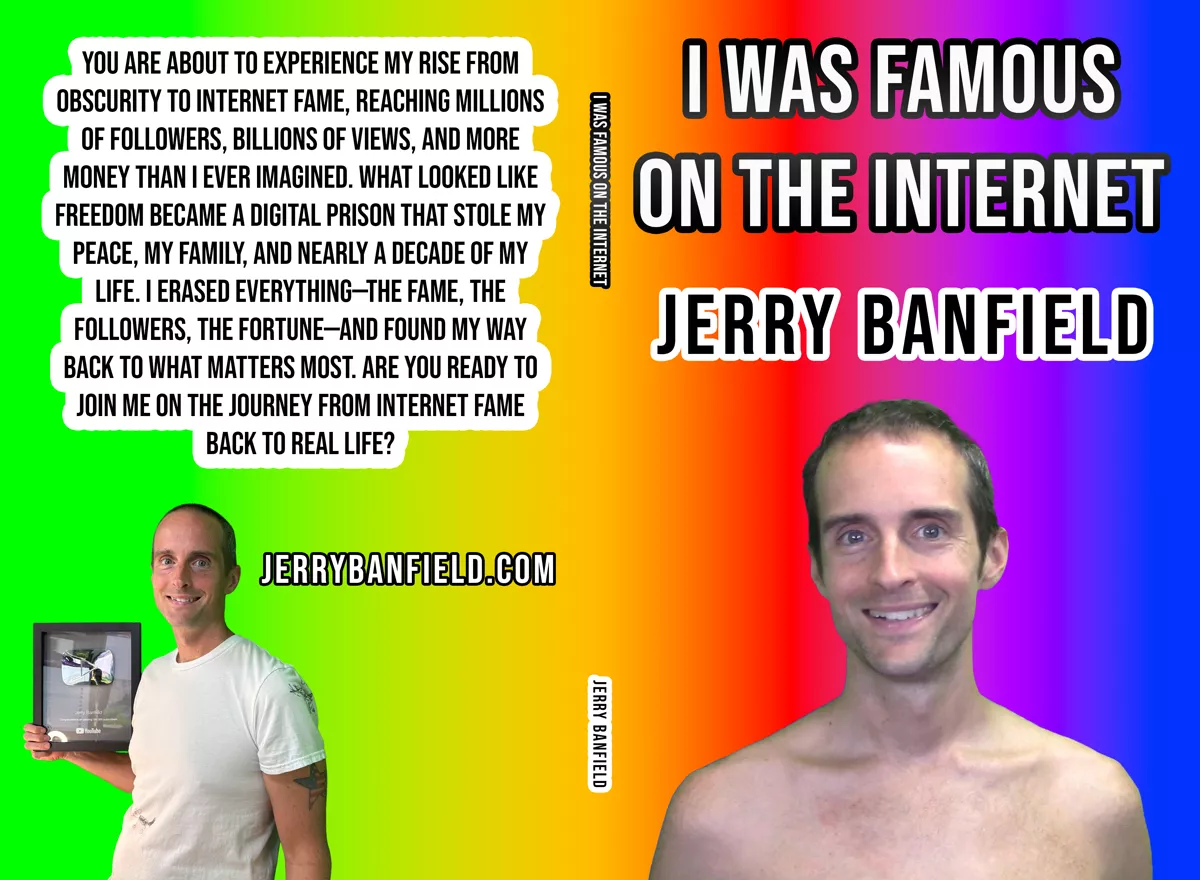
This is an excerpt from my memoir, I Was Famous on the Internet — my honest story of 14 years of internet fame and what it really cost, and why I deleted it all to choose real life.
The Dark Side of Influence
I hope I have not shown my actions in the light of some hero coming to save us all. If anything, what I’m doing now is an attempt to address and compensate for the things I’ve done before. I’ve been the guy who spent millions of dollars online, investing mostly in impersonal ways with people I didn’t know. Mostly, I come to you as a bad example, someone showing what not to do. For over a decade, I was the person who encouraged millions of people to pour their lives into the internet, to chase business through platforms like Facebook and YouTube.
I showed people how much money I was making online and encouraged them to join me. Entire generations of creators spun out from that example—people teaching courses, promoting passive income, launching channels—many of them learned from someone who learned from someone who had learned from me. Tracing it back, so much of what you see online today has roots in my early work. I was one of the first popular crypto YouTubers in the world. My first Bitcoin video was in 2014, long before most people even knew what crypto was. I had tens of millions of views on my crypto videos. Many of the crypto YouTubers people watch today used to watch me before they started their own channels.
It has taken years of leveling up my consciousness just to stop obsessing over how much money I could make online and start asking what kind of world I want to live in, what kind of neighbors I want to have. When I think of people as neighbors, it changes everything. Many content creators treat their audiences as sheep, suckers to be exploited. At the end, I tried to approach my videos as if I were sharing with an actual neighbor. I want neighbors who were wealthy, who have no need to steal from me. If the neighbors who are broke and been ripped off by scams, they might become desperate enough to try to take from me. If we thought of all people on this planet as our brothers and sisters, as our neighbors, we’d naturally become more mindful and compassionate with one another. That neighborly circle is exactly what I'm trying to build now, and you're welcome to be part of it — you can book a private call with me and we'll start treating each other like real neighbors.
The problem is that the internet is a place where compassion is difficult. The whole environment is designed to be impersonal. When you interact online, you can’t really see the other person. You might get a profile picture, but half of those aren’t even current—some are old photos, others are just random images with no connection to who the person actually is. When I thought I was sharing self-help ideas online, trying to change lives, I eventually realized I wasn’t really connecting with anyone.
I’ve had millions of people watch me but only met a few hundred in person. What I noticed is that it’s hard for me to connect, or even feel anything, for someone I haven’t met face to face. I remember flying to Portugal for Steemfest in 2017. That crypto conference was a gathering hosted by Steemit Inc when I was invested heavily in Steem and most of the people there knew me. When some of them saw mw, they were so excited, saying, “Oh my God, Jerry, it’s so nice to meet you in person!” They gave me these best friend vibes because they knew so much about me from my videos, yet I knew almost nothing about them.
From the outside, you might think that’s a dream come true—to have people all over the world come up to you, love you, worship you, want pictures with you. In reality, it was a bad experience. It felt weird, unnatural. People would rush up saying, “Jerry, I love you, you’re the best,” and inside I was thinking, Who are you? What’s your name? What have you actually seen of me? My mind was spinning, almost like I had a traumatic brain injury with thoughts like: You should know this person. They’re clearly your best friend. Why don’t you remember them? What’s wrong with you?
What looked like admiration on the outside felt disturbing on the inside. It didn’t feel like love. It felt like something was off, like something in the relationship was deeply unnatural.
Artificial Connections
Being recognized from videos can be flattering sometimes. I remember once in an AA meeting; two beautiful girls I did not know were ecstatic to see me there because they knew me from TikTok. They had watched my “I’m Black Day 30” race change video and they treated me like I was some kind of celebrity walking into the room. They invited me to sit next to them and were so excited to get to know me for real.
Yes, that was flattering. But it also felt wrong. Would they have reacted that way if they hadn’t seen those videos? As a married man with a beautiful wife, children, and a home, was it healthy for me to be sitting next to women ten years younger who were overly excited about me because of something I posted online? It felt unnatural, as if I had tricked them into thinking I was more important or more worthy of attention than the other people in the room.
At an AA meeting, I want attention only for what I share there, not because someone saw my face on the internet. Before that happened, I fantasized about women noticing me like that. Yet when it actually happened, it was awkward. I found myself thinking, You don’t even know me. Why do you like me so much? You haven’t heard me share. You don’t know anything about my sobriety. You’ve never spoken with me in person before. The whole thing left me conflicted—flattered on the surface, but with a sadness underneath.
After a month or two, the effect wore off. They stopped coming to the meeting, and I stopped seeing them. Suddenly, I was overly sad about losing a connection that was shallow to begin with. If they had never seen me online, I would have just gone to that meeting like any other, had the normal experience of being another anonymous member, and gone back to my home group with gratitude. They probably would not have talked to me. Instead, I found myself attending meetings I didn’t even like, just because those two girls were there. That’s what artificial connections through content creation do—they distract us from what is natural.
Life is healthiest when there are real, two-way interactions, when you know someone and they know you. That’s the biggest problem with the internet. As a content creator, it’s nearly impossible to have those two-way connections. Without them, you can’t truly know your audience. I remember countless days where I felt lost, frustrated, even angry with my viewers. I’d put out a video I thought they’d love, only to see them hate it. Then I’d put out something I felt embarrassed by, and they’d love it. Or I’d grind out endless Warzone streams I hated making, only to watch them flock to it. It made me resent the very people supporting me, because it never felt like I knew them or they knew me.
I tried bridging the gap with one-on-one calls. Some people paid over $300 for an hour on Zoom with me. A few of those conversations were enjoyable, but many were the opposite. People would book time just to have me screen share and click through simple tasks for them in navigating ICP, things they could have watched a tutorial for or asked someone local about. It got to the point where it wasn’t worth the money. I didn’t want to spend hours doing the most boring tasks imaginable for strangers who were obsessed with me.
Even though I could earn as much as $1,000 an hour for calls, I stopped offering them because I felt so drained after many of them. Worse than that, I realized I was a bad influence. Just like the mother I mentioned before, who spent hours watching my streams instead of being with her family and ended up divorced, some of these people were pouring money and energy into me instead of living their own lives. Some clients were spending all the disposable income they had sit on Zoom with me instead of investing that time with their community or family.
Then, when those people eventually moved on, got a life, and stopped watching my streams, I felt guilty and sad. They’d given me so much in tips and calls, yet when they returned to their own real-world lives, I felt abandoned. The whole online system is backwards. Instead of encouraging real relationships and genuine community, it thrives on creating artificial connections that look exciting but leave everyone emptier in the end. That’s why I only am available for conversations in person at jerrybanfield.com today and do not accept Zoom call requests.
The Power of Real Conversations
The world I imagine as ideal is one where we live conscious of being part of a larger whole, and to do that, we need strong connections with people in person. We need to have conversations where we really hear each other. I remember reading a book about a study where researchers wanted to see if people with completely opposing views could gather and find some common ground. They brought people together with complete opposite views on gun ownership and tested different mediums.
Online, in places like Facebook groups or discussion forums, it was nearly impossible for people to make progress. The text-based communication wasn’t enough to create connection. Instead, people resorted to political rhetoric, attacks, and insults. Even moderators and rules didn’t help much.
But when they brought these polarized together in person, everything shifted. When people could sit face to face, when they had a chance to really speak and be heard, compassion started to emerge. It didn’t mean anyone instantly changed their political views, but it did mean they could understand the other side.
I remember two stories from that study. One woman shared that she had been assaulted, and she believed that if she’d had a gun, it wouldn’t have happened. Afterward, she bought a gun and carried it everywhere, because to her, a gun meant safety and protection. Meanwhile, another woman shared that a family member of hers had been murdered with a gun, and in her heart, if guns hadn’t been available, her loved one might still be alive.
Neither of these women changed their stance immediately, but they began to see the humanity in each other. The woman who carried a gun could look at the other and think, She sees guns as something that killed her family. And the woman whose family member was murdered could look at the other and think, She sees guns as the only thing that keeps her safe. While they didn’t go home ready to swap sides, they were able to open a more compassionate conversation—one that considered the whole picture.
That’s what we need more of: people coming together in person to share real experiences. Online fights often center around issues that probably don’t need to be argued about in the first place. Many of the polarizing topics we see constantly pushed in the media are distractions.
This hit me personally when I went on a road trip with family members that are very loving in their actions. They show up, they’re kind, they don’t pick fights. In many ways, they embody what you would expect from caring family. Yet during that entire week-long trip, not one of them asked me a single question about myself. This was right after I had deleted everything online and made a huge life change, yet nobody asked, How are you doing? What’s new with you? What’s been going on in your life? If you're craving that kind of genuine, two-way conversation yourself, I make real time for it these days — you can set up a call with me and I'll actually ask about your life.
The reason, as I see it, is that my online work and my more sensational opinions over the years offended them. I suspect they felt that many of the political stances they had adopted were things I probably disagreed with or wouldn’t support. Rather than risk an argument or bring up something that might create tension, they chose silence.
So I spent a week in person with people I love, yet it felt like we weren’t connecting at all. There was this underlying tension, the kind that comes from people being physically together but emotionally guarded. They didn’t want to say the wrong thing, so they didn’t say much of anything. That silence, to me, felt heavier than any argument could have.
If you connect with how I live and think, you can follow the rest of my days on YouTube in my Life playlist.