If you want to know how a YouTube channel makes money, my newest answer is a full revenue report. In I Made $4,576 Last Month as a YouTuber, I brought in $4,575 after starting from zero in March 2026, against about $1,000 in expenses for AI tools, Adobe, X Premium and shipping. My own website was the top earner at about $1,400, above all my YouTube ad revenue combined across six channels, with the main channel paying around $1,000 in 28 days. A $1,000 a month MaxFi sponsorship, found through my ICP channel for my Crypto Reviews channel, came third, then a $250 sponsored crypto review, then books. The humbling part was the hourly math: about 155 hours of work put profit at roughly $23 an hour before tax.
That report changed how I think about live streaming. On a stream in October 2026, Super Chats were the single largest increase in my income, and my public sales dashboard showed $4,633 in sales from 25 people with a $140 average order, the largest being the Queen video in August. Then I asked my chat a question, which you can read in I Asked My Live Chat What to Sell: shirts, hats, signed books, or something else? Within weeks the Super Chats faded as I streamed more, down to $10 for an hour and forty minutes, while trolls made the chat miserable. A single video that took an hour to make earned $20 in ads and sold products on my website, so I now stream less and record more.
That section also covers why the way people pay matters: YouTube keeps about 40 percent of a Super Chat, a SuperTip takes about 10 percent, and paying me directly leaves even more. The same lesson is moving my books off Audible, where a record month paid $100 that would have been $200 to $400 on my site. I explained why print-on-demand shirts barely pay a dollar or two each, why I now give my YouTube course material away, and why going from $4,000 or $5,000 a month to $10,000 is easier than the climb from zero. My next experiment is local dating coaching, advertised with Every Door Direct Mail flyers, because I want a business that is both local and online.
Start with what each channel is for. In my 2023 walkthrough of getting monetized in 40 days, the main lesson was that the idea and the demand behind it mattered more than polish. Crypto was one of the easiest places to grow because so few channels made original, frequent videos about it. A single channel covering gaming, business and crypto confuses the algorithm, and I set 20 committed viewers who watch every video all the way through as the minimum to get a new channel started.
By mid-2026 I had moved toward volume and repeated contact with the same people. In Thousands of Views, $1,500 Paychecks, I described earning at least $1,500 in a month from 147,000 views in 28 days, about 100 days after starting from zero. Most of that came from paid calls, not ads, and about half of those views were on channels that were not monetized at all. Then came my post about the many ways to make money on YouTube, where I argued that the most money I have ever made online came from focusing on one thing, a paid community with recurring membership, and building everything around it. A platform can ban you, as one banned me, so I want to reach my supporters directly.
In the post where I said I monetized three channels in about five months, I described two crypto channels, one on ICP and one on crypto reviews, and a vlog channel about my life. My method is to upload fast, keep each channel specific enough that YouTube knows whom to show it to, and cross-promote so a viewer who finds one channel ends up watching another. I counted 646 videos published since May 18, 2026, about seven a day. The loop is record, upload, and let AI help with the thumbnail, the title and the blog posts that turn transcripts into pages where search traffic reaches the videos.
So this is where I have landed. Ad revenue will not carry a new channel by itself. Build each channel around one clear subject, track impressions and minutes watched, keep everything you sell on your own website, and keep asking your audience what they want to buy. If you want the coaching side of this, read why I coach YouTubers and what coaching is really for, or what small channels actually get paid for.
If you would like a personal look at your own channel, I offer a Personal Video Review at jerrybanfield.com/review/.
On this page
Every post I have written on this subject is below in full, newest first, each under its own heading.
- I Made $4,576 Last Month as a YouTuber. Here's the Breakdown. (October 26, 2026)
- I Asked My Live Chat What to Sell. My Store Has Made $4,633 From 25 People. (October 15, 2026)
- I Monetized 3 YouTube Channels This Year. Here’s What Worked. (August 17, 2026)
- I Know Too Many Ways to Make Money On YouTube (July 10, 2026)
- Thousands of Views, $1,500 Paychecks: The Creator Dream Is Alive with Jerry Banfield (June 28, 2026)
- How I Got Monetized + YouTube Partner in 40 Days (February 10, 2023)
I Made $4,576 Last Month as a YouTuber. Here's the Breakdown.
From my video published October 26, 2026.
I started off as a content creator in 2011, built up millions of followers, and deleted everything in 2025. Then I started from scratch again in March 2026. And I'm grateful that in the last month I've made $4,575 in revenue, which is pretty amazing considering I was making zero in March. I spend about $1,000 a month. I didn't go through all the expenses in detail, but I have things like Claude, ChatGPT, Adobe and X Premium subscriptions, about $1,000 in business expenses, and that includes shipping the products I've sold on my website. I calculated that I worked about 155 hours or so, a few hours a day, seven days a week. And I was disappointed when I calculated the profit per hour before tax, because I've been feeling like, oh, my skills are too valuable to go get a job. But it's like, bro, you made $23 an hour. You could go be a manager somewhere, or you could go work somewhere else and make $23 an hour. This is the reality of being an honest content creator at this point, one who is not out here ripping people off. It is the same math as when I gave YouTube 74 days to make $30,000, so I'll break down exactly how my income has come in.
The $2,000 video and $1,400 from my website
You'll see this one day where I made $2,000 selling a single video that I had sent to a woman I was dating, which I never thought I'd be releasing, but somehow people really wanted that. So I listed the edited version that removed her name on my website for $2,000, and somebody bought it. Over the last week I launched this new series of coins, and people bought some one-on-one calls. What's so cool is I can just go back and look on this dashboard and see what I made. In the last month I made $1,400 on my website, and I've got everything broken down as to exactly what sold.
So to me, the number one thing you need to make money online as a content creator is your own website, because you can see I've sold calls on my website. I've sold coins. I sold the satin shirt I was wearing yesterday. The shirt I have on today is available too, if you want to buy it on my website, for only a little more than I actually paid for it. It's my WATP first show shirt, the one I wore when I went on Who Are These Podcasts, which is a big podcast going over other podcasts. This shirt was like a hundred bucks downtown, and if you want it I could sign it and mail it to you. That's available. I made a game with AI that four people bought for $9 each, and I got some tips. I have my book Officer Banfield and my book Speaker Meeting that people bought as well. And I have a game, Jerry Banfield Infinite Momentum, which is like Vampire Survivors, that people bought.
Certainly the idea that, oh, I only make $23 an hour kind of sucks. But this is a lot more money than I made in any of the previous months this year, and if this keeps going up on average I could be at six, seven, eight, $10,000 a month within the next few months. The expenses should be pretty static, so the profit should stay relatively high. As I buy and deliver more shirts I may get more revenue with higher expenses attached. But what's cool is I'm in a position where my profit per hour should go up to $30, $40, $50 plus an hour. I reduced my one-on-one calls now to $96 to $98 an hour. I just did one of these calls earlier today, and I can talk with you about anything I do in my business. I think I'm going to take my 20-minute call off, because nobody's bought that.
Most of my experiments failed, and the lesson is my own website
What's pretty amazing is that I've essentially failed most of my experiments. Most of the products I've tried to sell have not sold, or have hardly sold. I sold several Cameos too, so I'll break down the rest of the money I earned also. But what I've learned is to just put everything on my own website and sell it there instead of selling it on other websites, because the more I send people out to other websites, the more I keep losing revenue. I sent a bunch of people to eBay, and my auctions all got ripped off by trolls putting in fake bids. It taught me a valuable lesson: you should have just kept everybody on your website the entire time, and if you had done that, you would have made much more money.
YouTube ads, Super Chats and why I stream less
Right now on YouTube, the largest payment I'm getting is from my main Jerry Banfield channel, about $1,000 in the last 28 days. A lot of that you can break down to see where the earnings came from, and a lot of it was Super Chats. I'm not doing live streaming as much anymore, because the mental health cost is not worth it for live streaming. What I noticed is that the more I did live streams, the less the Super Chats would come in per stream. The first few live streams, people were pretty heavy-handed, giving a bunch of money. But as I kept doing more and more, the Super Chat revenue just plummeted. Some of those tips on my website came straight from Super Chats as well, because I built my own OBS tip widget into my website with AI. So if you want to build a website with AI as a content creator, that's one of the best things I could possibly help you with, because I've actually done it, and it's so valuable. I've done a lot of things in my life, and I imagine most of my increase in revenue going forward will pile in through my website, the same lesson I learned streaming full time as a Facebook Partner in 2021.
I did some live streams here earning hundreds of dollars each, and I got really excited about live streams. But then I tried to do more and more, and the income just plummeted. This one, $75, good. But the next one, $46. Then $88, which is still solid, but consider that one was an hour and 30 minute stream, and this one was a three-hour stream. This one, an hour and 40 minutes, $10. This one, two hours, $40. So if I'm doing live streams and I'm actually earning less than $23 an hour, that ends up not being worth my time. Here's a two-hour live stream where people just insulted me endlessly. If I ban the trolls and all the nasty things people say, it makes the chat boring and takes the stream down. And if I have somebody else on the live stream, like Ashley Cummings, who I thought was a great guest, the Super Chats were very weak. In fact, that number includes ad revenue, so I think there was only about $2 in Super Chats on Ashley's stream. Most of these numbers were ad revenue. The Super Chats were just dead, and the trolls and the haters were all over.
What's been nice about running the numbers is seeing whether what I'm doing is, at a bare minimum, making 23 bucks an hour. Live streaming is not making $23 an hour on average, and therefore it's much faster to just make a video. Here's an example. This video made $20 from ad revenue almost alone, literally $20 in watched ads. And this video took 40 minutes to film and probably about 20 to upload, but then the videos are actually selling products on my website, so it works out. That is the hourly math behind why YouTube is the dumbest career move you can make right now.
Audible was a record month, and I'm still moving my books to my website
I did get some other earnings. For example, I have audiobooks on Audible, so if you search Jerry Banfield Audible you'll find them. I'm getting more and more books up on my own website, but I still have a lot of them on Audible, and this month was actually a record. I got $100 from people buying my audiobooks on Audible, especially Speaker Meeting 2017 and Officer Banfield. These are autobiography books. Speaker Meeting 2017 is my history in addiction and recovery, very detailed, nothing held back, and Officer Banfield is the same thing for my career as a police officer. Then I did some daily autobiography books that I tried when I wasn't on YouTube. Some of these books, like my YouTube and Google Ads books, used to sell quite a lot a long time ago, and Un Fn Myself is my complete life story. But still, I sold a good number of audiobooks on Audible and only got $100. If I'd sold those same audiobooks on my website, I'd have probably gotten $200 to $400. So I'm moving my audiobooks, and all my books, over to my website. For example, if you want a signed book, I'll send you any book signed for $22 plus shipping, any book you want from me, signed and printed. Speaker Meeting 2017 is on my website for $9, Officer Banfield is on there, and Speaker Meeting 2017 also has videos with it. Compared to how much money I made online in 2023, the mix has shifted toward what I sell directly.
The MaxFi sponsorship and six channels from scratch
I also got a $1,000 a month crypto sponsorship from MaxFi, which I'm very grateful for. That comes from my two crypto channels. The ICP channel is where they found me, but then I have this Crypto Reviews channel, which is the channel they're most interested in sponsoring, where I go over and talk about meme coins and liquidity providing. I just did a new sponsored video on there. So this is exactly what's happening inside my business right now. I'm getting people following and buying things from all these different channels, and I have six of them. I've got one and a half million views from scratch this year, and they've been scattered. Right now the Jerry Banfield Show, my @JerryBanfield channel, is getting the most watch time, even though the ICP videos look like they get more views. The watch times there are like five or ten minutes, because the videos are often shorter. But on these vlogs, people are watching 10 to 15 minutes lots of times, and coming back every day.
I also have a music channel, and for the first time ever I actually got a $100 payment from my music this month, which was awesome. I'm still debating whether to make a new album by the end of the year. I haven't made an album since September, over a year now, and I've made 350 songs that are on Spotify, Amazon, Apple, YouTube, wherever you listen to music. My dating channel has been cranking out a lot of views lately. I don't know that I've gotten any calls from it, but I think I sell some products. My games channel is just for fun and not making anything.
The creators channel and the video review
And then there's my creators channel, which I'm imagining has some really good income potential, because I am a veteran creator. I am wondering if somebody's ever going to buy the video review, because if you want me to look over your channel and see what you're doing, I'm in a really good position to do that. Anything you're trying to do online, I've probably done it before. I use the newest tools and things like AI. I build AI games. I got my whole website, my whole business, built with AI right now, and then I do the content creation, and everything's faster and better with AI, which is why I say AI just made personality more valuable than information. So if you want me to review what you're doing and provide suggestions, I am thinking the video review someday will sell, even after Devin Nash refused my YouTube consulting payment.
I also sold a $250 crypto sponsorship. I tried to have them pay through my website, but they just sent it straight to the address without paying through the website. But I did sell one of these sponsored crypto reviews.
Local dating coaching is next
I'm thinking I'm going to expand my business into doing some local dating coaching, because just talking with somebody about dating on Zoom, to me, is not very efficient. You can do YouTube coaching and a lot of other coaching on Zoom. But to me, dating is something where ideally you really need to be in the same town, because otherwise you can't give very specific advice. I paid $1,200 for local dating coaching from a friend who didn't even have a website or anything up for it. So I'm going to try building a page for people locally and sending out some Every Door Direct Mail flyers, and see if I can bring in a lot more revenue through local dating coaching.
I think the ideal position for the future is a business that's both local and online. Setting up the strong online business seems to be easier for me to do first. But I think one of the best ways I might be able to increase my revenue is bringing in more revenue locally. What I do locally as a content creator and with AI stands out a lot more than it does globally, because there are so many people doing content globally. And I want to be able to offer things that you really can't get online, like dating coaching where I could meet somebody and go out with them in person, like my dating coach did with me. She took me to a run club, took me to do free yoga at the pier one night, took me for a photo shoot downtown, and actually set me up on a date with one of her friends, who it turns out I already knew. It didn't go anywhere, but it was fun.
The final ranking
So this is exactly what I'm making in my business right now and exactly how I've made it, and I intend to keep doing it. I'm going to do revenue reports like this going forward, and you can find more of them in my Content Creators playlist. I appreciate all of you who have watched or supported in any way. My total income across all my YouTube ads is about $1,400. So my website is already the top income earner, and the likely path to much more money going forward, with YouTube ads second, then the crypto sponsorship third, then the sponsored crypto video, and other things like book sales last after that. Money is not the only measure, as I shared in how I define success as a creator, but I hope to see these numbers going up from you and the people alongside you visiting.
I Asked My Live Chat What to Sell. My Store Has Made $4,633 From 25 People.
From my live stream on October 15, 2026.
If two to three thousand of my regular viewers each gave a hundred dollars, I would be out of debt overnight. I said that on my live stream while answering a comment that said, "As a society we need to pay off Jerry's debt," and I meant it as a picture of how much money an audience has collectively, not as a request. Even with around 100 people in the chat and thousands of views on each stream, the math is striking. For most people a hundred dollars is not that much, and for some of you it is a lot, and I am not saying anyone should give me a hundred dollars. What I am saying is that the income I need is already sitting inside the audience I have, and my job is to find the right thing to offer it.
Super Chats Became My Biggest Income Increase
I made sure to take the time to respond to every Super Chat on that stream, because that is what is paying the bills. Super Chats were the single largest increase in my income over the previous month. Someone pointed out that I had missed one, and I decided I was never missing a Super Chat again. I had also forgotten to put my SuperTip link on screen, and even worse, I had forgotten to load the SuperTip dashboard at all, so I fixed that in the middle of the stream. I was reading every one and hearting every one, and I was genuinely grateful for all of them.
Where the money goes matters too. When you send a Super Chat, YouTube takes something like 40 percent of it. When you send a SuperTip, the platform takes something like 10 percent. When you pay me directly, even more of it reaches me. Maybe the audience pays off all of my debt and maybe it does not, and that is okay either way, but if you are going to support a creator, it is worth knowing how much of your money actually gets to them.
What Do You Want Me to Sell?
Someone told me that I had lost six figures in the year and that any job pays more than that. In the short term, yes, I have borrowed a lot of money to do YouTube. In the long term, my YouTube could make $10,000, $20,000, $30,000, $50,000 or $100,000 a month, and no job is going to pay that. I do not know how long it will take. So I asked the chat directly: what do you want me to sell? Do you want shirts? Hats? Signed books?
The problem with shirts is that there is almost no margin. I could sell them through a print-on-demand company, but I would make a dollar or two on every shirt, and they are cheap printed shirts. The alternative I showed was a shirt I had custom made by hand with a permanent marker. I could buy a blank shirt for about $3, sell it on my website for $20 or $30, and custom design every single one for the person buying it. Does anybody want a Jerry Banfield handwritten shirt? I really did want to know.
Someone asked if I do YouTube consulting courses. I sold YouTube courses as far back as 2015. Now I put all of my YouTube material out for free. What I do have is a review service: you send me your YouTube channel and I spend a total of 20 minutes looking at it and watching whatever you have. It does not have to be about YouTube. You can send me any situation in your life, as a video to watch, an audio voice memo or a long written email. Nobody had bought it in the couple of days before that stream. I also offer one-hour calls, and one person had bought one that month. Even if you think your YouTube skills are better than mine, a review can still work as a peer review, the same way I once paid Devin Nash for one, which I wrote about in my October vlog.
Someone asked if I would do an OnlyFans. I would, but I do not want to be on a third-party platform again, and if I had an OnlyFans I would have to pitch it all the time. If a woman wanted to partner with me on something like that, I would be happy to be part of it, but I would not do an OnlyFans by myself, that is for sure.
My Public Sales Dashboard
When I start making a lot of money on YouTube again, I will be showing it off everywhere. My website already has a business dashboard on it where anyone can see exactly how much money I make, and I pulled it up on the stream. It showed $4,633 in sales from 25 individual people, with an average order of $140. One thing I need to fix is that it counted 23 buyers and 25 members, and those numbers should agree. The data goes back to August 11, and the single largest sale was the August 31 order for the Queen video. It had not sold that much since. The one-hour call I sold showed up on there too. Imagine when that dashboard starts printing money and I start showing it off.
Here is why I am optimistic. I went from zero to $4,000 or $5,000 a month in about six months on YouTube. Going from zero to several thousand a month is the hard part, the part most people never get through. Going from $4,000 or $5,000 a month to $10,000 a month should actually be easier for me. I have made thousands of dollars in the last 28 days and I do not even know what to sell yet. As soon as I figure that out, I think I should be able to go over $10,000 a month. If you want me to look at your channel or anything else in your life, anybody can buy a YouTube channel review on my website at jerrybanfield.com/review/, and whatever you think of my skills, I will give you my honest take.
I Monetized 3 YouTube Channels This Year. Here’s What Worked.
From my video published August 17, 2026.
I just got accepted into the partner program on my third brand new YouTube channel in 2026. I've been on YouTube 15 years, but I deleted everything after getting super burned out in 2025. If you want to see what is working to absolutely grow like crazy on YouTube from scratch in 2026, I'm going to give you the most essential information right here.
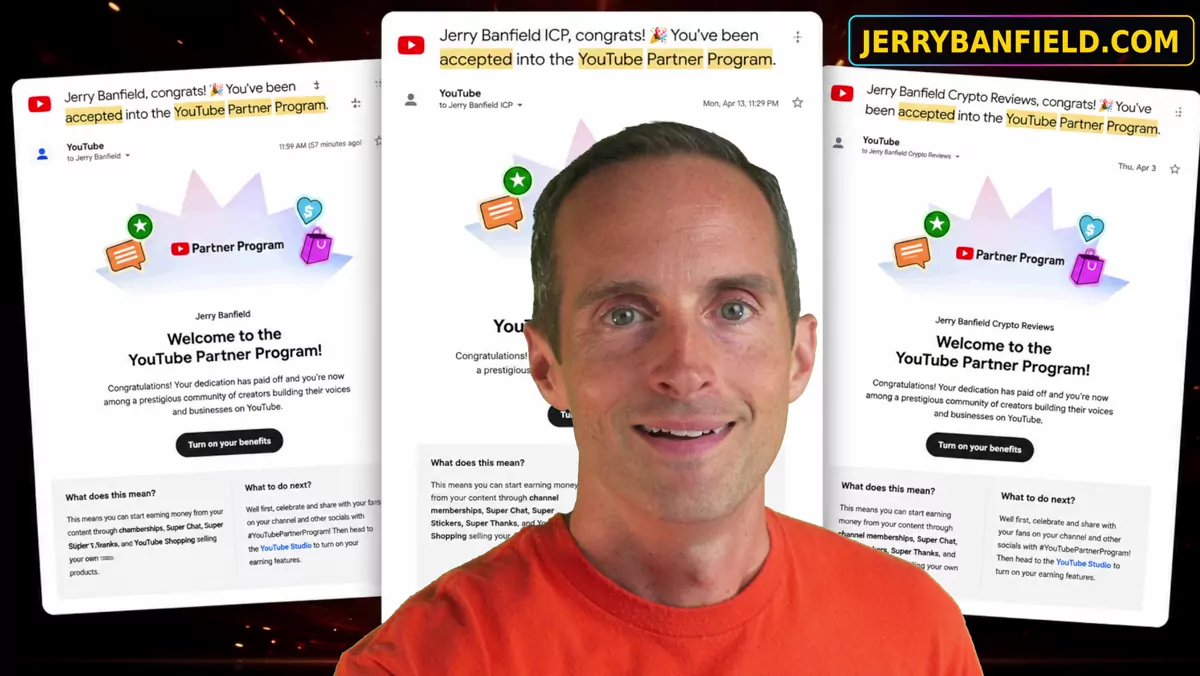
I've received partner acceptance letters in the last few months on three different channels. My newest one, Jerry Banfield, got accepted into the partner program about 59 minutes ago. Before that, I made a channel and it got accepted into the partner program within a month. And another channel got accepted into the partner program on April 3rd, a little over a month after I started it. So I am making YouTube channels that get a lot of organic traffic, and there's a very, very simple system around that.
Here's my first channel. I made it on March 21st, 2026, and it now has 3,000 subscribers and 348,000 views. This channel cranks out hundreds of dollars a month in ad revenue, but it's also the number one driver of getting people to go to my website at jerrybanfield.com and spend money with me as well.
The key context here: I'm a full-time YouTuber. I have no other job. I deleted everything last year. I tried to do something else — nothing else worked. So I started six brand new YouTube channels in March, and I've now got five to six hundred thousand organic views across all these channels. And I'm grateful that I've got people on my website buying my community chat. People schedule calls. People join my Skool. I've got a book, and people drop tips. And if you want to talk YouTube, you can have a call with me — I have incredible information about YouTube. And I keep it super simple.
The Simple Truth Nobody Selling You a Course Will Say
If you want to succeed on YouTube, this is what it really takes — and almost everybody else is making things complicated for you. They're trying to work you up into spending a whole bunch of money with them instead of giving you the simple truth: if you want views on YouTube, you need to film videos as fast as possible.
I know this goes against what a lot of people tell you, because most people tell you quality, quality, quality. They try to sell you a course on making better quality videos — better thumbnails, better titles. In my experience, that is terrible advice for the majority of you. Because unless you have a massive amount of knowledge about YouTube, you are in most cases going to be incapable of just making better titles, better thumbnails, and better videos. It will be hopeless. That won't work. Not only will it not work — you'll waste your time, you'll waste a bunch of money, and you'll come up with much less than I've got just grinding out videos.
In fact, if you look at the top channels on YouTube, they have more videos than I have. They have more views than MrBeast. They grind out videos. That's what they do. That's what I do. Some people want to debate the quality of my videos, but you can't debate the quantity: 646 videos published since I started this spreadsheet on May 18th, 2026. That's seven videos a day, mostly long form. That's 77 minutes of watchable content — watchable according to some — 77 minutes of watchable content, on average, published over the course of 90, 91 days. And that's every day.
So the secret is you need to be able to make content as fast as possible. That's what you really need to do. One of the easiest ways to do that is grab your phone, just holler at your phone, upload that to YouTube, put any kind of title on it, any kind of thumbnail, and do that over and over and over again. If you're just starting out and you've got a smartphone, you have everything you need. You don't even need to buy a microphone. You don't need a camera. Just do one video a day, every day — make a vlogs channel and do that every day for a few months. Then we'll see if there's any potential for you on YouTube. If you can't at least do one long-form video a day, like 10 or 20 minutes talking about your life, there's no point in you trying to do anything else on YouTube.
Most of the people selling stuff on YouTube want you to think there's some secret they know. Maybe you think you'll learn something that I don't know. There's not. It's effort. It's grinding. It's repeated iteration. It's showing up every day. And the secret is, if you can make videos as fast as I do, you have a very high shot at getting all these partner acceptances, getting ad revenue on a bunch of channels, and having a business system. In fact, I'm wondering which channel will be monetized next — at this rate, the YouTube coach channel and the dating channel are in competition to see which will be the fourth monetized channel I get this year.
Paycheck Channels: Two Crypto Channels, Two Audience Signals
Let me show you the other channels that I've got monetized. My second channel was a crypto reviews channel — the first two channels I mentioned are both crypto channels. What I call those are paycheck channels. If you want to do YouTube full time, you need to find a very clear problem, a very clear pain point, and solve it for people on a daily basis. That's what I did with my ICP channel. I made content for people in ICP, which I believe is the most advanced tech in crypto — game-changing infrastructure for the future. And then people want reviews of these garbage coins in crypto that are honest, which almost nobody does. So I made a second crypto channel.
Most people would ask: why didn't you just do all your crypto videos on one channel? Because I tried that. You need to make very specific content for each of your channels, so the algorithm knows exactly what kind of viewer it should show your videos to. The algorithm decides you're an authority on certain things, and then it brings your audience in. But if I do one channel and put all kinds of crap on it, the algorithm gets all garbaged up and can't tell who it should show my videos to — and then my satisfaction scores go down.
So I do one channel just for ICP. All I do on that channel is videos hyping ICP, every single day. I do a video about ICP every day. It's an ICP video every day, getting thousands of views every single day. And then I bring people to my website on all those videos. If I talk about Bitcoin there, it's only to bring it back to ICP. Then my crypto reviews channel takes a different strategy: it brings people in on a bunch of these other garbage coins — that's my attraction point, my audience point — and then I show them ICP from there. I'm basically doing the same kind of content, but I'm doing it two different ways to two different audience signals. And it works. I've used the tier-maker kind of thumbnails on a lot of those videos, because those work best, and that brings an audience in.
The Vlogs Channel Anyone Could Replicate
Here's another channel — my vlogs channel, the newest one, the one I just got accepted into the partner program today. This is a channel where I'm just doing vlogs. The first two channels you might not be able to replicate immediately so easily, but this channel you certainly could. It's literally just me talking about my life. What's interesting is I talk about the things that most people would keep to themselves. There's literally a video of me crying on camera and talking about this woman I met — some solid drama on there. I talk about crying while walking home from my date with this woman.
I tried some other stuff on this channel, but I lasered in: vlogs. Every day a vlog. Every day a vlog. Because if you think about it — what kind of content would you wish you'd done every day, 20, 30, 40 years from now? I've thought about this as someone who made content for 15 years and deleted all of it last year. The only content I really care about over the long term is vlogs: just take 20 minutes from my day, every day, and talk about my day, whatever was interesting. Then I put the most clickbait, sensational series title I can on all of it, and I bring people to my website. And this channel is getting its own organic discovery.
Cross-Promotion and Session Time
What's awesome is that when you have multiple channels and you do videos on them, they can all cross-promote each other. That's the real secret — do all these different videos on different channels, then cross-promote your channels. Right now I'm cross-promoting my vlogs channel, which you might not have realized I had. And that helps the outcome. The algorithm gets the right audience in on each channel, but the system also gives me outliers. Not everybody who watches my YouTube coach channel is going to go watch my dating channel, my Jerry Banfield show vlogs, my gaming videos — which are some of the funniest, craziest content I put out — or my crypto videos. But what this does is give me depth.
That means somebody, for example, discovers this podcast in their feed organically, and then they decide: oh, I like his dating content, I'm going to go watch his dating channel. My dating channel has got hundreds of subs right now and thousands of watch hours in the last month — on pace to be monetized in the next month or two. I tried a bunch of stuff on my Jerry Banfield dating channel that didn't work as well before. I just kept testing, and I figured out: what I need to do is personal stories. If I do personal stories on my dating channel, people resonate with those a lot more, because everybody else is doing how-to tutorials and telling people what they should think. What's really resonated? Take a title like "Men, stop giving up so easily on women" — that's much more generic than my newer ones: "I started cold approaching women. It worked immediately." "I was better at dating before I tried to be nice." "I stopped pretending to be friendly with women." "I spent $350 on Hinge in seven days, then deleted it."
What's happening here is that my dating channel and my vlogs are cross-promoting each other, and then my crypto videos are cross-promoting with my dating channel and my vlogs too. All that cross-promotion helps get more watch time across all my different channels. So if one person finds my vlog, then starts watching my dating content, YouTube looks at the session time and says: wow, somebody found this guy and they spent a lot of time on YouTube because of finding him — therefore, we're going to push his channel more, because this guy's keeping people on YouTube. Same thing with my ICP videos.
The Funnel Between My Channels
So people find my ICP videos — or actually, in the main funnel I'm running right now, people find my crypto reviews videos. Then they go to the ICP channel. Then they go over to the Jerry Banfield vlogs. And then some of them come to the dating channel, the games channel, or the YouTube coach channel from there. All of this is possible because I crank videos out as fast as possible.
To me, long form should be the basis of your content to begin with, because long form has great discoverability and builds depth. But once you've got your long-form content nailed and you can crank that out, then I start going into shorts, because shorts give me additional free discovery. Take the Jerry Banfield channel I just got monetized — I got that monetized mostly off long-form content, but now I'm expanding into shorts. On average, these shorts should get about a thousand views each. Some of them will get less, like 160 views, but others at some point will get 5, 10 plus thousand views.
And all these shorts feature me. A lot of people try reaction videos, which becomes problematic over the long term. How much time does that take? It takes you too long, and then the main point of the video is not you. All my videos are all about me. Who put this thing together? Me. That's who. Across all my channels, all my videos are about me — my shorts are about me, my longs are about me. I do react occasionally to other people's videos, but only if they're somebody who already supports me. All my shorts are just little stories, and they're giving me additional discovery that then helps me get more subscribers. My long-format videos are cranking in watch time, which gets me monetized easily, and the shorts crank in the subscribers. The shorts bring more people into the longs, and it's one big feedback loop.
Quality Is Debatable. Quantity Is Not.
The secret for all of this is you need to speed up your creation. Literally stop thinking about quality. The real question is: how do you guarantee quantity that's as high quality as possible? Some people make slimy comments, or narrow-minded, shallow comments like, "Oh, you're the king of slop." Here's the thing — and Gary Vee said this in one of his videos I really liked — quality is debatable. You can debate whether my videos are quality or not. That's your opinion. I love my videos and I'm proud of them. And some people say I'm a cult leader. But what you cannot debate is quantity. There's no debate that I've published 646 videos — that I've uploaded 646 videos to YouTube in just over three months. That's not debatable. And what gets results is that which is not debatable: quantity.
Now, yes — I don't just upload AI slop videos where I'm grinding out crap. What you see is that I have a very strong proof-of-human offering. Proof of human is becoming a premium in an age where people can grind out decently done AI videos talking about all kinds of stuff. What's special is that my videos, which are mostly unedited, have a raw, human, authentic feel. And that is also fast and easy to create. Take this very post: all I did was see that I got my partner acceptance today, paste the screenshots into ChatGPT, and say, put all three of these together in a thumbnail. I pay $200 a month for ChatGPT and $200 a month for Claude Max.
Then I also put all this stuff on my vlog, which gives me additional discovery — not that much additional discovery, but it makes everything have some level of permanence. And it compounds. For example, I filmed several videos today, and thanks to Claude, which took the transcripts and turned them into blog posts, I now have 1,287 blog posts on my website. Google sends people directly into my website. I let AI crawlers come in so AI knows what I'm talking about. Then people come into my website from my videos, directly from Google, from word-of-mouth marketing, from shares — and they spend money on my website and in my chat community. And I'm putting up more and more products.
A Mentor With Results to Speak for Themselves
For example, I'm going to put up a YouTube coaching program, which will basically just be having calls with me. If you really want to get good on YouTube, what helps is having a mentor who's got results to speak for themselves, who is going to be available to support and help you, and that you're going to be accountable to. I've helped people build channels to hundreds of thousands of subscribers and tens of millions of views — and all they did was talk with me once a week, every week, for a few months. I helped cut through the BS. Because where most content creators go wrong is wasting too much time on things that aren't important. You waste too much time editing when you should just practice speaking and refuse to edit your videos. I guarantee that if you refuse to edit your videos, you will stop umming and ahhing. And when you mess up, make it a funny moment. Laugh at yourself when you butcher the introduction.
This is something I discovered a decade ago. I did a two-hour, unedited Facebook ads tutorial. Obviously, one of the best kinds of content you can make is teaching people very concrete things they want to learn — that's getting more difficult with AI, but there are still things AI struggles to help with, and you can test out helping with different things. An hour into that two-hour tutorial — which somebody was actually watching, an hour deep — I was going through and writing some ad copy, and I said, "You know what? We're going to put a period on that motherfucker." And this guy went off in my comments and became a super fan. He said, "I was laughing my ass off so hard. I couldn't believe that in this Facebook ads tutorial you threw in something like that just offhand, and I started laughing so hard at it." That's your raw, authentic human experience.
Use AI to Check the Terms and Conditions
Now, you do need to be aware of the terms and conditions. Since I grind out so much quantity of content, I use Claude to check that I haven't violated the terms and conditions accidentally — because I'm cranking out so much content. And then I learn what to say to be a good boy on YouTube. Especially when you're starting out, you should have AI checking your content before you upload it, so you proactively avoid things like community strikes. After 15 years on YouTube, I've got a pretty good idea of what to say and what not to say. At the same time, some things can take you by surprise.
So that's the basic system I've used to monetize three channels since March 21st — about five months. Three YouTube channels monetized from scratch in five months. And at this rate, I'm going to have another one or two channels monetized by the end of the year. The one channel that's kind of dragging is my gaming channel — I haven't actually been playing that many video games, and we're still working on that one, trying different things. My gaming videos are some of the funniest stuff I make. Some of the most viral I've ever gone was for gaming. Like the video "Jerry Banfield's funniest pop your head up Scarface Warzone solos" — you will just go nuts. If you want to see a totally different side of me, and why I went viral before on Facebook gaming, that video is hilarious. I still watch it every now and then, it's so funny. What you can see is that I'm having fun doing my videos.
Why Not Just Do Crypto Content?
The last question I'll answer: you might be thinking, well, why don't you just do crypto content only? That pays the bills. It'd be so much easier to do two videos a day. I did that before, and I hated it. It's boring doing YouTube full time on nothing but crypto content. And this is what almost all these other people selling you courses will not address. They'll tell you to be an authority. They'll show you how to be an authority, tell you to pick some little niche and sell coaching programs to that niche. But if that's all you do on YouTube, it turns into a job. It's boring. Your creativity is stifled. If you really want to be a fantastic YouTube creator, you need to organize your entire life around being creative. I would know what the better long-term strategy is, because I deleted everything after burning out doing crypto crap for two years and then trying other stuff without making it all quite work. Now I've got it all working. I love the content I do. I love that in the same day, I recorded two or three crypto videos earlier today, I recorded this for my YouTube coach channel, I'll record a dating video if I have time, and I'm going to record a vlog right after this. Some days I'll record a bunch of gaming videos all at once — and I have old gaming footage I can use.
My 30-Minute Production Workflow
If you really want to do YouTube full time like I do, it's actually pretty simple: grind out videos as fast as possible, then keep increasing your quality and speeding up your production process. I film on OBS — if you search Jerry Banfield OBS, Jerry Banfield Equipment, or Jerry Banfield Studio, I show my entire setup, how everything looks in my studio and how I've got it all arranged. Literally all I need to do is hit the record button on the Stream Deck. As soon as I stop recording, I drag the file into a folder and start uploading it. The metadata is ready, it's checked for community guidelines, I copy and paste, and the video is live on YouTube. A video that took 20 minutes to film will probably take me 30 minutes of real time total — a couple of minutes of prep work to get the thumbnail background, 20 minutes of talking, and then five to ten minutes afterward to get the video uploaded. I can repeat that process across all six of my channels. That's three hours of real time to post six long-form videos a day. And when I have some extra time, we hammer out the shorts to increase discoverability.
So there you go. I just gave you better information right here than some of these people who hardly know anything about YouTube except how to make money off people who don't know any better — better information than I've seen anyone else cover.
If you appreciate that, go to jerrybanfield.com, schedule a call with me, and join my chat by buying my chat membership.
One purchase gets you lifetime access, and you'll be on the leaderboard. You can chat with me in there about anything you want in the community chat — Zenith, True Self, and Map all just bought their memberships in the last few days.
Talk With Me
You can talk to me immediately if I'm online, or you can schedule a call with me in advance.
You can drop a tip if you want to say thank you. And I think I'm going to get a little YouTube coaching program up for those of you that are serious.
You can also join the Jerry Banfield Family on Skool.
If you want more of what's actually working to grow and monetize channels from scratch, I keep every video like this one together in my YouTube Coaching playlist.
Thanks for reading. I'm ready for you on jerrybanfield.com.
I Know Too Many Ways to Make Money On YouTube
From my video published July 10, 2026.
I know too many ways to make money online — at least a hundred. And you would think, as a YouTuber, that would be a great asset. Awesome — I'll just use all of them. Well, here's what I've found over the last 15 years of uploading tens of thousands of videos and getting more than a billion views online: I got so burned out that I deleted everything. All of it. In 2025, I started six new YouTube channels. I've gotten four and a half million impressions, as I shared in one of my recent videos, over the 110 days since I started back again. And what I've found is that I've made the most money online — millions of dollars — by often focusing on one single thing that was most effective, and then doing everything around that.
I've been struggling to find that one thing lately, although it seems to have presented itself very clearly. Right now, it seems like Skool is one of the absolute best ways, as a YouTuber especially, to make money online today. Why is that? Well, let's look at the value you can provide in a Skool community. And what better way to demonstrate that than with my own community?
What Is Skool?
First off, with a Skool community, you need some kind of problem, and then a solution. But first, you might be saying: hold up, what is Skool? Skool is a membership platform. Imagine if you had Facebook groups, but you could also add online courses. It's similar to Kajabi, or Thinkific, or Teachable, or Udemy, but built directly to have community as the centerpiece.
Here's what Skool looks like on the inside, using my own group as the example — a group I just created in the last 30 days. You have posts. I have 13 members, which is awesome for starting something brand new. You can go live. You have a calendar where I schedule group calls. There's the classroom, where I'm going to be putting some of the online courses I filmed. You can look at each of the members, including their email addresses if you're the owner. You can look at a map to see where people are at all over the world. You can look at leaderboards to see where people have leveled up in the group. And then you have an about page where you can put your sales page.
If you want to see it on a bigger community, you get access to Skool's own community. You can see the events, the engagement they've got, and the status emojis they give you. You can look through the members, check the map, and direct message people — although in that community, you have to level up first. In my community, you can just direct message me if you join the Jerry Banfield Family.
In an Age of AI, People Are Missing Community
I was just telling a friend yesterday — he's been selling a lot of courses online, but he said all his course sales are going down. I said that makes sense, because today, in this age of AI, people are not paying for online courses nearly as much. Why would you go buy a course on Udemy, or on somebody's Thinkific or Kajabi, when you could just ask ChatGPT or Claude or Gemini about it? Why would you buy a course when people are competing, tripping over each other, to put out the best YouTube videos about that same subject — and they're using AI to make that even faster?
So what is worth selling, out of all the things online? You've got to think about how you can really solve someone's problems. What are people missing? Well, in an age of AI, what people are really missing is community. The more AI can do for you, the more you often don't need other human beings. I don't see why I'd hire a business coach today, when ChatGPT is capable of instantaneously giving me feedback. For example, I have so many threads going. Starting a few days ago, I went back and forth with ChatGPT for a crazy amount of time, trying to figure out the most effective way to make money in my business right now. I gave it a huge prompt packed with information. Does it give the best information out? No, but it inspires my thought. It talks about charging for stuff locally. And after this huge conversation with it, what I've come out to is this: I think the best opportunity is a Skool community. Because what people are missing is a sense of belonging. And what really helps is a group of people gathered for the same purpose.
Create a Life You Love
My purpose in gathering people is to help people create a life you love. Now, a lot of Skool communities — some of the top ones — are created around very niche things, like GTA 6 Profits, or Code with Claude, or Grow with Emily, or Master AI. Mine, because I have six different channels, is built around the one thing that brings everything I do together: I'm all about creating a life you love. That's what I'm here to help you do. And what really helps to monetize on YouTube, what really helps to dig into ways to earn money, is to figure out what problem you solve for people. I've zoomed out to the biggest problem I can solve for people: helping people create a life they love. I'm a living example of that. I've created a life I absolutely love, filled with all the stuff I love it being filled with. And I have a community created around that.
Then there are specific types of problems that attract people to the community originally. The idea is that people stick around, because there's also everything else you could want in the same community. For example, one reason to join my community: we had a new YouTuber join recently, Scouse Will, who I talked about in my last video. He joined because he wanted to be able to have group calls with me, and to ask and talk about YouTube. And I realized what problem I solve best for creators. I have so much experience that it doesn't make much sense for me to be pitching to brand new YouTubers. The problem I really help solve is this: if you are getting views on YouTube, but your income isn't going anywhere — especially if you're not monetized, or you're getting hardly anything out of ad revenue — I know a lot of ways to make money online. And I've given the most powerful information out of everything I've seen, out of all the stuff I've tested.
What Happened When I Launched
Within the first week or two of launching my Skool community, I made around a thousand dollars on it. And I've got a number of people signed up to pay $49 a month, so I'm going to continue to get recurring revenue. That's with being sloppy with my selling — not having things like watermarks clearly set up on my videos, and selling multiple things at once. What you generally don't want to do is have five different things you're selling at once. Join the Jerry Banfield Family. Join, get help every week. I have books — I've tried selling books, and I've sold tens of thousands of dollars in book royalties. I have one-on-one calls — I made tens of thousands of dollars selling one-on-one calls on Zoom. But what am I selling right now? I'm selling skool.com/jerrybanfield.
I've been down this road on somebody else's platform before. When they decided to ban my account — because they didn't like me, and I was making too much money, and I was telling everybody how I was doing it — I was making 10-plus times as much money as the people working on the trust and safety team. They get jealous. They make up policy violations. They banned me. I did all this work to promote their brand, and then they just take all that away.
Meanwhile, my own sales page has been created by training AI on millions of words of my content, including all of my research, thousands of recent videos, and books I published in the past. AI wrote this entire long-form sales page, which is incredibly specific, based on my exact experience and my exact words. And then I have blog posts that I crank out from all of that as well.
Recurring Income Through Community
So what I'm finding today is that the best opportunity to make money on YouTube especially is to have a Skool community, because of the recurring income. Here's what's really nice versus selling a course: if you sign up on my Skool because you're tired of hustling for views all the time and not making money, and you want to turn your views into money, then you can join my family. You can see how I do that, exactly, for yourself. You can get direct help and ask me all the questions. You can post your channel and we'll take a look at it. You can find hidden revenue opportunities.
This is not the same for everybody. A Skool community is not appropriate for everyone — some of you might do better just having one-on-one calls. But one of the best ways I see, that I'm personally going all in on right now on YouTube, is monetizing through building community. Community has so much value because it's not just me in the community. It's all the other people attracted to also join, who you can then connect with. You can direct message each other. You can give each other help. You can give each other feedback. In an age of AI, community is getting more and more important, while information is getting less and less important.
Skool seems to me to be the top community-building platform right now — at least the top paid community-building platform. And I recommend against doing things like free groups: free Skool groups, free Facebook groups. What happens with those is you get a lot of junk data. It's not focused. It's spread all over. And that means your posts don't go out to people on your Facebook group reliably. If you have a free Skool community, it can end up being really spammy. A paid Skool community creates a mutual investment of people who are there for a reason, for a purpose.
I've created communities in the past, and they were awesome. They were really helpful for me, and they gave a ton of value to the members. I think Skool's the best place today because it seems like the hot, up-and-coming place. If you build a Skool community that gets some traffic and makes some money, it seems like — according to what they're saying in their videos — they'll try to advertise your community and bring even more people into it. That feedback loop is really important. But you never want to lose control of your brand. And you always want to promote your brand.
While Skool themselves say the most effective thing to do is send people straight to your Skool URL, I'm not doing that. Because what if I want to move my community somewhere else? Which you can do, because you have all the email addresses on Skool. If my Skool got taken down, I could sit there and email everyone that was a part of the community. Whereas I couldn't do that on Udemy.
And what happens when you find a video, but you don't really understand — okay, I got that, but then what? My long-form sales page goes much deeper. Because my problem with everybody else's Skool communities is they're too shallow. I want something that offers more depth — more depth than just "you're going to help me with YouTube." Because what I'm going to do there is join, maybe find something useful, maybe not, and probably cancel pretty soon, as soon as I fix whatever acute struggle I'm having. Whereas to me, what's really valuable is to build a community that lasts the test of time, and to build a community you're a part of for a long time.
Deeper Than One Niche
I used to have this community called Jerry Banfield Partners. What was really powerful was having people be part of the community for a year or two, where they really got to know other people and would meet up in person. That was back when Jerry Banfield Partners was all about just making money online. But I want something that's more expansive, because my help is not limited to making money online. I know how to use AI — I'm often using two or three AI programs at once. I'm using Claude Fable to turn a video into blog posts and metadata. I'm using ChatGPT at the same time to generate thumbnails. And I'm putting my transcript through Gemini to make sure it's YouTube Community Guidelines compliant before I even upload it. So I'm on that AI stuff. But if you want to lose weight, I've done that. If you want a happy relationship, I have the exact same call to action and community for my dating channel. Because when you bring people together with diverse interests, you get diverse perspectives.
Right now the group calls have 13 members — still one or two people, so it's no big deal if there are different topics. But as the group grows, I'll have dating calls, YouTube calls, crypto calls, and AI calls. I could easily do a group call every single day as the group grows. And the beauty is, where else are you going to get that? If you're single, stuck, or starting over — bam, Jerry Banfield Family. You're getting views on YouTube, but your income's not going up? Jerry Banfield Family. And then I figured out crypto. I've got a gaming channel. And a main channel. Everybody goes to the same place, and it all goes to Skool. I could build all this myself now, but it's just easier to use Skool.
Why I'm All In on Skool
I like Skool because if you're already a member of somebody else's community from their YouTube channel, it's going to be so much easier to get you to join mine. Especially in a YouTube coaching niche — the same subject I dig into across my YouTube Coaching playlist — if you've already joined some other YouTube or Skool community, the friction to get you to join mine is very little. You've already joined theirs. You've already got your payment info set up. It's just a couple of clicks to join mine. Versus getting somebody to sign up on a cold website they've never been to before. Which is why I don't recommend using your own URL and then having a Kajabi or a Thinkific or a Teachable. It's more effective to use a platform like Skool and just maintain control of your brand.
So with everything I've done, I am committing to this. I'm all in on Skool. I know I just made a video talking about one-on-one calls, and those are good. But the ideal model is ongoing commitment — one single offer. And a community is just so much better of an offer, and so much deeper, than a one-off call with somebody. What I do now is, if you want a one-on-one call with me, you can just join my Skool community and then DM me and ask for a call. That is much better than trying to sell one-off calls.
I appreciate you reading this. I've shared all of this if you want your views on YouTube to turn into income. I'm living as an example of that. This is all I do. And it has literally only taken me three months to get to over a thousand dollars a month with brand new channels on YouTube, because I know this stuff — because I'm living it.
So if you want more income from the views you're getting on YouTube, join the Jerry Banfield Family and see how all this works for yourself. Let's find you some more money on YouTube.
Thousands of Views, $1,500 Paychecks: The Creator Dream Is Alive with Jerry Banfield
From my video published June 28, 2026.
The Creator Dream Is Not Dead
I saw a video saying that the creator dream is dead, that you can get millions of views and not get any watch time or any money. I'm here to tell you that's not true at all. Within the last 100 days, I started completely from scratch. I had zero channels. I had no accounts anywhere with any followers, because I got burned out last year after being a full-time YouTuber since 2011. When I started on YouTube in 2012, I went full-time, and I got really burned out last year. I had millions of followers and billions of views, and I deleted all of it. Every channel on everything, Instagram, Facebook, YouTube, TikTok, I deleted all of it. I started from zero, and that was about 100 days ago.
So I had no monetized channels, and I've got 147,000 views in the last 28 days, and at least $1,500 in income coming in. I'm literally just making videos at my house and publishing them. I'm not doing anything else for work. The creator dream is alive and well, but there are certain things you need to know to make this work, and I'll share them with you here totally for free.
Two Easy Ways to Monetize at Any Following Level
If you want to monetize, in my experience there are two awesome, easy ways for anyone to monetize at any level of following. First, you get a website, which you can set up very cheaply with Cloud Code on the Internet Computer. Second, if you want to monetize, you want a community. I've made almost a thousand dollars in the first two or three weeks of launching my community. Skool is one of the easiest ways I've ever seen to make money from YouTube, because when you show people how to do stuff well, they're going to need help. You schedule calls on Zoom. That's how I've made the majority of my income here, through Skool and one-on-one calls.
I also do get YouTube ad revenue, but at least around half of these views are not monetized, because four of my channels, Jerry Banfield Games, Jerry Banfield Dating, Jerry Banfield, and this Jerry Banfield YouTube Coach, are not monetized. So I'm not getting any ad revenue on those, but you don't need ad revenue to make money. What you need to do is make videos that help people. You can help people by giving them information, you can help people by relating to them and showing them where you're at, and you can help people by entertaining them. Ideally, if you can do all three of those in the same video, you will crush it. That's what I do.
Why Live Streams Work Best for Me
The best way to do all of that, for me, is to do live streams. But if you're better at shorts, if you're better at editing videos, you've got to figure out what you do best. To me, the thing that gives you the highest quality human experience is to do live streams, and to do shorter live streams. This one will be 20 minutes minimum, 40 minutes maximum. It's a live stream where I'm literally talking off the top of my head. There's no outline or anything in the background. I have no script. I just know this stuff, so I'm sharing it here with you. The goal is that your videos give people massive value, and then you set up simple, straightforward ways for people to get back to you.
You can make additional money by affiliate selling, which means selling somebody else's thing with an affiliate link. You can also make money with sponsorships. So you don't even have to monetize the same way I do. But what I'm telling you is the creator dream is alive, and everybody else is just giving you fear, uncertainty, and doubt. Yes, people are getting burned out. That's why I quit last year. But why did I get burned out? Because sometimes when you're an influencer and a creator and you've got all these followers, they can end up becoming a burden and actually sending the algorithm negative signals. I've actually been really satisfied clearing out all my old channels, getting rid of all the people who followed me more than a decade ago, and starting fresh to give the algorithm better, consistent signals. Then I niched my content.
Do It for Passion, Not Just the Paycheck
The idea is that if you go and try to help somebody and entertain somebody every day, and you have fun doing it, you're not even really working anyway. This is just a conversation I would want to have with myself. I literally am talking to myself about this same stuff anyway, so I might as well record it and share it with you. If you're going to be a creator, ideally you should have a passion for this and not just be doing it for money, because there are lots of ways you could sell your soul to try and just get a paycheck, and you might get paid better with job stability, health insurance, and so on.
I love being a creator because, one, I can't stand having a boss trying to tell me what to do and when I should do it and where I should do it. And two, I love just coming on YouTube and being a content creator. I can show up when I feel like it and I can talk about what I feel like talking about. My goal is to help expand people's minds and to help teach. There are so many fake YouTube gurus out there that if you try to actually apply the stuff they're telling you, it wouldn't work. But I just did all this stuff on myself, and I'm telling it to you for free.
So with your creation, what you need to think about is, what are you so passionate about that you would create it even if nobody watched it? That's important. But you also need to think about what kind of content is so in demand that if you created it, people would watch damn near anything. You need to combine the two of those. Ideally you can do them both together, but sometimes you just might need to do something just for you.
Why I Stopped Locking Myself Into One Niche
I've found that trying to niche down and pick one thing, like crypto for example, can backfire. All the experts over the years and my own expertise led me to conclude a few years ago that I should just do crypto and nothing else, because crypto is where I made the most money, got the most views, and there was the most demand for my videos. The thing is, when you're a creator, if you just lock in your creativity like that, I got to hate doing my crypto videos. I wanted to make music. I wanted to play games. I wanted to talk dating. I wanted to talk YouTube coaching. I wanted to talk health and fitness and esoteric ideas and philosophy. But when I just showed up trying to do YouTube like a job by itself, that was boring, and I hated it, so I ended up deleting everything.
What you want to do is make YouTube fun, but also make YouTube profitable. So you need at least one channel that is just a fun channel, where you don't worry about getting views at all and you just have fun. Then you need a channel where you ask, okay, where can I help? You do need at least some channel that is there to get views. That is your job channel.
My Job Channel and Finding Content Gaps
I have my Jerry Banfield ICP channel, and this channel has gotten the most views. It has 238,000 views since I created it on March 21st, 2026, which was just over 97, 98, 99 days ago. This channel is my job channel, and I try to go live on it almost every day. I'm not getting huge amounts of views. I get a thousand or a couple thousand views on most of my videos. I also found the format I can create the best. What I do best is live streams. That's the hardest kind of content to create, and it also creates an expectation that I'm live, that I'm talking off the top of my head, that this is not some scripted, perfectly edited video. So I found that live streams are the best thing for me to do. On a monetized channel, they make me the most money per minute of content. I've also tried shorts, and shorts suck for me. Unless you love doing shorts and watch shorts all the time, my shorts have been mostly worthless, but I tested some to make sure. Live streams are the best.
So this is my work channel. My job is to create content about ICP. One, I personally believe in it, but two, there's a huge demand. If you go create a channel on Internet Computer Protocol, or ICP, I'm not going to totally guarantee you anything, but in my experience there's a very high probability that anyone creating content on ICP will get viewers, because there's a content gap. There are people who are desperate for great ICP videos and will watch ICP content every day, and there's simply not enough content. There are content gaps all over the place.
Let me give you another example of a content gap. On my gaming channel, I found a content gap in a game called Hearts of Iron 4. I did a video titled "Worst Hearts of Iron 4 Player Ever," and it got 5,000 views when most of my videos before that were getting 20, 30, 10, or 100 views. That is a content gap. When I do a video about Hearts of Iron, instead of 10 views, I get 400 views. I test out different games and try to play what I like, and what you need is a content gap. You need an area where people want videos and are very happy to see anyone creating. Ideally, if you can combine that with an educational context, then you will easily be able to make money.
Now, yes, if I'm sitting here playing a video game every day, I could easily get 147,000 views playing a video game and make like $100 off of that, because gaming doesn't monetize that well directly. It's important to do different kinds of content. If you want to be a full-time creator, and I'm not talking to amateurs here, but even if you just want to do this as a side hustle, you should have at least 20 hours a week for your content. And you should have at least two, if not three, different channels. One should be a pure fun channel.
Build Channels That Feed Your Creativity
One channel should be a pure work, business, make-money channel. And another one you might make a hybrid that combines the two. I have all different kinds of channels and I create all different kinds of content, and that inspires me to be creative. The number one thing you need to do on YouTube is be creative. If you can't be creative, original, and authentic, you're going to have a hard time getting views.
The Tension Between Honesty and What People Want to Hear
Here's a real problem on YouTube: you can often much more easily make money telling people what they expect to hear than by being honest or telling people what they don't want to hear. I'll give you an example from my Jerry Banfield Crypto Reviews channel. When I first came out with my crypto reviews channel, the algorithm was pushing it really hard because it didn't have any negative feedback yet, and I was making videos where there was huge demand. If you look at some of the first videos on that channel, my first video got 2,000 views, the next 2,900 views, the next 8,000 views. But the more videos I kept doing, the more YouTube started to get signals that people weren't satisfied with my content.
Why weren't they satisfied? They weren't satisfied because I was telling people things they didn't want to hear. I was telling them that their token sucked. You would think "sucked" would be a good thing in a lot of ways. It's funny how sometimes we say things that should be a compliment, that should mean something is awesome, but they actually land as an insult. My goal is comedy, entertainment, and education, and value in all my videos. So you'll notice a lot of my views have trended down on that channel, partly because crypto prices are in the shitter and people aren't even watching videos. But also, when people come to my crypto reviews channel and they leave feeling dumb because I roasted their coin and talked about how terrible it is, then when YouTube asks them about satisfaction, they say, well, no, Jerry hurt my feelings and Jerry didn't tell me what I wanted to hear. So that can be an issue.
However, you still do it. You still act honestly, you still act with integrity, and you just keep giving the best value you can. Over time, the algorithm will get better at finding people who actually will be satisfied with your videos. You tell the truth even if people don't like it. And sometimes you just don't realize that your time is coming. These videos I'm making saying everything sucks, when they all collapse and go to zero, I'll have a whole inventory of videos saying "I told you so" right there, and then people are likely to be more satisfied. So it's important that you can cover something with integrity and authenticity.
In my experience, it's better to get views on something you honestly created and shared and make less money in the short term than, as I've done in the past, make lots of money on things that were not sustainable. Because usually when you make money on things that aren't sustainable, you'll piss it away and end up worse off than you were before. At least if you've never made any money on YouTube and you make a little bit, you're going to be happy. But if you're like me and you've had months where you made $80,000 or $90,000, and then you go back to making five or ten thousand, that's hard. That's what happened to me in 2025. I had so many of these huge months in previous years, and by 2025 I just felt like, I suck, this is all worthless and useless. Sometimes your content will not get there in the short term. But the thing is, it's got to be fun.
Read the Comments and Make Every Impression Count
You mainly want to read the comments. Spend time, spend hours looking at the comments and seeing what people are saying in reaction to your videos, and try to help someone. There's a huge amount of value I feel just in making a video that's there to help someone.
If you look at my YouTube Coach videos, a lot of people would look at that channel and say it's a big failure, that I don't know anything about YouTube, that I've only got 65 views in the last 48 hours on all my YouTube Coach videos. But I've made a significant effort on this channel. It has 65 videos on it. It does have 23,000 views, all of which are organic, and I haven't even put out a video since the 23rd, so about five days. Here's the thing, though: there's more happening than you see on the surface on YouTube. If you go to your content and your analytics, and especially if you look at how many impressions you have, you'll see it. My YouTube Coach channel, which on the surface people think is a waste of time, has had my thumbnails shown 73,000 times on YouTube. The majority of people who see that will not watch it. But I've communicated 73,000 times that you have enough, that you can make money on YouTube right where you're at now.
On a channel where a lot of people look at the surface and think, what a waste of time, nobody cares about any of this guy's content, YouTube still gave me 73,000 impressions. If you look at the videos, they got 64,000 impressions. The live streams, I've only done a few on this channel. This is my fourth live stream ever on this channel. So on the surface you might think not much has happened on a small channel, that your channel with a few hundred subs doesn't matter. But if you're getting your videos out to 73,000 impressions, that does matter.
As I said in one of my previous videos, most YouTubers waste their impressions. Most YouTubers just choose views over time, and their impressions are basically useless if people don't click their videos. Make every impression you have count. Make every title and every thumbnail help somebody, and you will be amazed that even if it looks like almost nothing is happening. Some of you look at my channel and see 42 views, 36 views, 119 views. Look at the live streams: four views, 75 views. This is the one I'm doing now: 75, 115, 63. You might look and think nothing is happening there, but I'm communicating a message to thousands of people on every single video.
Every View Is a Real Person You Reached
For example, on this video, again, so many would think it sucks: 38 views, four watch-time hours, who cares, right? But I communicated a message to mostly unique people, although there could have been some duplicates. I communicated a message 1,500 times with this video. So once you start seeing that, even if your video has 38 views on it, that's thousands of people you've had the chance to communicate with. And with things like crypto, that's a big deal. My crypto videos have gotten millions of impressions. When my crypto video says Cardano is finished, even if it only gets a thousand views, that's at least 10,000 people on the impressions that I sent the message to that Cardano is finished. When I'm doing ICP videos, those have gotten millions of impressions in the last 100 days. There are probably 100,000 people who have seen them at least 10 times, or 10,000 who have seen them 100 times. I've communicated millions of times to what looks like maybe 50,000 to 100,000 unique people. I've communicated a message from me to them, and I've gotten paid to do it.
What an honor. What an awesome job, where I get to come up with messages that I want to send to other people, and I get paid to send them. That's awesome. And if you laser in on the message you're sending, it matters. There have been videos I've seen on YouTube that communicated a message that was helpful, and I still have never watched another video from that channel, but it helped me. If you start looking at it that way, your goal is to serve humanity and to help humanity by sending helpful messages. That kind of energy will bring people who will pay you.
Turning Helpful Videos Into Paid Calls
I get paid well through Jerry Banfield Family. People book time to talk to me on Zoom, and that has been the majority of my income. The way you do that is, when you help someone with your videos 10 or 20 different times, that creates a desire in people. Some people have literally only ever watched one of my videos one time, and they'll come in and pay for a session. If you want to get some money in the door, all of a sudden all you need is about 15 people to pay you for 30 minutes of your time, and now you make $1,500 a month. Or you need one person who will pay you 15 times. You see how easy this is? You don't need to have huge numbers of views. Even the views I have, a lot of them are on gaming videos, or crypto videos that are extremely repetitive, or YouTube Coach videos where nobody's even scheduled a call, or videos where I'm just having fun and entertaining, like on my Jerry Banfield channel.
A lot of the time you need to make repeated impressions with people. That's why I suggest trying to put a video up, or going live, or doing a short every single day if you can, because that's what I've been able to do. I've consistently put videos up. I have a spreadsheet where I actually track this. So here's my spreadsheet. I've done an average of six videos or live streams a day since May 18th, when I started tracking this, and that's 260 videos and live streams I've done. Now I'm only doing live streams, because live streams are the most effective form of content I can do. I've done a total of 12 live streams that I've tracked on here. Actually, I've already done two today, so let's add those. The dating one and the ICP one are about 70 minutes. So I've now done 14 live streams total since I started doing live streams on June 22nd. Every day, live streams are my only form of content, and I'm averaging two live streams a day among my six channels.
How I Track My Live Streams and Why
I focus on doing the ICP channel primarily, because that's monetized and I get the most money per live stream on that channel. I'm averaging 35 minutes a day live, and I've done 24 hours of live streams. I've been live for 24 hours in the last week. This is actually the third live stream I've done today, and we've been on this one 20 minutes already, so we'll put that in at 90 minutes. That's 15 live streams, 2.1 a day, about 89 minutes a day on average. On average I'm live, and across the week I've been live around 24 or 25 hours.
So this is what I do, and this is how I track what I'm doing. Whatever you want to do on YouTube, track whatever it is you're doing so that you can see it. Because when I look at that spreadsheet and I see all the videos and all the live streams and all the minutes I've gone live, that's your accountability. That's your productivity. That's where you get to say, oh, look at what I've contributed. A lot of us focus on what we're going to get. And to be clear, I'm not looking to be full-time on YouTube for $1,500 a month. This is just what I've done in 100 days following my own advice, not anybody else's, following what I know.
The Best Time to Be a Small Creator
In my experience, this is the best time to be a small creator on YouTube. There are huge opportunities you can have. AI makes all of this like a superpower. I generated this nice-looking thumbnail with ChatGPT in just a few minutes. I generated the title idea for this video by taking somebody else's video and saying I wanted to make the opposite message, and it literally just gave me a nice title to work with. Then I use AI to crank out blog posts on my website, so that this way my videos are truly uncensorable.
I've got all my videos on my website, 896 posts. All of these send people to YouTube, and all of these send people to my community. I set all this up with AI. Look how many posts there are. I've got diary entries from when I deleted everything on YouTube and was narrating just into audio files, and AI cranked all that out and put it all together, and this is all on the blockchain.
Get a Mentor Who Actually Has What You Want
If you want to do better on YouTube, I suggest you get a mentor who has what you want. Most of the people on YouTube do not have what you want. They're telling you whatever they need to say to get you to pay them. They're doing things that won't work for you, things that they don't actually have to do themselves. Once you have an audience on YouTube to some degree, you can just kind of do whatever you want and keep having an audience and keep making money. What's hard is starting from scratch and building something up, like I did in 100 days with no foundation.
So join Jerry Banfield Family and share your YouTube channel. I have brilliant insights I can give you. You can DM me and you can talk to my AI. I plan to have in-person meetups in St. Pete at some point. I've got a PDF showing how to get your whole website on a blockchain and use AI to turn all of your videos into blog posts, so you can have Google search traffic and AI training there indefinitely. I know this might sound a bit advanced. But if you want a mentor, if you want a teacher, don't you want someone who's advanced, who knows this stuff really well, who's here to support you, and who's living it themselves on their own channels, rather than saying what they might do if they started from zero now, even though they don't have to? I do, because I did, because I deleted all of it.
So I'm really proud of where I'm at on YouTube today. I've offered this as a gift that most people don't even watch. I've communicated the idea that you have enough, whereas a lot of people are communicating the opposite idea, that you don't have enough, that you're not enough. The truth is, you don't need my coaching at all. I'm not paying anybody to coach me. I'm just doing this myself off my own experience, my own passion, my own motivation. Now, when I want to learn something rapidly in other areas of life, I absolutely do get a coach or a mentor to help me. But I know how to do this, and I'm doing it myself. And if this was awesome for you, I've got a lot more videos and a lot more live streams for you in my YouTube Coaching playlist. The creator dream is alive, and you can start right where you're at.
How I Got Monetized + YouTube Partner in 40 Days
From my video published February 10, 2023.
My friends, you are about to learn how I got a brand new channel on YouTube monetized and into the partner program within 40 days of uploading my first video. I've built an audience of people hungry for more videos, and in my experience that should equal hundreds if not thousands of dollars a month in ad revenue. If you're a YouTuber, you'll want to read all of this, especially if you're thinking about starting a new YouTube channel. And even if you don't have a channel, or you already have one and you don't think you need another, I believe this will still be helpful for you.
Let me walk you through the proof from my analytics. I got the email from YouTube saying I've been accepted into the partner program. Once you hit the 4,000 watch hours or the shorts threshold, you go to the application: you hit the Apply Now button, review the terms, get your Google AdSense account set up (or connect it if you already have one), and then get reviewed. That entire process only took about two days for my channel, even though it says it can take up to a month.
Now, I'm not brand new to YouTube. I've been on YouTube since 2011. I make new videos and they hardly get any views. So I started four new channels. Not just one, four. And I could barely even use my existing channel to get any traffic. It was so bad. So if you're a YouTuber who's already got a bigger channel that isn't getting as many views as you think it should, I'd suggest starting at least one, if not multiple, new channels. I started four because I'm a full-time YouTuber and I've learned the very hard way that you need to segment your audience. I have people who want business videos, people who want recovery videos, people who want gaming videos, and people who want crypto videos. And my crypto channel is the one that's taken off.
Not all YouTube channels are created equal
The first key lesson you absolutely want to get down is that not all YouTube channels are created equal. You want to think supply and demand for YouTube. Where are you really needed as a creator? There's a ton of people who want crypto videos and information on YouTube, and there aren't that many crypto YouTubers, especially ones who make quality content that's original thinking and who consistently crank it out. In my experience, crypto YouTube is one of the easiest places to grow a new channel. So think carefully about the kind of channel you create, or just create multiple channels and try them out. If you're brand new to YouTube, you can do a generic channel just to experiment and play around with it. But for the long term, you need to niche your channels down into exactly what you want to make videos about, because the YouTube algorithm punishes you. If you're on a main channel like I've had for years and you put out gaming videos and all kinds of different videos, that is going to wreck your algorithm.
So let me show you inside my channel analytics. I've got about one day of revenue so far, not even a full day, and it's come in at seven bucks, which is great. This is my crypto channel. I've made a video most days, although I took a week off trying to do a Mr. Beast style go-all-in and make a really great video. For me, and for my crypto YouTube people, and for my particular style, what works is to just grind out a video almost every day and give the real, raw, authentic side of me. This is where you've got to know your value proposition and your audience. On crypto YouTube, people generally want updates almost every day. So if you look at my videos, I put out a video almost every day: the 10th, the 9th, the 8th, the 7th, the 6th, and so on. I took one day off there, and I took about a week off there.
And you'll notice in my analytics that my growth has mainly come from cranking these videos out each day. When I stopped putting videos out each day, it kind of went flat. Then I go back to putting videos out each day and it really cranks up again. Crypto YouTube is very much a "what's happening today" kind of experience. Whereas other channels, like Mr. Beast putting videos out for a very general audience, his videos are just as watchable, often even more watchable, a year or two after he's done them. In something like crypto, people want the newest videos all the time, which means there's a great opportunity for creators.
Getting the watch hours: video length matters
The key to getting monetized is getting those watch hours. So you'll want to know how long I made my videos, what the topics were, and where I got my traffic. Most of my videos, although I've done some that are seven or eight minutes, average out shorter. If you look at my top videos: this Cardano video averages three minutes of views, this Stellar video two minutes, then the CRO video three minutes. My watch times run anywhere from two minutes at the lowest for a seven-minute video, up to over five minutes for longer videos.
So if you want to get monetized faster on YouTube, you really want to make longer videos, because longer videos give you more watch time. If you look at my watch time, the longer a video is, the more watch time you can get, which makes it much, much easier. My sweet spot has generally been cranking out videos around 10, 15, or 20 minutes. Sometimes you get a bit too lengthy and people won't even click on it because they see it's so long. People like to finish a video. But my videos here have averaged maybe 15 to 20 minutes long.
Where my traffic actually came from
Now let's take a look at where I actually got my traffic, because this goes against a lot of what you might see from YouTubers trying to tell you how to build a channel. If you look at my views and the click-through rate, this is a solid click-through rate on cold traffic, people who have not seen you before. Once people get to see you and recognize you, you should be able to get even higher, but for cold traffic this is pretty good. And what's amazing is half a million impressions on a brand new channel. Clearly this works better than trying to go the shorts route: I did one short-form video and the rest long-form. If you want to get monetized, the long form is generally going to be a lot easier, because getting 10 million shorts views basically means you need a video to go viral. Otherwise, do the math yourself: if you can crank out shorts that get 2,500 views, you're going to need quite a few videos to get monetized. Whereas if you can crank out videos that get an average of four minutes watched each, that's going to be a lot faster.
If we scroll down and look at my traffic, this is what you need to do if you really want to grow a channel. You need to get hits in YouTube search, because the browse features are often stupidly competitive, especially in areas like gaming and general entertainment, where you've got so many people aiming for those and such a history of videos. The majority of my traffic has come from YouTube search, and I've made my videos with YouTube search in mind. If you look at my top videos, they're specifically targeting YouTube search. I was targeting people looking for information about Cardano, so I put both the name of the crypto and the abbreviation, I put the word crypto in my title, and I put the image of the crypto in my thumbnail to maximize my search traffic. Same thing on Stellar, same thing on CRO.
For Bitcoin, I tried something different. I took an idea I saw somebody else make a video on, I literally copied the exact same title, and I did my own take on it. If you're wondering where to get titles that people will click on, just look around and you can literally copy the exact same title. You could even copy a similar thumbnail format. A lot of people have already done the research, so you can see what works in the algorithm. It's not hard. I actually came up with some of these title ideas myself; I hadn't seen anybody do them just like that, but now I already see people on crypto YouTube copying my title format, and it's working good for them too, which is hilarious. So there's a lot of copying. If you see something else that's great, just take it, execute, and deliver better on it than somebody else has. Comparing Gala to Bitcoin was an original idea too, for example. I did some reviews and experimented, but basically my content strategy was to get in those YouTube search results.
Then, once somebody's watched one of my videos in YouTube search, I've got a better chance to show up in their browse features, especially since I've got a pretty high percentage of likes on most of my videos. Somebody actually watched five minutes of a video and dropped a like. Then when I put out another video, I've got a great chance to get into their browse feed, and that's where you build a relationship over time. When somebody who found me in YouTube search sees me show up in their browse feed and likes that video, now I've got the chance to go out even more in the browse feed, because YouTube's got data that says people like this in the browse feed. Whereas getting into the browse feed through cold traffic can be difficult.
If you're wondering how to get that initial traffic on your videos, you need to understand this: you need some initial traffic on your videos to have a chance to climb up into YouTube search. And that's been my key to getting into YouTube search, on my first few videos and every video since. When I release a video, I share it out directly on Twitter. What's nice is I share all my different YouTube channels out to the same Twitter account. Then I go on Facebook and share the same thing out to Facebook. Even if I don't get that many views this way, if you look at my external traffic, it's a small percentage, only a couple of thousand views out of the total. But the biggest difference in the world is just getting a little bit of traffic versus nothing at all.
You need 20 raving fans to trigger the algorithm
It's essential to understand what happened when I first put my videos out. If you go back to my earliest uploads, those first few videos have actually gotten a lot more traffic since then from all different types of sources. But when I first published them, this one got maybe 50 or a hundred views. That one is still about where it started. And this one got 50 or a hundred views, same with the next. They've all gotten more over time as people found me in search and went back to watch older videos.
If you're going to make videos, in my experience you need at a minimum 20 people, 20 raving fans who are willing to watch all of your videos all the way through. That's the threshold you need to break into YouTube search, because a lot of YouTubers, probably the majority, don't even have 20 people who will come to YouTube every time they post and watch the entire video. I set 20 as the absolute bare minimum to scratch the surface and trigger the algorithm. Many others might come through and watch a little bit, not even like it, and leave. But if you get 20 people who watch every video all the way through, that's what you need to trigger all that other traffic. Obviously, the more you can get, the better. On my initial videos there were about 20 hardcore fans who, every time I put a video out, would immediately go watch the whole thing. That's what you need.
How to get that first bit of traffic
If you don't have much of a following on social media, you can obviously share there, but my own social traffic has been pretty dead. You could probably scare up 50 or 100 impressions on Twitter, maybe a couple hundred. On my Facebook page, even though I've got millions of followers, the traffic is just dead. I'm lucky to get a couple of likes and a couple of clicks. So you don't have to have that many people on social media. What helps a lot is to send messages to people directly. The smaller your engaged following is, the more you should just direct message people the moment your video comes out.
Another thing I did to share my videos, and it has only gotten a small amount of traffic, ties into the fact that I'm making crypto videos. I post my crypto videos to DTube, which is a blockchain alternative to YouTube. It's very quick and easy, and I've already made a video about it on my crypto channel. Then I share it out to some of these decentralized social media websites built on crypto, and on these I actually earn a bit of money, a dollar or a couple of dollars a post. DTube is my favorite decentralized crypto social video platform. There's also Hive and Steemit you can go to. You can find my profile at steemit.com/@jerrybanfield, and the same at hive.blog/@jerrybanfield. I found these communities that are very specifically related to what I'm doing, and I've posted a lot of videos there. It hasn't gotten that many views if you look at the analytics, but it was essential to getting the videos started and getting that initial traffic moving.
So when you look at my sources, you've got Facebook and Twitter, then WhatsApp from people messaging others with my videos, then DTube, then Blurt blog down at the bottom. The Facebook traffic got a lower watch time than usual. The Twitter traffic has been high quality. The secret is simple: it's up to you to get the initial traffic, at least 20, if not 100 views on your video.
The three keys to a quality video
If you've made a quality video, you might ask what I even mean by quality. There are three key aspects of quality on YouTube. First, and most important, is your idea. The idea you have for a video determines its whole potential. Take this one: I saw somebody else do a top five AI crypto altcoins video. I literally took the exact same title, put a thumbnail on it that I thought was nice, and threw it up. I saw people talking about Gala Games, so I did a video saying I bought Gala Games and I'll be a crypto millionaire. These are simple and straightforward.
The second key is thumbnails. I tested getting my thumbnails designed by a graphic designer. This Gala one I had done by a graphic designer, this one I did myself, and honestly you can't really tell the difference. Clearly I don't need a graphic designer to get views, but you do need video ideas that people are actually interested in. That's what's more difficult on a gaming, business, recovery, or general channel versus something specific like crypto. I know crypto, so I know what titles other people are using, and I can innovate and make my own. I do both: I make thumbnails that are simple and give a clear indication of what the video is about, and I innovate on titles.
The third key is execution, and my style, the easiest style to do, is to just be real and authentic and raw and unedited. This lets me grind out videos, which lets me fail faster, test faster, and see what people like and don't like so I can do more of what works. If you spend a ton of time and energy trying to make one perfect video, you'll often be devastated when it does poorly. MrBeast's advice is to just grind out 100 videos and improve a little bit on each one. Along with that, you need your own unique style that works. For me, raw, generally unedited, straight off the top of my head is the style that works. Yes, my videos get longer. Yes, some people get tired of my rambling. But I'm able to make as many as five videos a day for five different YouTube channels, and that gives me a lot of chances at success, especially on this business channel.
I just rip other people's titles. This one I've seen so many others do, so I literally took the exact same title and did my own version, very quick. I took this one right off somebody else's idea. Same with this one, and this is a similar theme I've shared before. I just take somebody else's idea, which they probably took from somebody else too, quickly share my thoughts on it, and upload. It's a very effective formula that has worked really well on my crypto channel.
Pick topics you'd love to make forever
The question then becomes how I keep doing this going forward. The last thing to consider with your channel is whether it's something you would love to do indefinitely, because if you hate making crypto videos, you probably don't want to grind them out for years. I'm passionate about crypto. I see it as part of a financial revolution, and I can easily crank a crypto video out every day for years. I've figured out by testing which topics I love and enjoy. I know I can make gaming videos, business videos, recovery videos, and vlogs indefinitely. So I've found the areas I love creating in, and I've dropped the areas I don't love. This is the inside look at exactly how I got my channel monetized.
Returning viewers are what YouTube really wants
The last thing to look at is returning viewers, one of the big things YouTube cares about. You've got your thumbnail, your idea, your title, and your execution in the video, and then the last key thing YouTube cares about is returning viewers. YouTube wants to see channels where people keep coming back over and over again. This can take a little time and momentum to get going. Across my lifetime on the channel, when you first start you obviously won't have any returning viewers. But even if you can just get about 20 people, and this is why I keep coming back to that number of 20, to return to your channel, it sets the algorithm in motion. Then, as YouTube shows your content to more people, the thing you really need to work on is whether the people who see your videos want to come back.
You can't control whether someone who found you in search also gets shown your video in browse features, but you can do your best on each video. Notice I had fewer returning viewers during one stretch: when I took a week off from making videos, my returning viewers started to dwindle a little. Then I came back to making videos, and my returning viewers went back up. What YouTube really wants to see on a channel is your returning viewers going up. You can also see down there which of your videos brought a lot of people back, and that's an indication of what you might want to make more of. On mine, I can see that Cardano and Algorand were videos where people who watched them chose to come back for my new ones.
If you can keep increasing your returning viewers, your channel will build really solid momentum. That's the trick: make videos that hit in YouTube search and that the people who find them want to come back for. For example, if I just crank out gaming tutorials for one specific game, I can get into search, but a lot of the time the person who finds that video won't care to come back for my other random gaming tutorials. With crypto, though, I cover all these different projects, so if someone watched one project, there's a good chance they'll be interested in a different project I'm covering too.
This can obviously be challenging, and if you want to make it easier, there's always an easier path: networking makes everything a lot easier for you. If you want to network with me, and you're one of the few people who read all the way to the end, the best way to do that today is to join the Jerry Banfield Family community. Everybody in here is intent on building the financial future they want, and if you're creating on YouTube, it's worth asking yourself why. What kind of financial future do you want to have? This is the one single community I've built as the best place to network with me, where I'm available every day and where people like me are joining every day.
A community built for creators
If you're a YouTube creator, this is something I've built as a community that I believe will be outstanding for you to join, where you can work on not just your YouTube channel but the bigger picture of how your YouTube channel fits into your entire financial life and your entire lifestyle. We have a Discord server where we share our net worth each month. I just started this group, and we're already up to five members. We've got channels in there about all the things that we do, all kinds of different subjects related to being a millionaire. There's a channel just for creators, and if we get enough YouTubers, there'll be a channel just for YouTubers.
So if you want to accelerate and make things easier, come network with me by joining the Jerry Banfield Family. I've been on YouTube almost 12 years now. I've learned a lot the hard way, and I'm here to help you every day. I'm here to answer any questions you have.
How knowing the right people accelerated my crypto channel
There's one more thing I do need to mention. One thing that made my channel grow a lot faster on crypto is that I know two crypto YouTubers. One is Joe Paris, and Joe Paris invited me in. I also know Supoman Crypto, who streams on Twitch now mostly, and some of his community came over to my YouTube channel as well. Both of their tutelage, both of them showing me how they do their crypto channels, made it a lot easier for me to see how to do mine.
When you know other people who are already wherever you want to go, it makes it so much easier to get there. That's exactly why I've built this community. If you want to be a millionaire, if you want to be a full-time YouTuber and creator online, you can make it a whole lot easier on yourself by surrounding yourself with people who are doing it. If you want to go deeper on the channel-building side of all this, I've put a lot of what I've learned into my YouTube Coaching playlist.
I appreciate you making it all the way to the end. I hope it was fantastically useful for you, and I hope you become a returning viewer if you've stayed with me this long.