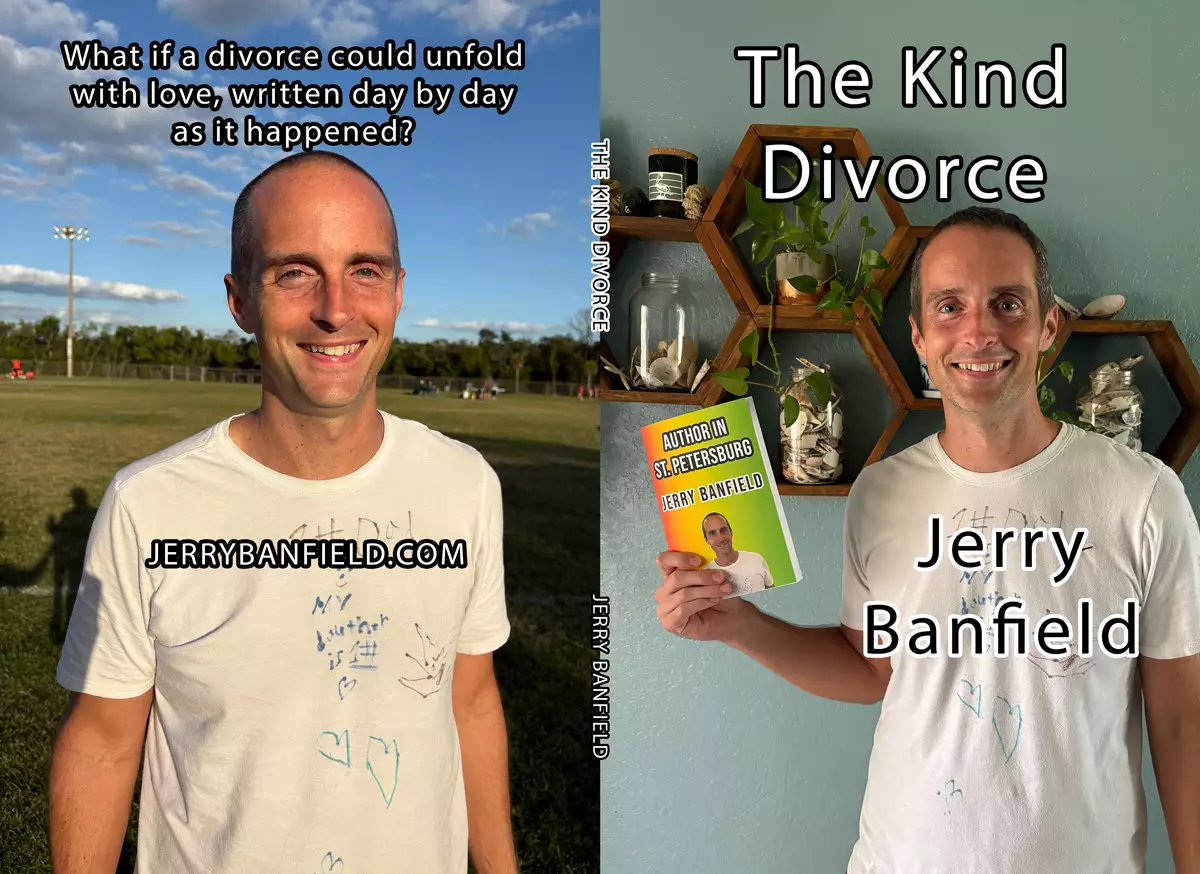
This is my journal entry from October 5, 2025, part of my daily autobiography The Kind Divorce — my real, unedited days, published in order.
I woke up this morning with a burst of excitement about a new business idea that feels like it perfectly fits this next chapter of my life. I spent much of the day thinking about agents, publishers, and how the traditional book world operates. The more I researched, the more conflicted I felt.
Technically, I could pitch three or four different manuscripts right now. For nonfiction, that’s all you really need: a proposal, not even a finished book. I kept reading about how advances work, how royalties are split, and what kind of control authors have. And the more I learned, the more I thought back to the analogy I made in I Was Famous on the Internet about middlemen who take most of the reward from the people doing the real work.
Submitting my book to a publisher means they’d take around 90% of the profit while giving me 10%. If that’s not the same dynamic I was trying to escape from in the online world, I don’t know what is. It feels like another version of being someone else’s product—of selling my work through a system designed to take most of the reward away from the creator. I’ve said it a hundred times lately: I’m tired of middlemen.
What I want is a system that cuts out as many intermediaries as possible, where I have full creative control and keep most of what I earn. Right now, that looks like self-publishing and focusing locally. The internet can still distribute my books, but my real business will be personal, intimate, and offline.
As I brainstormed, I thought about offering something like a board game night—three people paying $30 each to come hang out and play games with me. But the more I thought about it, the less appealing it sounded. Group events come with headaches: scheduling, uncertainty about attendance, different personalities. It’s just not the vibe I want.
What truly excites me is one-on-one connection. That’s what I already pay the most for myself—whether in massage, coaching, or therapy. And that’s what feels most natural for me to offer. So, after hours of bouncing ideas back and forth with ChatGPT and mulling it over, I landed on something that feels perfect: Invite people over to my house for a two-hour experience and charge $222.
Each person could decide what they want those two hours to be. It could be coaching, conversation, games, lunch, brainstorming, or something more creative. Every session would be unique, but the structure would stay simple and repeatable. I’d only do one session per day to keep it special and prevent burnout, with multiple times available for people to choose from.
For example, one person might book a lunch slot and spend two hours eating and talking with me about their goals. Another might book an evening session—say, 6 p.m. to 8 p.m.—to play a board game and talk about life. Someone else might want help dictating their own book or finding direction after a major life transition. A parent might even book a session for their child who’s struggling with internet addiction so I could share my story and offer perspective from someone who’s lived it.
It feels like such a natural extension of who I am—part friend, part mentor, part storyteller. People already tell me they wish they could just sit down and talk for a while. A reader from the tennis club even left a five-star review for Author in St. Petersburg on Amazon and said he had so many questions he wanted to ask me. I thought, Perfect—that’s exactly who this offering is for.
Imagine if a reader could book two hours at my house, maybe over dinner or a board game, where we talk about everything he’s curious about. It would be fun, authentic, and valuable for both of us. And because it’s at my home, it creates a relaxed, personal atmosphere—something most people never get from formal coaching or events. I’ve always preferred going to other people’s homes for sessions too. There’s something about being in a personal space that opens people up.
What’s incredible is how simple and sustainable this could be. If I charged $222 and only did one session per day, that would be enough to easily afford the four-bedroom, three-bath house across the street. I wouldn’t even need to depend on book sales or publishing advances. Just real, human connection—one person at a time.
It feels like the first business idea I’ve had in a long time that truly aligns with who I am now: no middlemen, no performance, no digital noise. Just honest conversations, meaningful experiences, and enough income to live comfortably doing what I love.
I’m really grateful for the clarity I have now around my books and business direction. The more I thought about agents today, the more obvious it became that I don’t want to go down that path. I want to publish my books as fast as possible and get them out into the world—not spend months or years sending queries to agents who already receive thousands of submissions and barely read most of them.
I’m done trying to stand out in competitive environments. They drain my energy. The traditional publishing process feels like another version of that—doing endless busywork, jumping through hoops, waiting around for approval. Even if I were to land a book deal with a $30,000 or $40,000 advance for I Was Famous on the Internet, it could still take years before the book actually hit shelves. And once it did, would it even be my book anymore? Would I have to edit parts to make them more politically correct or palatable to some corporate editor’s idea of what readers can handle? I can’t imagine anything worse than putting my voice through a committee of gatekeepers again.
That’s what I ran away from in the first place—the endless middlemen. Who even cares now whether a book is traditionally published or self-published? I don’t. And the people who read my work certainly don’t. They care about truth, not logos. What I really want is the most local kind of book distribution possible—handing my books to people in person, watching their reactions, having real conversations. I even ran the numbers with ChatGPT and it projects I will make more money focusing local over the next decade than going with traditional publishers.
This morning, I woke up feeling deeply grateful to be spending what might be my last week in the house with my ex-wife and the kids. They went down the street to her parents’ house for pancakes while I started moving things into my new place. Around 8:30 a.m., I hauled one of the wooden chests my dad made—loudly rattling it down the street on a furniture mover. Then I packed my car with more stuff: a few boxes of my books, the AeroGarden, and another one of Dad’s handmade chests.
My dad never published books, but he was a creator in his own right. He made furniture—real, solid pieces that might last a century—and he always signed each one with his name, the year, and the location he built it. I love that thirty-plus years later, I’m still using his creations daily. That’s exactly what I want my books to be: something lasting, physical, meaningful. That’s what my videos never were. They lived for a moment, then disappeared into the algorithm. My books will be here long after I’m gone.
I’m genuinely excited to move into my new house now. I’m even more excited about dating again—about channeling that romantic energy into life, meeting someone new, feeling inspired. I know it’s going to generate amazing material for future books.
Later in the morning, I went to the 10 a.m. yoga class at my yoga studio. I arrived a few minutes early and stood at the back of the room, scanning for a good spot to put my mat. After about two minutes of observation, I settled on a spot next to a man from yoga, who I’ve known for years. We’ve shared probably fifty or a hundred yoga classes, plus other events, so it felt comfortable.
To a man from yoga’s right was a woman who caught my eye—attractive, a little thicker but muscled, confident, with a warm, natural presence. She had short hair, a healthy glow, and skin complexion very close to mine. From the back of the room, I noticed she wasn’t wearing a wedding ring, which was later confirmed when I walked up.
I wanted to test out my “pickup energy” again—to see how I carried myself now that I’m actually single and available. I set my mat down beside her and settled in. She didn’t make direct eye contact, but when I was looking for a place to set up, she had looked back in my direction—just briefly, but enough for me to feel that moment of acknowledgment.
I know some people would call that reading too much into things, but I trust the subtle cues between people. I believe in telepathic connection, in energy exchange that happens before words. Most people are too distracted to notice it, but when you pay attention, it’s real. I’ve learned to trust it over the years—and while I don’t always get it perfectly right, I’ve confirmed enough of those instincts to know they matter.
A yoga instructor led a great flow that morning—grounded, smooth, and energizing. I left feeling proud of how open and alive I felt again. It was nice to just be in the room, breathing, moving, noticing. For the first time since the divorce chat, I felt overcome with curiousity about who I might meet next.
After the 75-minute yoga class, I decided I would pay close attention to the girl next to me to see if she showed any body language suggesting interest in talking. If she did, I’d go for it—just start a natural conversation, stay present, and really listen.
Almost immediately after class ended, she gave me one of the clearest signals I could imagine. She turned her whole body toward me and sat cross-legged, facing directly in my direction, even though we hadn’t made eye contact or exchanged a single word. To me, that was about as direct a green light as I could get.
So, I talked to her. We started chatting, and I found out she plays tennis—which instantly made me light up. I love tennis, so I asked if she’d like to play sometime. She said she and her husband both play and offered to exchange numbers. I took her up on it.
I laughed and told her that I’d spent a year getting my ex-wife into tennis and that she’d just started playing too. It felt a little funny saying that, given that I’m technically still married but already emotionally single. I’m in that in-between space where I can honestly say, “I can be married or single, whatever you want.”
It felt a bit abrupt to hear her mention her husband, but I didn’t let it throw me off. I’m happy to play tennis with anyone, especially someone friendly and fun. I’d gladly hit with her husband too. What I want more than anything right now is to play—more actual matches, less time spent on lessons. Lessons have been great, but sometimes they get in the way of just enjoying the game.
After class, I felt electric. Confident. Alive. It’s like my “pickup energy,” that ability to approach someone new, is sharper and freer than it’s ever been. I have no hesitation anymore. If I walk into a room and see a girl I find attractive and I sense she’s open, I can easily start a conversation, stay connected, and ask for her number if it feels right. And if she’s married or not interested, that’s fine too. What I love most is how open I feel now—to connection, to possibility, to whoever’s meant to walk into my life next. Whether it’s a tennis partner, a friend, or someone who ends up in my next book, I just want to keep following those sparks when I feel them.
When I get home, I make a simple lunch—noodles with vegan butter and seasoning—since there’s barely any food left in the house. Our plan for the day is to restock at Whole Foods and Target, then take the kids to visit Roxanne, the dog we used to have before she went back to her foster family. We’d adopted Roxanne and her sister Melanie together for a few months, but the sisters started fighting. Roxanne began biting Melanie, and we eventually chose to return her. The foster family ended up adopting her themselves, and they’ve taken great care of her. They live over in a nearby town, so we plan to visit after shopping.
At Whole Foods, I let both kids take their own carts. It’s adorable watching them fill them up like little adults, choosing what they want. I tell myself I’m not going to nitpick. They can pick almost anything. We end up buying a bottle of fresh-squeezed orange juice for $19, which tastes incredible but makes me laugh at how overpriced it is compared to the $5 bottles sitting right next to it.
We stock up—hummus, a couple of frozen pizzas, chicken noodle soup from the hot bar, and tons of fruits and vegetables. When it’s time to check out, both kids insist on using the self-checkout. Each one picks a register, and they scan everything themselves. I help my son with bagging while my daughter insists on doing hers entirely solo.
My daughter’s total comes to $160, and my son’s is $186. As I watch the totals climb, I feel that little flicker of fear about money. I have almost nothing coming in right now, and here I am dropping $350 on groceries. My mind starts whispering that I should be worried—but I push the thought away. I remind myself that money has always shown up when I needed it, and it will again. I’m paying with credit anyway, and if something changes, I’ll adjust. For now, I trust the Universe—and I’m grateful to be able to feed my family good food.
After Whole Foods, we head over to a foster family’s house in a nearby town. It’s great seeing her, her husband, and their kids again—and of course, seeing Roxanne. She’s still as loving as ever, a German Shepherd–Shar Pei mix with that classic shepherd face and a little of the Shar Pei’s loose skin around her neck. She recognizes us right away and does her signature move—leaning her body against us like she’s giving a hug. It’s such a sweet, grounding feeling.
The kids take turns petting her and laughing. A foster family’s son shows my son the RV trailer their family just bought for $10,000. It’s surprisingly spacious—room for four to sleep, plus a kitchen and bathroom with a shower. I can’t help thinking how practical it would be to have something like that myself. I imagine parking one in my mom’s yard or in my ex-wife’s backyard—my own little minimalist home.
But when we meet my ex-wife later at Target, I bring up the trailer idea, and she shoots it down immediately. She’s right, though. It’s fun to fantasize about, but not realistic. Setting one up would require thousands of dollars for plumbing and electrical connections, not to mention maintenance. It’s not the life I want to build right now. Still, I’m glad I let myself dream for a moment. Sometimes even a fleeting idea can make the whole day feel lighter.
At Target, my ex-wife grabs one of those huge carts where both kids can sit in the back with a full-sized basket in the front. It’s one of those carts that can do a full 360-degree spin—it looks ridiculous but handles like a dream. The kids love it. We start in the home section where the diffusers are buy-one-get-one-free, so we each grab one. My ex-wife insists on paying for both, which is sweet of her. I also pick up a new tennis racket for $25—nothing fancy, but it feels solid and I could use a backup. My ex-wife gets one too. She double-checks that there’s no one else I’d rather rotate onto the family membership at the tennis club, and I tell her of course not. She’s just paid for the last couple of months herself and will be covering the next month or two as well. Plus, she’ll be taking the kids there often, and we can all use the pool.
My son and I had thought about going to the tennis club tonight, but it starts raining, so we head home instead. I also grab a lava lamp while we’re at Target—something about it just feels fun and nostalgic. It’s been at least ten years since I’ve had one. I set it up in the new house along with the diffuser and some essential oils to help mask the faint smoke smell that lingers from whoever lived there before. The owner did a good job cleaning, but there’s still that unmistakable stale edge in the air. Between the diffuser and the lava lamp’s slow-moving glow, the place already feels more alive. My son’s fascinated watching the lava heat up, waiting for the first bubbles to rise.
After setting everything up, we walk over to my mom’s house. The kids immediately dive into their favorite activity there—drawing. My mom has an incredible stash of markers, colored pencils, and art supplies, enough to keep them entertained for hours without screens. It’s one of my favorite things to see: their creativity bursting out in real time.
Tonight, they’re drawing pictures of my mom’s dog, Scooby, in different seasons. My son draws “Summer Scooby” first, then makes a copy on the printer so he can take one home while my mom keeps the original. I love moments like this—quiet, simple, full of warmth and imagination.
At one point, I tell my son I want to split an ice cream sandwich with him. I explain that I don’t want the whole thing, but I do love a few bites for the taste. This turns into an impromptu life lesson on diminishing returns. I tell the kids that, for me, the first three bites of something sweet are always the best—after that, you’re mostly just getting fat and not even enjoying it anymore. To make it more fun, I give them an example: “Imagine if I gave you $15 the first time you farted, then $10 the next time, then $5, and then only $1 for every fart after that.” The kids burst out laughing while my mom rolls her eyes in mock disapproval.
We share the Oreo ice cream sandwich—two Oreo cookies with Oreo ice cream in between. I take three bites, hand it off to my son, and feel completely satisfied. The first bite was the best, the second and third were still good, but beyond that would’ve just been excess. Sometimes the sweet spot in life really is just three bites. It’s small, silly moments like this—teaching, laughing, eating ice cream with my son—that make all the heaviness of the divorce and moving out fade for a while. Tonight, everything feels strangely balanced again. Building a well-rounded life like this—kids, recovery, work, and real friends all in the mix—is exactly what I love helping people with, and you’re welcome to book a private call with me to build yours.
After leaving my mom’s house, I walk back across the street with the kids. Just as we get home, my sponsee calls and says he wants to go to a meeting tonight. I tell him I’d prefer to meet somewhere closer to my house. I’m tired of my old home group—it’s gotten repetitive—and I want to go somewhere with a true open discussion. He agrees, so we meet at a different group I used to attend.
The room is full, mostly newcomers. The topic for the night is letting go and moving on, which couldn’t be more perfect given everything I’m going through. When it’s my turn to share, I talk about the divorce again, how grateful I am to be sober through it, and how much easier it is to get divorced sober than to get sober while married.
By the time I finish, I’ve taken at least four or five minutes, but it feels worth it. I tell the group that, if you round to the nearest thousand dollars, I’m currently making zero dollars a month—and I have no idea exactly how I’m going to afford the rent for my new house. But I’m sure I’ll figure it out. And I say, “I sure as hell am not going to apply for a job.” The whole room bursts out laughing. That laughter feels good—it’s connection, not judgment. A few guys come up after and say they want my number, saying things like, “You’re an unusual guy.”
They’re right. I am unusual. It reminds me of the song Unusual, whose hook has stuck with me even though I haven’t heard it in years. That’s the kind of stickiness I want my books to have—something people remember long after they’ve closed the pages.
After the meeting, I come home, get the kids settled, and put them to bed. I’m honestly looking forward to having my own place partly so I can have my own private space without feeling awkward about being in my ex-wife’s house.
Once I’ve showered, my ex-wife comes out from putting the kids to bed, and we talk about my new business plan. I tell her how grateful I am that ChatGPT helped me think through what I really want to do—stay local, focus on my books, and offer something personal. What I want to sell is simple: two hours with me. I see the funnel clearly now. First, I give someone a book. The book inspires them to visit my website. And my website leads them straight to scheduling a one-on-one session with me.
I think about one of the studio’s co-owners at The my yoga studio. She’s hosting an event at her house on November 11th—twelve people for a two-hour meditation and sound bath in her garden. Tickets are $25 each. And while that’s nice, I’d personally rather pay $300 to have those same two hours with her alone. That’s the difference between a group experience and a one-on-one. You can make the same money, but the intimacy—the depth—is entirely different. Groups get tricky. One-on-one is where the real magic happens.
It hits me: that’s exactly what I need to offer. For anyone who’s read my books this far, what they probably want most is just to talk—to connect directly, privately, without distractions. No two or three other people. No performance. Just an open, honest conversation.
That’s also where I shine the most. In one-on-one settings, people can really open up. They can ask me anything, say anything, and I can do the same. If you’ve read my books, you already know how raw I am on the page. Imagine that same energy in person. That’s the experience I want to sell—and the one I’m most excited to give. I’m grateful tonight because I’ve consistently felt upbeat and genuinely excited for the future. After a week of emotional turbulence, I finally feel like my normal self again, which is such a blessing.
At the meeting tonight, there was a fellow member I’ve known for six or seven years. As she shared, I could hear the pain and fury in her voice—she said she felt filled with anger and completely out of control. She wrapped up her share with a sharp “and that’s it,” but when someone thanked her, she said she wasn’t actually finished. The timing made it sound like he was cutting her off, and she got upset. She stormed out, slamming the door behind her.
I thought about getting up to talk with her, to see if I could help calm her down, but I sensed she wasn’t open to that yet. Some people need to burn through the emotion first before they can hear anyone else.
After the meeting, I talked with another fellow member I’ve known for years. I told her I felt like the opposite of the angry woman from earlier tonight. Even with a divorce underway and financial uncertainty hanging over me, I still feel extremely grounded and centered. It’s such a contrast to those chaotic, uncontrollable emotional states I used to live in.
I told her that the only reason I’m able to feel this peaceful now is because back when I was in those angry states, I made a firm decision that I didn’t want to live that way anymore—and I started doing whatever it took to stop. That decision built the life I have now, where I can feel every emotion fully without losing control of my mind or my body.
When I asked her how she’d been, she said, “Well, we’ve only got today anyway.” I smiled and told her she was right—but that momentum really helps. I could tell she felt uncomfortable, and I remembered the last time we’d talked, months ago, when she told me about her partner. I realized the man sitting next to her tonight was him. She seemed surprised I remembered.
I reminded her that one of the most important parts of recovery, at least for me, is rigorous honesty. If someone asks how long you’ve been sober, the honest thing to do is just answer. It’s crazy how often people hide their number of days sober out of fear of judgment. But if you can’t even tell the truth about that, how can you stay sober by living an honest program?
That’s usually why people dodge the question. Still, I hope she finds her footing. What strikes me most isn’t any particular setback—it’s that I don’t always see a real desire for the struggle to end. That’s the crazy thing about suffering: sometimes we think we want it to stop, but deep down there’s a part of us that clings to it. It’s familiar. It’s dramatic. It gives us an identity.
The real shift happens when you can see that part of yourself clearly—when you recognize the part that loves to suffer—and ask, Who is that? Is that really me? Do I actually want to keep living this way? For me, the answer is no. I’ve learned that I can choose to stop suffering whenever I’m ready. The clearest sign that I’ve made that choice is when I reach out for help. Because the moment I ask for help, I’ve already stopped feeding the pain. I’ve already started healing. If you’re ready to reach out for help with something you’ve been carrying, you can set up a call with me and we’ll talk it through together.
Continuing
If you connect with how I live and think, you can follow the rest of my days on YouTube in my Life playlist.