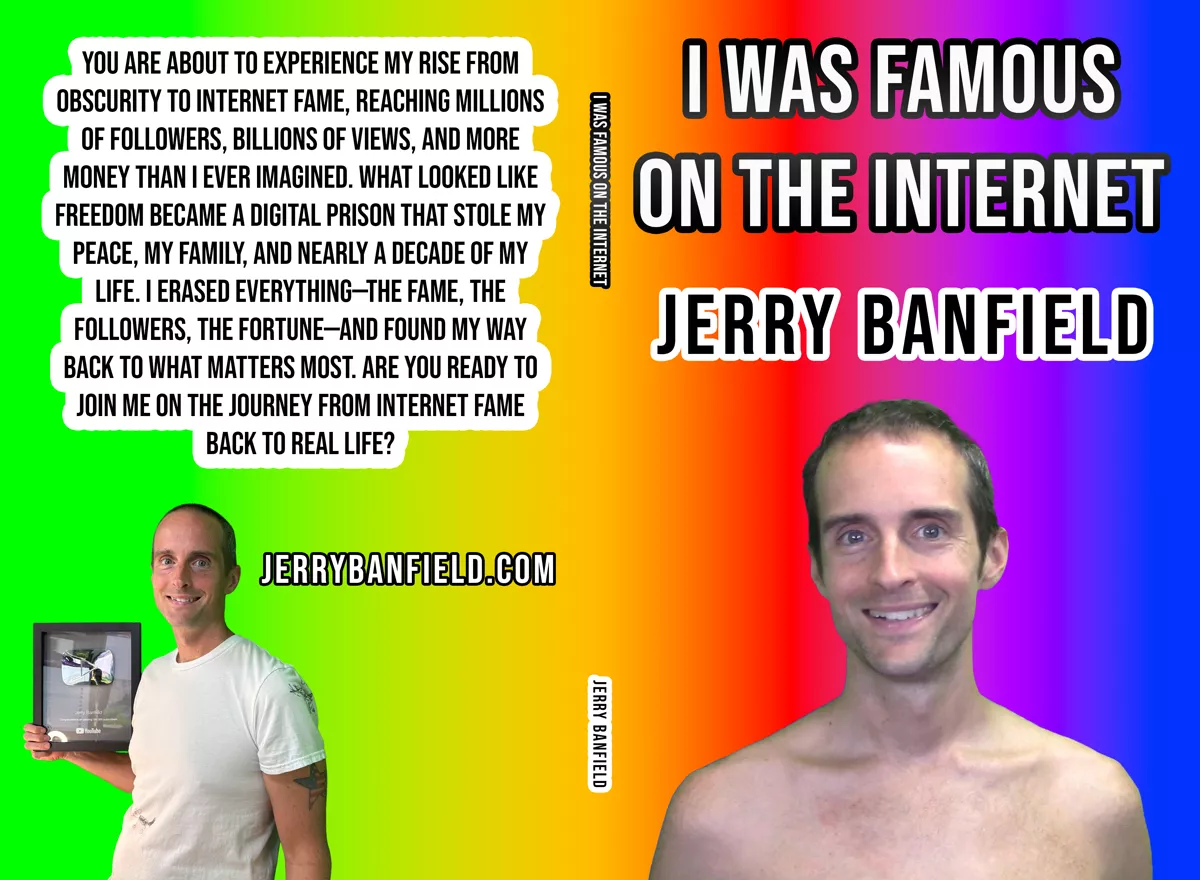
This is an excerpt from my memoir, I Was Famous on the Internet — my honest story of 14 years of internet fame and what it really cost, and why I deleted it all to choose real life.
Sensationalism vs. Real Life
What I’ve observed with some of my family members is that instead of creating real conversations with genuine connection, they’ll sometimes bring up these sensational topics they’ve been manipulated into watching online. Rather than asking something simple like, How are you or talking about health, relationships, or anything relevant to our actual lives, they’ll toss out some extreme issue they picked up from a video, a podcast, or the news cycle. Immediately, that creates tension in the air. It starts with a question like, What do you think about this issue? or a statement like, I don’t think that should be allowed.
These sensationalized topics don’t make sense in real conversations between family members. They’re often fringe ideas that have no bearing on daily life, yet they become the centerpiece of discussion because that’s what the media serves up. I’m not giving specifics here because specifics are where people get triggered and start over-identifying with the issue, missing the broader pattern.
Though, if I use an example from my own life, my race change is the perfect case. Would I have ever changed my race if I wasn’t an online content creator? In real life, would anybody have cared if I quietly identified as Black? I could have walked around in my community feeling Black, checked “Black” on the census, and nobody would have noticed. In real life, it wouldn’t have made sense to announce it. I wouldn’t have gone into AA meetings shouting, I’m Black now, everyone. I wouldn’t have shown up at yoga in a T-shirt that said, I’m Black now. People would have just been confused, and if anyone did get offended, it would only be because of what they’d absorbed from online culture.
Meanwhile, my race change went viral online. That single decision brought me more attention than anything else I had ever done. Millions of views and endless conversation all because online thrives on the sensational. Offline, there would have been no benefit. It would have just seemed ridiculous. That’s the difference. Online, things that make no sense in real life can become the most valuable currency for attention.
Even years later, I still get asked in person, Are you still Black? Recently, when I applied to massage school, I faced that question in a very different way—on the race section of the application. I put “two or more races.” Why? Because in real life, when someone sees me, they see what looks like an obvious White person. If I had put Black on the application, it would only create confusion. People would think, You don’t look like you have any Black ancestry. And I thought about it carefully. I do identify primarily with Black, but I also must respect other people’s perspectives. Unless someone has seen my videos online, 99% of people are going to look at me and see White.
That’s how real life grounds us. It encourages more respect for the perspectives of others. When I made the race change online, I was as sensational and dramatic as I could be about it. I loudly rejected being identified as White or Caucasian. That played into the internet’s economy of outrage and attention. Offline, though, it makes more sense to simply say I identify with two or more races. Nobody questions it. Nobody cares which races I mean. They just accept it. He looks White, he identifies with something else too, nothing interesting here. Let’s move on.
That’s the big difference. Online, you can make people care about things that don’t matter in real life. It’s one of the great manipulations. And the solution is to stop taking that bait. Stop letting sensational political issues, the ones that make no sense in everyday conversation, dominate your mind. For me, the only way to guarantee I avoid the bait is to stop scrolling and delete the accounts. Now that I am not consuming that noise and grounded in real life, I am free to have conversations that actually matter with the people who matter. Finally, I feel safe, because I’m not worried that every interaction is going to turn into an argument about something absurdly sensational. Incredibly, when my friends and family now bring up the insanity they see online, I am no longer upset at them or upset at whatever they are talking about. Now that those grounded, real conversations are the best part of my days, I want to help you get there too — you can set up a call with me and we’ll have conversations that actually matter on our call.
What Now?
Now that I’ve covered what I see as the most important concepts—being a sovereign being, avoiding groupthink online, building real connections in person, the lessons of my own life as a bad example, and the difference between real conversations and online sensationalism—the next thing to look at is the practical side. People always want to know, What are you going to do for money now that you’ve left YouTube, crypto, and the online platforms?
That question has come up more than any other when I talk to friends and family. For more than a decade, I earned my living online, and I have almost nothing else besides that currently. Naturally, people want to know, How are you going to survive now?
My answer is simple: I’m going to do what’s joyful and listen to what’s needed in my local community. The mistake I made in 2020, when I tried to unplug, was that I only followed what was joyful for me. I didn’t listen enough to what people actually needed and wanted. In 2024, I dabbled with stepping away, but I didn’t give it enough time and I didn’t truly commit. This time, the difference is that I’ve committed.
I’ve discovered how much I love creating books. Last weekend, I dictated four or five hours into this memoir. I love the process of narrating, transcribing, and shaping my thoughts into something physical. I love seeing words laid out on a page instead of buried inside a video where my face, background, and images can become distractions. There’s a purity to words on a page that excites me. Holding a physical book in my hand and being able to give that to someone is one of the most satisfying things I’ve ever done.
I’ve already seen how magical opportunities come from being open in this direction. For example, while I’ve had many skills massage therapists could have valued for over 11 years—marketing, websites, life coaching—I never once exchanged services for a massage. I just paid out of pocket, every time. But as soon as I opened my mind to looking at what those around me needed, I began exchanging my marketing and coaching services for massage. The last two massages I received, I didn’t pay anything for because I bartered my coaching and marketing skills. The massage I have scheduled for tomorrow, I already provided the website in exchange.
Finding Real Opportunities
I love creating books and while they do not make any money currently, I could get royalties indefinitely from this book that I’m writing today. I also imagine that my books will connect me with opportunities that would have been hard to predict logically such as coaching, clients to tutor in my book creation workflow, seniors interested in creating a book as a legacy project, speaking opportunities, and whatever else I can do to help. I’m imagining that having readers like you book a time to speak with me in person at jerrybanfield.com will provide the opportunity to fully monetize what I do in time.
Last year, I had the perfect opportunity to earn a lot of money in my local community but I was to distracted online to see it. Hurricanes ripped through St. Petersburg, leaving trash everywhere. For months, people were being gouged, paying companies thousands of dollars to haul debris. Meanwhile, most trash disposal is simple: all you need is a truck and about $20 to $50 to pay at the dump. The rest is pure labor. I estimated that some of the guys who stepped into this gap were making $300 to $500 an hour because demand was so high and supply so low.
If I had quit the internet last year and been paying attention, I would have remembered that back in 2022, I hauled 15,000 pounds of my mother’s storage trash to the dump myself in a U-Haul. I did most of it alone, with just a couple of guys helping for about 5,000 pounds. I had already proven to myself that I could handle the work. If I had been present instead of distracted with online nonsense, I could have seized that opportunity—offering fair rates, saving my neighbors money, and still making hundreds of dollars an hour.
Around the same time, there was a huge need for fence repair. People were paying thousands of dollars for jobs that were relatively simple. I fixed my own fence with a $100 hammer drill from Home Depot, plus $50 in lumber and screws. That saved me $1,000 right there. Then I fixed family members’ fences, which were in much worse shape. In less than a week of work, I saved them $5,000 to $6,000. It struck me then that I could have easily expanded this. No license, no permit needed—just tools, time, and a little skill. I could have gone around repairing fences in my neighborhood and made $10,000 to $20,000.
If I’d been fully present instead of focused online, I could have made $30,000 to $50,000 between October and December of 2024 just from hauling trash and repairing fences. That would have been enough to pay my part of the bills for the entire year and write books that I could give away the rest of the year. How many other opportunities did I miss like this last year? How many more will I see this year?
The question I want to offer back is this: What kinds of things do you not know about because you’re distracted online? Most people I talk to want a clear blueprint or formula. They want step-by-step instructions, but that way of thinking blocks you. The more you rely on the internet for ideas, the more you limit what your mind can see. When you’re taking in endless information about how to make money one way, you stop noticing all the other opportunities all around you to make a living without depending on these online platforms.
Work, Money, and Real-World Connection
Speaking of work and money, which is one of the biggest reasons people get lured into using these platforms, I want to go deeper into how this might relate to you. For me, the kinds of questions I imagine you all will want more details on are: What local jobs or businesses thrive without internet marketing? How do I transition from online work into something real-world and face-to-face? How do I network in my local community if I am starting completely from scratch? These are the questions I live with, and I intend to share how I approach them. If you're trying to make that leap from online work to something real and face-to-face yourself, I'd be glad to think it through with you — you can book a one-on-one call with me and we'll map out your own path together on our call.
The place I started was simply by looking around at what I already needed and trying out some new things I thought I might enjoy. I explored being a yoga instructor. I experimented with the different ways I could turn tennis or massage into work including enrolling for two weeks in massage school before dropping out. In my book Author in St. Petersburg, I go through, day by day, the exact process I used to strip down my life and figure out what to do next.
Everywhere I look, I see help needed in local businesses. In-person work is where the scarcity is. There are massive shortages across trades: electricians, plumbers, HVAC technicians, contractors, massage therapists, etc. None of these can be replaced with AI. The more advanced AI applications become, especially as tools like ChatGPT get better at generating video and content directly, the less need there will be for human creators online. Many creators are already being bought out or scaling themselves through AI, which only accelerates this. From my perspective, the future of the internet is continuing to degrade from where it already is today, which makes this a great time to exit. At the same time, the future of in-person work feels brighter.
Massage, according to statistics I’ve seen, is projected to grow much faster than most industries. There is no substitute for hands-on healing, physical touch, and real connection. The lonelier people become, the more addicted they are to their screens, the more they will recognize that massage is one of the easiest ways to drop back into the body and feel a true connection with another person. Trades, too—building, plumbing, electric, HVAC, contracting—are all in rising demand. Fewer people are doing them because so many are chasing after internet work instead.
When I unplugged from the internet, I started meeting everyone who would sit down with me for tea, yoga, or a game of tennis. I sought out the people I was genuinely excited to see. I asked everyone, everywhere, what they thought I should do with myself. That process of asking, listening, and connecting gave me both the direction and the opportunities to rebuild a real-world life.
If you connect with how I live and think, you can follow the rest of my days on YouTube in my Life playlist.