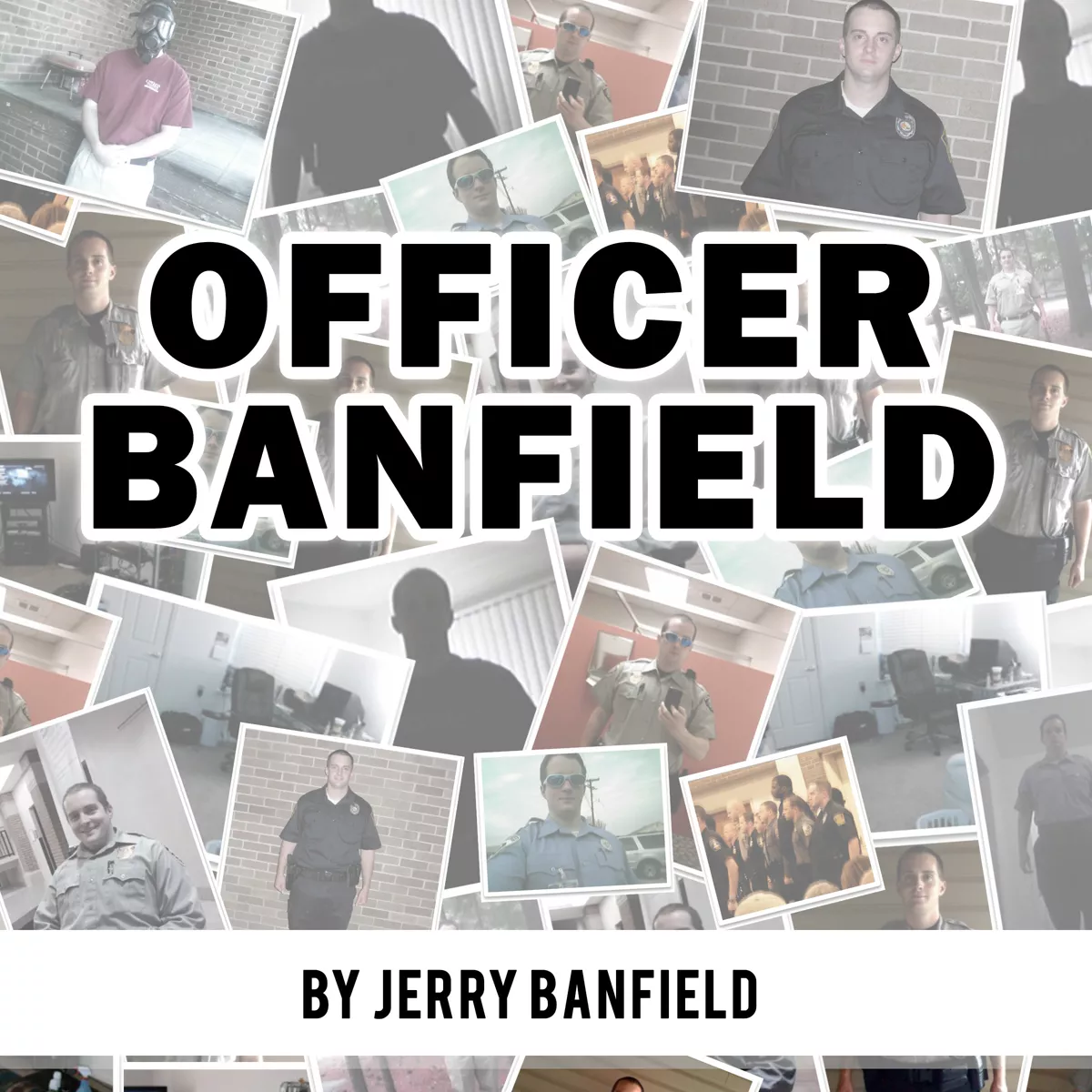
This is an excerpt from my memoir, Officer Banfield — the honest story of my years as a corrections and police officer, hitting bottom in alcoholism, and the long road to recovery.
Would you like to hear how all of these events fit together in the chronology of my life?
Because going forward, I'm just going to tell whatever story needs to be told in whatever order comes up because that way we can just freestyle this and have a good time together instead of trying to put the order that all these things happened in.
The timeline here will address that right now.
I was born in 1984 to two loving parents in Michigan, and my mother went in the army when I was about one year old in order to support me because my father was an alcoholic, drug addict, gambling and sex addict. There were probably a few other addictions.
He also went to Vietnam. He lived an amazing life. He got sober finally when I was six years old in 1990 while we were living in Japan as my mother was stationed there. I grew up living in several places around the country as well as Japan and Germany.
I went to college at the University of South Carolina starting in 2002. I graduated in 2006 with a Bachelor's in Criminal Justice. I struggled to find jobs because for some reason I waited until 2005, which was junior and senior year, to start experimenting with marijuana.
Instead of getting that out of my system earlier, I smoked weed for the last time in October or so 2005. Trying to get a law enforcement job within a year of smoking marijuana tends to be very difficult, and the first job I got
was at the South Carolina Department of Juvenile Justice as a corrections officer in November 2006.
I called the adult corrections and asked about getting hired there. The guy told me that I should go be a police officer and hung up on me.
I then learned that the Department of Juvenile Justice was hiring and in my mind, I thought, "That will be nice. It will be with kids. It won't be as bad as the adults. They are kids. How bad could it be?"
I was wrong about that. The reason the Department of Juvenile Justice was hiring was because no one wanted to work there and very few people, especially the white boys, could keep a job there for even a few days usually, once they actually got into the correction units.
I was desperate to get out of that job, but I was so stubborn. I would not quit until I got a police officer job. I was risking my life for $20,000 a year, spending 40 hours a week locked up myself in prison.
In 2007, thank God, the South Carolina Department of Mental Health hired me as a state law enforcement officer, one which I was really excited about.
I got my gun, my badge and my patrol car. I got to be on the road and the main thing I did was transport incarcerated mental health patients from one place to another.
Technically, they weren't in prison. They had been declared insane by the court and were confined in state mental health facilities.
I drove them from one appointment to another and I responded to calls for assistance for the Department of Mental Health units.
The dream job that I wanted, that I remembered people at the
Department of Mental Health fantasizing about, was to be a police officer at the University of South Carolina where I went to undergraduate school.
The South Carolina State University -- I didn't even say that right. I'm not editing this either. We are just going straight through and tell the honest truth because if you want it real, sometimes you need to hear it messed up and imperfectly done.
Will you bear with me as I go through this and just tell it to you straight from the heart without trying to cut out anything you might not like?
Because I'd probably cut this whole damn book, if I went through and tried to pick out everything you might not like in it. I also know I like to hear someone's real humanity, which means the stutters, the screw-ups, the imperfections. So, we will just keep talking right through that.
The University of South Carolina law enforcement officer position was a dream job because it was one of the very best paying introductory level policing jobs in the area and most of the time it was really nice police work.
You had the advantage of feeling like a real cop being out on the street with your patrol car and your gun working out in public, whereas in mental health, it felt like I was still in corrections lots of times. You weren't generally out doing much in public. It was all interacting with people who worked in the mental health facilities.
The University of South Carolina gave you an ideal combination of being a real police officer and having kind of a nice cushy relaxed job most of the time.
I was hired at the University of South Carolina in 2008 in April as a police officer. I loved that job and had a lot of fun at it until September 2009 when I quit. We will go into much more detail obviously about all of these
things.
September 10, 2009, was the first day I was not in corrections or policing for three years and let me tell you what a relief that was.
No court cases with people to worry about. No of the law enforcement stresses. I remember just being at home living with my parents thinking, "Thank God I made it through that." I had been so afraid of leaving the law enforcement world once I got in it, that once I got out I was shocked at what a relief it was.
I moved home with my parents in 2009 and focused completely on playing "Call of Duty Modern Warfare 2" and going to graduate school for my Master's Degree in Criminology.
I also intended to get a Ph.D. in Criminology. However, while I was working on my Ph.D., and after finishing my Master's up, I decided to do my own business online full time, which did nothing but lose money and run me into debt for the first two years, but I've made a million dollars since then.
If you would like to hear more about that, will you please listen to pretty much all the other books I have because most of them are about my business online and all the things I've learned from having a business online?
Things like Facebook marketing, how to publish your own books, et cetera…
That is a basic synopsis of the timeline in this book.
Therefore, most of the stories will fit between the years 2006 and 2009
in this book.
I mentioned that I started going to recovery before and the worst times in
my drinking were from 2006 to 2009 while I was in corrections and law enforcement.
I will very clearly document a bunch of the very worst and stupidest stories here with you in this book because this is an exercise in honesty, to just tell my truth and to trust you with it. I find that the only real good way to learn honesty is to learn it from others.
In the capitalist society we live in today, we are surrounded by a lot of deception and dishonesty because it is profitable. It is profitable to not tell uncomfortable truths, because in a capitalistic society, you don't want to offend any potential customers or clients.
Therefore, we live in a truth drought. If you are in America, or many of the similar countries, we are desperate for someone to just tell us the uncomfortable, awkward truth.
I heard over that in the formerly communist countries it is much different because over there, truth was one of the very most prized commodities. In a communist society of fear, you needed people to be brutally honest with you, so that you could trust they wouldn't report you to the secret police, and it wasn't a big deal if you offended most people because you weren't having your pay based on who you offended.
That's just what I've heard. I've never lived in a communist country. I'm imagining though, that in some places this truth might not be that out of the ordinary, and that's what I'm hoping to share here. It is what I've learned in recovery. If you're hungry for that kind of honesty in your own corner of life, come book a private call with me, where we can be honest and grow through it together.
The final point on the timeline is that I went to Alcoholics Anonymous starting in 2014. I thought after I quit law enforcement that my drinking wouldn't be that bad again. I thought I could just drink reasonably, and not get into that much trouble, that all of the craziness was due to how I was in
law enforcement and the things that happened.
And yes, for several years I drank and none of the crazy stuff from law enforcement happened, until it started to again, until I hit dark and desperate places again, until the same kinds of things like gambling online started to happen again.
I realized, "Wow, just because my life is better today and I'm not in the crazy world of law enforcement, my drinking is still getting worse and all of those crazy things that happened before can happen again, and I'm powerless."
I couldn't stop drinking, even though I wanted to because I knew inevitably that I would change my mind one day. After the hangover passed, my mind would suddenly and miraculously shift.
I would say, "Whoo, that was a bad night before. You know what? I'd have to be stupid to get that drunk again and get into all that crazy stuff. I would never try to do that again. Drinking? I'll just have maybe six or eight, maybe 12 tonight. I'll play some Call of Duty Zombies. It won't be that bad."
Thankfully, I got hopeless and desperate. I realized that it would lose and take away everything I had ever worked for in my life, that I was drinking my life away, that getting out of law enforcement did not save me from my alcoholism, and that I needed divine intervention because I couldn't do it myself either. If you see your own life in that powerlessness, you can set up a call with me and talk it through.
I prayed to God.
I said, "God, please, I'll do anything to get sober."
One of the thoughts that came was, "Well, going to Alcoholics
Anonymous might be part of that 'anything' you just offered."
From there, I've been going to AA. After the first 90 days when I did pretty much nothing except go to meetings, I started taking suggestions and this book is a part of my recovery. This is kind of a fifth step for my time in law enforcement, and a lot of my worst drinking stories, which is one of my big motivations to share it.
I'm grateful today to have a life that is unrecognizable from what I share in this book with you. This feels like I'm talking about someone else's life today and that is proof of a miracle, proof of change.
I hope this shows you that if I can go through this much change, everyone else can normally go through this much change in a lifetime as well.
There is hope for everyone if there is just enough patience to love people until they can love themselves.
Thank you very much for getting this far into the book already. I imagine there is a significant portion of people who already got tired of listening and say, "I'm done. This book is stupid. It's boring. I can't listen to this at the gym. My God."
I have one thing to ask.
I've learned that it is okay to ask for the things that I think I need, and it is okay for you to respond however you want. You can help a lot with carrying this message.
Will you please leave a review on this book if you find anything that you like in it, that you love in it, that you think is worth sharing, because you will feel good helping carry this message of love, hope, faith and honesty to
others?
Every single review makes a big difference for who buys the book, for who decides to read the book, for where the book gets shown, and then every person that listens to the book can potentially have this same message carried to them.
We can help each other and do a lot of good with things as small and seemingly meaningless as leaving a review on a book.
If you don't leave a review on it, that's okay. I will still love you.
I will still keep making books whether you like them or not. Thank you very much for getting started.
Now it is time to get into the stories.
If you connect with how I live and think, you can follow the rest of my days on YouTube in my Life playlist.