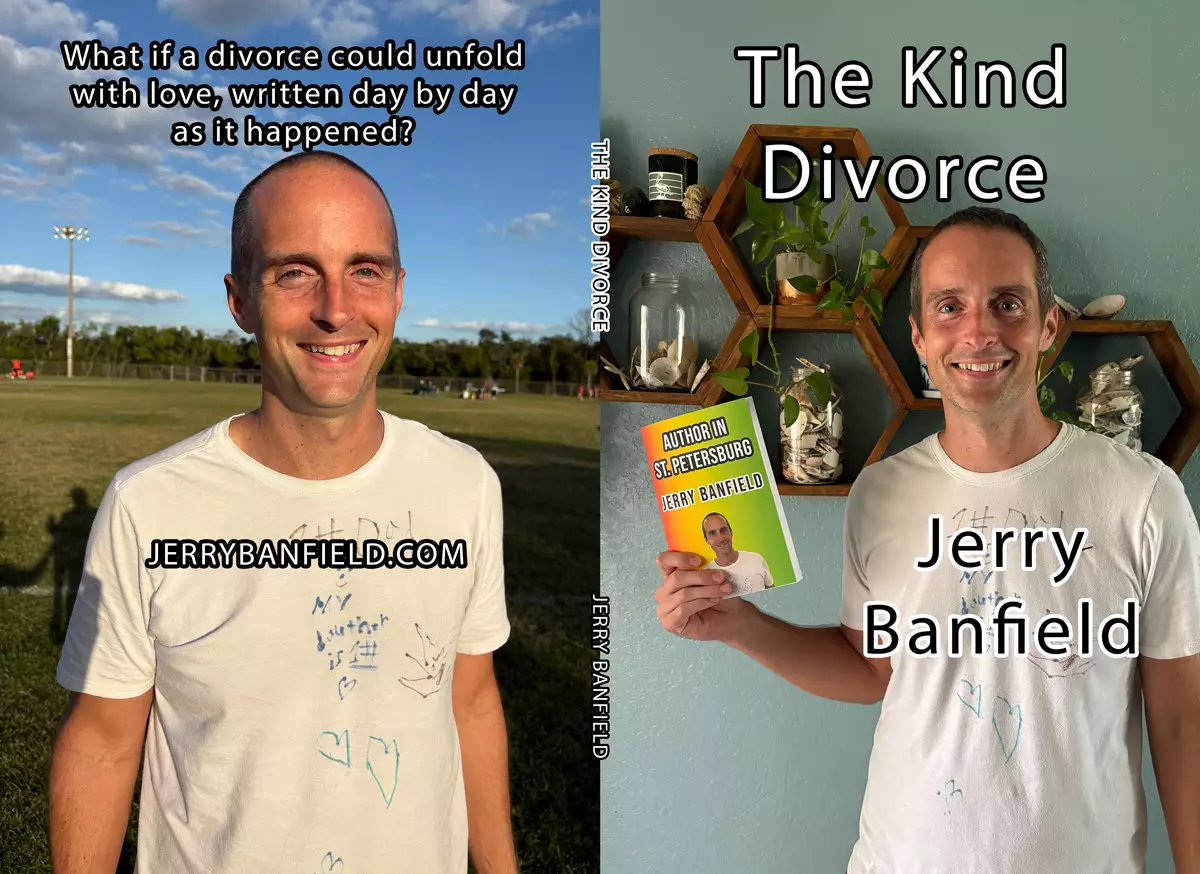
This is my journal entry from September 15, 2025, part of my daily autobiography The Kind Divorce — my real, unedited days, published in order.
We had our first anatomy and physiology quiz at massage school today, and I scored a perfect 100. It felt incredible. Out of twenty questions, there were only two I wasn’t completely sure about—the answers were “secretion” and “up.” I’d guessed correctly on both. The sense of satisfaction was less about the grade itself and more about feeling grounded in the material, finally getting a rhythm with this new phase of my life.
We covered the muscular system today and learned the seven ways that muscles are named—by location, shape, size, direction, number of origins, location of attachments, and action. I had lunch with some classmates, a lively group who make the long class days feel much shorter. I sat next to a classmate in class—she had looked me up online and told me she was interested in reading my books. I brought her a copy of Author in St. Petersburg as a gift. There’s something deeply rewarding about seeing people’s curiosity about my writing spill over into my real, in-person life.
Later, we had a class on infectious respiratory diseases, which stirred up a storm of questions inside me. The instructor started by explaining microorganisms—bacteria and viruses—and how they cause various illnesses. But I couldn’t help asking myself: how do we actually know that bacteria and viruses are the cause and not the effect of something deeper? The human body is full of microorganisms all the time, and yet people manifest completely different states of health. Some are vibrant; others are sick. So what if the bacteria or virus isn’t the original cause of disease but rather a reflection—a consequence—of the host’s internal state?
I asked the instructor where the proof lies that these microorganisms aren’t responding to something else within us: a mental, emotional, or spiritual imbalance that shifts the internal environment and gives rise to certain physical expressions. Maybe what we call a “virus” is not an invader at all but a byproduct of creation within the host. Maybe the host’s beliefs, emotions, and energy shape its manifestation.
This line of thought connects to You Can Heal Your Life by Louise Hay, which I’ve been reading. She describes her own experiences with illness and how shifting mental and emotional patterns brought relief to her body. Her ideas mirror my own experiences—when I face certain emotions, beliefs, or desires within myself, I notice changes in my physical health. To me, those internal states are the real causes, while the physical symptoms, bacteria, or viruses are simply effects. I am the causer. I am the creator of my body and my life. The microorganisms I might observe under a microscope are reflections of my inner world, not the source of it.
When I tried to express some of these ideas and questions to the instructor, the response was defensive. He seemed uninterested in discussion—only in reinforcing his authority. His stance was that “science has proven this,” and that was supposed to settle it. But that only raised more questions for me. What motives and intentions lie behind what we call “scientific research”? How can anyone assume neutrality when money, reputation, and ideology influence what gets studied, how it’s measured, and what results are published?
From where I stand, much of what’s presented as science today feels like dogma—an institutional belief system that punishes curiosity and rewards obedience. At its best, science is supposed to be an open exploration of truth through observation and questioning. But in practice, it often looks like a religion, with power and money dictating which beliefs are acceptable. Most studies seem like confirmation bias dressed up in data—people proving what those in charge already want them to believe. I left class both fascinated and frustrated. Fascinated by how deep the rabbit hole of health and consciousness goes, and frustrated that so few people seem willing to ask these questions out loud.
Later in the day, I stopped by Publix and bought some apple cider vinegar. It got me thinking—would you believe that vinegar companies have funded studies showing that drinking apple cider vinegar contributes to weight loss? Even when these studies are labeled “double-blind” and “placebo-controlled,” the fact remains: the vinegar companies themselves paid for the research that concluded their product does something beneficial. Can that really be called objective science? It feels like confirmation bias disguised as credibility—companies paying for validation, not truth.
Still, I drank the apple cider vinegar. I’ve seen other writing, like in How Not to Diet by Dr. Michael Greger, suggesting that one or two tablespoons a day may correlate with weight loss. From what I’ve read, I’ve come to believe it’s best not to drink it straight because it can burn your throat—I always dilute it or mix it into something like a salad dressing. For me, the bigger point is that I look things up for myself rather than just taking anyone’s word for it. That’s how I live. I question everything. I don’t sit passively, nodding my head, accepting whatever authority tells me. If you'd rather think for yourself too, you can book a private call with me and we'll work through your own thinking together instead of me handing you answers.
That’s exactly what set off my anger in class today. The instructor’s rigid stance and the material itself triggered something primal in me—a kind of intellectual immune response. My mind rebelled against what felt like an attempt to force-feed unquestioned dogma. It reminded me of how the body reacts to what it perceives as an outside threat. My emotional immune system was fighting to protect my sense of autonomy and curiosity.
At one point, the instructor asked if anyone had lost a family member to COVID. I raised my hand and said my uncle had died. But I added, “He had a hard, unhappy life, and his health was already failing. Something was going to kill him soon, regardless.” I asked why COVID should be credited with his death when, to me, it simply played a role in a process that was already inevitable. It would be like saying, “He went outside, it rained, and he died—so the rain killed him.” That logic doesn’t hold up. To me, the deeper cause was spiritual. He didn’t want to live anymore. His body had given up long before any virus entered the picture.
I argued that if doctors hadn’t been testing for COVID, they would’ve found another label for his death—heart failure, pneumonia, something else entirely. The instructor didn’t seem open to the idea that we might create our own life and death experiences through our state of being. But at least I said what I believed.
Afterward, I felt awkward about how fiery and confrontational I’d been—especially during my second week of school. Yet as I sat with it, pride began to replace the discomfort. I’m forty-one years old, and despite nineteen total years of formal education—thirteen from kindergarten through high school, four in college, and two more in graduate school—I’ve never stopped questioning. I haven’t been broken by the system. I still refuse to think on autopilot.
Yes, I could have been more tactful, but I’d rather be awkward and honest than quietly compliant. Maybe I even planted a seed in that instructor’s mind, or showed some of my classmates that thinking for themselves is still allowed. Either way, I’m proud that my curiosity is still alive—and that after all this time, I haven’t stopped asking hard questions.
The day before, I’d listened to a book preview—just a short sample, not the whole thing—that really stuck with me. It talked about how, in the age of AI and instant answers, one of the most valuable skills we can cultivate is the ability to ask good questions. To pause before accepting what we’re told and ask: Why is it like this? What assumptions is this person making? What’s the motive or narrative behind giving me this information? The more I reflect on that, the more I realize that critical thinking has become a form of rebellion. Once you start asking those kinds of questions, most media platforms quickly become unbearable—you can see the manipulation everywhere. Their motives are clear: keep me on the app, keep me distracted, keep me passive. They push victimhood because a disempowered person doesn’t question anything.
That’s not who I want to be. I am a sovereign being. I’m here because I chose to be here, and I’ll leave when I choose to leave. That perspective shapes everything I do now.
On the drive home, I called my sponsor and a friend to talk about an idea I’d been excited about—starting a new Alcoholics Anonymous meeting in my area at 4 p.m., five days a week. My sponsor told me there were already enough meetings and suggested I check with another long-timer who’s been sober for over forty years. I texted the man, and he replied that he didn’t think another meeting was necessary either. He implied my plan sounded grandiose, driven by ego and a need to control. He did, however, offer a useful suggestion: call AA Intergroup. So I did.
When I called, the woman at Intergroup sounded genuinely supportive. She said they’d be happy to add a new meeting and that the process was simple. I followed up with the man to tell him, and he texted back, “Good luck with it—it sounds totally self-centered.” Reading that, I felt the same rush of emotion I’d felt earlier in class: frustration at being misunderstood by authority figures. Both he and my sponsor—two people I’ve respected and learned a lot from—had dismissed the idea. But even when people doubt me, I trust my passion.
I reached out to the pastor at the nearby church where I’d hoped to host the meeting, and both he and his wife were thrilled. They said they’d love to support another AA group. They already host meetings there, and of course, it also helps them with rent income. We scheduled a time to talk on Wednesday. I also contacted the girl who’d said she wanted to help me start it, and she’s excited to move forward.
I love that about myself—I seek feedback, I listen, I reach out for advice, but I don’t let rejection or skepticism stop me. I follow my passion. When I see something that needs to be created, I create it. When I feel inspired, I act. And when something feels right, I don’t wait for permission—I build it.
Even if my friend with over forty years sober disagrees with me, I see his resistance as a test of faith more than opposition. He’s asking tough questions, and that’s good. If those questions had shaken me enough to quit like they did a year ago, it would’ve meant I didn’t really want it. But they didn’t. Instead, they reaffirmed my commitment. I don’t care if some people end up calling it “Jerry’s meeting” or say it’s “Jerry’s way.” So what? I’ve spent enough time in the existing meetings around here to know I’m ready for something new—something that fits me. A 4 p.m. slot when there’s nothing else available suits my life perfectly. So I’m going to create it, put in the work, and trust that others will show up who need it too. The girl who’s helping me start it is already eager to begin, and I’m sure there are at least a handful—maybe ten or twenty—others in the area who’ll be just as grateful for a meeting at that time. If you're chasing something new and tired of being talked out of it, you're welcome to set up a call with me so we can think your idea through together — not me telling you what to do, just helping you find your own answer.
I also messaged a massage therapist today to see if she’s available for another massage on Friday, and she said yes. I plan to bring her a copy of one of my books. I’ve been reflecting on how I approached her before, trying to coach her a little about her life, and realizing how misguided that was. I don’t know her well enough to give her advice. I’ve only had two sessions with her. She’s shared personal details, enough for me to build her website, but not enough for me to presume to guide her life.
That realization has been clarifying. I don’t want to be in the business of giving advice—not medical, not legal, not personal. Giving advice often requires credentials, and credentials tend to box people into conventional thinking. I don’t want that. I’d rather lead by example—live in a way that inspires people to find their own answers, to cultivate their own intuition. My role isn’t to tell anyone, “You should do this” or “You shouldn’t do that.” I don’t have enough data about anyone’s life to make that kind of claim.
Take a massage therapist, for example. I know almost nothing about her beyond what she’s shared in a few brief encounters. I’m not qualified to give her life advice. With people closer to me—my ex-wife, my kids—that’s different. I know them deeply, but even then, offering advice has limits. For instance, I might tell my ex-wife she should try Al-Anon because I’ve known her for fourteen years and I see firsthand how it could help. But even then, I know it’s better to lead by example and stay patient. Pushing people, even from a place of love, usually just breeds resentment.
I’m learning that real influence doesn’t come from telling people what to do—it comes from living in a way that makes them want to ask better questions of themselves.
If you connect with how I live and think, you can follow the rest of my days on YouTube in my Life playlist.