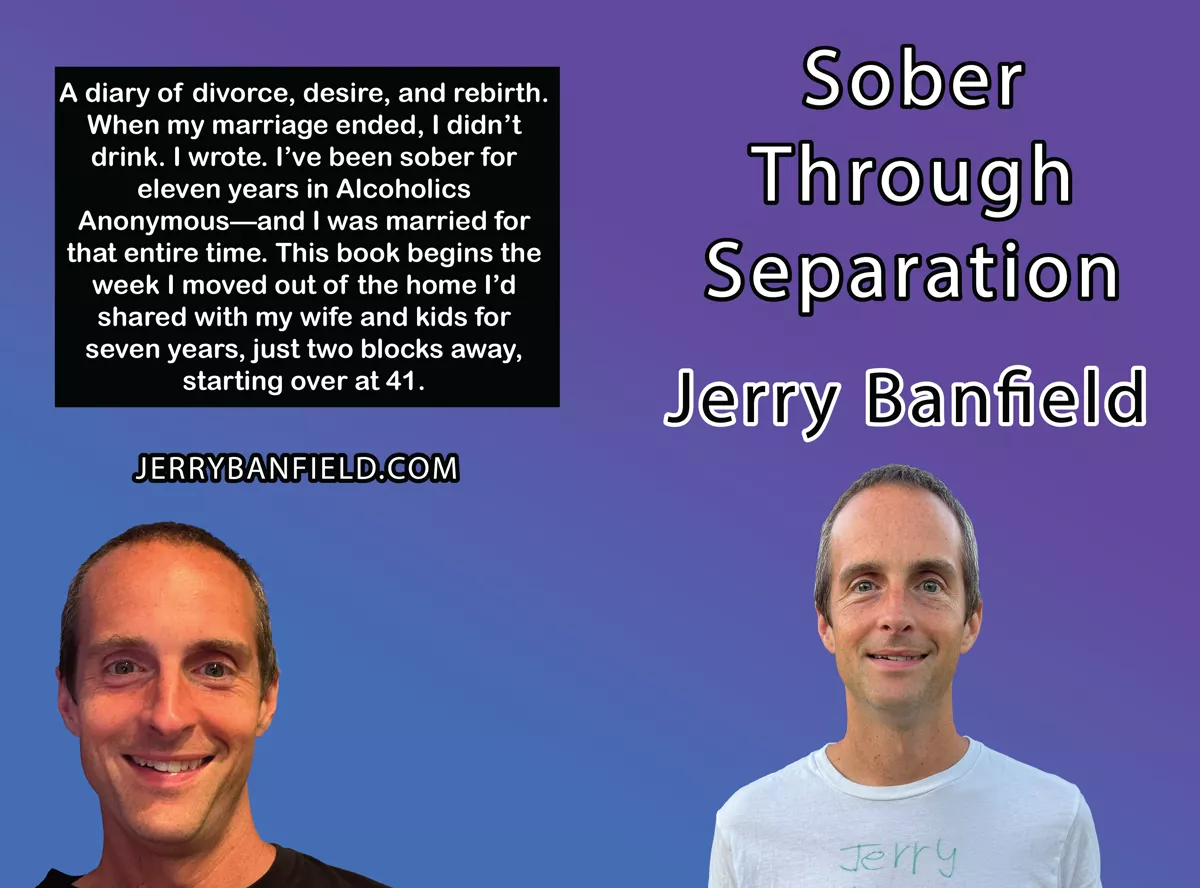
This is my journal entry from October 16, 2025, part of my daily autobiography Sober Through Separation — my real, unedited days, published in order.
I wake up at my ex-wife’s house with the kids and start the morning routine. There are lunchboxes to fill, breakfast to make, and everyone needs to get dressed and out the door on time. I make them each a burrito and encourage my daughter to prepare her own lunch, which she does impressively well. My son even gets himself dressed. I can’t help but point out how much my ex-wife usually does for them compared to how much they’re capable of handling on their own. My ex-wife’s mom arrives around 7:35 a.m. to pick them up, and everything flows smoothly. Once they’re gone, I walk back to my own house and settle into work on my books.
I come up with a title for my last diary book—The Kind Divorce. I feed the full manuscript into ChatGPT and have it generate hundreds of title ideas. Out of all of them, The Kind Divorce stands out as the clear choice. I dictate an introduction explaining that it’s a series of journal entries chronicling my experience of discovering and navigating divorce in real time. After rereading the first few entries, I realize how seamlessly they fit with the introduction, and I start to feel that this might be the best book I’ve written so far. I Was Famous on the Internet will always be the one I give to people first, but The Kind Divorce has a depth and honesty that feels powerful.
As I continue refining it, I start to believe that my books could one day provide a full-time income. If I earned about $4 in royalties per sale, I’d only need to sell around 2,500 copies a month to make $10,000. That seems entirely possible—especially if I eventually publish dozens or even hundreds of books. If I released two or three each month, that would add up to 50 a year. In a decade, I could have between 200 and 500 titles. Once I reach that point, a single reader discovering my work could end up buying many of them. The potential scale of it all excites me, and I feel grateful to have this time now to build that catalog.
Meanwhile, my car is at the the Toyota dealership dealership, and I’m texting the service guy every hour for updates. By 11:30 a.m., I still haven’t heard back, and I’m restless to get to yoga. Google Maps says it’s a 28-minute walk to my yoga studio, but I’m confident I can do it faster. I plug in my headphones and listen to Models: Attract Women Through Honesty by Mark Manson. It’s exactly the kind of dating book I’ve been looking for—grounded, realistic, and full of useful principles. After reading The Game by Neil Strauss, which was entertaining but manipulative in tone, Models feels refreshingly genuine. I’m glad I found it.
I walk briskly toward yoga, immersed in the audiobook, and plan to ask the instructor for a ride home afterward. When I arrive at my yoga studio, I slip easily into conversation with people as I usually do. By now, I’ve built strong social proof there—I know so many names and faces that it’s easy to connect with everyone. The Game suggests avoiding asking for women’s names right away, but my approach has always been the opposite. I ask people’s names immediately because remembering and using them creates a lasting sense of familiarity. When you consistently greet someone by name, even briefly, a genuine connection grows over time. It’s a completely different strategy than trying to pick someone up at a bar. For me, it’s about showing people you notice them—and that small gesture has a real impact. That same noticing—greeting people by name and actually seeing them—is exactly how I want to show up for you, so if you want to be truly seen and heard, you can schedule a private call with me and I’ll see you on the call.
The instructor teaches a solid class today, and during it, I notice a woman I hadn’t paid much attention to before—at least not while I was married. Now that I’m in the middle of a divorce and open to dating again, I suddenly see her differently. She’s beautiful, always friendly, and today she flashes me a warm smile that lingers. I make a mental note to give her one of my letters and see if there’s any compatibility between us.
Before class begins, a yoga instructor comes up to me and says she’s been loving my book I Was Famous on the Internet. She tells me it’s made her reconsider how she uses her devices and whether she even wants her kids on tablets anymore. She’s already recommended it to another mom from the school—someone who used to take yoga classes at my yoga studio. I thank her sincerely and tell her how much it means to hear that. Her reaction motivates me to keep spreading the book, knowing it’s actually making people think about their own habits.
After class, the instructor gives me a ride home, which I appreciate since my car’s still at the dealership. I hand him one of the letters I printed last night—the one where I lay out exactly what kind of help I’m looking for with both dating and finances. Once I’m home, I dive straight back into writing. My goal is to finish editing The Kind Divorce tonight while I’m sitting with the kids at bedtime. It’s been one of my most rewarding projects so far, and I want to see it through.
The guy mentioned yesterday that I should check out local meetups, and I saw him again today, so I decide to take his advice. I search for writers’ groups in St. Petersburg, but nothing active shows up. The few I find are outdated or have stopped meeting altogether. Maybe I’ll need to look again later, ask around, or visit a local bookstore to see if they host anything. I’m sure there’s a writing community here somewhere—it’s just a matter of finding it.
My ex-wife’s mom picks up the kids from school today, which helps since I still don’t have my car. Later in the afternoon, the dealership finally calls with an update: the repairs will cost $1,300. I ask ChatGPT whether that sounds reasonable, and it suggests an independent mechanic could probably do the same work for a few hundred less. Still, the time and hassle of retrieving the car and taking it elsewhere aren’t worth it right now. It does, however, remind me to find a good independent shop for next time—ideally one close enough to walk to or with loaner cars available. The Toyota dealership used to make sense because I could rent a car there, but without that option, the convenience is gone.
At 3:30 p.m., I walk to my AA meeting. There are a couple of new guys and also the girl I started the home group with. The meeting goes well, plenty of time for everyone to share. When it ends, she offers me a ride home. My instinct is to decline, but then I think—why not? During the meeting, I find myself noticing her more than usual. I’ve always thought she was somewhat attractive, but today I realize she’s actually gorgeous—and someone I might be very compatible with. Of course, she has a boyfriend, so I won’t make any moves, but I appreciate the reminder of how abundant life feels when I’m open to seeing people differently. When you look at someone with fresh eyes, qualities you’ve overlooked can suddenly seem magnetic.
She’s in her mid-twenties, kind, and has an energy that draws people in. I know her well enough from our home group to see that it’s not just surface-level attraction—it’s something about her spirit. Two of the new guys at the meeting say they want to join our home group too, which brings us up to four members. That’s great news; we’ve needed the extra help. I half-joke with them—though I mean it a little—telling them not to join and then try to mess everything up.
After my home group friend drops me off, I get ready to walk to the tennis club. I pack an overnight bag for staying with the kids again at my ex-wife’s house and head straight there since it’s mostly on the way. I drop off my computer and clothes, refill my water bottles, and continue walking to the club—without my racket. I arrive about ten minutes early and start chatting with a man I mistake for a reader who wrote a glowing Amazon review for Author in St. Petersburg. I start talking to him like he’s read my books, but he just looks confused. Then it hits me—he’s someone else entirely. Fortunately, I can laugh it off. I don’t get embarrassed easily anymore. I just acknowledge what happened and move on.
A few minutes later, the reader I’d been expecting shows up with his son. Two teenage boys also want to join the men’s clinic, but the coach says the minimum age is eighteen. So the reader takes his son and the other boy to a different court, and I join them. I figure it’s a great chance to get more time with the reader and give the boys a proper doubles game. The teens were born in 2009 and 2010, and both are strong players. The reader’s excellent too, which leaves me easily the weakest of the group—but I love that. Playing with better players always sharpens my game.
In the first match, the reader and his son play against me and the other boy. They beat us 6–2. Then the reader and I team up, and the boys win, but only by a narrow margin in a tiebreaker. It’s a fun, competitive couple of sets. I manage some solid returns on their heavy, spinning serves and a few clean shots of my own. Afterward, I exchange numbers with one boy’s dad, who tells me they live just two blocks from the tennis club and are training his son to reach the highest level possible. I offer to hit with him anytime, happy to be a kind of human practice wall.
I walk back toward my ex-wife’s house, talking with her on the phone along the way. She went to a hot yoga class today, which makes me feel a twinge of jealousy. She resisted doing things like that when we were together, yet now she’s diving right in. Still, maybe that’s part of the gift of this divorce—it’s giving her the freedom to rediscover what she actually wants. I wonder if, without realizing it, I was sabotaging her by framing certain things as my ideas instead of encouraging her to see they might be hers too. The space between us seems to be doing both of us good.
I’m glad I’m feeling better today after yesterday’s sadness. When the kids get back from my ex-wife’s parents’ house, we go over to my mom’s for about half an hour. I share half an Oreo ice cream sandwich with my son and two halves of Italian ices with my daughter. Time flies, and before I know it, it’s already 8:05. We walk back home, and I offer the kids $5 if they’re ready for bed by 8:25. They make it right on time again. I sing “You Are My Sunshine,” snuggle them up, and then get to work editing the last thirty pages of The Kind Divorce.
I move steadily through the rest of the manuscript, polishing the introduction and feeling a deep sense of completion. When I step out of the kids’ room, I finish editing and prepare to finalize everything tomorrow—the manuscript, the formatting, and the cover. All I need is a photo for the front, maybe one of my ex-wife and me, or just me alone.
As the night winds down, I notice a strange sensation of missing my own space. I feel like I’m staying in someone else’s house now, which is ironic considering that just over a week ago, this was my house. I lived here for seven years, and yet it already feels foreign. I find myself missing my bachelor setup—the freedom, the privacy. I find myself missing the privacy of my own place. I’ve also been wondering about balance—whether I’d be more motivated to actually go meet women if I leaned on solo habits less. At least I’m not watching porn anymore. If you’re wrestling with your own balance between leaning on solo habits and actually going out to connect, you’re welcome to schedule a one-on-one call with me and talk it through together on our call.
After my long shower—so long that the steam makes my nose run—I sit on the couch and read more of Can You Catch a Cold? The book questions the early experiments that shaped germ theory, arguing the studies behind them were weaker than most people assume. I find its case persuasive, and it’s left me questioning things I’d taken for granted. I share this only as my own evolving belief, not as medical fact.
The author walks through various human studies that supposedly demonstrated viral transmission, but nearly all of them are riddled with uncontrolled variables. You can’t just take mucus from a sick person, expose another person to it, and then claim a virus is responsible if they get sick. There are countless other substances involved—hormones, stress chemicals, toxins, even emotional factors. None of these were isolated or ruled out in the experiments. Reading it, I’ve come to feel that germ theory rests on more assumption than I’d once believed.
What stands out to me is how germ theory shifts responsibility away from the individual. If you believe an invisible microbe is attacking you from outside, you never have to examine what’s happening within your own body—your stress, diet, thoughts, or energy. The book makes a convincing case that the theory’s popularity serves a purpose: it keeps people dependent and afraid rather than empowered and accountable for their health.
The deeper I read, the more the foundation seems to wobble, at least to me. It’s striking how thoroughly the world has accepted this idea—and how I, too, believed it for most of my life. I even catch myself washing my hands out of habit, and since reading this book I’ve personally eased up on it a little. I want to be clear this is just my own experiment and belief, not advice for anyone else.
Of course, I still wash when my hands get oily, just to feel clean. The book has me reexamining other habits too, though I hold all of this loosely—as questions I’m sitting with, not conclusions I’d push on anyone.
I go to bed a little before 11:30, grateful for another night with the kids and at the same time surprised by how much I’m looking forward to being back in my own space tomorrow. Before bed, I make some final edits to the letter I’ve been refining. My ex-wife tells me that the line about “daily lovemaking” feels off-putting to her. She’s not my target audience, but her feedback makes sense—if I want the letter to circulate widely, I don’t want something in it that might stop someone from sharing it.
Still, I want the letter to remain as honest and direct as possible. I decide that even without that phrase, it gets the message across. The section still says that physical touch is my love language and that I value daily intimacy and connection. That’s clear enough without being explicit. I’ll start giving the letter to more people tomorrow and see what kind of feedback I get.
If you connect with how I live and think, you can follow the rest of my days on YouTube in my Life playlist.