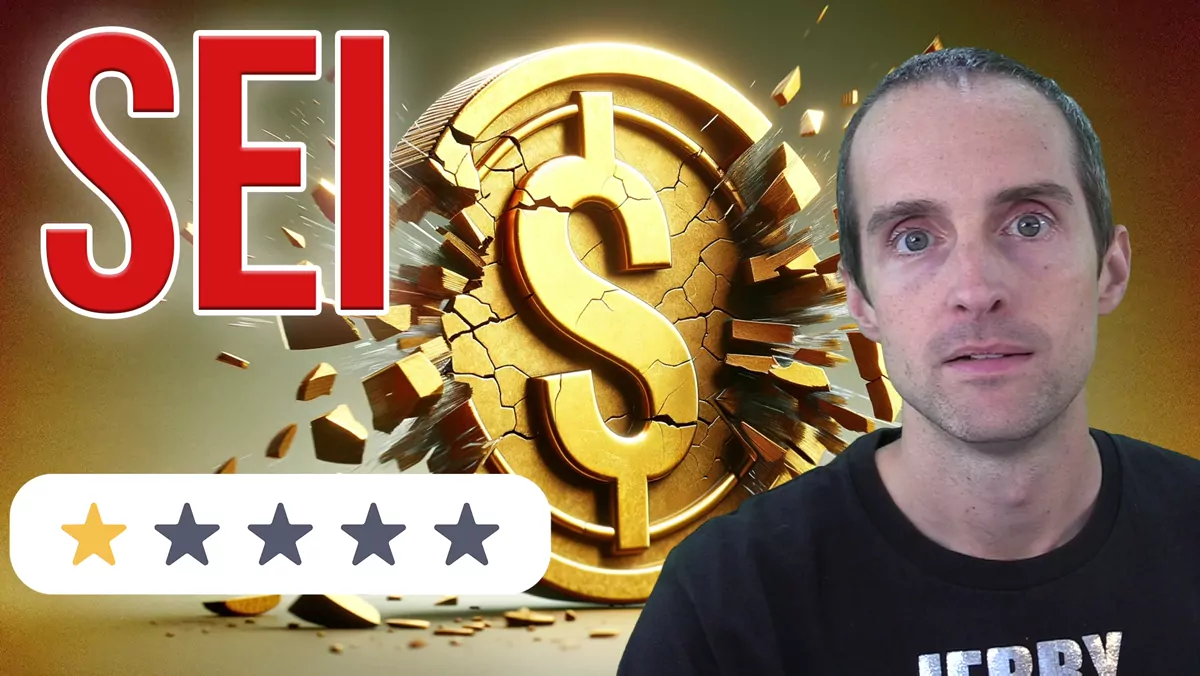
My friends, you're about to experience an honest review of Sei. I think Sei looks absolutely horrible. However, I'm going to give you the good, the bad, and the ugly on this review, because I'm tired of y'all getting ripped off by these altcoins that suck, have no real long-term potential, and are just copies of other technology. And then in the bull market, the insiders dump on you, and you get left holding them to the bottom. So I'm going to start with Sei's price chart, then go through their accounts and websites and news stories.
The good: the timing and the pump
First, the good. This is the good thing about Sei. It launched in August 2023, and it has done a 3x since then. A lot of the most hyped and speculated cryptos were released in this same kind of pattern. They came out before a bull market, they had time to get some adoption, and then they had a massive pump. Sei does have a lot of volume right now.
However, the fully diluted market cap is already $7 billion for something that hasn't been out a year. And to me, technologically, it looks like it is useless. It is not any real improvement over things like Solana. It's basically the same. Yes, there are some small differences as far as I can see, but it's basically just like another Solana. And the whole point of this, in my opinion, is to just rip people off who don't know any better. So far, that looks like it's what's happening.
Now, this could get a speculative pump. I also think this is being manipulated upwards. However, there are institutions that appear to have invested in this. It looks like it has big money behind it, with Coinbase, Jump, and some other names you might recognize. But here's the question: what is it? And how does what it does compare to the other technology in crypto?
What Sei says it is
If you look at the website, it says Sei enables mass adoption of digital assets. It says Sei is the fastest Layer 1 blockchain, designed to scale with the industry. Then there's a comparison with Bitcoin. I mean, mother of God, are we comparing something brand new to something that came out in 2009? It's 15 years later. So they've got a comparison you've seen everywhere. And then, comparing to Solana, it says it can do twice as many transactions as Solana, with faster finality, and there's front-running prevention.
For most people, this is where their research would basically stop. It looks like you've got some building going on here, a new blockchain space, secured by some of the most well-respected institutions. Now, that's definitely a good thing. It's built to prioritize security, and last I checked, that's going pretty well on most chains. It says it's massively scalable, that decentralized applications are here to stay, that it serves as a step function in blockchains, that it's engineered to evolve, and that it's built with interoperability and language capability in mind. It says it's the fastest blockchain. And this is where you're getting screwed, because people in crypto don't understand the bigger picture.
Why this is basically a copy of Solana
In the simplest terms, this is basically a copy of Solana. Obviously there are differences, but it doesn't innovate anything fundamentally new. And if you haven't seen the Internet Computer, you wouldn't even understand what is fundamentally new. Sei is another one of these blockchains where all it does is transactions and tokens. It's basically a copy of Ethereum with some different designs.
The Internet Computer is the forefront of crypto technology. It's the only place you can build your app fully on chain, where you can put everything: the website, the front end, the back end, the NFTs. Sei is another one of these blockchains where you can't do any of that, which to me means it is completely pointless. Solana already has the user adoption. There's no reason you would build on this or use this token instead of Solana, because Solana already has the users and it has the developers. This is the same conclusion I came to in my honest review of Solana itself.
And if you know about the Internet Computer, there is no reason you would build part of your application on Sei, then build part of it on Amazon Web Services, then have to pull in oracles like Chainlink just to make your application work, then be vulnerable to hacks, all while trying to use a brand-new ecosystem. The goal of the vast majority of these projects, in my opinion, is to rip off naive investors who don't know any better. That's the real goal.
To me, the Internet Computer is the only game-changing technology. There's nothing else you can build fully on chain. The Internet Computer is live, the token has lockups, and I've done so many videos on it over the years. When you compare Sei to the Internet Computer, the fully diluted valuation is about the same, and Sei has a ton of token unlocks coming. To me, this is an absolute dumpster next to the Internet Computer. Nobody who's heard of the Internet Computer, who does good research and is going to make a profit, would buy this. No educated crypto investor, in my opinion, would buy this. And it's already pumped three times. I think the volume is being manipulated intentionally. Exchanges create fake buys and fake sells to generate additional volume and get people's attention.
If you want to follow my thinking across all of these coins, I keep it going in my Crypto Reviews playlist, and if you want that same honest read on your own holdings, you can book a private call with me and bring them to our call.
The red flags: no explorer, no team, no holders
When I went looking at the Sei explorer, it wasn't even linked correctly on CoinMarketCap, which is sloppy. There was no explorer even linked there in the first place. If you're telling me a $7 billion fully diluted crypto is that sloppy, that's a problem. And check this out: a $7 billion fully diluted crypto, and where is the team? Where is the team? Do you see the team? These are the same red flags I see in almost every one of these projects, like Solana. I pointed that out with Solana too. You go to their team page on the Internet Computer side and look at the talent they have.
The Internet Computer has the largest research and development team in blockchain. Look at their team page. They have 250 employee patents. Their employees have published 1,600-plus publications. They have hundreds of thousands of citations. Now look at Sei. You see a chart on Sei that's just like every other one of these copycat projects: "it's the fastest," the same kind of chart. They of course don't compare to the Internet Computer, because when you compare the actual computation Sei does next to the Internet Computer, it's basically nothing. It does almost nothing computationally compared to the Internet Computer.
And there's no team listed on the Sei site at all. There's a jobs link, and it is good they're hiring some people. Solana wasn't hiring anybody, which is not a good sign, because if you're growing, you're going to need to be hiring. So at least Sei is hiring. But you cannot even see the team. This is marketing 101: you put your team out there. And they have no team page.
Here's another big red flag to me. They have 600-and-some thousand followers for a brand-new crypto. The fastest Layer 1? Fastest according to what? If you want to talk about the amount of computation you can do, it's not the fastest at all. It does almost no computation. So who cares whether you can do a single transaction? Look at Solana: they've already got a ton of users and a ton of applications, and they can do a transaction in two to five seconds. The transaction finality on Sei is 380 milliseconds. Who cares? It's a negligible difference. On the Internet Computer, you're doing the equivalent of hundreds of thousands of Ethereum transactions per second right now, 6,000 transactions per second, and the finality is faster than Solana. Of course that's not mentioned on Sei's site, because they don't want you to know about it.
When I went to the explorer, there were some actual transactions that looked like they were happening. But you can't even see how many holders this has. Where does it show you how many holders it has? This is horrible. Maybe it's hidden somewhere, but it's not obvious. You can't see the holders. You can't see the team.
The follower and engagement numbers don't add up
Now, this is almost guaranteed: these are bot followers. Let's compare to the DFINITY X account. DFINITY has 686,000 followers, it's followed by about 100 people I follow, and it's been around since 2016. It's the best technology in crypto, with huge amounts of people talking about it, and it's onboarding developers faster than everything else.
Now look at Sei's X account. It's a brand-new account, joined April 2022. Almost guaranteed, they pushed hundreds of thousands of bots onto it to try and fake their engagement. Unfortunately, this is very standard practice in crypto. There's a crypto mafia playbook: you buy fake followers to pump it up, to get people to think you're popular, and you buy bots to push engagement on your posts. It doesn't even look like they're doing the engagement part well. Six hundred and some thousand followers, a brand-new crypto, and only 8,000 impressions. Eight thousand impressions on a live they just hosted, with 744 people tuned in. I mean, come on.
Look at my own X account. I post a video and I get 5,000 impressions off an account I created last year, with all organic followers. Five thousand impressions on a video I put up three hours ago. I have way higher engagement with 5,000 followers than they do with 636,000 followers. I am disgusted by all the cheating I see in crypto, and it's people cheating you. They're cheating you of your time and your money. This project stinks of cheating, and everybody seems to be in on it. If you're holding something like this and want a second set of eyes to think through your own position before you decide anything, you can set up a call with me and we'll sort through it together.
Two conclusions about the investors
So there are one or two basic conclusions. One: all these investors don't really know what they're doing with this, and they're ignorant of the Internet Computer's technology, so they're investing in far-inferior technology. Or two: they're knowingly and intentionally investing in this and trying to pump it up to make a profit off of retail's ignorance. They're trying to push building crypto through centralized, established hosting with centralized fail points, like developer Amazon Web Services accounts and oracles.
And then they push news stories like this: Sei raised a $50 million ecosystem and liquidity fund, it has 120 projects building on its blockchain, a public testnet attracted 3.6 million unique users, and it processed 35 million transactions. The story says there will be a lot of native crypto adoption, but there need to be applications that are more general and super inclusive. Yes — the Internet Computer does exactly that. That's exactly what the Internet Computer does, and it's already doing massively well.
And what's actually happening in the Sei ecosystem? They're just funding money to get people to build. But they're not really building on Sei. They might be building one part of their application on Sei, and 99% of it is sitting on centralized hosting. They'll call it IPFS, but a lot of those IPFS nodes go right back to Amazon Web Services. This same pattern is why I gave my honest warning to holders of other hyped coins, and it's the same story I told in my review of Sui, another copycat Layer 1.
My verdict: a one-star dumpster fire
To me, this is an absolute one-star dumpster fire. Here's one way I think about it: I would give a tiny $1 million market cap coin on the Internet Computer a five-star rating, and I'd give this a one star. Because if Sei were a $1 million market cap, it might have some potential — maybe it could get a speculative pump. But it's a $7 billion fully diluted crypto. It's already so big that anyone buying this, yes, it could have a speculative pump, but the odds are that almost everyone who buys this over the lifetime of the technology will lose money. That's my opinion based on my own research.
So I think I've made it pretty clear what I think of this. I'm staying away from it. This is just what I've seen doing my own research, quickly, while live. People requested this review, so I did the review, and I hope it has helped you do your own research and avoid getting ripped off.
I've talked to so many people who have lost massive amounts of money. I've made money 10 years in a row in crypto. The only year I didn't make money was my first year, in 2014, when I foolishly traded Bitcoin and managed to lose thousands and thousands of dollars, instead of simply dollar-cost-averaging into it at smaller levels and holding onto it. That experience is a big part of why I keep sharing honest reviews like this one in my Crypto Reviews playlist.
I talk much more about the Internet Computer elsewhere. My website is hosted on the Internet Computer. Can Sei do that? No. And there's no reason you would. Why would you put out a new blockchain when you can't even build a website on it? On the Internet Computer, you already can build websites. It's ridiculous. None of this is financial advice — it's simply what I see when I do my own research, and I'm sharing it so you can make your own decision.