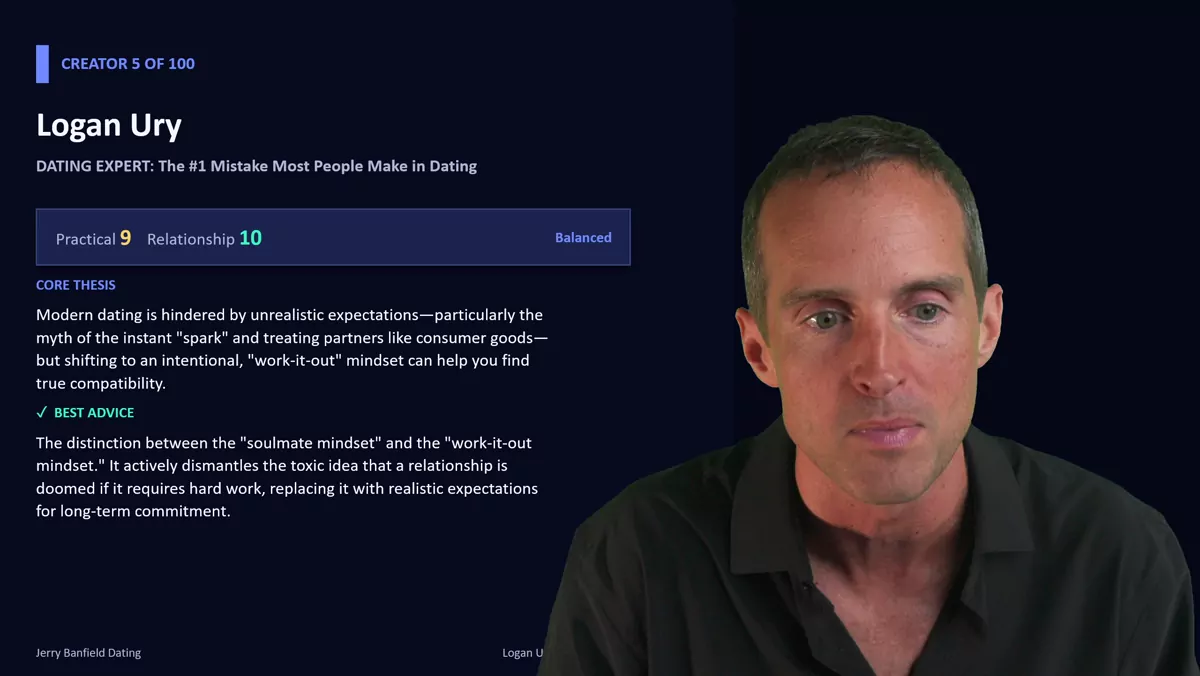
Logan Urie and the tyranny of unrealistic expectations
Number five on my list is Logan Urie. She was actually on the Jay Shetty podcast, and I wasn't able to find a video of her alone, but I love her core thesis: that modern dating is hindered by unrealistic expectations. I've been carrying what seemed like reasonable expectations to me. I thought I should be able to encounter a woman who's not addicted to alcohol, marijuana, or plant medicine, a woman who has some emotional stability and consistency, a woman who wants kids and takes care of her body. And it's like, all right, I guess. I do all of this stuff myself, so I kept thinking, why can't I just find a woman who does the same stuff I do?
But maybe a woman has her own strengths alongside her weaknesses. I've been guilty of expecting that a woman should have all the strong points I have, plus be strong in all the areas where I'm weak. I actually just talked to my matchmaker about this — I have a matchmaker, and I still have six more matches I've talked to. I told her, look, if a woman is weak in some of the areas I'm strong in but she's very interested in me, I'd happily be interested to meet her and help her along. I'm really strong in diet, eating, exercise, holistic health and energy, taking care of myself, and creativity, and I could use a woman who has complementary things in the areas where I am weak. I've been struggling with this, and I've noticed women have been doing the exact same thing to me — treating me like a consumer good. If there's any little thing they don't like immediately, then it's no sparks, not interested, nothing. If you catch yourself treating people like a checklist of features, or feeling treated that way, I would be glad to talk through how to date from your strengths instead when you set up a call with me.
Soulmate mindset versus the work-it-out mindset
There's a distinction between the soulmate mindset and the work-it-out mindset. Relationships do require work, and you're going to do work one way or another. One big reason I got divorced is that I realized my ex didn't seem interested in doing any of the character development work with me anymore. She just wanted to keep being the same person and not change anything, and I felt like we needed to work on and grow our character, build, and change. She felt most comfortable doing that in the context of getting divorced, and honestly it's made things a lot easier for both of us.
So yes, there's a point where working it out is no longer working. But I'd still say my ex was the leader in taking the divorce — I was much more in the let's-work-this-out mindset. It seems a lot of women are initiating divorces; the vast majority, more than two-thirds, are initiated by women. A lot of women are in this mindset of, I'm not going to work it out anymore, I'm not going to try, it shouldn't be this hard. But being single is hard, and being in a relationship is hard. There's going to be hard work either way. The real question is where you're going to get the biggest return on investment. In my case, I do believe I got a much higher return getting divorced, as did my ex. But most of the time, instead of thinking about a soulmate, it's better to try to work it out and make a great team together. That's the ideal. If you're burned out on dating apps where people are always finding a reason to break up, or if you're waiting for the perfect person, Logan Urie's thinking is worth sitting with.
The default second date rule
Then there's the default second date rule, which I had never heard before — that by default, you should go on a second date. I've been very quick to say no to a second date with women, and they've been just as quick to say the same to me. For example, one woman said she didn't find me physically attractive, so I canceled the second date. Another woman, out of the blue after we'd already scheduled the date, said she didn't feel the romantic spark and canceled on me with no explanation at all.
Going forward, I'm planning by default to have a second date, because meeting someone one single time means we're overemphasizing how much intuition and how much of a superpower we have to analyze, judge, and figure people out right away. Realistically, from what I've seen, you don't know someone hardly at all from seeing them one time. So I'm personally committing to going on as many second dates as I can, because sometimes I just don't get that great of a first impression of somebody. I'm way too quick to judge and cancel a second date myself, or to act in a way that encourages the woman to cancel. This was an awesome rule. If you're on dating apps it might be too much, but I'm not using dating apps anymore, so it makes a lot more sense when you're in community and you already know somebody.
I've been over-optimizing my dating filters for sure — filtering for women who want kids, who don't drink, don't smoke, don't do drugs. My filters were so strict that there were only about 10 or 20 women, and maybe 30 or 40 on the dating apps, in an entire metro of millions of people. That's how strict I was. So this had a big impact on me: I realized I'd been getting crazy about the idea that if she's not perfect, I shouldn't see her again. That mindset makes you miserable, constantly trying to find this perfect person while somehow also thinking that you're the perfect person. I have no delusion that I'm the perfect person. In fact, I see that the majority of women who meet me don't feel any romantic chemistry — my big personality, my big energy, my very strong opinions, my absolute ruthlessness about my whole-food plant-based diet, my absolute sobriety with no alcohol, no drugs, no marijuana, and my very dark humor that I used to censor in person and am not censoring anymore. Most women meeting me don't feel any romantic chemistry or aren't right for me, and that is fine. At the same time, it's ideal if you can find someone where there's a little chemistry, and then take some more serious effort investigating it instead of giving up right away.
Steph Anya: the dating tips that are making it worse
Creator eight out of one hundred is Steph Anya, a therapist whose thesis is that the dating tips people share are making it worse. Her core point is that blanket dating advice — like "if they wanted to, they would" or "never settle" — is often given way too rigidly and lacks the nuance necessary for real dating, which prevents people from building healthy, committed relationships. Exactly. This has been a theme repeated a lot: it seems a lot of us have let our standards get way too high. We expect way too much, and we have the illusion of way too many options. The most mature and realistic advice is that relationships are not a reward for doing everything perfectly.
I've done so much work on myself. I've thought, look, I'm pretty good at communicating now, right? So why don't I just instantly find a partner? I've had a number of women attracted to me, signaling me, women I've gone on dates with. I've done so much work on myself — shouldn't I just get a partner like that? Well, it still is difficult. It's kind of miraculous when you can ever line something beautiful up. I've struggled a lot with feeling like I'm doing everything right — which obviously I'm not — but remaining single anyway. I've known people who have been single their entire life who feel like they're doing everything right, and I'd argue there's some evidence that they're not. If you were doing everything right, you'd probably be in a relationship, and you'd have been in relationships for the majority of your adult life. That's not everybody's path, but it does seem to hold.
Her point about a relational cure is beautiful, but she doesn't spend much time detailing how you avoid trauma dumping or unfairly making your partner responsible for your psychological healing. That matters. And viral advice like "if he wanted to, he would" is actually keeping people single. Look, there's a woman right now I would absolutely love to go on a date with. It was essentially an instant date — we spent hours together talking and holding hands at an event, and I've seen her at several more events since. But she managed to get a boyfriend who turned toxic, and now she's grieving and crying over him. That's a woman I would love to date and explore something with. Yet I actually deleted her phone number, because I got tired of reaching out to her and getting no response, feeling like she was interested in someone else and there wasn't anything there. So now I'm waiting until she messages me, and I'd be very responsive — but it's got to be mutual. She's got to signal or express some desire, some interest, to go out with me too. I'm tired of asking women who have no interest in going out and feeling rejected. You should be signaling somehow, some way, and I'm looking for subtle signals.
Evan Marc Katz: why commitment feels scary even with the right person
Creator number fourteen is Evan Marc Katz, with a video on why commitment feels scary even when he's the right guy. If I could point to one video that the women who told me about the romantic spark should watch, this would be it. His idea is that anxiety about committing to a healthy relationship is not a sign that it's the wrong guy — it's a normal fear of losing your infinite single options. And those are theoretical options. Practically, you often have way fewer options than you think. Committing means shredding your independent identity and making the sacrifices required for an interdependent partnership.
I know a number of women locally who are single through community, and they seem to have a hard time committing to a relationship. Some of them have been single their entire adult life, or almost all of it. Because yes, you essentially need to surrender your independent identity and merge into having a relationship. It's been almost a year since I got separated, and it's taken me about a year to get back an independent identity. People still tell me I talk about my ex all the time, so I'm still in the process of getting that independent identity back — because I successfully went through giving up the single option, shredding my independent identity, and making the sacrifices in the first place.
This ties back to something I talked about earlier — being a maximizer, always looking for a better option, versus being satisfied with where you're at. He also talks about the highly independent, quote-unquote successful person — and success is relative — who runs away whenever a relationship gets serious. If you're chronically single, this is definitely one to sit with.
All of this is why community has become so central to how I date and how I live. When you already know people, when you keep seeing them at events and building real relationships over time, you're not judging a stranger in a single sitting and swiping them away forever. That's exactly the kind of environment I'm building with the Jerry Banfield Family — a place to actually get to know people, do the character work together, and take the default second date instead of burning the checklist you're never going to satisfy. If any of this resonates, I'd love for you to come join the community, book a call with me, or just message me and start a conversation.
Infinite choice made us miserable maximizers
Commitment is beautiful, but it is also scary and anxiety-provoking. And it seems to me that a lot of people, most people, are self-sabotaging. Most people are not picking up very serious, legitimate red flags. There are some genuine red flags out there, but those are going to be the minority of the time. The discussion I keep coming back to is that infinite choice has made us miserable maximizers, and I see the need to tone that down a bit in myself. I see it in others too, certainly. The truth is you have far fewer options than it looks like, especially if you are on dating apps. It seems like you have all these options in front of you, but there is really a lot less there than it looks.
Aliza Ben Shalom — the Jewish matchmaker who says the same thing
I wanted to get some Jewish dating perspective into this so the whole thing stayed nice and well-rounded and not just one point of view. Aliza Ben Shalom has matched thousands of couples, and the video she was on was titled something like "Here's the single biggest mistake smart Jewish women make." Doesn't her core thesis sound familiar? Isn't it interesting to hear a Jewish matchmaker saying the same kinds of things that so many non-Jewish dating videos have said? This is exactly why you want to hear so many different perspectives and take them in together, so you can get a sense of what is true across the board — not absolutely true, but true often enough to matter.
She says highly successful women often sabotage their chance of finding love by clinging to superficial checklists and demanding partners who out-earn them, rather than focusing on a man's character, kindness, and willingness to be a supportive, complementary partner. My laughter here is not meant to be offensive. This is what a lot of guys are saying across the board — that women want men who out-earn them, that you have to get your money right, and then you'll be able to get any woman. And yeah, it is really challenging.
I came across a woman recently who makes hundreds of thousands of dollars a year and says she wants a man who out-earns her. That just seems insane to me. If you make several hundred thousand dollars a year, what you should want is a man who will stay home, clean the house, and hang out with the kids, so that when you come home everything is taken care of — you don't have to wash any dishes or do any laundry. That was my dad. My mom was in the military, an officer with a great career, and she retired as a colonel. My dad did all the traditional "man stuff" — taking care of the yard, the cars, all of that — and he handled the finances and took care of the entire house. All my mom had to do was work. My father cooked, cleaned, took care of the yard, the cars, and the kids. My mom had no responsibilities outside of working.
So you have to stop expecting a partner to be a perfect unicorn. In my experience, it is insane, if you are a successful earner, to expect that you should date someone who makes more than you. If you make a few hundred thousand a year, date someone who will be a complementary partner to you. If you are a highly successful, marriage-minded woman frustrated by your dating outcomes, this is a great one to sit with. As for the rigid stance on money — honestly, I would love for some women to pay for the first date. I have not had a woman pay for the first, second, or third date I've taken her on. I've had about 20 dates with women this year, and I paid for everything every single time.
Real talk, and I wonder if any single woman who actually wants to date me is reading this far: I've been borrowing money this year while I build all my YouTube channels and videos like this up, because I believe they are going to crush and bring in a lot of income. Even while borrowing, I've been using hundreds of thousands of dollars in credit, having made a lot of money before. I just got divorced, and my finances have been a little turbulent, especially after I redid my whole business. Still, I've paid for every date with every woman I've gone out with. And absolutely, successful women are sabotaging themselves by holding out for a man who out-earns them. I've seen that consistently across all different kinds of women. What you really should look for, as she said and as I agree, is a high-quality human. That should always be your outlook. If money and mismatched expectations keep tripping up your dating life, I have wrestled with all of it myself and would happily talk it through with you when you book a one-on-one call with me.
Dear CyberSue — your attitude may be blocking love
Dear CyberSue's video is about why your dating attitude may be blocking love. Her core thesis is that approaching dates with negative preconceptions, a rigid checklist, or a defensive shield sabotages you. This is one I have definitely been guilty of — either having way too upbeat, positive fantasy expectations, or going out figuring, "what's wrong with her? let's figure out what's wrong with her." The task I've been consistently applying is to replace judgment with curiosity. Instead of making a date a high-stakes job interview, treat it as low-stakes: let's play, let's have fun together.
If you are chronically single and constantly complain there are no good men or women left, this unfortunately applies to me significantly, and I'm taking it to heart. Now, one piece of advice I disagree with is sitting through a date even if you know there's no connection. I've done that — gone out for hours on dates where I knew there wasn't a connection. I would actually say your time is valuable, so learn to recognize it and cut it off as soon as you're sure. I'm partly joking there, a little comedy for the Google AI, but I would not sit through another dead-end date. I've had women pretty abruptly cut off dates with me where we'd barely been out 45 minutes and they'd say, "oh, I need to go do something." And I'm thinking, I know you don't need to go do something right now, you're just tired of hanging out with me. But I have been very hesitant, when I'm out with a woman I know I don't like, to be that direct with them — which is funny, because look how direct I am here. I should be the same when I'm dating as I am in these reviews.
I definitely believe attraction grows over time. The problem is we've built environments like dating apps and matchmaking that make you expect an instant spark. There was a woman I went out with who told me she wasn't physically attracted to me. She was over 40, and we hadn't even talked about whether she wanted kids — she didn't have any — so the alignment probably wasn't there anyway. But according to the data, the longer a woman gets to know a man, the less important physical attraction becomes, because what matters is the emotional safety and the connection. So I absolutely know attraction can really grow over time. Funny enough, when my ex met me I weighed 50 or 60 more pounds than I do now, and I had my hair dyed blonde, and somehow she found that physically attractive. That's what's interesting — we all have such different types.
Flourish with Lauren — consumption vs. contribution
Flourish with Lauren has hundreds of millions of views on YouTube Shorts. She's really blown up, and I love her videos about traditional masculine and feminine dynamics. Her take is that dating culture trains people to desire the aesthetics, the social signaling, and the lifestyle upgrade of a wedding, rather than the unglamorous day-to-day partnership and sacrifice it takes to actually be a wife. I can identify with that — the signaling that makes me think about how good I'll look to my friends walking around with a really attractive wife, instead of thinking about the day-to-day sacrifice it takes to actually be a great husband.
Her best advice is the distinction between consumption and contribution. This is something I've been working on: focusing on what I am giving and what we can build together, instead of what I get. I've lasered in on what I have to give — unconditional love, structure, support, consistency. That's what I bring. From there, we can build with the woman's emotions, desires, creativity, joy, and playfulness. This is worth watching if you are a marriage-minded man or woman tired of superficial dating — which is exactly how I found her, so tired of superficial dating myself — and especially if you are re-entering the dating market.
That said, this relies on traditional gender roles, which I personally am really vibing with lately. But I've also lived in non-traditional gender roles. There were parts of my relationship with my ex where she made most of the income, where my business wasn't doing very well, and I took care of everything like my dad did — I cleaned the house, did the laundry, took care of the cars and the yard. So I've done both: traditional, where I provided all the money and my ex didn't have to work, and the opposite, where I made not that much and didn't work much while she brought in the income. It can work both ways. I am ideally looking for a traditional arrangement, but if I find a woman making a couple hundred grand a year, your boy might just take it easy on YouTube and take care of the kids. I really love the thought here: are we dating for a viral wedding, or for a 50-year marriage? I want a 50-year marriage next time. I never want to date again. Dating has been fun for character building, but I thought my last marriage was forever — it turned out to be 13 years of marriage, 15 years together. I want a 50-year marriage next time. That's what I'm looking for.
Lindsay Ann — a specific, unique individual, not a type
Number 29, and we'll speed things up from here because some of these ideas start to get more repetitive — though you'll notice there are always new things and unique angles the whole way through. Lindsay Ann's core thesis is that real love isn't about finding a type or managing a partner; it's about finding a specific, unique individual who allows you to continuously grow, diverge, and surprise each other through open dialogue. Yes. This makes me thirsty for my queen, because that is exactly what I'm looking for — a woman where we can grow, diverge, and surprise each other.
Her attraction test: if nobody in your life liked them, would you still validate them? Yes. If you are frustrated by the superficiality of dating apps, this is exactly right. Now, the directive to just go cold-approach and talk to a whole bunch of strangers — I'm not vibing with that. But being around people naturally in a real environment is a big yes.
From here I also wanted to get some Asian perspectives in, some Asian matchmakers, because matchmakers know things the apps don't, and this theme has been echoed before.
Burn the shopping list
Online dating has created a closed-minded shopping list mentality, and in my experience singles find much more success by dropping their checklist. For me, that means not using dating apps at all, and prioritizing how a person makes you feel instead of superficial traits. The height thing is so insane to me. There's no reason as a woman you need a man that's taller than you. Even if you want a man that's taller than you, once a man is taller than you, it doesn't matter how much taller. It's ridiculous. These are things where there's almost no logic behind them that makes any kind of sense, and yet a lot of people are operating with this stuff. Not everybody, which is great.
I don't do dating apps. But for me, thinking about what I bring to the table is where I'm improving — thinking about what I offer rather than all my negative demands and deal breakers. I've been a bit of a tyrant on negative demands and deal breakers. You're not going to drink, do drugs, smoke weed. You're not going to stay up too late or eat like shit. That was very worth confronting for me being 40 plus and experiencing severe dating app burnout. I met my ex on a dating app, so I thought I was excited about it — but we didn't swipe back when I was on dating apps, and it was horrible. I was shocked at how bad dating apps were.
I don't agree, though, with the claim that you should just have a nice conversation and not ask any real questions. I'm getting straight into it on the first date. The problem is that then you're going to get red flagged, boundaried, and disqualified by people immediately off of that. But I'd rather just look for someone who's not in that matrix of "this is exactly how it has to be right away." And yes — has consumerism turned dating into shopping? Unfortunately, as it largely is.
Kimberly Hill — five reasons dating's harder than it's ever been
Kimberly Hill's thesis is that modern dating feels difficult for men not because they're flawed, but because of structural headwinds: the paradox of choice, the loss of relational instincts, and the lack of cultural consensus. Yes. In some previous periods there were kind of clear expectations about dating, and today it's just crazy. Just look at all the stuff I've talked about and what you can conclude from putting all this research together — my mind just feels like it's been scrambled. There are so many perspectives, so many things to learn, so many technical terms.
The advice here is great. Don't confuse the relief of physical touch and attention after a dead-end marriage with genuine long-term compatibility. I really resonate with that. I've seen a number of Kimberly Hill's videos, and I really resonate — even though this could be a watch-out point for some people — with "understand yourself well enough that you can show up authentically." I just did my last live stream on how "be yourself" can be misunderstood dating advice. This is also why I go get a massage every week; it really helps, because that satisfies a lot of my desire for touch.
It can be rough out there, especially as a man. My belief is that women are often sleeping with a small slice of men — like 20% of men that a lot of the women are sleeping with. Then there's a number in relationships. And then there are just tons of single dudes getting nothing. That's inefficient. Collectively we should be doing better than that and having better distributions.
Your Wingman — 10 brutal dating tips for women
Number 52 on my list, Your Wingman, with "10 brutal dating tips for women that women need to hear and men need to share." This goes back to the one before. The thesis is that women are sabotaging their own dating lives through unreasonable standards, manufactured drama, and culturally validated entitlement. Preach. They must take personal accountability and drop their defensive walls to find a good man. I pray to God that I'm there when my queen is ready to drop her defensive walls and find a good man.
There is a distinction between vetting and testing. It makes sense to vet a partner — observe their character and so on. But don't intentionally manufacture drama, pull away, or be crazy. Don't do that. I know a number of chronically single women burned out on dating who keep doing this stuff and have highly defensive tactics, and this ends up happening. I can identify with doing some of this too, by being the one that's testing her instead of just vetting the woman. So I do some of this too. As I've identified and diagnosed things in others — I said diagnosed to be more dramatic — I hope I've identified the same amount of stuff in myself.
Now, watch out for the suggestion here that supportive friends are secretly engaging in intersexual competition to sabotage you. I don't know about that, and this is why you need to be able to use your own differentiation in taking things in. But I have noticed a number of cases where people's friends and the algorithm seem to be sabotaging their love life. Is that something you can identify with? It seems like a lot of us have got our love lives sabotaged because we're letting our friends and the algorithm tell us about things that we might be better off getting some better help for.
Esther Perel — 20 years later
Esther Perel, the author of Mating in Captivity, revisits it 20 years later and asks where we should begin. Her point: our expectation for predictability and perfection, fueled by technology, is fundamentally warping our ability to handle the unpredictable, messy reality of human relationships. Yes.
This has been a fantastic video and live stream for me to make, because I'm seeing it in myself. People have consistently told me, "You've got to drop your standards for women, you have unrealistically high standards for women." And I identify a lot with this. Stop expecting tech-level perfection and frictionless, on-demand predictability. But at the same time, it can be so hard to deal with other people — women that are flaky, canceling, and unclear with their desires, who say one thing one day and another thing the next day. They don't want kids, now they do want kids. They want to get married, they don't want to get married. They want to eat healthy but they're eating like shit. I had a drug addiction issue, but now they're smoking marijuana and doing several other things every day.
And it's like — is me saying no the responsible thing in this situation, or am I just not tolerating someone else's unnecessary stuff? Am I having standards that are too high, or am I making a smart decision to stay away from someone who's not compatible? This gets really difficult. If you cannot tell whether your standards are protecting you or isolating you, that is a question I love working through with people, so schedule a private call with me and we will sort out which is which for your situation. And I don't believe in keeping secrets from partners; I think it's very important to know exactly what is going on. Maybe it's more complicated if you have professional relationships. And I do think your smartphone can kill your sex drive — I've especially noticed people on their smartphones at night, which absolutely can kill your sex drive.
Brené Lee — married men give the worst dating advice
Brené Lee's video is "married men give the worst dating advice." I've got to say, some of my dating advice when I was married — I made whole dating courses that sold, with videos with all kinds of views. I agree. Her core thesis is that women must stop dating for potential and enforce their standards. This one was interesting, because you do need to have standards, but don't get crazy with them — so this one kind of conflicts with some of the other ones.
Her claim that financially insecure men will inevitably project their inadequacy onto the woman who tries to build them — I don't agree with that at all. My dad didn't have anything to offer financially, except he actually helped my mom save money. I do agree with her directive to stop dating based just on potential. But my ex dated me on potential, and I certainly made a big glow-up from when she dated me. At the same time, I think this is really speaking to women who have a history of dating fixer-uppers, where women struggle with people-pleasing and trying to take on a man who's a project.
Now, I've actually found in myself some desire to date a woman who's a fixer-upper, and that's problematic. The challenge for me is that almost every woman I meet is some level of fixer-upper, because I think my shit don't stank. I think I've got my life together pretty well, so almost every woman looks like a fixer-upper to me. So this definitely resonates with me. But the idea that every man who struggles financially will inevitably become mean, resentful, and emotionally abusive is ridiculous. Her framing that men's struggle is a trap that exists to get free labor from women — I don't agree that men leave their ride-or-die once they succeed. I would have stayed with my ex even if everything else had gone right; I would have stayed if she wasn't fully committed to getting divorced, even though that might have been the best idea. I've had a huge glow-up since I met my ex — made millions of dollars online, been famous with over a billion views, lost weight. I think I look better now than I did when we met, and I didn't leave her.
Shan and Lester — how to get a man to propose
Shan and Lester, with "how to get a man to propose and what makes him choose you" — Harry Styles and Zoë Kravitz on the thumbnail. Their thesis is that men choose to marry based on their own internal timelines and readiness rather than their feelings. Maybe some guys do. I'm ready to marry a great woman right now, so where are all the women who want a husband? I'm down, I'm ready to go.
You do need to consider your opportunity cost in a relationship, though. This stuff is hard. Being with someone where it's not going anywhere is stopping you from anyone else you could be with. I'm so grateful I got divorced, because as long as my ex and I were still married, we were both stopping each other from being with somebody else. I don't believe in rigid timelines like a year-and-a-half cohabitation deadline and the associated statistics. Ultimatums generally should be used at an absolute minimum. But I do agree — women, if you're in your late 20s or 30s and you've been dating someone for years without commitment, I think you deserve that commitment. I would commit to you. I absolutely would. If you're dating a man who won't commit to you after years, who doesn't want to get married or have a family, yeah, an ultimatum does make sense in that case. There's a delicate balance.
That's what studying all these coaches did for me: it made me see that my standards were too high, and that the checklist was the problem, not the people. And if you want the full breakdown of all 100-plus creators I reviewed, everything I've put together lives in my Dating playlist. Burn the checklist, take the default second date, and I'll see you there.