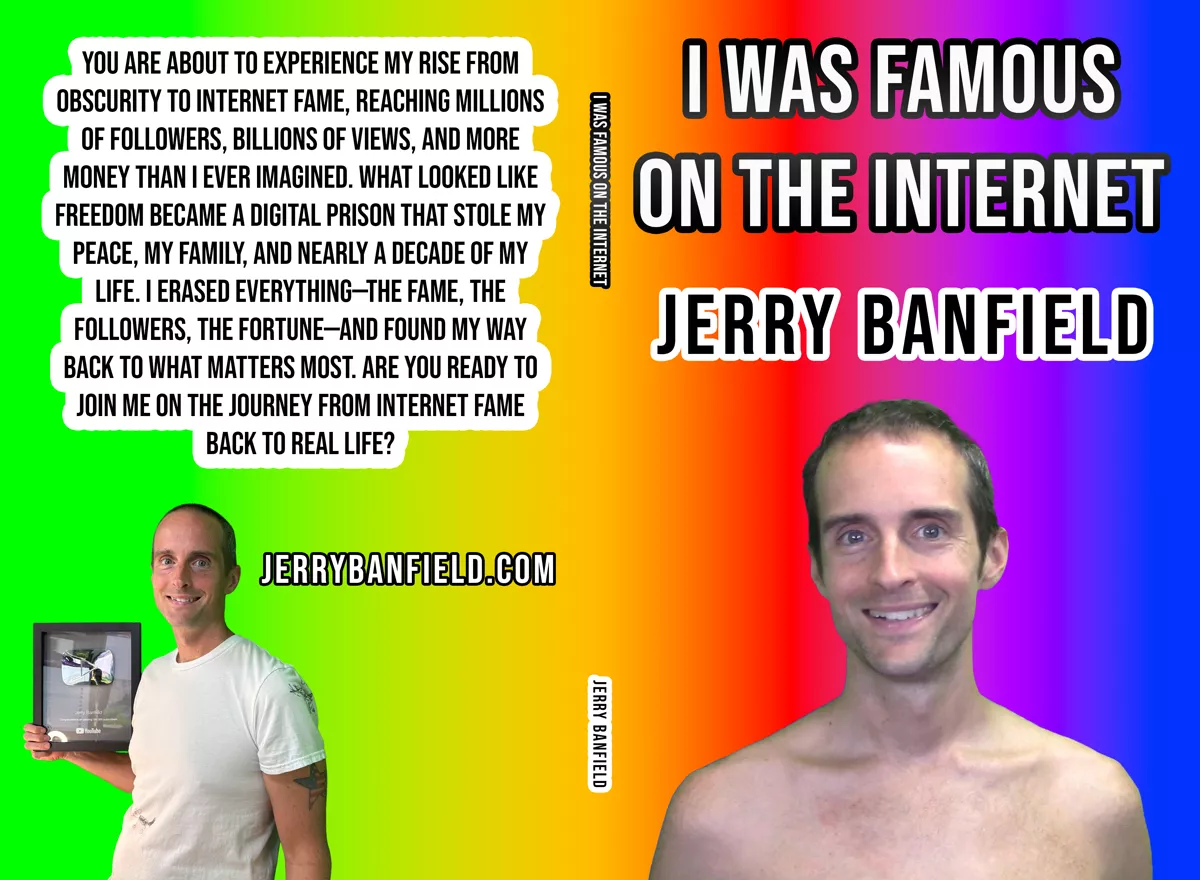
This is an excerpt from my memoir, I Was Famous on the Internet — my honest story of 14 years of internet fame and what it really cost, and why I deleted it all to choose real life.
From Survival Mode to Collective Service
I’ve always believed in the idea of being the change you want to see in the world. For me, that means being very conscious of how my actions affect others. I can’t just crank out videos saying whatever I need to say to get paid, because I know that harms people.
There are plenty of voices in the system who would argue otherwise. They’ll tell you people deserve to be exploited, that the masses are sheep wandering blindfolded, begging to be led. Some believe people like to be dominated, that they crave submission, that they can’t handle freedom, and that they prefer being owned, controlled, and enslaved by technology because they don’t want the responsibility of creating their own lives. I don’t agree with that because I love creating my life. I love being sovereign and part of being sovereign, for me, is staying conscious of how my choices ripple out to affect all of humanity.
It really comes down to identity. If you believe you are only this body and this mind, you will inevitably live self-centered, consumed with your own survival. You’ll cling to the idea that if your body dies, then you die. Religions prey on this fear, offering promises of an afterlife, but only if you obey their rules while you’re alive. Science fuels this fear too with theories that do nothing to explain the nature of reality and reinforce a mechanistic view of reality. To me, both are just another way of giving up your free will to someone else.
The most important thing I have is my intention—my free will, my ability to choose. That’s where my power lies, in deciding to delete everything online and focus on writing books instead of staying trapped in the endless loop of content creation. That’s why I’m writing this very chapter, to explain that I don’t believe everyone in the world is evil.
What I’ve said in earlier chapters might make people sound terrible—from Facebook gamers cheating their way to the top, to instructors and creators knowingly lying, exploiting, and stealing, to naïve people like me who thought we were saving the world but were really just hoes getting pimped out by platforms. At the end of the day, all that behavior comes from selfishness. From being a scared little person who feels alone inside their own mind, terrified of death, struggling for survival, tricked into chasing useless material possessions, and identifying only as a body with a brain.
The solution, as I see it, is expansion. Recognizing that we are more than just these bodies and minds. Realizing that even without a body, without a mind, life continues. We are infinite creator beings, divine sparks, eternal parts of this universe. We will always exist. That’s the truth of who we are.
Almost everything online works to shrink you down into thinking you’re nothing more than a small, fragile body. Yes, there is spiritual material online that can help awaken you—much of which has helped me—but a lot of that is just recycled from books, repackaged, and resold. When possible, it’s better to go to the source which is often a book.
The system we’re in is not something imposed on us by an outside force. It is our collective creation. It’s the reflection of the consciousness we are operating in together. When people stop acting like isolated little bodies clawing to survive against all the others and instead begin to identify as cells in the greater body of humanity, everything shifts.
That’s how I view myself now. This body I’m in is just one cell in the human organism. Just like you want the cells in your body to function properly so your whole body stays healthy, my body’s purpose is to contribute to the health of humanity. That’s its job. That’s my job.
For years, I deluded myself into thinking I was serving the collective online. Maybe I was, for a while. But eventually I saw the truth: I wasn’t serving. I was surviving. I was in scarcity mode, trapped in fear, playing the same game I despised others for playing.
The real change we need isn’t complicated. It’s moving out of survival mode and into thriving mode. It’s shifting into connection, into contribution, into serving the collective good instead of feeding the endless cycle of separation, competition, and exploitation. That’s the future I want to live in, and the future I want this body to serve. If that pull toward real connection and contribution resonates with you, you can set up a call with me and we’ll look at what being present for your own life could look like.
Bright Auras and Dim Lights
With everything I’ve said about self-sovereignty, selfishness, and identifying with something bigger, you can see how so much of the online system is designed to keep us small. It divides us into these narrow little niche identities that separate us from the rest of humanity. For me, the solution has been learning how to connect with people face to face. Receiving massage has been one of the best tools for that, getting me into my body and connecting deeply with others.
Alcoholics Anonymous meetings have been another place where I’ve connected with real people, in real life, hearing about what they’re going through. To me, an AA meeting is the opposite of what happens online. It’s raw, honest, uncensored human experience, and I believe that’s what we need more of. We need to sit in rooms together, listening to real stories, hearing real struggles, instead of scrolling through all this filtered, censored content online.
Yoga has also been a huge real life practice for me. It’s the perfect example of how to work out in a way that doesn’t just strengthen the body but connects people. At my yoga studio, I get to spend an hour most days in a room full of people, all present, all listening to the same instructor, all moving together without headphones in, without distractions. We’re breathing, stretching, sweating, and focusing. That’s the opposite of what I feel happens online, and it feeds me in a way the internet never can. Yoga, massage, support groups—these are my lifelines.
For years, I used those things to fuel myself back up after being drained by my online work. I’d pour myself out on the internet until I felt empty, then refill through yoga, massage, and AA meetings. What I see now is that the real power comes when I stop draining myself in the first place. I had a sense for a long time that if I wanted to truly step into my next level, I needed to unplug.
The sneakiest thing about the internet is that it doesn’t just eat your time—it suppresses you. Movies, television, mainstream music—they can do the same thing. These forms of media numb us and keep us down. Most people don’t even realize it, because they don’t remember what life felt like before screens. If you look at babies, infants who aren’t constantly staring into devices, you see it. They have raw life force energy. Their presence is pure. Their love is powerful. They radiate something most of us forget as we grow older and get pulled into digital worlds.
I was listening to Oprah’s book What I Know for Sure recently, and she shared a story about a man who survived a plane crash. The plane had gone down the wrong runway in a storm and crashed into buildings; explosions tore through it. He said as people were dying, he could literally see their energy leaving their bodies. Some people’s auras were bright, vibrant, glowing. Others were dim, faded, barely there. From that moment on, he made it his life’s mission to cultivate a bright aura, to be that kind of light in the world.
That story struck me deeply. To me, sovereign beings are exactly that: bright souls, bright spirits, alive and radiating energy. That light can dim or brighten over the course of a lifetime, but wherever you are, you can brighten it today. That’s what we need—not just to transform our own lives, but to transform the world. While there are things online that can support us, the truth is that most of the internet dims and drains our energy. If you want help finding what would brighten yours, I’d love to hear where you’re at — you can book a one-on-one call with me and we’ll talk through your own next step.
I’ve seen it in my own life. Using technology in certain ways can be incredibly supportive. For example, I dictate voice memos into my laptop and then run them through ChatGPT. In just four hours of dictation, I cranked out 19,000 words by combining Apple transcripts with ChatGPT instructions. That’s so much faster than I could have typed, and it even reads better this way. For me, that’s a powerful use of technology—it helps me create.
Still, the challenge remains: most of what we consume online distracts and dims us. It constantly pulls at our attention, making it harder to expand our consciousness. Transformation requires focus, and the internet is built to scatter it.
Looking at the bigger picture, I’m not saying everyone at these tech companies is evil or serving some dark purpose. Maybe there are people who consciously do that, but for me, the key is transparency. If we could see what’s happening out in the open, we’d have a clearer view. What I’ve seen over the last decade is how much deception exists online. Double lives. Two-faced personas. People showing one thing on their feeds while secretly doing something else. If you could see behind the curtain—how people cheat at games, cheat in business, cheat in finance—you’d never follow them. That disconnect between the image and the reality is what poisons so much of the online world.
Money, Survival, and Consciousness
The whole system always comes back to the way we use money, and the way we use money always comes back to consciousness. If you look at many of the platforms that dominate the internet today—the ones that attract billions of users and endless streams of attention—they all began as tiny startups. At first, they were funded by investors, but the real money came later, and it came from the public.
The average person contributes by pouring money into retirement accounts—401(k)s, IRAs, investment funds. What they’re really doing is throwing money into accounts while asking for the highest return possible. Most of the time, there isn’t much thought about where that money is going or what it’s fueling. I heard someone complain recently about “rich people” and their lifestyles, yet this same person has significant retirement savings. Some of those savings are invested in the exact companies that make those rich people wealthy. Their hard-earned money from decades of work is actively helping create the same reality they complain about.
That’s the clearest example of how consciousness creates reality. When we go through life mindlessly—taking jobs just to survive, signing up for retirement accounts because it seems like the safe option, and hoping we can retire someday without considering how the money for that is made—we often don’t think about how our choices ripple outward. People rarely take time to examine every single investment and consider how those dollars are being used to create profit. Instead, money gets thrown into mutual funds, into financial advisors’ hands, into systems that funnel it right back into the largest corporations. The financial advisor makes a healthy cut, the companies gather massive amounts of capital, and from there, trillions of dollars accumulate into the hands of a small group of people who become unimaginably powerful.
That’s how platforms like Facebook, Instagram, YouTube, Google, and TikTok gained so much control. The public mindlessly invested in their stocks through retirement funds and mutual accounts, demanding higher returns without asking how those profits were generated. All that capital concentrated into a few hands, and the result is immense wealth and influence for a small group while the majority remain dependent on their systems.
What would happen if we invested more consciously? If, instead of defaulting to the survival mindset, we put money into local businesses, family, or people we know face to face? Imagine if money circulated in smaller, personal ways. Instead, the conditioning many of us carry is filled with warnings: don’t invest with family or friends, it’ll ruin the relationship; don’t trust small ventures; it’s safer to park everything in mutual funds and let someone else manage it. Those stories keep us from making mindful choices.
The survival mindset reinforces it all. When we are constantly busy and barely keeping up, we do not take time to ask important questions. We just sign papers and move on. Fear also drives it—the fear of old age, of sickness, of being left alone without anyone to care for us. That fear often leads us to hoard far more money than we will ever use. Ironically, the money we cling to often ends up being taken anyway.
Many of us spend our youth trading health, well-being, and time for money. As we start to earn more, we get busier, making increasingly mindless decisions with our money. By the time may of us reach old age and have accumulated real wealth, we are often drained, energy dimmed, and lacking appreciating for our wealth. Often the money gets drained to endless healthcare expenses which might have been unnecessary with preventative measures and living a joyful life. Sometimes the wealth is grabbed by family members who feel entitled to it, or by scammers and predators who show up at vulnerable moments. Sometimes it’s simply claimed by the state when there’s no one left to take it.
The survival mindset and self-centeredness warp money—one of the most valuable energies we have, a tool for distributing human work and time—into something hoarded, manipulated, and wasted. And collectively, we support this by the way we participate in it.
For me, the call to action has been to get more mindful with my money. Even investing in crypto has shown me how easy it is to fall into the same trap. Holding ICP, for example, meant sending my money to people far away, with no real accountability or personal connection. That’s why I’ve been selling whatever I can, apart from the portion I locked up for eight years, and why I no longer put fresh money into it. It makes sense to invest here and there in things I truly believe in, but ideally, most of my money now goes into personal, face-to-face connections—supporting people I actually know, building something real together.
If you connect with how I live and think, you can follow the rest of my days on YouTube in my Life playlist.