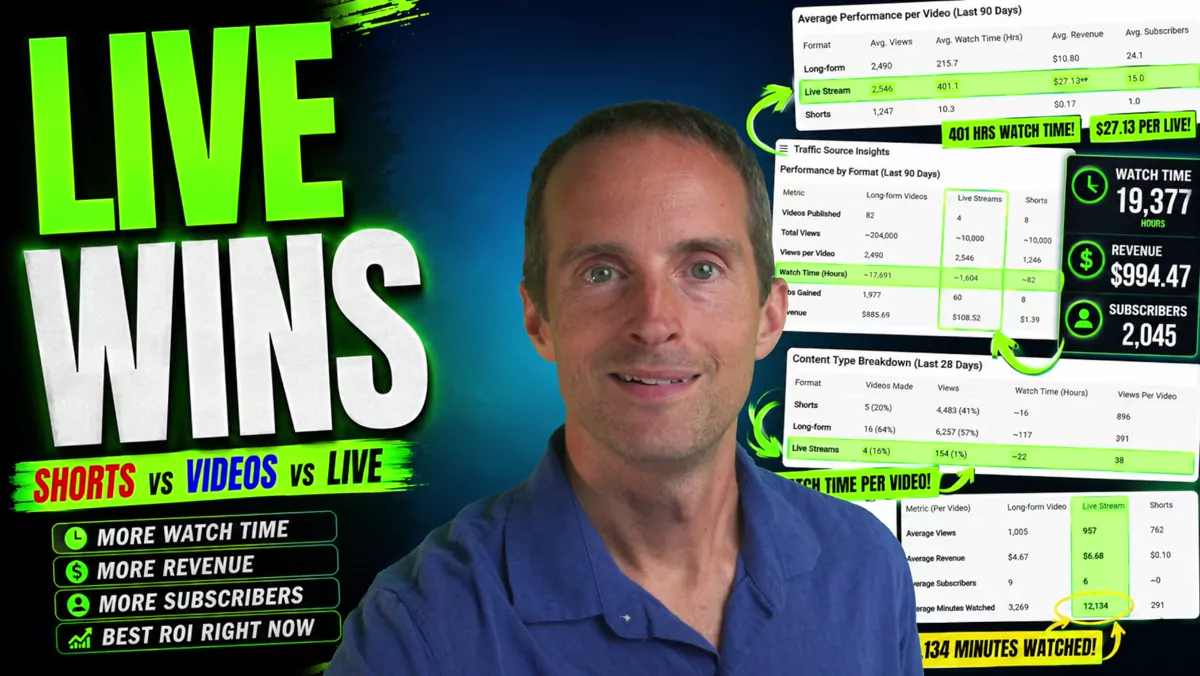
I tested every format on YouTube in the last year on six brand new channels to see which one would work the best. Shorts, long form videos, anywhere from longer like an hour to just a few minutes, or live streams. And based on my data, live streams are a big winner. That's why I'm doing this as a live stream.
Now, my results are not necessarily what everybody is going to get. But there's a very clear takeaway: if you can live stream, live streaming is the absolute best thing you can do, especially on YouTube currently with the algorithm right now. Live streaming is the best way to be a real human. If you're going to do videos and not live streams, you really do need to edit them for retention to get everything just perfect. But the beauty of live is it's the easiest way to just be an authentic human. It's the only truly interactive experience.
So let me go through the data right now from all the videos I tested to figure this out. And keep in mind, I've been on YouTube since 2011. I've gotten over a billion views online as a creator, and I got so burned out that I deleted and burned all of it to the ground in 2025. I started six brand new channels this year, only on YouTube. I didn't start any other platforms. Technically, I did take an X account somebody held for me.
Why I tested shorts but didn't trust them
I had this conversation with Gemini, which is YouTube's AI. I use all of them — Claude, ChatGPT — and here's the bottom line. I tested doing shorts because I saw some people, like Lord Heck and a few others, getting huge amounts of views with YouTube shorts and tons of subscribers. But my question is this: I want to be a full time YouTuber. I want to make like 10 grand a month consistently. I don't want to put myself in a position where my content is all about somebody else, because yeah, in the short term you can clip viral videos and make some money off it, but you're putting your channel at a lot of different risks. Including that nobody cares about you in particular. But there are other ones too, like copyright strikes, takedowns, lawsuits, copy content, policy violations, and just wasting your time clipping all these other things and not really communicating anything.
So I tested some shorts. And I tested mostly long form videos. And I have six different channels in different niches, so you can see how it looks across all of them.
Channel one: Jerry Banfield ICP
This first one is Jerry Banfield ICP. This is a channel I've had for a while. And keep in mind, I've grown all these channels organically. I tested some paid ads. Those sucked. So I put all those videos unlisted and didn't use them again. In my experience, paid ads were worse than useless. I did some videos about that — paid ads were worse than useless. So everything I'm showing here is organic views. This Jerry Banfield ICP channel also had no paid ads on it because it's a crypto channel.
This one: 82 long forms, four live streams, eight shorts. Total views, 204,000. From long form, 10,000 from lives, 10,000 from shorts. Views per video for shorts and lives were about the same, and lives and longs were about the same. But look at the watch time. Look at the watch time per video. Yes, I got a lot of subs from long form videos, and I got some good revenue from long form videos. But I did 20 times fewer live streams. I did 20 times fewer live streams. If I'd done 20 times more live streams, in my estimation I'd have gotten twice as many watch hours, probably even three or four times. I'd have probably gotten more views per video, and more total views, and probably at least double the revenue, and probably more subs.
Now, the shorts ended up being nearly worthless. Look at the insights. While the shorts got about the same views, you had to publish twice as many shorts to get the same views. The revenue and the watch time for shorts were negligible. Live streams are high value. The live streams are the most efficient format for views per video. They drive significant watch time and revenue relative to the amount of them. Long form is the engine — my standard videos grew the channel. But if I'd just done all live streams, I'd have probably grown even better.
So if your goal is immediate revenue and deep authority, shorts are underperforming. I then put it into averages. Look at these averages: more average views for a live stream, almost double the average watch time, almost triple the average revenue. The only reason I actually got more subscribers from long form is because I started a new channel from scratch and didn't hardly live stream on it. If I had live streamed on it, the average subscribers probably would have been higher, but I already had the subscribers when I started live streaming. So live streams are a revenue and retention powerhouse — the revenue was 150 times more than a short.
Channel two: from crypto to money
Now let's look at a different channel. This was originally crypto content, but I pivoted into money. This channel got a thousand views on average — these are averages this time to make it easier. A thousand average views for a long form, less on a live stream, less on shorts. But look at the average revenue: like almost 50 times more average revenue from a live stream. Keep in mind, this is a smaller channel that just barely got monetized recently, within two months of me starting it. Average subscribers were a little less, but again, I put a lot of videos up.
Look at the average minutes watched though — four times the average minutes watched per live stream. That is huge. Live streaming, and ultimately YouTube, is an attention game. If you really want people to do things like convert on your offers, this matters.
If you want to sell stuff — one on one calls, for example, I just had a one on one call — live streams are so much better because they have more watch time. And if you want to sell something, you're going to need more time with people. The more time you have with people, the more you're going to be able to build trust and turn somebody from a casual viewer into a super fan. Ultimately, if I want you to come schedule a private call with me, you're going to probably need to be a super fan. If this is your first video watching, it's unlikely you're going to book immediately.
Now, I'm an outlier. I like never join anybody else's stuff, because they're offering too little value for too much money and they don't live stream. I don't trust somebody editing some video and trying to make themselves look smart. I trust somebody who can go live and talk off the top of their head to actually know about something. And then maybe I'll think about your offer if it's a great value for the price. And if you want to be able to deliver value, you're going to need to be able to sustain yourself financially. So to me, the number one way to do that is to get those minutes watched up.
Why live streams get more minutes watched
The reason the minutes watched are higher comes down to two big reasons with live streams. First, when that notification pops up — Jerry Banfield is live — people often drop what they're doing and come watch, whereas it's easy to scroll past another video. And second, the live streams tend to be longer and they're interactive with the viewers, which makes them more interesting than some edited video.
Also, for me, I hate editing videos. If you hate editing videos, you've got to live stream, because long form videos that are unedited just consistently don't do very good. The live stream is nice because if you're not going to edit your videos like me, the live stream sets the expectation up front that it's going to be unedited, which is really helpful. (I've written more about this in why you don't need to edit your YouTube videos to go viral.) What I can see with the different formats is that you want to give people clear expectations up front. When you see that Jerry Banfield YouTube coach was live for 30 minutes, you know it's a live stream. You know it's not going to be some edited, polished video. You know it's going to be real and raw off the top of my head.
That is the hardest thing right now for AI to do. AI can crank out videos. AI can crank out shorts. AI cannot functionally jump in and do a live stream like this — interact with the audience and do all of it in real time. Maybe in a few years it will be able to. But right now, that is something that gives the highest level of human experience. And for people wanting a human experience, live streams are extremely attractive.
Make your live streams watchable after you're live
Now, I tested in the past doing all kinds of live streams, AFK live streams — never do that. And the key with live streams is to make them watchable after you're live. The biggest mistake I see people make with live streams, and that I've made myself, is doing YouTube live streams like you do Twitch live streams. Nobody's going to watch a Twitch live stream after you're live, unless you go viral or something — for changing your race like I did. Unless you go viral changing your race like I did, then people watch your video on demand. But other than that, nobody's going to watch your Twitch video on demand.
On YouTube, you want to do live streams that essentially are a video. I've made the mistake on YouTube of doing this three, four, five, six hour live stream. Nobody's going to watch that afterwards. That makes sense if you have a huge following and you're trying to optimize for cash flow and attention and concurrent viewers. But if you want to build your audience and optimize for overall money and growth, every live stream should be done like it's a video. So I never do an introduction to my live streams. I never have a "going live" screen. I never have anything like that.
I mean, if you have enough followers, you can get away with crap like that. But if you want to grow, and you're watching this, you probably want to optimize every second of your live stream so that as soon as you hit live, you start talking like it's a video.
More data: the dating and gaming channels
Now we'll go through the rest of the data. On Jerry Banfield Money, the live stream drastically outperformed in revenue and minutes watched. And notice, this was only one single live stream on this channel against nine shorts and 25 long form videos.
Next channel: Jerry Banfield Dating. Nine shorts, a crappy amount of views, only 13 watch hours. 21 videos, 3,400 views, 124 watch hours. But look — I just did the second live stream on that channel. One live stream, 117 views, 18 hours of watch time. So do the multiplication on that. If you multiply that by 20, it might have gotten fewer views, but multiply the watch time hours by 20, and you're looking at a huge increase in watch time hours and more subscribers.
I'm just breaking down why live streams to me are the dominant form of content to make on YouTube, especially as a beginner. Even if you think "I can't talk live like you do, I can't just talk off the top of my head" — practice. I've done thousands and thousands of hours of live streaming, and the best way to get good at talking off the top of your head is live streaming and just practicing at it. Now, I have a presentation in the background here, but on some videos I just literally have a background up and talk. This one made sense to be data driven.
So if you look at the live stream numbers on the dating channel, I probably would have gotten many more subscribers, much more watch time, and I probably actually would have gotten more views also, compared to just doing videos. With just one live stream, I generated more watch time than all nine of my shorts combined.
People ask where I do my thumbnails — I just crank them out on ChatGPT. I have the $100 a month ChatGPT and crank them out on there.
Now here's the Jerry Banfield Games channel. On this channel I did a number of live streams that were not as engaging, like where I was just playing a video game in the background. Notice on this one, on my Jerry Banfield Games channel, I actually got one video to get like 4,000 views, even though I had like barely 100 subscribers. One video got like 4,000 views. That was an outlier though. The one video did take off, but here's the thing: if I had done a live stream of that same game, Hearts of Iron 4, I almost guarantee you I'd get more watch time and probably about the same amount of views, if not more, but probably double the watch time.
While on this gaming channel shorts did get a decent amount of attention, look at the subscribers. The one live stream I did got seven subscribers. The nine shorts got six subscribers. And yes, this one looks like it didn't include some of the newest subscribers, because I actually got more than that. But the shorts were the least effective tool for gaining subscribers. And to me, subscribers are what you really need if you want to monetize on YouTube. The long form videos accounted for 81% of my total watch time. That's because I had some that went off. If I'd have done all of the long form in the same format as a live stream, it would have been much higher.
So those are the data from several different channels. Across all different kinds of content, it's very clear: live streams overall are the best thing for me to do.
The sweet spot is a 20 to 40 minute live stream
I'll show you some actual videos from my gaming channel. On this gaming channel, here's one — I got 5,000 views on a five minute video on my channel. But if I had live streamed this, I probably would have gotten about the same amount of views. Except instead of a three minute video, the average watch time probably would have been a 20 or 30 minute average watch time if I did an hour or two hour live stream.
But now what I'm doing with my live streams is keeping them generally to a maximum of 40 minutes, a minimum of 20 minutes. That way, I can go live and make a video on demand that's worth watching, but not go so long that it's just blowing up your time. There seems to be a sweet spot on YouTube where if you hit a certain length, then people watch the whole video. Like this one yesterday I did on the crypto channel — I actually got double the views on this live stream that I got on the recent video. The watch time on the live stream compared to the video is crazy. The live stream was so much higher.
What I want to do also is have the most consistent format: live streaming. If I just do all live streams — there are a lot of people who watch shorts, they don't watch long form videos or live streams, and vice versa. There are lots of people who watch long form content, mostly edited videos; they don't watch live streams, they don't watch shorts. YouTube knows which people like to watch live streams, and I need to find my people. If you are trying to figure out which format and which niche will actually surface your people, I would love to dig into that with you, so schedule a one-on-one call with me and we will build your plan around it together.
Find your people
What's important is to find your people on YouTube, and live streaming is the easiest way to get ahold of your people for most of us, because it's the most real, the most raw, the most human, the most authentic. With everything happening with AI on YouTube right now, and all this AI slop that's getting ground out, and everybody doing all this insane editing, the way to stand out to me is to be live. If you want to dig deeper into this mindset, I've shared a lot of it in why I love being a "failure" on YouTube, and you can also watch more of my newest videos in my YouTube Coaching playlist: https://www.youtube.com/playlist?list=PLGI0fuGonTRbfcxe3FLYWqbgcPXOBmKC0.
There's a point people raise that shorts are great for instant subs but can fry channels — that managing a few big ones leads to an average view duration of 10 seconds, and that everything besides shorts dies since everyone is used to shorts, not long form. Well, here's the thing. YouTube knows which people like to watch live streams. So when you just live stream, YouTube is trying to find the people it already knows are likely to watch live streams. It's trying to show your content to them.
Dating is a perfect example. If I'm putting out videos that are unedited, I might as well be live streaming, because my unedited videos are competing with everybody else's edited videos. Whereas when I go live, like I just did on my Jerry Banfield dating channel, I'm not competing with people's unedited videos. Well, in some ways I might be, but in other ways I'm the only live channel on YouTube talking about dating, or one of the very few.
While the initial dating video, while it was live, got four views — it actually got like nine, but the studio said four — here's the thing. This live stream could end up getting 100 views, or 80 views. But the goal is how much watch time. The more watch time someone spends on my video, the more likely they are to watch the next one. So imagine if, instead of doing all these videos on this dating channel where the most got 600 views, I had done all live streams instead, and YouTube's whole algorithm was pointed at live viewers and live streams, and everybody who watched on average watched much longer.
This is June 23rd when I'm recording this. You'll be able to see how I progress over time as I do every single video live from now on. And I'm really excited, because in the past I've had the sense that I should just live stream and I shouldn't even do videos, because I don't edit, and you really have to edit. I'm really excited to see where this goes in the future.
Live streaming across multiple niches
What's really cool is that, being full time now — well, I've been a content creator, I haven't done anything else for work besides this, I haven't done a job or anything since 2012 — I have all these different niches I can live stream to. And then sometimes people will go subscribe to another one. That's a unique feature of live streams. With videos, if I'm doing a five minute video about dating, it can be hard to get enough of you interested that, if you also play video games, you'll watch that dating video and then go over and watch my gaming videos, or listen to my music, or find my other YouTube channels.
But live streams are so deep. For example, my ICP crypto channel currently has the most views. And keep in mind, all of these channels were created within the last three months — this is starting from scratch. What you also don't realize is that for this many views, I probably got 10,000 or 20,000 impressions on this live stream and then a couple thousand views. So people know that I live stream. And what happens is people from this live stream — a few of them went over and subscribed to my dating channel, because I mentioned I'd be doing a dating live stream. A few people went over and subscribed to my gaming channel. So when I go live on two or three different channels, I get two or three different notifications. And if somebody's in the mood for one of those one day, they come by and hang out. A number of the people from this ICP crypto channel went over and subscribed to the Crypto Reviews channel. So that's the beauty: when you do live streams, it's really easy to cross promote all the different stuff you do.
Live streaming and conversions
As I said earlier, when you've got enough attention for long enough, then everything gets much easier. Since I've started switching to live streaming, I don't have enough data yet, but it seems like the conversion on people actually going and joining went up. Which makes sense, because in a 30 minute live stream I can mention my community two or three times — statistically, lots of people are only going to hear the first one. And it also seems reasonable that when I'm talking for 30 minutes, I can mention it a few times for less amounts of time, when it's relevant. Whereas if I'm doing a five minute video, I often get stuck doing a one minute outro, which leaves the video on a not-as-good note.
So live streams, to me — I hardly see anybody on YouTube talking about how amazing live streams are. And from my experience, I'm all in on live streams. I'm not doing any more videos or shorts. The only time that's worth doing is if you can totally outsource it. I've thought about trying to do it with AI, but that's distracting too — you need a human to supervise it, and you can only do so much work. I've tried clipping my live streams, but then you have to upload another video. So at some point, if I was making 20 or 30 thousand a month, I might just record all my lives, send them to somebody, and have somebody put them together and upload them all completely without my input. But even there, you're taking additional risks — that somebody screws up, or a community guidelines violation, or who knows.
There's a crazy live stream workflow some people use: you go live, export the live in YouTube studio, so that one live can become one to five long forms. I've actually got an easier workflow than that. In the past, I've broken some of my clips — I'll just hit record on OBS, talk, and then I'll have a clip already done, so I don't have to do anything else with it. But that makes for not as good of a live stream experience. That makes more sense if I'm doing an hour or two hour long live stream. If I'm just trying to make a video on demand, and I'm doing a live stream for two hours and then take five clips out of it and upload those clips, it'd be better to just do more live streams for less amounts of time than to try and clip all those. If I'm going to put energy into titles and thumbnails, I should just do the live stream once.
Going viral versus steady growth
There's a common belief that live streams are more algorithm friendly, that most viral videos are five to ten minutes, and that live streams are good for connection but not views. Well, yes — if you want to go viral, the little five to 15 minute videos are certainly effective. But even Mr. Beast is now uploading 30 minute long videos. So to me, a 20 to 40 minute video with an average set at like 30 minutes is absolutely ideal.
And I've had live streams go viral. As I said, with the race change example — I changed my race and that went viral. A live stream can go viral. Now, I'm not trying to get stuff to go viral these days, because when you're trying to build a community, you don't need to go viral. What you need is to develop people to discover you, to find you, and to develop and deepen relationships over time. So what I'm looking to do is just consistently, steadily grow over time. If you want to map out that kind of steady, no-going-viral growth for your own channel, you can book a private call with me and we'll look at your numbers and your format together.
What doesn't work well is suddenly going viral. Your whole business system breaks. Your mindset goes crazy. And then two years later, you feel like you're starting over and you have nothing. So I aim for consistent, regular growth. I know a lot of YouTube teaches you to try and go viral, but I don't like editing videos. I'm not paying a video editor. And it seems like, to me, I really love live streams more than any other form of content. Live streams are the only thing I'll drop what I'm doing and go watch somebody for. I don't care how good your video is. A live stream just instantly cuts through the rest of the feed. This whole approach lines up with how I think about creating in general — I've described it before as how YouTubers follow the Cult of Done Manifesto.
The League of Legends live stream that beat everything
There's no point in me pretending otherwise. I've tried uploading thousands and thousands of videos. And one of my very top YouTube videos ever was a live stream. It was a sloppy live stream with a long, awkward intro.
I did a League of Legends stream 10 years ago where I hired this professional League of Legends player who had retired and was coaching. I paid him 30 euros, and I titled it "Can a pro coach help me get out of bronze in League of Legends?" And this live stream literally took two or three minutes of me trying to connect to Skype, share my screen with him, and get the live stream going. It was a long, awkward intro. And then I played one game of League of Legends — me paying $30, doing a live stream — that got 800,000 views on YouTube, all organically. It made me an entire League of Legends following. And then I was getting hundreds of concurrent viewers all the time on all my League of Legends streams after that.
So that actually outperformed everything. That was the highest viewed organic video on all of my YouTube channels, and it was a live stream. It was an inspired live stream, to be sure. But the live stream pairs the best with me. I had some other videos technically with millions of views, but I advertised those to kind of rank them in the algorithm. Most of those videos, I could have done them live as well. That one League of Legends video destroyed the algorithm — it was one of the most popular League of Legends videos for quite a while. It got me tens of thousands of subscribers off of one single video.
So of all the content I've done on YouTube, a live stream was the number one organic piece of content I ever did. And that's good for me to remember going forward. In fact, if I had to do YouTube again, I probably would live stream the entire time and never do videos outside of right when I first started. If I had just only done live streams on YouTube over the years, I think it would have been a totally different thing.
Going forward: only live streams
So going forward, I'm only doing live streams, and I think I've made it really clear why. And it's so cool too — I love the interaction. I love having the audience for live streams. But you should do live streams as if there is an audience. Just pretend, if there's not an actual audience, that there's an audience, and perform. The smaller you are, just act as if there's an audience. That is practice. And what's cool is you never know which live stream could blow up. I could do a video game stream that gets 10,000 plus views, and all my other channels could get hundreds of subscribers from that video. Then I could have a dating video blow up off of that.
The thing is, if I'm doing videos and live streams both, it's kind of segmenting my content. But if I laser in and do only live streams for everything I do on YouTube, then from there we can specialize, monetize, and visualize.
One final point. What's really nice on live streams too is that if someone watches a video that was previously live, it can create a desire. It's like, "Hey, I missed the live stream, but next time this guy goes live, I want to catch him live." And that sets up a much deeper relationship where you watch live and interact for free. We build free community, and from there it's much easier to step into something paid versus if you just watch videos. There are people that showed me their paid community a hundred times, and I still am not even thinking about joining. But if I had been on their live streams, hanging out with the community, and other people in the community were telling me about it in the chat, then I probably would have joined. That's exactly the kind of free-to-paid path I'm building — first you hang out live, then you go deeper.
I'm really excited because what's cool is I have all these different niches I can live stream to, and live streaming is the easiest way to find your people, deepen relationships, and grow steadily over time. Going forward, every single video I do is going to be live.