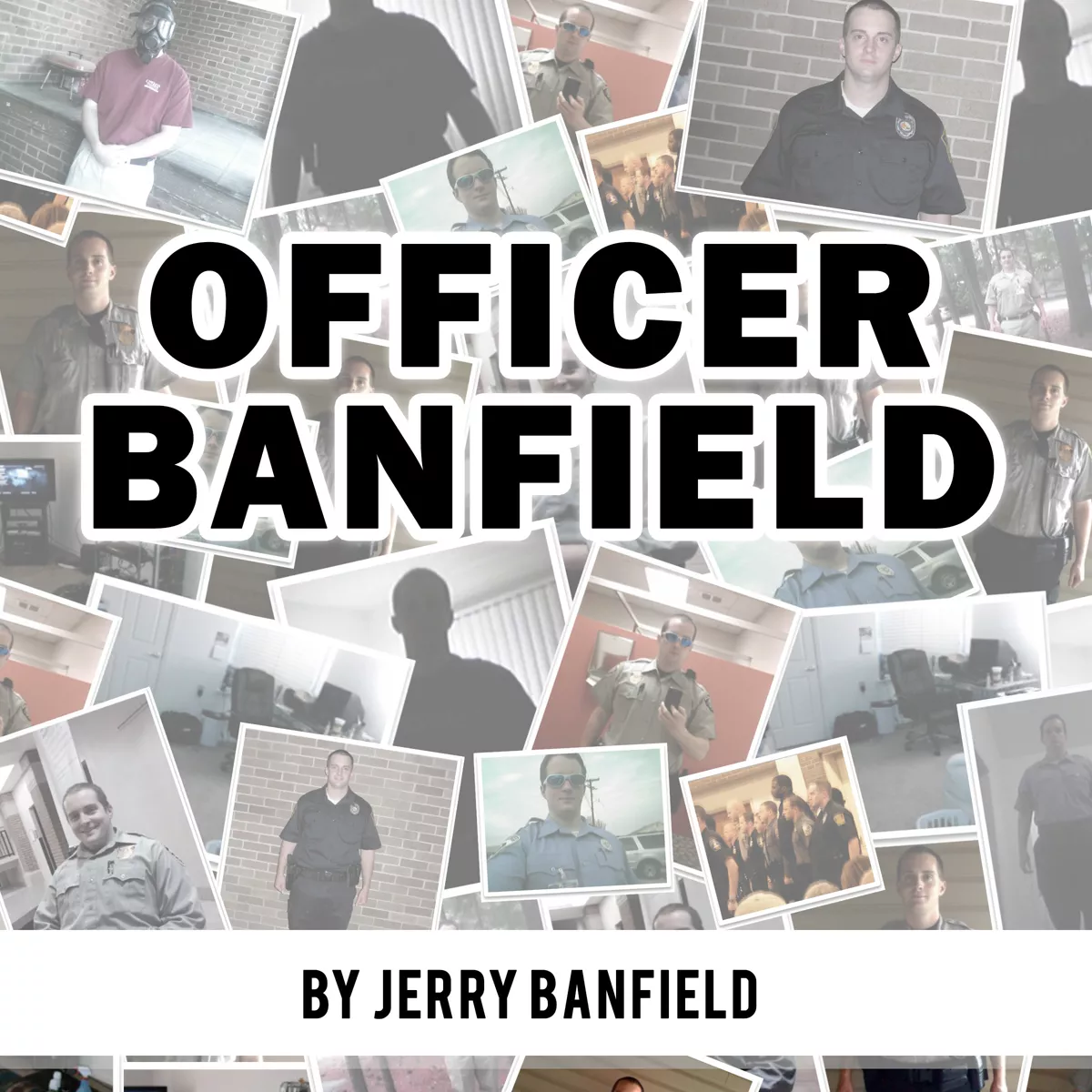
This is an excerpt from my memoir, Officer Banfield — the honest story of my years as a corrections and police officer, hitting bottom in alcoholism, and the long road to recovery.
The South Carolina Department of Juvenile Justice hired me as a corrections officer in November 2006. This chapter covers the first two months of my experience at the South Carolina Department of Juvenile Justice during training.
During my time at the South Carolina Department of Juvenile Justice, which we will just call DJJ from here on out, there were three distinct parts to my service.
First was training.
Training was filled with optimism and hope that I could make a difference in the lives of kids who had often committed some of the most heinous crimes. Others perhaps just have been in the wrong place at the wrong time, all of which who were locked up in state facilities in Columbia, South Carolina, and whom I hoped I could carry some kind of message of hope and help with rehabilitation.
The second phase of my time at DJJ was characterized by an ugly reality, going in and seeing the mess firsthand: "Oh, my God. What can I possibly do? This is a nightmare and an awful job."
Then the third phase of my own hope and recovery in my life, where I actually was able to enjoy my job on a daily basis, and maybe make a little bit of a difference and stick with it until I got hired by the South Carolina Department of Mental Health and Public Safety as a police officer.
Those three distinct things stand out in my mind, especially in the
context of what I've been saying lately on my Facebook live streams, that you love what you do, and do what you love, as I'm grateful to do today. I do what I love today and I love what I do. If you want to build work and a life like that — one you do not need to escape from — you can schedule a private call with me and we will figure it out together.
I think it is possible to love almost anything and the miracle I can see looking back at my DJJ experience is that for months I hated the same job, but which I later, at least for a couple of months while plotting my escape, did actually enjoy and do pretty well in.
The time in training and the time at the end of the job have a lot in common.
I am also thanking my editor right now. He has motivated me to keep going with this and I'm grateful.
It is five in the morning, right now on Wednesday, November 7, 2018, as I'm narrating this, looking back 12 years ago on my time at DJJ. I've recently been live streaming a lot on Facebook and thinking, "I need all my energy and time for that. Why bother with this book? Who cares about my experience from 12 years ago at DJJ?"
These stories aren't relevant to whatever is going on in my life today and I'm grateful my editor helped me see, "Look, you've already started the book. I'm enjoying the book. Please finish it."
So, here we go.
The Department of Juvenile Justice hired me in November 2006.
After months of refusing to work a job that I did not enjoy from door to door marketing to call center work, I was grateful I made it to being hired by the Department of Juvenile Justice in November 2006 where I started a month or so of training to ideally prepare me for a successful career as a
corrections officer at the Department of Juvenile Justice.
They did tell us right away that the attrition rate was very high, that more than half of the officers would not make it through their first year, and I later came to learn most of the white boys like me would not make it through their first night in the facility.
But in training, we didn't get into that level of detail. I would figure that out soon. I did notice that I was the minority at the Department of Juvenile Justice, that almost all of the other officers were of the black or whatever politically correct term we are calling it today "African American," which doesn't make sense because they haven't been to Africa for a long time or some of them at all, or whatever.
It's also ridiculous.
Dark skinned was the majority where I was, at the Department of Juvenile Justice. I was one of the only white people out of a class of about 30, which was a distinct change from most of my life where I had been surrounded by mostly white people, and many of the darker skin people were also used to being surrounded by white people.
Here I was among many black people who are used to being with other black people, which I felt very comfortable with. I didn't feel out of place and I didn't feel discriminated against either. I felt like I fitted right in, which was nice.
I got along very well with everyone in the class. I enjoyed the training materials. I had this huge hope for what the future could be, that we could go in and carry a message of hope to these children who were locked up, and I thought because they were children, because they were 18 years old or less, that they wouldn't be as bad as the hardened criminals that you
would find in the Department of Corrections.
What I did not realize is that while the Department of Corrections allowed their officers to just beat the shit out of anyone if they got out of line, the Department of Juvenile Justice officers were not hardly allowed to lay a hand on the children, and they basically just roamed free.
One of the things that stuck out in training was they said that the kids have no doors on their cells and this made me wonder, "Wait! Hold on a second. I'm in a dorm room with me and one other officer who might be a grandmother?"
Yes, there were ladies there that were 40 and 50 years old, that were just starting to become correction officers.
"You are telling me you are putting me in with the murderers, the rapists, the hardened gangsters and it is grandma and me in this dorm room? We are locked in this dorm room and it is the two of us and these kids don't even have doors? They can literally run from room to room? They can all group up in the bathroom together? They can just do whatever they want and I'm supposed to tell these kids what to do? I don't even have any handcuffs, no mace, no baton. I got nothing and I'm supposed to go in there with my fat ass, my bare hands and my white skin, and tell almost all these kids, black or Mexican what to do and they are going to listen to me without beating the shit out of me? Oh, my God!"
Training started to look a little bit sketchy right away. As soon as they started to explain some of these little details, which I didn't think about that much at first, but when you started to actually think about it a little bit more, and then see the reality, it was amazing that worse things didn't go on there.
We were already inundated with stories of things that had happened to
previous officers, like officers had been beaten nearly to death by the children and when you were in the unit, if you didn't get your call out for help on the radio, if someone was not watching on the camera, those kids could have their way with you as an officer for quite a long time and apparently that had happened before.
Kids had nearly beaten officers to death. Other officers had been arrested for bringing in contraband to the kids. There had even been cases where we were told of officers having sex with the children, and then going to prison for that.
Wow!
What a bunch of fun stuff to get into.
They also trained us on safety procedures like how to use your radio, how to call for help, and how to deal with and interact with the children. I don't remember a whole bunch from training. I mostly remember the other people there.
I remember there were fathers and mothers. There were lots of people about 40 years old who already had some other career and were just starting out for the first time in corrections, or there were lots of people there who had been a correction officer at the Department of Corrections and got fired and were now trying to work at the Department of Juvenile Justice.
There were a couple of our young people like me. There was a girl about my age who had graduated from college and was trying to get started as I was. There was a young man who was also in the same spot, and we ended up electing a class leader, which was a cool process.
I decided I would run for class president of our training class because
you got to then give a speech at graduation and I was really excited about that, and I worked really hard on becoming the class leader and they did elect me as the class president.
To me, the very best part of training was getting to give that speech at the graduation right before we went into the actual unit to begin our training. That was the high point probably of my time at the Department of Juvenile Justice.
I wrote a speech down of about three paragraphs filled with hope that we could carry a message into the children, filled with the idea that we could make a big difference in the world by going in there and loving those kids.
I wrote an amazing speech. I memorized every single word of it. I practiced it at least 20 if not 30 or 40 times all the way through. By the time it was the graduation day, I was able to give that speech from start to finish without reading anything.
When they called me up to make the speech, I had so much energy.
Some might call it butterflies or anxiety, but I call it excitement.
I crushed that speech.
Someone said that the applause was the loudest they have ever heard at a graduation by far. The speech came off amazing and I don't say now that everyone loved it. I have some degree of humility and realize someone in there probably thought it was a bunch of bullshit.
I am grateful for the chance to have given that speech and I hope it helped someone because I very soon forgot about everything I said in my speech once I actually went into the units.
Meanwhile, my personal life during my training at DJJ consisted of
having a girlfriend who was in college. She would come over and see me lots of nights. I also started to get sick with mononucleosis, which I hear lots of people get in high school. It decided to set in on me right at the beginning of DJJ training, which was brutal in a lot of senses because having mono saps you of all your energy.
Just going to DJJ training was absolutely exhausting and almost all I did besides this was to see my girlfriend and sleep, and maybe play a few video games.
When you have a mind that has lots of racing thoughts and sometimes gives you a hard time going to sleep, which for most of my life the only way I could sleep was to absolutely physically exhaust my body either with exercise or with staying up too late, or with something like alcohol, and then physically kind of pass out, the nice thing about mono was that you could have infinite sleep essentially.
I remember days I would sleep for 12 hours, wake up, eat, maybe watch a movie or play a couple of video games, and then go right back to sleep for eight more hours.
Mono is awesome if you just want to enjoy some time laying in bed. Or maybe I was just really depressed. I don't know what was going on. But at the time, I attributed it to having mono and my lymph nodes were really swollen up. At the end of training, the mono started to get a bit better. It started to pass and I started to return to normal, which was merciful.
I had also been trying to make some attempts to stay sober. However, by the end of training, I had kind of given up on that. I was trying to drink reasonably and the drinking would end up getting a lot worse as I went farther into DJJ. If you are wrestling with something similar and want to talk through where you honestly are, you are welcome to schedule a one-on-one call with me and talk it through on our call.
The training with our classroom time and sessions wrapped up in the
beginning of December. One of the most memorable things from training is someone had passed a note around about me being some kind of white cracker or some kind of racial thing like that. I had brought the note in to a supervisor.
I said, "What is this?"
It was like one of the people had written, "What's this cracker ass talking about?" or something like that.
I brought it and said, "What is this note written about me? This is racial discrimination. This is wrong. If I had written the equivalent thing about this for a black person, I'm sure there would be a massive uproar. So, what is this getting written about me? I want something done about this."
And the guy who was black himself laughed in my face and said there wasn't anything to do about that. He told me to go take my butt back inside and get back to training, which gave me an interesting look at the inside of the Department of Juvenile Justice and how discrimination might feel on the other end.
I felt like there had been some kind of slight or some kind of wrong done to me. When I look back on it, it was all in my own head.
"Who cares what other people are writing about you?" "What difference does that make?"
I made an issue of it and they didn't want to make an issue of it.
Now, in my opinion, the double standard seems kind of ridiculous.
Whereas, if I had written the same kind of thing on another note, I probably would have gotten fired and had some horrible ordeal go on, which seems kind of ridiculous.
So, maybe sometimes it is nice if we all just relax a little bit and I applaud the guy today for saying, "Look, this isn't a big deal. Just, you know, chill out about it."
Another memorable thing from training, one of my colleagues left her sandwich in the car with mayonnaise in it. Even in November, in South Carolina, it was hot enough for her to get sick out of that just leaving her sandwich in the car.
We also did some CPR training and I got some basic certifications which still leave me comfortable today. If anyone is choking around I can say, "I'm just going to help you. I'll help you right out with that."
Once we got finished up with training in the classroom and we made my beautiful graduation speech, the next phase of our training was to actually go to the units and get a little bit of training before we actually took a real assignment and went in a unit by ourselves.
It was kind of like field training officer time if you are a police officer, where you get assigned and ride around, and you have someone watching over you and telling you what to do the whole time.
Except, this started out with a lot of just classroom time where they showed us videos and this is where you got to see more of how the inside of things really work. The initial training in the classroom before you went into the actual facility itself was a bit nicer. They started to get real with us in this second part of training, telling us that the attrition rate was incredibly high and that many of us would not be seeing each other for the reunion even at one year.
I started to think, "You know what? I am sure I can make it through this."
I always like to be the survivor mindset, that I'm going to beat the odds
and I did not.
I did not make it, as they said at that first Christmas party I went to,
"Most of you will not be here next year."
And I thought, "Ha, I will be."
I was wrong.
I did not make it back to the Christmas party the next year.
I went through the training for a couple of weeks more, and then I was ready for my first unit assignment at the beginning of December, which will start the next chapter.
Thank you for listening or reading the Department of Juvenile Justice training chapter here, which I hope has prepared us for the main event in my time as an officer inside the prisons at DJJ.
If you connect with how I live and think, you can follow the rest of my days on YouTube in my Life playlist.