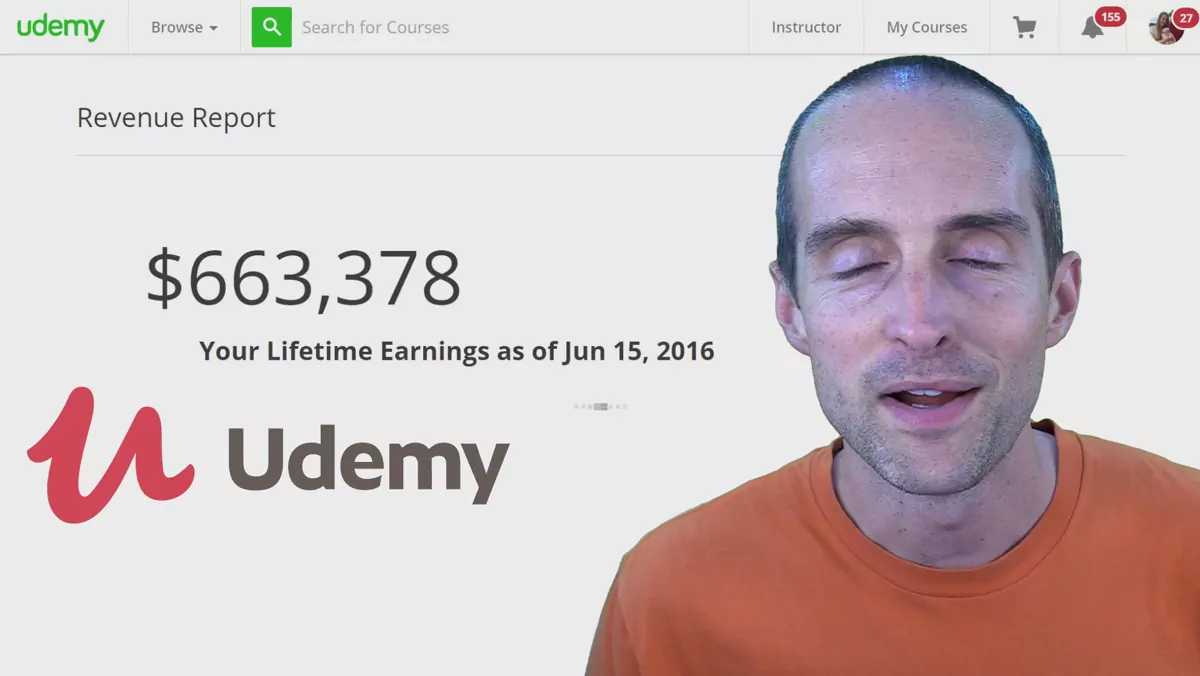
I want to tell you how I became a top 10 Udemy instructor in 2015 and 2016, and then ended up getting banned from Udemy, which went viral and stirred up a lot of conversation. One of the most noteworthy things I've done in my time as an entrepreneur online has been my success on Udemy. It was my first big success, and it was the first story people really got to know at a big level about what I did. It's a huge part of my journey to be here with you today as a full-time creator. In order to tell my Udemy story, I need to put everything else in my life in context as well.
If you haven't heard of it, Udemy is a platform for online on-demand courses, where you can go buy an online class on almost anything and watch the videos. There are hundreds of thousands of instructors on there now. I was a top 10 instructor in 2015 and 2016 by the amount of money I was making for myself. My final revenue report showed I earned $663,378, and that's just my part. I made millions of dollars in sales on Udemy.
How I found Udemy on the Warrior Forum
Here's what's amazing. I discovered Udemy on the Warrior Forum back in 2013 when I was posting these video tutorials I was making on YouTube. I posted a video giving away my very best business secret for free. At the time, I was making most of my money online as an entrepreneur selling Facebook marketing and advertising services.
In 2011, I started a business online and started a YouTube channel. I got really inspired when I met my wife, and that inspiration pushed me to start making YouTube videos and to build a business. I tried to sell t-shirts, I tried to help people with video game addiction, I tried all kinds of stuff. Facebook marketing was the first thing I really latched onto, because so many people wanted help with it. Facebook had just launched the pages feature, and all these people were trying to get likes on their Facebook page, and nobody could figure out how to do it. I figured out how to do it.
At first, I was buying likes on Fiverr, but those were just bots. It was a terrible experience, and they were always lying and cheating you. So I, as far as I know, was one of the very first people in the world to figure out that if you really wanted cheap likes on your Facebook page, you would run ads in all these developing countries. These were really low-cost ads. My record, I think, was getting a thousand likes or more for a dollar directly through Facebook ads. I could prove that I was paying Facebook and they were showing the ads and driving the likes. I had this big breakthrough where I could guarantee people I could target them by specific country. I could get cheap likes in the USA by creating ads that people would hit the like on. My biggest business secret was using those Facebook ads and targeting all these developing countries.
I put out a YouTube video telling everybody exactly that. I did a live stream showing exactly how I did it. This destroyed my existing business, because as soon as all my previous clients saw it — some of whom had paid me thousands of dollars to guarantee them things like 100,000 likes on their Facebook page, which I could often get for less than half of what they paid me — they realized they didn't need me. I had always guaranteed it would all be through Facebook ads, and I could prove in their Facebook page analytics that it wasn't dirty Fiverr bot traffic. (Although Facebook itself appeared to be doing some kind of fraud with bots on their own ads, but that's a whole other Veritasium video.) I put my biggest business secret out for free on YouTube, and it destroyed my whole business system. I thought the transparency of showing my system would make people really want to work with me. Instead, it left people feeling they didn't need me and they could do it themselves.
So how does this relate back to Udemy? What happened was, I shared this on the Warrior Forum, and it went crazy. People were just blown away that somebody actually shared this hard-won secret directly, for free. The Warrior Forum shared and promoted my post, and the video got tens of thousands of views. It was the first successful piece of content I ever created on YouTube. I did several more follow-up live streams. Eventually, someone on the Warrior Forum said, "This is really good information, you should create a Udemy course." Or they asked, "Where can I buy your course to get the more in-depth material?" And I said, "I don't have a course. What do you mean, sell a course?" They said, "Well, go make a course on Udemy, I would buy it." That's how I originally found Udemy.
One of the biggest things in life is your attraction point, or what you're looking for. As an entrepreneur since 2011, I'm always looking for opportunities. More specifically, I'm looking for opportunities to be useful to other people. You have to be specific, because if you're just looking for opportunities to make money, some of those opportunities mean you rip people off and trick them out of their money. Other opportunities mean you provide something really useful and valuable, and then people reward you financially by buying your course or watching your video. Surrounding yourself with other people hunting for those same useful opportunities changes everything, so if you want a second set of eyes on the opportunities in front of you, you can schedule a one-on-one call with me.
Giving the course away for free until it became the best
I found Udemy at the beginning of 2014, right when my dad died and I was in the middle of my alcoholism. I took 12 hours to make a Facebook marketing and advertising course. I filmed all the videos with a cheap microphone and a cheap webcam and uploaded them. Initially I tried to put a YouTube tutorial into Udemy, and they rejected that. So I took 12 hours in a single day to film an entire course for Udemy, and they approved that one. I was all excited, and I absolutely could not sell it. I was so extremely disappointed and disgusted. I ran Facebook ads, I showed my results, I mentioned it in YouTube videos. I made three sales in my first several months trying to sell my course.
At the same time, I got sober, which was a huge turning point where I decided to change my life for the better and do whatever it took to have a better life. My will to live came up. Right about that time, maybe April 2014, I got so disgusted with my inability to sell my Udemy course that I literally started giving it away for free. I created all kinds of free coupons, and almost nobody was even taking them. So I ran Facebook ads to my course with a free coupon link, and that worked. My course got thousands and thousands of students, but I made no money off of it at all. I started getting some reviews on the course, and some of them were critical. That gave me a clear view of exactly what people wanted me to add. I made the course better and better.
As I got sober, I wasn't poisoning myself with alcohol and losing 40 hours a week to either drinking or hangovers — or, when I wasn't drinking or hungover, cramming a week's worth of work into one or two sober days. All of a sudden, I had all this time and energy. I made the course way better, I was giving it away for free, and it kept getting all these reviews. Then, in June 2014, Udemy picked up the course because it had become the best Facebook marketing and advertising course on the platform. They put it in one of their promotions, which made me $1,000 in a single month in July 2014.
I was looking for opportunities, and my existing business had collapsed due to my alcoholism. I realized Udemy was where the future was going. If I would just commit to Udemy, I could make a full-time income there and wouldn't have to do anything else. I had never made $1,000 a month before. I'd put a ton of work in to get to that point, but once the course was up there and just cranking out that $1,000 a month with almost no additional work, I thought, "Oh my God, I was barely trying and I made $1,000 in a single month. I bet if I really tried, I could make over $10,000 a month."
From then forward in 2014, I dropped everything else I possibly could. I dropped clients and started cranking, putting more and more effort into the Facebook Udemy course. I created a couple of other courses. I had a month where sales went downhill and they stopped promoting my course. I'd made about $1,000 in July, about $1,200 in August, about $1,500 in September, then only about $600 in October, and then around $1,600 again. That motivated me to work even harder to get the course to the top of the game for the big Black Friday, November sales. I made thousands of dollars in November, and I thought, "I've made it. I've barely tried, I barely know what I'm doing, and if I can make thousands of dollars in a single month, all I have to do is go all in on this and I'll crush it." When I saw the final November sales, it was around $5,000 to $6,000. At the time, that was a fortune to me. (To make that now, I have some months where I make way more than that without doing anything, because the price of ICP goes up — I've had months where I made almost $100,000 — but at the time, $5,000 or $6,000 was a fortune in one month.)
Going all in: two videos a day
In December 2014, I decided I was going to go all in on Udemy and pour my heart and soul into it. I set a simple goal: just do two videos a day. That's all you do, two videos a day, every single day. That's over 700 videos in a year. I actually ended up averaging like four videos a day, and I ripped courses out. This is the same publish-relentlessly habit I still believe in — if you want to see how I'd apply it now, I'd tell any new creator to publish one video a day to win long-term.
By a year later, my income in December dipped down a bit after the big sales. But I'm always looking for opportunities. I looked at Udemy and realized that after getting to the very top with Facebook marketing and advertising, Udemy wasn't that competitive, and there was a lot of money to be made. I could easily take the top of several other topics. I also found a course from a guy named Alan Hill, who made a course called "How I Make $1,000 a Day on Udemy," and he gave it away for free. I watched all of it, even while I was driving — I wasn't looking at it most of the time, but I was listening in the background. I ripped through his course as fast as I could.
Alan was maybe in his 40s or 50s at the time. He was bald, he wasn't that good-looking, and he didn't have that engaging of a personality. I looked at him and said, "If this guy can make $1,000 a day on Udemy, I am absolutely certain I can do at least $2,000 a day, if not more. I guarantee I can do double what this old buffoon does." From there, I had both the inward drive and the outward proof, and I went hard on Udemy.
Conquering Udemy with freelancers and a hacking course
The biggest area I saw to conquer was to find in-demand topics and crank courses out on them, and to make my own versions of other people's courses. Other people's courses covered topics like YouTube, so I made a YouTube course. Even though my course wasn't as good as some of theirs, the idea was that if you'd taken my course on Facebook and you liked me as an instructor, you could also learn YouTube from me. So I cranked out courses on everything I knew.
Having done a lot of hiring of freelancers, I also knew I could hire people to make courses for me on in-demand topics. I could pay them to give me the course and the copyright, and I could upload the courses as my own. That's where I really ripped and went nuts on Udemy. My biggest area of success was a technical topic called Wireshark, which had no good course on Udemy at the time, and Udemy's data said it was an in-demand course people wanted. I paid a freelancer in Eastern Europe maybe a thousand dollars to make a course and give me copyright. He had a nice Russian accent, which was great for networking and hacking. I threw it up on Udemy, and the sales instantly started ripping.
So I realized I could go for a bigger audience. I paid him to make a 12-hour hacking course, and I probably only paid him four or five thousand. At the time, I was borrowing that on credit cards and business loans, because I was that sure. My approach was, I'm either going to absolutely destroy my entire finances, or I'm going to rip and be the number one instructor on Udemy. I believed in myself and I borrowed every dime I could get my hands on. I paid as many freelancers as I could — tens of thousands of dollars to make online courses. This one freelancer absolutely killed it. He made a best-selling hacking course, a best-selling Linux course, and a best-selling Wireshark course. I cut him in on the revenue share, giving him about 20 percent of the revenue in exchange for answering questions, and that was huge money for him in Eastern Europe. If you're weighing a big, all-in bet on your own content like that and want a second set of eyes before you commit, you can book a private call with me and think it all the way through with me on the call.
Then I made a "How I Make $1,000 a Day on Udemy" course off the back of my success with these other courses, and I kept making courses on all kinds of subjects myself. I eventually got that hacking course up to 20-plus, then 24-plus hours. I put a ten- or eleven-hour preview video on YouTube. I ran Google ads that were unskippable in some cases and ran up huge amounts of watch minutes, which ranked the video number one. If you searched for a hacking tutorial, I ranked it number one, and the sales went absolutely nuts. I made over a quarter million dollars just on that hacking course alone, off of YouTube and Google ads.
From that success, I became "the Udemy guy." I was telling other Udemy instructors exactly what I was doing — how I was hiring people in these countries to make courses on these topics, and how I was running Google ads. I set up a remarketing affiliate system, too, where if you ever went to any of my course landing pages, I barraged you on Google and all across the Google Display Network with an affiliate code that would send you back to one of my courses. If you bought any course on Udemy within seven days, I'd get 50 percent of that, plus a cut of the revenue if it was my course.
Becoming the Udemy guy
My success on Udemy snowballed into these other course platforms, and you couldn't go on Udemy without seeing my courses. The Warrior Forum had me on for a session and put it out to all their members via email about my Facebook course. I got offers from all these other platforms to put my courses on them. I hired my friend and paid him five thousand dollars a month to put my courses on other platforms. I put them on StatCommerce, which was selling them on sites like CNN.com and Entrepreneur.com, and that was raking in all kinds of cash. I also put a bunch up on Skillshare, which was a big waste of time, but at least people still found me there, and I put them a few other places.
By June 2016, Jerry Banfield was everywhere in online education. I was a massive deal. That was kind of my downfall, because I got to be obnoxious. When I told everybody how much money I was making, it aroused huge feelings of jealousy from some of the staff at Udemy, who were looking at this in-your-face instructor making videos. In some of the months in 2016, I made close to one hundred thousand in a single month. By the time they banned me, my slow months were a thousand dollars a day, and when the sales really came in, I'd get up to two, three, four, or five thousand dollars a day.
I was in your face. I had YouTube videos everywhere. I was advertising on the official Udemy search term. To be fair, I was aiming to be the number one instructor on the platform, and I was doing anything I could within the policies. But I was in a bunch of gray areas — advertising on the Udemy search term, using the remarketing and affiliate program. They changed a bunch of policies based on stuff I was doing. And I was telling everybody how to do all of it, too. (Looking back on the whole arc of making and losing this kind of money — twice — is its own story; I became a self-made millionaire twice and lost it, and Udemy was the first time.)
The incentivized reviews war
Eventually I pissed off the Udemy team pretty significantly. The first thing that set them off was when I discovered that the very number one instructor on the platform — and quite possibly several others — was getting courses ranked so high above everyone else by doing incentivized reviews. At the time, when you took a Udemy course, it was hard to get reviews. I gave away thousands of coupons to my course and I'd be lucky to get a couple of reviews. The number one guy on Udemy had a review system where he would give you a year of free web hosting if you left a review on his course. He was in the number one topic of web hosting and website development, and he was destroying all the other instructors with this incentivized review system, which also had an affiliate marketing system built into it. He was absolutely wrecking, but that was kind of a dirty system.
I looked at that and thought, "Oh, so this is what it really takes to win the game. You need to do incentivized reviews to get to the top." So I had the friend I was paying five thousand a month hire a team of people to review my courses. I would pay them twenty dollars and give them a free coupon to the course, but I told them to do an honest review — so if they hated the course, leave it one star. This one lady I paid twenty dollars left a one-star review, and I thought, "Nice, I'm not hiring you again." But everybody else would just drop five-star reviews all over the courses. For some of them, it was super-easy money: twenty dollars to click, leave a review, and ask, "Can I get another one?"
My friend got a bit sloppy. When I did this initially myself, I was pretty careful, so it didn't look blatantly like I was incentivizing a bunch of reviews. My courses got some extra reviews, and it ranked them higher. I had a call with a Udemy staff member where I explained exactly what I was doing, and I wish I had recorded it. She was very carefree about it and said, "That's fine, that's no big deal." But I got to be so popular that I released a brand-new course and immediately shredded the competition with seven to ten five-star reviews within a day or two of release. Then Udemy took down hundreds of my reviews — everyone that had come from Fiverr, and some genuinely organic reviews from free coupons, too. They took off hundreds of my reviews. There had been an uproar among Udemy instructors about my reviews crushing the competition, so a bunch of people complained, and Udemy took my reviews down. They didn't take any other action at all — they just took the reviews down and didn't even say anything to me.
So I posted and made a big deal of calling out Udemy for allowing the top instructor on the platform to do an insane amount of incentivized reviews, which they were officially sanctioning in his course. I made a big stink of it and made them look really stupid, all while owning exactly what I was doing myself. They got really pissed off at me for that. This was around mid-2015, when I was really starting to blow up on Udemy.
They were really angry at me for calling out the top instructor and making it very clear that nobody was doing incentivized reviews on anything close to the scale he was — what I was doing was nothing compared to him, and they were extremely aware of it and allowing it. Shortly after that, he removed the free web hosting from his course. From that point, there was a group of Udemy staff who didn't like me. Anytime I did any little thing, they would harass me about it, threaten to ban me, and give me a policy violation on something — like sending out an email — that nobody else would have gotten a violation for. I only ever got one official minor policy violation, in the fall of 2015. For the whole review situation in 2015, they gave me no policy violation; they had no strike system for any of it.
How I got banned
Udemy was going through a hard time in 2016. I had laid this whole foundation: I'm going to do anything to get to number one, even if it means crushing my competition, using unfair business practices like incentivized reviews, being blatantly obnoxious, and endlessly seeking attention. Then, in 2016, I started partnering with a lot of co-instructors. My last scheme to take over Udemy was this: a lot of instructors had made garbage courses, two hours long, without very good substance. I would come in and say, "Look, add me as a co-instructor, give me half the revenue, and I'll double the length of your course. I'll film two more hours of video for it. We'll do a 50/50 split." That was completely within the policies.
This one single person had a worthless course on digital marketing, and I put two hours of concrete, nice tutorials into it. Then I would send promotional announcements to all of my students across all of my courses, every week or month or however often they let you. This one lady turned me in to Udemy and said I was violating the marketing practices — that I had her add me onto her course, and whatever else she could say to try and get me in trouble. I had no policy violations on my account at the time. Within a day or two, Udemy banned my entire account, with no policy violations at all, for something that would have been a minor offense for anyone else. Nobody else would have gotten banned. I was not violating that particular policy one bit. I was perfectly within the rules to join a course as an instructor and film two hours of video to take a two-hour course to four hours.
I realized it didn't matter. It wasn't about the policy. It wasn't about following the rules. They could do whatever they wanted. It didn't matter that I was in the right — at least in the sense that I wasn't blatantly violating any policies, even though I was in a lot of gray areas they didn't have policies about. But they banned me. I remember getting the email. They just took my entire account down: no strikes, no warning, no questions, no call within a month or several months. They didn't want to hear my side of the story. They just took my entire account down, all of a sudden, when I thought everything was fine.
The Udemy community went off. I went viral on it. There were a lot of instructors who were really pissed off, but they were scared to say anything. Some instructors left the platform or stopped creating. And there were instructors who hired me secretly and, to this day, still don't want me to disclose that they're working with me to dominate Udemy. I just got to be too big of a personality. I was too callous about everyone else's feelings and completely obsessed with my own success and my own results. And I was extremely transparent about all of it. Any one of those single areas — if I had just not been completely transparent, or if I'd been more considerate of everybody else — I probably wouldn't have gotten banned.
Why I'm grateful I got banned
I was really butthurt about getting banned from Udemy. I was so mad, absolutely disgusted. I felt it was unfair. I was talking to my wife's attorney, trying to ask her how we could sue them. She told me I shouldn't, that they were a big corporation and there was no way it would work out. I was also really mad at myself. I felt like Udemy was the opportunity of a lifetime, something that would never come again, and that I'd really messed my whole life up by getting banned. I felt both that I had contributed to it — which I absolutely did — and that I was a victim of being treated unfairly, which there's validity to as well. After being banned, I was just full of anger and I felt really lost. That's when I started really getting heavy into crypto and gaming.
At the time, I just wished I could get my Udemy account and all my money back. But now, looking back, I'm really grateful that I got banned. If I were still making $100,000 a month on Udemy, I wouldn't have grown and developed and had all these other experiences and matured as much as a person. I might never have gotten much into crypto or gaming. Some of the people I've mentored on Udemy for a long time make so much money there — some of them started out making nothing, hired me at hundreds of dollars an hour to coach them, and absolutely destroyed it. Some of them have made more money than I ever made on Udemy, because they applied what I taught and put their effort into it, and it worked for them. But some of them have been stuck doing only Udemy, because it makes too much money for them to spend much time on anything else. If you want that same kind of direct coaching on where to take your own channel, you can set up a call with me and we'll map it out together.
In retrospect, I wouldn't have gotten to have my whole experience on Facebook gaming if I'd kept pouring everything into Udemy. I've seen some of my friends get stuck there — there are things they ought to do, that they have the money to do, but they just can't let go of making so much money on Udemy every month. So this has actually been really good for the path of my life. If you want to hear how I'd approach all of it now, I've laid out what I'd do differently with Udemy, Facebook Gaming, and crypto.
At the same time, it's clear to me that I didn't value being on Udemy that much. Part of me really did want to get banned and didn't like having everything so easy. Because if you want to have a really high opinion of yourself, just have loads of money, attention, and applause thrown at you, and you'll find that life can become pretty meaningless and pointless pretty quickly. It's like, well, there go all the struggles I had, and now everybody loves me, I'm just awesome, I have everything to show for it, and the things most people are trying to do come easily to me. It was a great experience, but it was also a learning experience in the sense that I can tell I didn't really care about being on Udemy for the long term. My mindset was so short-term: I've got to get to the top because it's not sustainable. I clearly didn't believe I could just keep teaching on Udemy and keep being on Udemy.
If I'd wanted to take a more steady approach, what I would have done instead is just teach the courses I knew about, keep learning other things, occasionally put courses up, and be happy earning a lot less money while enjoying the chance to learn things and teach things.
Why I'll never sell an online course again
The best part about being banned from Udemy is that I now have a commitment to put all my content out there for free. I blew up my YouTube channel while I was on Udemy, and I'm not going to do that again. One of the reasons my original YouTube channel got so few views is that I got all these subscribers by selling them Udemy courses, but they didn't really care about my content. I made all kinds of different content and used my YouTube channel simply as a means to build my Udemy business. Since I got banned, and since I tried other ways of selling courses, what I've come to is that I want to always create content for free. Any videos I make, I want available for everybody for free. I don't want to charge people for my videos. I want to teach so that anyone — wherever you are in the world, whatever your income — can watch my videos.
The worst part about being on Udemy was that I was constantly selling, and the masses couldn't see me. People couldn't go in and buy my Udemy courses even though they were discounted to $9. Most people in developing countries cannot get $9 together and then have a credit card or debit card to sign up on Udemy and buy a course. But most people can access something for free, like YouTube. That's the best part of not being on Udemy: as long as I was on there, free content didn't mean much to me, but now I love that everything I create for videos is available totally for free. I will never sell an online class again, and I'm grateful for the journey on Udemy.
It's a great story. It's one of my most known stories, and I wanted to go really into detail on it. Thirty minutes obviously isn't the whole story, but you get the picture. If this resonated with you and you want to keep up with how I think about creating now, you can follow along in my YouTube Coaching playlist.