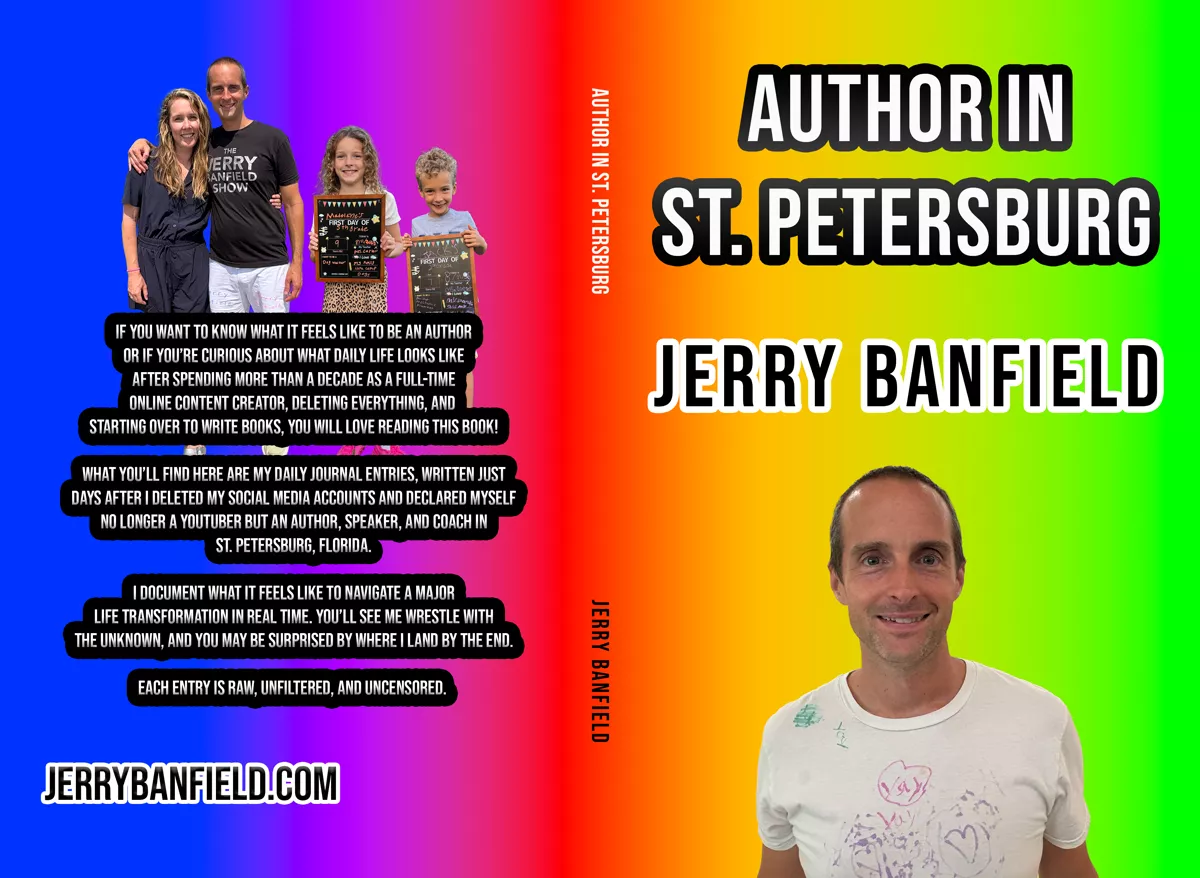
This is my journal entry from August 20, 2025, part of my daily autobiography Author in St. Petersburg — my real, unedited days, published in order.
I left the house around 7:45 this morning to take the kids to school and didn’t get back until about 3 in the afternoon. It felt like a preview of what my massage school days will be like, only then I’ll be leaving even earlier. I enjoyed being out of the house all day. After drop-off I went to a yoga class with one of the co-owners of my yoga studio, one of my favorite instructors. I’m sad I’ll be missing her morning classes for months, along with the familiar classmates I’ve grown attached to. I told those I had time to speak with that I’ll be switching to night classes instead. She reassured me, saying I would form new attachments with other instructors. Her words reminded me of a larger truth: whenever we let go of one thing—whether a job, a relationship, or even this physical body—we create space for something new.
I stayed at the studio after yoga instead of rushing home before my AA meeting. It gave me time to chat with people and to sit down with one of the Seth books by Jane Roberts, reading The “Unknown” Reality, Volume One with notes by her husband Robert Butts. I love the Seth material because it challenges conventional thought and opens up perspectives I rarely see elsewhere. The section I read today explored probabilities. Most of us tend to view life as a straight line of certainties—events happen one way, fixed forever. That way of thinking fuels endless debates about destiny, fate, and free will. Thinking in terms of probabilities, however, shows just how much choice we have, how many possible paths exist.
Massage school is a good example. In my mind, I’ve explored the probability of not going at all, of choosing a different school, and of enrolling in the the Sarasota school program. Yesterday I received a text that my application was approved. Today I scheduled my enrollment appointment for Monday, August 25, which includes a free massage. Once I complete that, I’ll have two weeks before classes begin. Seeing these possibilities makes me feel more empowered; instead of one rigid outcome, I see a spectrum of choices.
The Seth books also encourage me to see the past as a field of probabilities. Every memory could have unfolded in other ways, and every time I revisit a memory I alter its meaning. One striking example came from my gaming days. For years, I told myself I had abandoned Duke Nukem: Zero Hour on Nintendo 64 halfway through. Later, when I replayed it, I was shocked to discover I had in fact beaten it. The story I carried for years was wrong—I had played, quit, and then returned to finish, but I had erased that last part from memory. It left me wondering how many other things I am certain about in my past that may not have happened the way I remember.
I encountered something similar while writing I Was Famous on the Internet. To double-check my memories, I went back through my statement of Udemy earnings. While I recalled the general outline, the specifics of which months I made which amounts were fuzzier than I realized. It showed me how much data is lost in memory, and how much freedom we have to reinterpret the past. In AA, I’ve learned that by revisiting resentments or traumas with forgiveness and compassion, I can change how they feel. Experiences that once made me bitter—like my father’s harsh discipline—now serve as sources of gratitude. They allow me to help others through their own pain.
The Seth book described it beautifully with the analogy of a photograph. A single picture captures only one frame, but all the unseen moments before and after, the different expressions and angles that could have been, still exist as invisible realities that support the visible one. The same is true of memory: most of our past is invisible, forgotten, or imagined. That gives us the ability to reshape it now.
This perspective excites me. I’ve read or listened to all of the Seth books available on Audible, and now I’m working through the ones only in print. They’ve inspired my own vision for writing. My books, too, are essentially diaries filled with ideas, and I hope they can serve readers the way the Seth material has served me. Sometimes I even wonder about opening myself to channeling directly, especially with how naturally dictation flows for me now.
What I cherish most today is that I found thirty uninterrupted minutes to sit down with a book. That time is precious. When I worked online, I rarely wanted to spend additional hours reading; I craved stimulation or audio-only input. Now I actively carve out time for paper books. By not driving home between yoga and AA, I gained twenty extra minutes of reading and sacrificed only a snack. That trade-off was worth it.
After finishing my reading at my yoga studio, I headed to my Alcoholics Anonymous meeting. I was called on to share, and the topic was the Fourth Step—taking a fearless inventory of ourselves and the changes required to get sober. I emphasized how writing out a ten-thousand-word story of my life unearthed memories I had long buried. Sitting in meetings and hearing others talk openly about childhood sexual trauma and other painful experiences also brought some of mine to the surface. I’m grateful I chose to talk about them instead of keeping them secret or drowning them in alcohol.
It takes courage to face the most embarrassing or heartbreaking parts of your life and speak them aloud. That is one of the most therapeutic aspects of AA. I can often sense when people are carrying unspoken trauma; if they knew I could see it, perhaps they would be more willing to deal with it. Still, I remember how impossible it felt to acknowledge mine until others modeled that courage. Hearing someone share about their darkest secrets in the middle of a meeting gave me the strength to approach them afterward and say, “Me too.” If you'd rather start somewhere quieter than a room full of people, you can book a private call with me and say your "me too" on the call first.
I’m thankful today for everyone who spoke up about difficult subjects. That’s the heart of AA—reminding each other that we’re not unique in our pain. Almost everyone there has endured a childhood filled with struggles they’d rather keep hidden. Compared to many stories I’ve heard in meetings, mine was mild. My father loved me and provided for me, even if his discipline was harsh. Perspective helps me stay grateful.
After the meeting, I told the sponsee I’d been struggling with that he should find a new sponsor. With massage school starting soon, I won’t be at this particular meeting anymore, and it’s the only one he consistently attends. I gave him a few suggestions of people to ask, and he seemed genuinely happy about it. We both knew our work together had stalled. Sometimes sponsorship isn’t a straight path with one person—it takes input from several people over time before everything clicks. I also had the humility to admit I’m not special in this role. There are plenty of people in the rooms who can sponsor him just as well, maybe even better.
Before I left, another member encouraged me to exchange numbers with a newcomer. I explained that I only exchange numbers with people I’ll actually meet at meetings. I’m not interested in being a free phone therapist for someone I may never see again. Early in sobriety I gave my number to everyone, and most of the time nothing came of it. Occasionally it even led to uncomfortable situations, like when I was too eager to connect with a pretty girl at meetings. I prioritized seeing her, calling after six in the evening to ask which meeting she would be attending, which created awkward misunderstandings about my intentions. I also had people from the crack house calling me at four in the morning asking for money. I’ve learned my boundaries: I’ll share my number if I expect to see you regularly in person. My life is already full—ex-wife, kids, family, sponsor. I don’t have time to pretend I can be there for everyone.
After AA, I had lunch with a close friend who is also a massage therapist. She has been one of my best friends in St. Petersburg, but we hadn’t seen each other in months. The last time I booked with her, she canceled at the last minute because she was sick, and it strained our relationship. Massage had been our main way of connecting, and she had become unreliable, canceling at least half of our scheduled sessions. Eventually, I told her I wouldn’t book again until she was more stable. That was hard, because she is one of only two massage therapists I’ve known well enough to also spend time with outside the studio as friends.
At lunch, it felt like there was an unspoken elephant in the room—that I’ve been scheduling massages with everyone but her. Still, we had a great conversation, and she encouraged me to go to massage school. I left grateful we could reconnect despite the frustrations. My hope for lunch was to keep carrying the message of sobriety, even if I didn’t speak directly about her drinking. Instead, I shared about my own recovery, trusting she might draw something from it for herself. In Alcoholics Anonymous I’ve heard countless stories of people who stayed in touch with old friends during their drinking years, planting seeds until the day came when those friends reached out for help. I hope one day she will call me about going to a meeting. Statistically, the odds aren’t great, but I still keep space open for the possibility.
Part of me felt that if I hadn’t met her for lunch, it might have been time to let go of the friendship. But we ended up having a good talk about massage school, and that alone made the meeting worthwhile.
Later in the day, I came home preparing to play tennis with my friend. A heavy rain earlier had left the courts soaked, and since he drives thirty minutes from Tampa to a local tennis club near my house, I checked the courts myself before he left. I called to suggest we cancel. He was disappointed but thankful to save the trip.
As I walked back, I watched the men next door working on the roof of the house being built beside us. Their labor reminded me of how many unrecognized heroes surround us every day. People often label firefighters or police officers as heroes, but these carpenters are risking their lives in the blistering Florida heat, balancing on plywood and two-by-fours several stories up, often for twelve-hour days. That is heroism too.
My first AA sponsor had fallen from a site like this, crushing part of his skull. He never regained his full mental capacity and became bitter, harassing women at meetings until the group asked him to leave. Shortly after, he was struck and killed by a car while riding his bike. Many thought we were wrong to expel him, but I believed it gave him a chance to be free from the broken body that frustrated him so deeply. Despite his struggles, he was the perfect sponsor for me at the time. He called me every day and kept things simple. When I did my Fifth Step with him and confessed a night that had weighed heavily on me for years, he helped me see I could let it go. He told me every day that God loved me, and that message was exactly what I needed. His short, painful life made a difference, and I still think of him often.
These construction workers remind me of him. They give years of their lives—and sometimes the whole of them—so others can live in comfort, all while receiving only an ordinary paycheck. The people who eventually move into the house next door will probably never meet these men. Yet they are risking everything so someone else can have a home. That is a form of sacrifice that deserves recognition.
There are so many ordinary heroes we overlook. During the lockdown years when people hid in fear inside their homes, I thought of the garbage men who could not stop working, the farmworkers harvesting food, the truckers hauling it, the clerks stocking shelves. People praised nurses and doctors, and rightly so, but how long would anyone survive without those others? Trash pickup, groceries, farming—these are lifelines, and the people who do them are heroes in their own right. I make a point to wave at the garbage men with enthusiasm. Their work may often be thankless and even leave them carrying the stench of the truck home with them, but it matters.
Writing books that help people see these overlooked heroes feels like my way of contributing, too. Parents also belong among these unrecognized heroes. On some planets, being a parent is considered the highest calling, requiring a rigorous training program beyond anything like a PhD. Here on Earth, anyone can become a parent without preparation, and many of the traumas that fuel addiction come from that lack of guidance. If parents went through structured training—learning love, compassion, and resilience from mentors—countless children would be spared the wounds that send them spiraling later in life.
I am grateful my diary gives me a place to explore these ideas freely. They may never fill an entire book, but they matter to me. Perhaps my writing will help someone appreciate the heroes around them in ways they never did before. For those who connect deeply with my words, I look forward to the chance to meet in person. Starting in May 2026, I plan to offer coaching sessions that include massage, giving people the chance for a direct, memorable, and healing experience with me.
If you connect with how I live and think, you can follow the rest of my days on YouTube in my Life playlist.