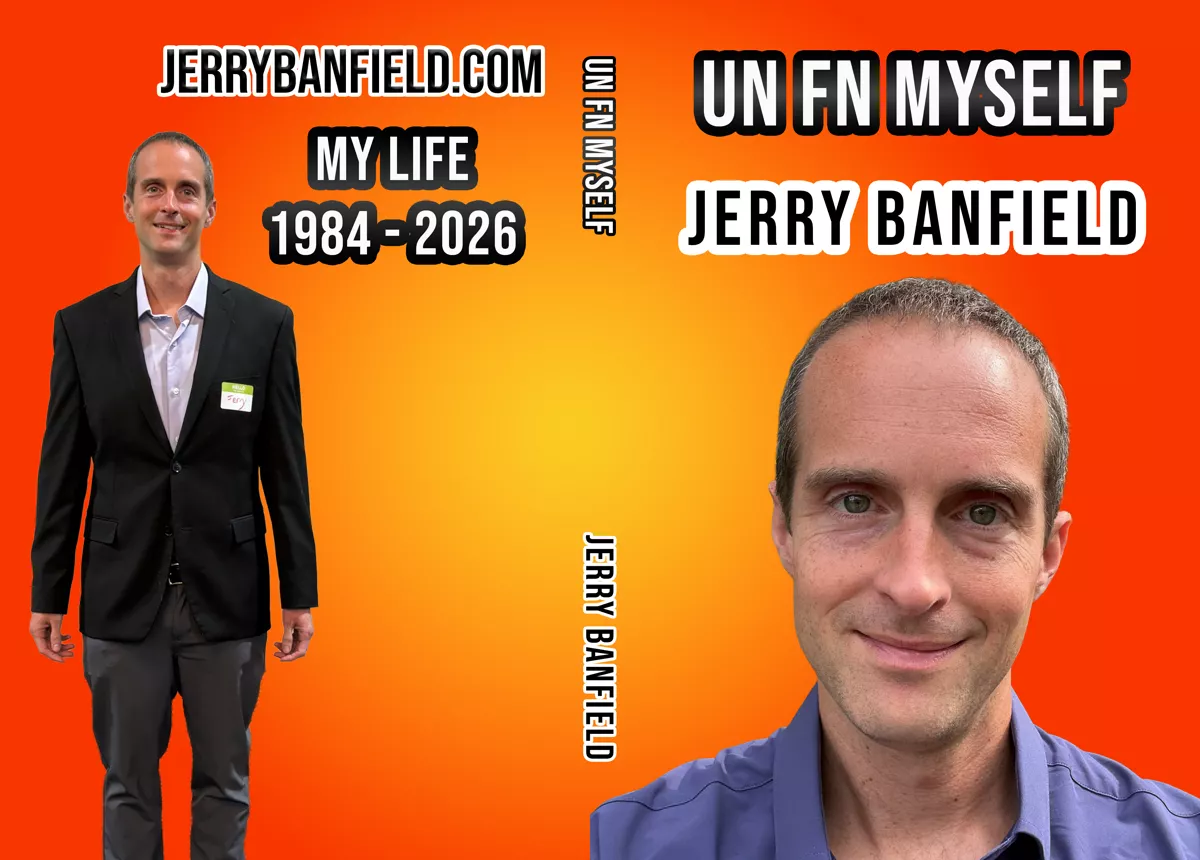
This is an excerpt from my full-life memoir, Un Fn Myself — my real story of addiction, recovery, fatherhood, and everything in between from 1984 to 2026, including the parts most people would cut out.
For example, I had an author on my stream around this time named Tony Rodrigues. He wrote the book Ceres Colony Cavalier. Tony said that he had been abducted by aliens, sold into sex slavery on Earth, and then sold into service for a breakaway Nazi German civilization that had a colony on Ceres, the planetoid floating between Mars and Jupiter. He talked about how there should be a planet between Mars and Jupiter, and how the asteroid belt looks exactly like what you’d expect if a planet had been blown apart in a war. In that view, Ceres is a remaining chunk of that destroyed planet, still floating there.
I had Tony live on my stream, and I believed him. The way he answered questions stood out immediately. He didn’t think or respond like most people. It felt like he’d been through experiences so deep and extreme that they had permanently altered the way his mind worked. His answers didn’t feel rehearsed or performative. They felt grounded in something lived. He came across as completely genuine, and listening to him made it clear to me that whatever he experienced was real to him. That conversation pulled me even deeper into the conspiracy world.
What added fuel to my fire was hearing whistleblowers claim that Facebook was allowing secret groups where deeply disturbing content circulated—things so extreme they shook my trust in the platform entirely. According to these accounts, Facebook leadership either failed to intervene or, in some cases, appeared complicit. I have no way to independently verify those claims, but hearing them fundamentally altered how I saw the platform and my role within it.
The more I saw, the more books I read, and the more time I spent live streaming on Facebook and really observing the environment I was part of, the more uneasy I became. I started asking myself what I was actually contributing to. I was pulling all these people in, getting them to spend hours of their lives on Facebook, and I didn’t like the answer I kept coming back to. It felt like I was supporting something ugly—something that felt soulless, manipulative, and wrong at a deep level. The environment I was immersed in started to mirror the stories and conspiracies I was reading, and instead of feeling separate from it, I felt embedded in it. That realization made me question everything I was doing.
Even with all that doubt, there were still nights that were genuinely fun. I remember one night in particular when I streamed Terminator 2 on NES. It was around eight at night. My ex-wife was inside putting the kids to bed while I was out back in the shed, streaming. The game was brutally hard, even with infinite lives turned on, and I was just losing my mind. I was screaming—fuck, god damn it, motherfucker—over and over as the game destroyed me. The chat was laughing their asses off, I was laughing, and it felt like this shared moment of ridiculous joy. Nights like that were great. We had plenty of them. But day to day, underneath those moments, the question kept coming back: What am I doing with my life? I felt like I was helping people throw their lives away on Facebook, just like I was throwing mine away. It didn’t feel like I was making the world a better place. If you are wrestling with that same question about whether your work actually means anything, that is exactly the kind of thing we can dig into together when you schedule a private call with me.
I kept coming back to this idea that I wanted to guide humanity toward a Star Trek future. I’d had a dream years earlier where I was acting as an ambassador for Earth, standing before some kind of galactic council on another planet, discussing the state of consciousness on Earth. The council wasn’t happy. They thought humanity wasn’t ready. I remember arguing with them, saying we needed more time, that things were moving slower than we wanted but still heading in the right direction. I’ve always carried this feeling that I’m here for a reason, that I have a purpose beyond just surviving. As successful as my gaming videos were, they started to feel disconnected from that purpose.
When I did streams focused on conspiracy theories, health, or helping people live better lives, it felt different. Those streams still pulled tens of thousands of views, sometimes more, and the engagement was deep and real. On those days, I felt like I’d actually done something useful. My intention with gaming was to carry that same message while playing, to blend the two worlds. But what kept happening instead was that the game consumed me. I’d get so locked in that there was no room left for the message. Worse, I’d often spiral into toxicity or depression on stream and end up embodying the exact opposite of what I claimed to stand for.
I’d be talking about love, light, sobriety, and joy, and then moments later I’d be shirtless on stream screaming things that did make it appear to a new viewer like I was just doing drugs and going nuts. Then I’d post afterward about how sober I was, how inspired I was by certain authors, how spiritual I felt. The contradiction was impossible to ignore. I started to feel like a massive hypocrite. Almost every day, the same thought came back to me: There has to be something better I can do for humanity than this. I became obsessed with that idea, with the vision of a better future, and with figuring out what my role in creating it was supposed to be.
One of the ideas that stuck with me from Tony Rodrigues’s book Ceres Colony Cavalier was an exercise centered on self-sacrifice. In one of the stories he shared, the lesson was simple and brutal: if you’re part of a unit, you must be willing to sacrifice yourself for the group. He described a training scenario involving a squad of soldiers faced with an overwhelming threat, where survival required one person to willingly give their life so the others could live. According to Tony, the deeper purpose wasn’t the scenario itself, but the psychological imprint it created—the understanding that self-sacrifice for the greater good was not optional. That idea landed deeply with me, and it stayed there, as you’ll see in the next chapter.
As 2021 wound down and moved into 2022, I was heavily into a game called Returnal on the PlayStation 5. It was a third-person, single-player shooter, and I loved it. I got completely obsessed with it. The problem was that my viewership was absolute garbage whenever I played it. No matter how successful I’d been with Warzone or retro games, the moment I played something I genuinely wanted to play, the audience disappeared. That made me deeply resentful. After all the time I’d put in, all the hours, all the experimentation, all the success, I still didn’t have the freedom to just play whatever game I wanted without being punished by the algorithm. It felt like complete bullshit, and the frustration built constantly.
Around the same time, near the end of 2021, I told my ex-wife something that cracked things even further. I told her that I thought we should move another woman into the house and that we should have a situation where I had two wives. In my mind, it would be my ex-wife and another woman living with us. Predictably, my ex-wife wasn’t on board with any of it. She got furious and made it absolutely clear what she thought of me for even suggesting it. From my perspective, I was just being honest about what I wanted. I didn’t want to leave my ex-wife, but I wanted more than our marriage was giving me. I thought it could work. We had space in the house. I imagined a setup where we all lived together, shared responsibilities, and raised the kids as a unit. In my head, it felt like it could be a great life for everyone involved. My ex-wife completely disagreed, and that conversation planted another seed of resentment—one that she didn’t forgive and couldn’t let go of after that.
That’s how we entered 2022. After my most successful year online in a long time, it felt like I’d completed my comeback. I started posting short videos across all the platforms—TikTok, Facebook Reels, everywhere—and they were taking off. The views were pouring in. Facebook Gaming bonuses stacked up. The money was coming in fast. The audience was there. On paper, it looked like total victory. And yet none of it felt good enough. Beneath all of it was this constant sense that I wasn’t actually doing anything useful with my life. It felt predatory. It felt like I was exploiting people. I started to feel like a vampire feeding off other people’s time, attention, and money. If you have ever felt that gnawing sense that your own success is quietly costing other people something, I am glad to sit with you and think it through when you schedule a one-on-one call with me.
There was one woman who crystallized this feeling for me. She was a mom who spent hours watching my live streams instead of playing with her kids at the park. Instead of being present with her family or showing up fully as a wife and mother, she was watching me play Call of Duty and then streaming it herself. The thing that disturbed me most was that she hadn’t even been into video games before she found my stream. She didn’t watch gaming content. But I was good at marketing, and Facebook was cranking the algorithm so hard that I pulled her into this world anyway. I hooked her. I hooked grandmothers too—women who spent hours watching my streams and sending me money. I hooked people from all over the world. And once they got hooked into my stream, they spilled over into other streams. They bought gaming PCs. They tried streaming themselves. They poured money into hardware, software, subscriptions, donations. From everything I could see, almost none of them made any profit. I made huge profits. They lost money. Facebook took money from them. Hardware companies took money from them. Game companies took money from them. Other streamers took money from them. And in return, most of them got almost nothing.
At the same time, I was still looking upward. If I was going to keep gaming on Facebook, I wanted to reach the highest level. I entered a Facebook Stars contest, and in the category for the largest partners—the ones with millions of followers—I ranked in the top twenty for engagement. That was real validation. I was officially a top twenty Facebook partner. I was close to the peak. I had the audience. I had the influence. I had the money. And yet, the question that wouldn’t go away was why. What was all of this for? I wanted to serve humanity. I wanted to do something that actually mattered. I was willing to sacrifice. I was willing to give up comfort, status, money—whatever it took—to do something that felt real and meaningful.
That’s where things stood as we crossed into 2022. Everything I’d built was still standing, still growing, still profitable. But internally, something had already shifted. The success no longer felt like an answer. It felt like a question. And from there, the journey into 2022 and beyond really began.
If you connect with how I live and think, you can follow the rest of my days on YouTube in my Life playlist.