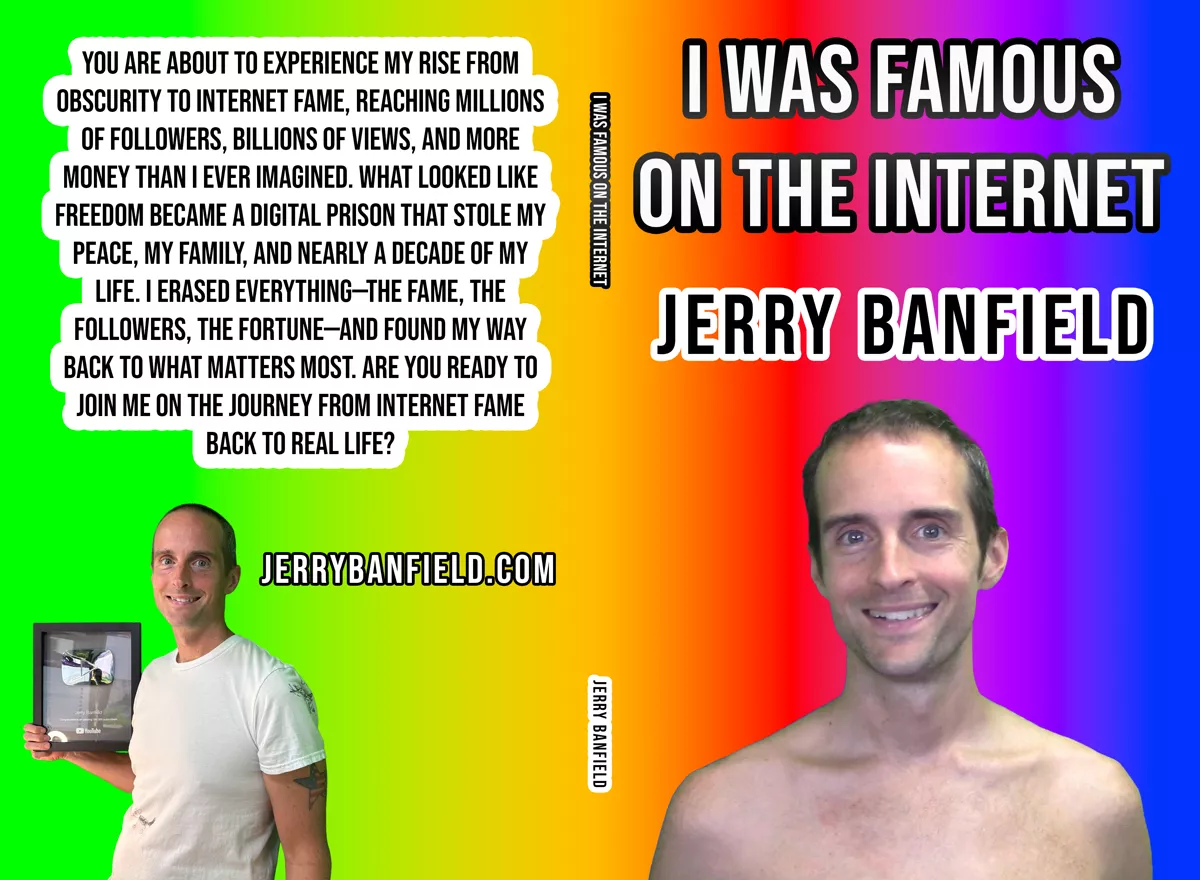
This is an excerpt from my memoir, I Was Famous on the Internet — my honest story of 14 years of internet fame and what it really cost, and why I deleted it all to choose real life.
The Unstable Internet
My race change was another lesson in just how unstable the internet is and how easy it is to ignore problems that are not happening to you. While I was popular on Facebook, I’d heard countless stories from other Facebook gaming creators about their pages getting automatically flagged for “unoriginal content” which destroyed everything. I’d had the same problem myself multiple times, but because I was a partner, Facebook always fixed the issues manually for me within 24 hours. The masses, though, were left to suffer with no support. Facebook demonetized thousands of creators automatically, without any viral story or any clear communication about why it had happened. When I was a partner, I had little compassion or concern for their problems.
Then, when I was demonetized, I got hit with the same automated “unoriginal content” flag on my page when I posted a short that had been clipped from one of my live streams. Over the next year and a half, they never removed it despite my many attempts to get the same help I got as a partner. When I approached Facebook support as just a regular creator with no monetization, I found nothing but bots and automated responses. Not one person was willing to help. I realized how unsympathetic I had been when I had my elite partner status and how I had overlooked the awful environment I was encouraging people to spend time in.
The worst irony came when I wanted to bring people from Facebook to platforms where I was still monetized like Twitch and YouTube. 98% of people who followed me on Facebook refused to switch to Twitch or YouTube because they were so addicted to Facebook they did not have any interest in using other apps. I was so annoyed, thinking I had done all this work to build a Facebook page, and yet 98% of it was not transferable to another platform. People kept saying they loved watching me on Facebook, but they weren’t willing to install a free app called Twitch on their phone, where they could have had a dedicated streaming experience that still monetized my work.
The level of addiction and unwillingness to change in the viewers was horrifying. I thought they were there for me but clearly, the vast majority cared more about the app than me and would simply watch someone else rather than install a new app on their phone to keep watching me. This insanity in the viewers today makes me angrier than being canceled on Udemy or Facebook.
Crypto Still Sucks
After being demonetized on Facebook, I went back into full on experimentation mode like I had after Udemy. I tried just about everything including creating a new YouTube gaming channel, streaming on my original YouTube channel, going all in on Twitch, multistreaming, and repeatedly switching strategies. In October 2022, I went all in on live streaming Gods Unchained, a “crypto” play to earn game. I bought tens of thousands of dollars’ worth of the GODS coin connected to that game, only to quit playing a couple months later. I even tried doing $100 giveaways during every Twitch stream. Those worked great until the giveaway ended, at which point everybody left.
Six months after losing my Facebook monetization, I was desperate to make money and to have a comeback. That’s when some of my old crypto YouTuber buddies reached out. Years earlier, I had shown them how to be successful crypto YouTubers. Some of them had even paid me to coach them while they built their channels. Now their channels were massive, and they promised to promote me and help me restart if I got back into crypto YouTube.
In December 2022, I launched a brand-new crypto YouTube channel because that seemed like the best opportunity I could find to make money online. I told myself I wouldn’t repeat the old mistakes I’d made with my first channel. I wouldn’t just say anything to get paid or watched. I would lead by example. My plan was simple: build a brand-new crypto portfolio from zero via buying $50 a day in crypto. I figured nothing could be more honest than that especially if I just bought whatever coin I felt like each day and shared a video explaining why.
I started off buying a mix of the top cryptos along with some niche altcoins. That’s when I discovered how bots and a generally silent hidden hand mafia controlled crypto YouTube. I noticed when I bought $50 a day of certain cryptos and hyped them in a video, I would get that money back and much more through ad revenue, new subscribers, and course sales. As I repeated this process over a few months, viewers became desperate to know which of the coins I actually thought were good. For those desperate viewers, I would sell them a $300 course, where I picked out a handful of cryptos as my “best picks.” Those picks weren’t much different from the others, but I presented them as the standouts, based on some arbitrary characteristics. Most people were satisfied with that, and it worked for me to make tens of thousands of dollars in March 2023 off of my then four-month-old crypto channel. Cutting through that noise and learning to research crypto for yourself, instead of paying someone for their “best picks,” is exactly what we can work on together when you book a private call with me.
A small part of me still wishes I could have been happy doing that, because if I’d kept going, I would have made millions of dollars since then. My new crypto channel was growing rapidly, and the people running bots absolutely loved me. All I had to do was put my face on a thumbnail, smiling and pointing to a crypto symbol with a massive price increase, and the views poured in. The audience believed me because I actually believed what I was saying too.
The easiest way to get views and money online is to be very conscious that you are draining and exploiting people with the belief that they deserve it. If you can do that, then you can really play the game at the highest level. My limitation was that I could not consciously accept that I was draining and exploiting people with my content. I had to feel like I was doing something good, that my intentions were pure, or that my videos were helping people. Unfortunately, that was a major limitation that always led to my downfall.
I saw it clearly with other instructors on Udemy and with the top gamers on Facebook. The ones at the top consistently were the ones who could consciously admit privately that they were draining their audiences and cheating. They would rationalize this because it was just the nature of the game be it online course sales, crypto, or video games. If you weren’t willing to go that far, then you weren’t willing to be at the top. If you didn’t realize being an influencer was a game where you were just a hoe and the content platforms and the elites were the pimps while all of your viewers were tricks, then you were blind to how it all worked and deserved your place with the unwashed masses.
I couldn’t consciously stomach that. I played a game of hide and seek with myself, pretending like I was helping people. Then one day, I looked in the mirror and realized I was doing the same crap with my crypto channel I had years before. This inward feeling was sharp contrast to what looked like more rapid success in growing a brand new crypto channel to tens of thousands of subscribers and dollars per month in less than 6 months. I was proud that a year after being canceled on Facebook, I had reinvented myself. My fame on crypto YouTube was bringing me back toward where I had been with Facebook Gaming, only this time with even more money.
The problem was that I couldn’t stomach what I was doing. I saw clearly after a few months that I was lying to people and buying cryptos based purely on what got me results rather than what was actually a good investment. Even if I rationalized it as just playing the game, I was still a liar giving out junk crypto information. Once I had this realization, I started telling the truth. My honesty was the same problem I ran into on Facebook and Udemy. Once you start telling the truth, you piss off the people who are thriving on lies, cheating, and deception which appears to be the majority of those in the top positions.
In May 2023, I suddenly switched from videos that were community farming, praising cryptos, and saying how great they were, to putting out videos saying I was wrong, that I had been giving shallow information, and that most of these cryptos were garbage backed by liars and bots. That was when the bots turned on me and took my channel down. My best idea at the time was to talk about Bitcoin and to say that most altcoins were crap, while at least Bitcoin had history and stability.
When the people controlling the bots saw me suddenly shift to trashing the altcoins I had been promoting, they must have felt betrayed. I never spoke with them outside of my live stream chat where they told me “You’re going to regret what you said about [that shitcoin].” The liars and criminals controlling the bots were true to their word immediately. They mass reported my new crypto channel with thousands of bots within a few minutes of the comment on my live stream. My live feed was cut off suddenly and I received an email immediately from YouTube saying my channel was permanently terminated for “illegal activity.” I appealed within an hour and explained that my channel had been hit with a bot attack. It took a week for YouTube to give me my channel back, even though there was no illegal activity on it.
The only reason I even got that channel back was because I started posting on X. I reminded Team YouTube that I had another channel that had been active since 2011 without a single violation. A week later, I got an email saying my appeal was successful and my channel was restored but my viewership and algorithm was destroyed for the foreseeable future.
For the next few months, I was more cautious, but eventually, having already been taken down once, I got even bolder than before. Over the next two years, I would publish around a thousand videos with extremely critical reviews of altcoins. Some days I put out five or six videos each ten minutes long with a thumbnail saying things like “Dumpster Fire” next to the logo of the coin. I realized that one way I could genuinely add value to crypto was by calling out which coins sucked—which was nearly all of them. I hoped to inspire others to do the same and crush the liars and criminals behind many of the coins with the truth.
The problem was that I still needed a coin I could invest in myself. I was extremely hesitant to go all in on anything because I was highly critical of everything, which left me with very few options. Eventually, after enough research, I discovered there was one crypto with the best technology, the biggest research team, and the clearest delivery on the real promise of Web3 and the future of the internet.
Discovering the Internet Computer Protocol
In the early days of my new crypto channel, one of the cryptos I hyped up casually was called Internet Computer Protocol or ICP. I gave it the same generic kind of hype I had given plenty of other cryptos, basing my pitch on just a tiny bit of research. After my channel was taken down by bots for speaking out against what I saw as the crypto mafia, I started searching hard for something real in crypto buried beneath all the fraud.
A few of my live viewers told me I should look into Internet Computer Protocol. The more I researched, the more everything about it looked perfect. The founding team was the largest research and development team in all of crypto. The founder, Dominic Williams of Dfinity, gave me Steve Jobs vibes. He had an incredible vision for the future of the internet; one I had never heard anyone else in crypto talk about before.
Naturally, with a mission this big, Internet Computer Protocol had been sabotaged at its launch by the same criminals behind the fall of FTX, who artificially pumped the ICP price sky high using futures markets and then crashed it so everyone would dismiss it as just another rug pull. For years afterward, ICP suffered from almost no marketing, even though they had the best technology in crypto. For example, ICP still has the only system I know of where you could put an entire website, database, photo, video, or even a full game completely on-chain. That realization struck me as the most important piece of information in crypto. If you want to think through what actually matters to you in crypto and ask me your own questions directly, you can set up a call with me to get clear on your own thinking.
Nearly everything else in crypto was basically just a glorified Google spreadsheet with a private key that let you access and edit data. All blockchains besides ICP depend almost completely on centralized entities, especially crypto exchanges, because you cannot do much directly on the blockchain. Take Bitcoin as an example. You must download a wallet on your computer to truly use the blockchain yourself without having some third party in the middle. To even fund your Bitcoin wallet, you generally must buy Bitcoin on a centralized exchange and then send it to your wallet. If you lose your computer, your private keys, and/or get hacked, you lose all your Bitcoin and no one can help you get it back.
Other cryptos had made small tweaks to Bitcoin’s open source (publicly available) design or to the relatively small innovations of Ethereum. Ethereum, at its core, is basically a Bitcoin copy with a few small modifications including the ability to run very simple bits of code called contracts. The fact remains that the Ethereum blockchain itself can only process tiny amounts of data that are not even enough to have a phone photo directly on the blockchain itself.
For something like a so-called crypto game, the truth was that you’d have a token on a blockchain—often on a “layer two,” which was just another blockchain plugged into a different one—but 99% of the actual computation and resource usage happened off-chain. The marketing around this was deliberately murky and misleading. Most materials made it seem like crypto games or NFT marketplaces were hosted directly on the blockchain, but that wasn’t the case.
To me, most altcoins and Bitcoin are like someone advertising a house for sale “on the water” where there’s just a puddle in the backyard alley, like at my house. If you complained, “Hey, I thought you said this house was on the water,” and I replied, “Well, it is on the water—I never said how much water,” you’d feel misled and would never buy the house. That’s exactly how crypto marketing operates but investors instead plow huge amounts of money into metaphorical houses they never see in person. Founders, team members, paid influencers, and even crypto journalists claim projects are “on the blockchain” when the truth is that less than 1% of what matters is on chain while 99% is hosted on centralized tech. In most industries, we would refer to this as fraud.
If you connect with how I live and think, you can follow the rest of my days on YouTube in my Crypto Reviews playlist.