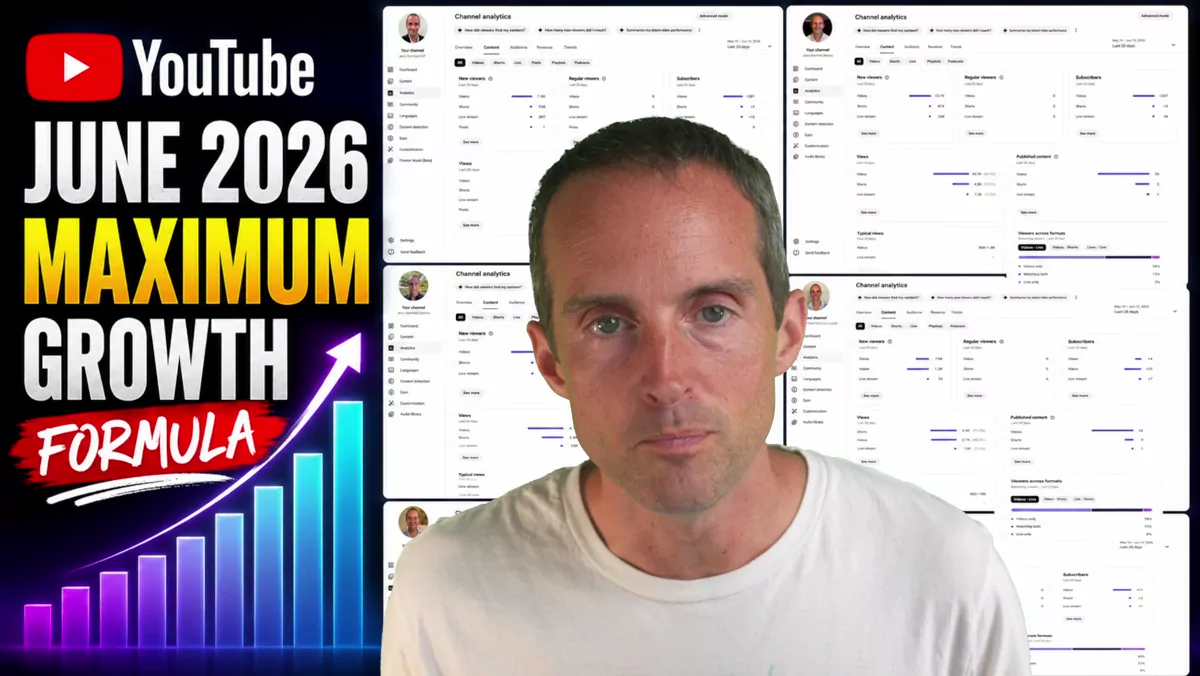
I think I've found the best way to grow on YouTube in 2026, and I have the data to back it up — because this year I launched six brand-new channels from scratch and tracked exactly what happened. Here's the executive summary, and then I'll go into the details. Over the last 28 days I uploaded 141 videos across those six channels: regular videos, 18 shorts, and 10 live streams. A few things jump out of that data right away.
The shorts are getting the most views per upload, even though I only just started posting them, so they've had the least time and the smallest built-in audience — none of my shorts have hit their real potential yet, none have cleared two or three thousand views. You'll also notice the subscribers per short are smaller, while live streams actually got the most subscribers per thousand views. Live streams are the fewest uploads, but they bring the most money per upload and the most subscribers.
The formula my data points to
Put those signals together and the growth formula is this: build your strategy first on shorts, then compound it with five-to-ten-minute clip videos, and then — once you actually have an audience — add live streams here and there to deepen your existing viewers into super fans. I barely did any live streams until I'd built some audience, even starting from scratch. The best thing to do with super fans is give them a membership. The way you actually sell those memberships is at the end of a five-minute video or inside a longer live stream — that's what makes it easy.
One short and one long a day: inside my ICP channel
My top-performing channel is my Jerry Banfield ICP channel, so let me use its analytics as the example. Most days on that channel I publish one five-minute video and one one-minute short. What I see is a nice combination: the shorts often reach a completely different audience than the long-format videos, and the shorts don't seem to hurt the long-form views at all. That matters, because if I published two long-form videos in a day, those would compete with each other — I've shown that happen before. A short plus a long don't conflict; two longs do.
I've only tested a handful of shorts on that channel so far, and none has done anything spectacular yet. But the interesting part is who's watching them. I am getting subscribers from them. Looking at the reach, the shorts go out in the Shorts feed, and a significant percentage of people are also finding them through YouTube Search — totally different traffic sources than my long-form videos usually get. On one short the average view duration is 44 seconds, which makes sense for a one-minute video, and it reached 34 viewers who had never seen me before.
Shorts versus long videos: different discovery, different math
Compare that to a long video from the same period — an average-performing one, a video on Ethereum DeFi. That one earned more ad revenue (about $8), got more subscribers, and more watch hours. But it was discovered mainly through browse features, then YouTube Search and suggested videos. So the Shorts feed is a completely separate discovery surface — the ideal is to get found in both. On that long video only 15% of viewers were new, versus 85% who'd already seen my videos. Interestingly, that little short was the single top entry under "viewers also watch" across nearly a hundred videos on the channel over 90 days.
Here's something most people miss. Shorts reach looks tiny because YouTube only counts views on shorts, not impressions — but when someone does view a short, they're actually hearing me talk. On a long video the numbers are different. Two videos I compared looked like they got similar views, but the long-form one was actually shown about 16,000 times across YouTube — nearly ten times as many impressions for the same number of views. Part of why is that the long video was reaching my existing subscribers; I have a couple thousand, and about half of the people it reached were subscribed and half weren't. The short was shown far fewer times, but a larger share of the people who saw it weren't subscribed, and slightly more were brand-new viewers. That's the whole point: shorts and longs combined cover both audiences.
When live streaming is actually worth it
If you want to make something longer — say over 20 minutes — you might as well just live stream it. Look at what live streams did for me: one got 12 subscribers and made $7; the next got 12 subscribers but made $20 because people sent super chats; another was a $10 stream. One stream pulled 19,000 impressions even though it only got about 1,400 views, with 172 watch hours, and it reached a decent percentage of new viewers rather than only casual ones. A more recent hour-and-twenty-minute stream reached a smaller share of new viewers — I'm starting to saturate that audience between shorts and longs — but it brought in about $30: roughly $14 from replay ads, $3 while live, plus super chats and memberships taken directly on the stream. There's no point live streaming until you have an audience, and you build that audience with shorts and longs first. If you want help turning your own viewers into super fans the way these streams do, you can book a one-on-one call with me, where I'll review your channel and answer your video questions directly.
The simple daily plan
So the ideal growth formula right now is straightforward. Shorts are the foundation — the easiest way to get discovered. Five-minute-ish clips, ideally under ten minutes, are a great way to earn more impressions and get pulled into browse features. Then live streams — both vertical and horizontal at once, which is just a checkbox on YouTube — deepen your conversions with the viewers you already have. In practice that means one short and one long every day, where "long" means about five to ten minutes: two videos a day, no more and no less. That's it. If you want more breakdowns like this, you can watch my YouTube Coaching playlist.