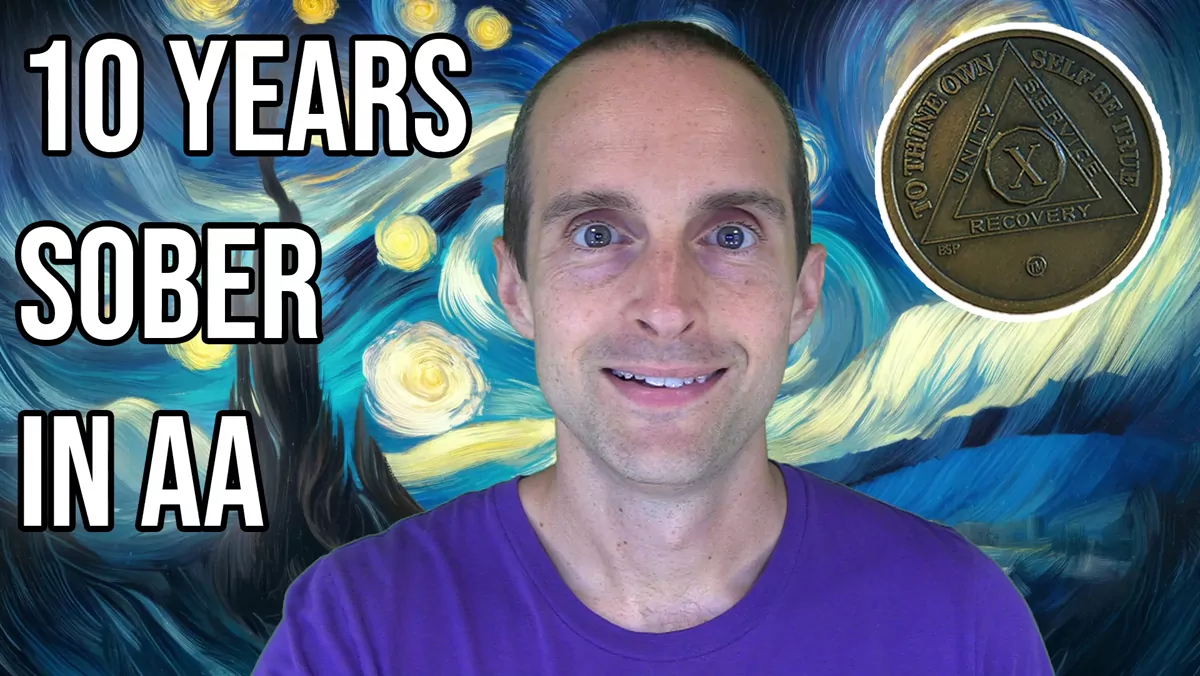
I'm very grateful for 10 years sober in Alcoholics Anonymous today. This seemed impossible at one point. I'll tell you how I got to this point, what my life's like sober, and some of the things I've learned along the way.
The last night I drank, I was utterly hopeless
Ten years ago today, I had my last hangover, and I felt utterly hopeless and defeated. I had tried to manage my drinking every way you can imagine: drawing lines on bottles, promising I'd never drink again, trying to just drink reasonably, trying to start earlier in the day and finish up earlier in the night, trying to drink only beer, picking a set number of drinks I'd allow myself, drinking just a couple and then cutting off. I tried so many different ways of drinking. What I found was that if I was controlling my drinking, I wasn't really enjoying it, and if I was enjoying it, it was consistently out of control.
It's not that every time I drank I had big issues. In fact, many of the times I drank it was just pretty boring — me sitting at home drinking, playing Call of Duty Zombies. At least from my point of view, I wasn't hurting anyone. But from everybody else's point of view, I was poisoning myself. I was being antisocial. I was not that much fun to hang around with, which is why 10 years ago my wife was ready to leave me. My friends had grown tired of hanging out with me and often were busy or not available.
The last night I drank, I realized I was utterly hopeless, because I had tried to get sober a bunch of times. I had told my wife, I swear to God, I'll never drink again. I had told everybody in my life I'm getting sober, and then repeatedly I had changed my mind. I even had almost six months of sobriety at one point, but I wasn't doing Alcoholics Anonymous. I decided to go totally sober without drinking for 2012 — I hadn't drank the whole year — and then around May, I decided, you know, as long as I just drink out of town and don't drink around my wife, and I hang out with my friends, I won't fight with my wife when I'm drunk. That soon enough turned into drinking at home with my wife on the other side of the house just trying to stay away from me, and finally her getting tired of it.
The last night I drank, I also gambled online, which was really helpful, because I'd been under the illusion before that as long as I didn't drive while I drank, and gambled online when I drank, and did like a hundred other little rules, then my drinking was fine and safe. After I gambled that last night I drank online, I couldn't deny anymore that my drinking would never, ever be safe. That I couldn't set boundaries and stick to them. That on any given night, anything could happen.
I remember praying desperately to God in my bed: please, I'll do anything to get sober. I could see the path my life was going to take. My wife was about to leave me because of my drinking. Then I would be all alone and I would drink that much harder and feel sorry for myself and blame everybody but me. And then I would harm myself at some point, and that would be it. I realized I couldn't just decide to go a different direction and stop drinking and be fine. I knew that if I stopped drinking, someday I would want to drink again — no matter how good life got, no matter how long it had been, I couldn't just stop drinking and not change my mind about it someday. That left me feeling really desperate and really out of control. If you're lying there right now feeling that same kind of desperation, you don't have to carry it by yourself — you can schedule a one-on-one call with me and talk it through together.
So I prayed to God, please, I'll do anything to stay sober. And the thought that went through my head was: well, going to AA would be a part of anything. So I figured out an AA meeting to go to, and I knew I could stay sober for a few days before I went. I went to my dad's memorial out of town with my wife, and the day we got back, I went to my first meeting a little less than a week later. I had enough honesty to see that I was either going to drink the day after we got back from my dad's memorial, or I was going to go to an AA meeting. There was no middle ground. There was no "maybe we'll just not drink today."
My first real AA meeting
I went to AA and, man, I was surprised how good it was. The first time I'd ever gone to AA, I was 21, and I was trying to make it look like I wanted to do something about my drinking. But really I was just trying to get other people off my back. I didn't take a white chip. I drank two drinks at home right after that meeting in 2005, and I'm like, see, I drank two drinks, the world didn't fall apart immediately, I'm not an alcoholic. Well, over the next nine years until 2014, I got a lot of proof that, yeah, you might be able to drink one night and get away with it, but you always, always pay the price for drinking. Even if the first night there's not a problem, that second night, that fifth night, there's always going to be a price to pay. And I'm glad now that I'm sober I don't have to pay a price to have fun. I can just have fun and enjoy my life, and there's no price to pay, which is so nice.
When I first went back to AA, I was surprised how happy people were there — how happy, joyous, and free. I have a shirt on that says "happy, joyous, and free." I was shocked, because when I walked into Alcoholics Anonymous I felt the opposite. I felt sad, chained down by alcohol and my own personality, and I felt depressed. So I walk in, there's all these happy, sober people, and I'm like, I know I belong here, but I don't fit in. I'm miserable, and most other people here are doing pretty well.
By the end of the meeting, I shared that I was coming back, and a little bit of what I just told you. Everybody shared at me and tried to help me and give me their experience. At the end of the meeting, I sat in my car and I cried. My dad had passed away a few months before, and that was the first time I really felt his loving presence, like his prayers had been answered. I'm like, man, that was great, I'm gonna go back. I noticed that I felt bad when I walked into that AA meeting, and I felt good afterwards.
Two meetings a week wasn't enough
So I started going to just two meetings a week, because in my delusional thinking I was drinking anywhere from two to four days a week, and I'd often drink anywhere from eight to 18 hours on one of those days. So I was generally putting 20 to 40 hours a week into drinking, especially when you count all the time recuperating from hangovers. In my delusional mind, when I first got sober, that was about equal to one meeting on Tuesday and one on Thursday. And thankfully, the biggest difference in life is zero to one. Going from zero AA meetings to a couple of meetings a week — that was enough to get me by for a couple of months.
And then it wasn't anymore, and I wanted to drink. After a couple of months, I got mad at my wife one day — to be fair, because I was causing problems. I was the problem, and my wife was showing me exactly how I was living. I got mad at her, and then the obsession to drink came back, after giving me a false sense of security for a couple of months that, oh, you're good, you're going to AA, you're sober, it's over, it's done.
It was July 4th in 2014. My wife went to hang out with her family for the day, because I was not being cooperative and was angry, restless, irritable and discontent, and I told her I didn't want to go spend the day with her family. Well, that part of me that wanted to drink wanted to get rid of her so I could drink properly. As soon as she left, it went from kind of playing possum — acting like it was dead and wasn't there — and as soon as she left the house, it came roaring up. It's like, all right, this is what you've been waiting for. Let's get back to drinking. We can drink real hard all day. She's not even going to be here. You got me.
And it was weeks — weeks of the obsession to drink. Finally I started to share about it at meetings. I stopped acting like I was fine. It's so silly. You see newcomers in meetings, they're a couple months sober, and you ask how are you doing, and it's, "Oh, it's great, everything's wonderful." I'm like, sure, I hope you're telling the truth. Because in my experience, a couple months sober is when things really started to fall apart. The wheels started to really come off, and I started to see how insane I was before I drank.
One day in AA, still going to two meetings a week, I raised my hand and said: I hate this. I'm miserable. I wanted to drink all day, and I'm going to drink tomorrow. You guys said just don't drink today — I'm fine, I won't drink today. But tomorrow's Friday, I'm drinking tomorrow. And they, again, helped me, prayed for me, loved me. I went home and read the book and I felt hopeless. I didn't have a sponsor. I wasn't calling people. I was praying, I was going to two meetings a week, and I was not drinking. But God, it was hard.
One day I got so desperate, I took one of my wife's liquor bottles out of the cabinet — something she'd had for a while. And I was like, I'm going to drink for Christmas. And it's July. Nobody but me touched it since then. I took it out and smelled it, like, I'll have to drink if I smell it. And I smelled it, and it's like, see, you still have a choice. You still have a choice. Once you take that first sip, you're not going to have a choice anymore — but right now you still have a choice. And this is sick, and this is stupid. Why are you trying to tease yourself into drinking? I put the liquor bottle down and I cried. I remembered the man who's now my sponsor — he wasn't at the time, but I remembered him saying, "Booze is caca." I'm like, why is my mind trying to tempt me into doing something I know is bad for me? This is sick. What is wrong with me? And how do I get fixed?
I started finally taking suggestions
So I started finally taking suggestions. I started reading the book like my life depended on it — because believe it or not, it took me two months in AA to even buy the book. The more the obsession to drink got on me, the more I started to try and read it and understand it.
The first suggestion I took that was extremely powerful, besides going to meetings and reading the book, was this: I got a massage one day when I was just miserable. The obsession to drink had me so stressed out and anxious and afraid. I went to get a massage, and I faced my fear. I realized I was just as afraid of getting a massage and trying something new — of seeing what life would really be like sober — as I was of drinking myself to death. The Massage Envy was right next to the liquor store, and it's like, these are your options. You go in the Massage Envy and try something new, and maybe you have a good sober life and feel better. Or you go into the Publix liquor store and drink yourself to death. I was terrified to go into the Massage Envy, and I realized it was completely irrational.
That was a suggestion given to me by somebody who'd been sober for 20 years, who said if you need to relax — which I did, and still do — go get a massage. So I got a massage, and the obsession to drink left. At the time, it felt like the voice of God telling me to get a sponsor, go to five meetings a week, and read the rest of the book. Now I see it more simply: I relaxed, I did a really good 10th and 11th step, getting a massage relaxed the body, and my mind came through with the very clear guidance I had prayed for and asked for.
After that, I got a sponsor. I finished reading the book. I started going to five meetings a week instead of two. And life has consistently gotten better ever since. Everything is so much easier than it used to be. I remember when I'd get upset or angry at something in my business, my first year sober — man, the rage and the mental obsession with the rage would last like a week. Now it often goes away very quickly, sometimes in minutes. When I catch a resentment against someone, it goes away very quickly. I had a resentment against someone in AA a few weeks ago, and I've turned it into just putting out pure love for that person and how grateful I am that we're sober together and we've been around so long. And I asked other people for help.
A life better than I could have imagined
I'm just consistently blown away by how good my life is in sobriety compared to how I even could have imagined it. My life today in sobriety is better than I could have imagined when I got sober. I make YouTube videos for a living. I have plenty of money. I can have anything I want. I have a house that I love. I do all work that I love. I have a wife that I love. She just said the other day that this is her favorite time in our relationship, and I'm like, that's one of the nicest things you've ever said to me. After all this time, she said this is the best, her favorite time in our relationship. It's just really peaceful. We get along really well. We communicate very clearly. We understand each other. My relationship has gotten progressively better.
They say that alcoholism is a progressive disease. And so is being sober — it gets progressively better as long as you keep working it and continue to learn and change and grow. Because I realized how effective the Big Book of Alcoholics Anonymous was, I got curious. I'm like, what else is out there? If this one book and these people at this one program have helped me so much, there must be a lot of other books and a lot of other things to learn and try. And I've tried them. Hypnotherapy. I went through the whole A Course in Miracles workbook. I've read hundreds and hundreds of hours of self-help books — Eckhart Tolle's The Power of Now, Wayne Dyer, so many hours. I'm into Neville Goddard right now. I'm constantly taking in that which leaves me feeling good and powerful and joyous, and I'm constantly out there trying to lift as many other people up as possible. As many of you as will hear my word and hear my experience, I give this out to you. I give this out to anyone, everywhere, all the time. This is the same thing I do every day inside the Jerry Banfield Family, where I get to keep showing up for people who want to feel good.
Yoga plus AA
I go to yoga five or six days a week, and in my experience, yoga plus Alcoholics Anonymous is an extremely powerful combination for helping me feel good. Yoga feels a lot like an AA meeting, but it's a very physical practice, whereas the AA meeting you're just sitting in a chair — a very mental practice. For me, the yoga and the AA combined are extremely effective, and neither one by itself would provide me the same amount of complete relief. Doing yoga is one of the things I've added in the last few years to my sobriety that's really helped me relax and be at peace in my body, and love and appreciate how I look and how healthy my body is.
I have so many gifts of sobriety that I wouldn't have dared to even think were possible. For example, in my experience, I have not been sick since October 2022 — not one single day. That's almost a year and a half, and that's the healthiest I've ever been. I was a pretty healthy child and young adult despite all the alcohol poisoning I gave myself, and I'm at the best health I've ever felt. So if being sober is difficult, the only thing you need to do is start thinking: what do I learn? How can I expand and grow so that my sobriety is really enjoyable? If your own sobriety still feels like a grind instead of a gift, book a private call with me.
Recovery is the opposite of isolation
A big thing for me is always being out there and serving others, and being connected with others. Alcoholism, to me, was a disease of isolation — me at home drinking by myself, playing video games. Recovery, to me, is a process of being with other people, being open and transparent, not having any secrets. A big turning point in my sobriety was when I stopped having secrets. That was when I did the fifth step with my sponsor, and then did the fifth step again with my grand-sponsor, and then again with the rector at the Episcopal church, and then again with my new sponsor, and so on. The more I got out all those secrets — my behavior that left me feeling bad — and the more I heard other people's secrets, I'm like, man, other people had much worse secrets than I did. It gave me perspective that they could be happy and sober despite, in my view, having both worse things done to them and doing worse to others. They were able to be happy, joyous, and free and productive members of society. They helped me to feel good, look myself in the mirror, love myself, and appreciate that this body and this mind — this has been a nice ride. This has been a nice life. And I want to help other people who want to feel good.
Respecting other people's choices
Most recently, what I've been working on is making sure that all the people in my life are on the same frequency I'm on — that I'm helping people who actually want my help. One thing that can happen in sobriety is that when you start getting your own life together and you feel great and everything's wonderful, you can get a savior complex, where you want to go out there and drag everybody else out of the gutter and the bar and out of their living room gaming all day, and get them sober and clean and healthy. What I've learned and worked on most recently is to respect other people's choices. Some people don't want to be sober. They don't want to be healthy. They're not interested in doing anything except living in the insanity.
The way I can help them the most is to stay away from them, and to think of them as healthy and happy and sober and loving — but not spend time with them in the middle of their alcoholism or their drug addiction or their sickness. Because it's much easier for them to bring me into their world than it is for me to drag them into mine. In the process of me trying to drag them and force them and make them change and come into my world, I'm slipping myself into their world.
So I've learned to not discriminate in terms of boundaries. I don't care if you're a family member or a friend, I don't care who you are — you have the same set of standards. I only surround myself with people who are sober, or not an alcoholic and not a consistent drinker — someone who at most occasionally drinks a tiny amount of alcohol a month. I surround myself with sober people, people who are sane, who are considerate and trying to help others, people who are healthy and who've got a joy for life. And that mainly is my wife, my children, my wife's family, and people at Alcoholics Anonymous and yoga. That's almost everybody I hang out with now. I've had to let go of, or set hard boundaries with, family members and friends who want to keep drinking, taking all kinds of drugs, and living in the insanity of it.
I've realized the best way I can love is to love from a distance and then imagine whatever I want about the person. For example, I had a friend I was seeing once a week for a massage, and she was in the middle of her alcoholism — not drinking while she was seeing me, at least as far as I could tell, but in the middle of that alcoholic insanity, constant drama, everything being everybody else's fault but hers. I couldn't really enjoy the massage. Her alcoholism, even though she wasn't drinking around me, was getting so bad. So I told her, look, I'm not going to have another massage with you until you're sober and working a program of recovery. I haven't heard from her since then. And I'm able to love her and picture her getting sober, contacting me, being like, hey, I got sober, my life's going great, and I'd love to see you for another massage. That's what I picture in my mind. Now I've been able to see a massage therapist who is sober, and we can really help each other.
Don't kid yourself that sober is depressing
Being sober is so good. Don't kid yourself for a minute and think that it's bad or depressing, because getting sober in Alcoholics Anonymous has been one of the very best experiences in my entire life. It was so challenging getting sober for me that doing things like switching my diet to a mostly whole-food plant-based vegan diet was relatively easy in comparison. Many of the challenges I've had in relationships, and people that have died, and almost everything else compared to getting sober, has been pretty easy. So I'm so grateful for my experience getting sober today, and I hope this has been useful for you. I've put this into the newest chapter of my autobiography. If you want to keep walking through this with me, the same recovery and life conversations carry on in my Life playlist.
If you're earlier in this than I am, two things I've shared before might help: I've walked through the 12 steps of AA from my own recovery, and I've talked about what long-term emotional sobriety actually looks like in action years further down the road. And when it all feels impossible, what's helped me most is the same thing I describe in giving value to people when the world feels hopeless — getting out of isolation and being of service.
My 10-year sober day
The last thing I'll end with is my day today. What am I doing on my 10-year sober day? It's just a very normal day, because every day I enjoy every day. I also don't need to do anything special every day, because every day is special to me. It's a nice day to be alive — because 10 years ago, getting where I'm at today looked impossible, and at best improbable.
Today I woke up at 7am. My wife flew out of town to go to a work conference, and her sister took the kids to school. I got the kids ready and out the door in time. I walked my dog, I went to yoga. I had a bee sting on my foot yesterday and it was swollen up, and I focused totally on picturing my foot going back to normal, thanking my foot — both feet — for all they've done to help me stand up. I went to a power yoga flow that was nice, saw several people I know there, and came home. Then I took a call — somebody paid $300 to talk to me about crypto. That's been a gift of sobriety, being able to value my time, and have other people value it too. They paid $300 for an hour to talk to me about crypto and share their ideas with me.
Then I went to an Alcoholics Anonymous meeting at noon and saw a lot of people I know there. I came home and worked on trying to make some music. Music has been another gift of sobriety, something I had no interest in before getting sober. Then I picked the kids up from school. The kids are eating popcorn, watching their tablets — my son was watching a video, my daughter's playing Mario Kart on the Switch. I'm gonna have a salad, make some dinner for the kids, walk the dog, put the kids to bed, see if I can get that song finished, and then go to bed around 10 or 11pm. I'll get eight or nine hours of sleep, get up, and do almost the exact same thing again tomorrow.
So my life is really good today. There's very little drama or stress. My life is just pure joy most of the time. The biggest challenge is just trying to figure out how to create videos that people love and enjoy, that give people what they want, while satisfying my own desire for fun and joy. I really appreciate you reading all of this.