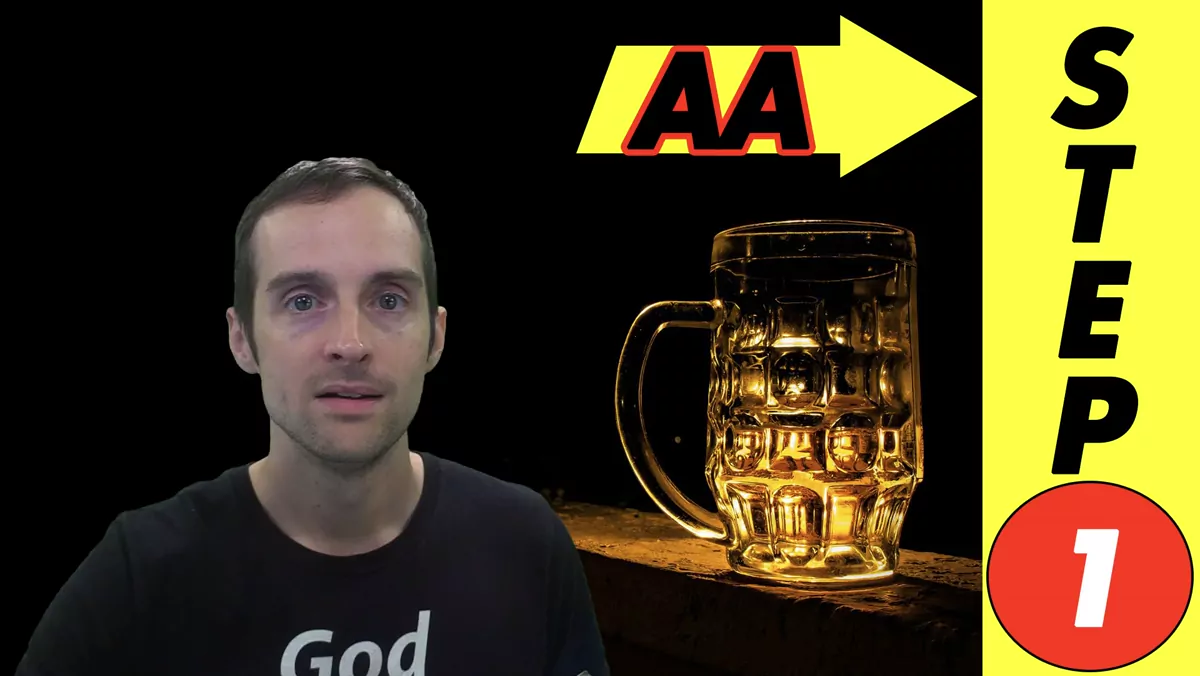
Are you ready to talk about step one in Alcoholics Anonymous? The first step of Alcoholics Anonymous is as follows: we admitted we were powerless over alcohol and our lives had become unmanageable. What we're here to do is talk about this in practical terms for the AA beginner, or for an AA family member or friend — a potential Al-Anon member — who is trying to understand this. I'm Jerry Banfield. I'm an alcoholic. I'm grateful that my sobriety date is April 2014, and I've been going to meetings every day for five years. I've put this together for you with the hope that it's useful, and I've got a whole playlist for these.
What Does Powerlessness Over Alcohol Actually Mean?
The question is, what is the practical meaning of step one in Alcoholics Anonymous? Step one really helps us see whether we need AA or not — whether we belong in AA. Ultimately, we just need a desire to stop drinking to go to Alcoholics Anonymous. For many of us, getting to that first step is really hard. Are we truly powerless over alcohol? What does it even mean to have power over something? In Alcoholics Anonymous meetings we frequently say the phrase about whether one is able to control and enjoy their drinking. Many of us were able to either control our drinking or enjoy it, but not consistently control and enjoy. To me, the hallmark of powerlessness is the inability to consistently make the right decision with regards to alcohol.
Many of us need help to remember all those painful memories that we've swept under the rug and forgotten about, in order to stay sober. Hearing other people talk about theirs in Alcoholics Anonymous meetings helps me to remember mine, because our minds very easily forget the pain. When I remember even a fraction of all the examples of how powerless I am over alcohol, I see that taking any alcohol at all into my body is a very bad decision. Why? Because to have power over something means I can control and determine what happens next. For me, powerlessness means that if I take even a sip of alcohol, I cannot consistently control what happens next. That's powerlessness.
Think about getting on a roller coaster. Once you strap yourself into the roller coaster, you are powerless after that. You are going on the ride whether you want to or not — whether you kick and scream, whether you have a panic attack, whether you try to get off. You are going on the rest of the ride whether you want to or not. The same thing with alcohol: for me, it's a ride. Now, sometimes I could influence it a bit, at least in the past. I'm not interested in trying it again. What I've noticed is that sometimes I could have some control, but the thing about powerlessness is the illusion that you do have some control. Having a drink, saying you're only going to have two, and then ending up drunk at the end of the night — that's not control. Even if that only happens 10% of the time, that's still not control.
Think about the things you do have control over — driving, for example. If you decided to drive in a certain lane, you would say you had control over the car. But if 10% of the time the car drifted into the wrong side of the road against your will — if you thought you changed your mind and decided to drive the wrong way down the road, and that happened 10% of the time — you'd probably never drive again, because that would be terrifying.
To me, something like a DUI is an indication of powerlessness. Two DUIs, to me, is almost certainty of powerlessness. Because if one could control and enjoy their drinking, maybe you could say anyone could make one bad decision — whoops, I drank too much and drove. But someone who had control would under no circumstances do the exact same thing again. That's what's tough about alcoholism: we blame it on other things. Well, if that cop hadn't been sitting there — he should have something better to do than be pulling me over after I had six beers. Come on, I'm not a real criminal. If we are doing things that we didn't set out to do as a result of drinking, that is clear evidence of powerlessness.
Think about it this way. If you had one Diet Coke and suddenly decided, after having that one Diet Coke, to drink 12 more, and ended up in jail the next day, you'd probably never have Diet Coke again. Like, whoa — I can't believe that happened as a result of having a Diet Coke. You would see that after you had that first Diet Coke, your decision making took the power away from you.
The Magical Change of Mind
For me, it was always the magical change of mind. After one drink, I'd start changing my mind a little bit. And after a few drinks, I'd change my mind a lot more. And there goes all the power I'd had. What was scary to me was seeing how I'd change my mind about staying sober. I'd swear to God and my wife and my parents and anyone else who would listen that I was going to stay sober. And then — sober, before taking a drink — I would change my mind, and I would think I changed my mind in my own best interest. I'd say, well, I think I can handle a couple of drinks. And then guess what? Lots of times, I would be able to handle a couple of drinks the first time, and the second time, and maybe even the fifth and the tenth time sometimes. But that eleventh time would go way out of control. And that's powerlessness.
When you have the illusion that you have control over something when you really don't, that is real powerlessness. When you think, I've got control of this drinking thing, I can do this — and you keep making the same mistakes over and over again — that's helpless. That's like a baby who wants to do something and yet is just screaming and crying on the floor and can't do it. That's powerlessness. Even if it's just 5% of the time — you might be able to drink 19 times out of 20 and have control over it — if that 20th time you lose control and do something dumb, and you wake up the next day and wonder how you did that, that's what powerlessness looks like.
Our Sober Lives Had Become Unmanageable
Once you recognize that, then you see into the next part of the first step, which is that our lives have become unmanageable. It can be relatively straightforward to say, okay, all right, Jerry, I got it — I realize that once I take that first drink, I don't have power after that, at least not all the time. Once you can get to that point — okay, I understand now that if I have one drink, I cannot always control what happens next; okay, I'm powerless over alcohol — for me, the harder part was the second part of the first step: that our lives have become unmanageable. Let me throw an extra word in there: our sober lives had become unmanageable. That was a tough one for me to realize, because I thought if I didn't drink, my life was pretty good. I thought I was managing my life perfectly sober. I thought my only problem was this little alcohol thing.
Once I started coming to Alcoholics Anonymous, almost immediately I was able to realize my powerlessness. I had thousands of examples of where I had one drink and at some point after that lost total control, and lots more examples of losing partial control and making a little bit bad decisions. The hard part for me was seeing that my sober life was unmanageable, and that's where I really needed help. Because with a thousand examples of why I should never drink again, why is it that sober, I still wanted to drink anyway, even when I knew better?
Imagine someone who put their hand on a hot stove, got burned really bad, and said, well, I just won't put my hand on that stove as long next time. And they get burned again and again. You'd say they were insane and needed to be locked up. Well, that was my life with alcohol — let me just see — and I got burned again and again. What was really scary to me was realizing that my sober decision making process was horrible. My sober decision making process consistently led me to think a drink of alcohol was better than whatever my life was sober, despite all the evidence that it wasn't. Despite all the times I'd been burned. Despite losing a relationship, a car, at least one job directly from alcohol, and nearly another job from alcohol. Despite losing my health, despite losing friendships, despite losing thousands and thousands of dollars and thousands of hours to hangovers and stupidity, smashed and broken property, all kinds of undetected crimes. Despite all that, sober, my mind would tell me — and I would believe it — that the best thing I could do that day was to take a drink. That's an unmanageable life.
The Result of Step One: Seeing the Insanity
When you see that consciously you are purposefully trying to screw yourself over, and when that is realized, you've fully completed step one. When you can see that I'm powerless over alcohol — I have that one drink and I'm knocked out of the batter's box, as one guy said, and there's no telling what's going to happen next. Even if that particular time everything's fine, give it 10 or 20 times and there's no telling what'll happen. Once you see that — wow, my sober life is so bad that I still think drinking's a good idea anyway, even though I know better — really, the result of step one is seeing that, oh my God, I'm insane. That leads us directly to step two.
For me, this came about three months into Alcoholics Anonymous, going to two meetings a week, after 11 years of alcoholic drinking, averaging 20 drinks a week or so. Now, that would include times when I was sober for months — just, I'm going to stay sober. That includes other times where I had 40-plus shots of liquor and/or beers in one week. Usually those would be nights where I'd have like 10 or 20 in one night, and I'd do that one or two or three nights a week. I usually did binge drinking, so I'd get really drunk, hangover, sober up, really drunk, hangover, sober up.
What we get out of step one is we see: oh my God, I am insane. I am trying to hurt myself. I'm clearly disregarding anyone else around me. I am a sick person. I am an insane person who wants to hurt themselves and who craves the opportunity to hurt themselves and hurt others through my alcoholic drinking. That is an issue going on with me sober. That's an issue going on with me without any alcohol in my body. That's really, really screwed up. The gift of seeing that after 90 days was seeing that I was so insane that I was two. I wasn't one — I was two. I was a me that wanted to drink and a me that wanted to stay sober. I was literally two people. Everything was this miserable back and forth. At some points, I literally was so full of fear that I locked up, and I would just stand in the middle of my house and just stand there, because I was so afraid of what I was going to do next. The only way I felt safe was to just stand still. I don't even know how long I'd get stuck there.
Once I saw — whoa, this is insane; this is like what they talk about for people going to mental hospitals — the gift of that is seeing, oh, I need help with this. I am insane and I need something to restore me to sanity, because clearly this is not an ideal state, and alcohol is not going to fix this. Thus, we are led into step two: when we see the nature of our insanity — that despite all of our alcoholic drinking, we still want to get drunk again, no matter what the cost.
Thank you very much for joining me here for this step study — here with me, alcoholic Jerry Banfield. I intend to go through all the steps of Alcoholics Anonymous, plus all the related Living Sober things that we encounter, and if you want to walk this road with me today, the best way to do that is to schedule a private one-on-one call with me. You can also see more of my personal story in my Life playlist.
Thank you very much for reading this. I love you. You're awesome, and I'll see you again at step two.