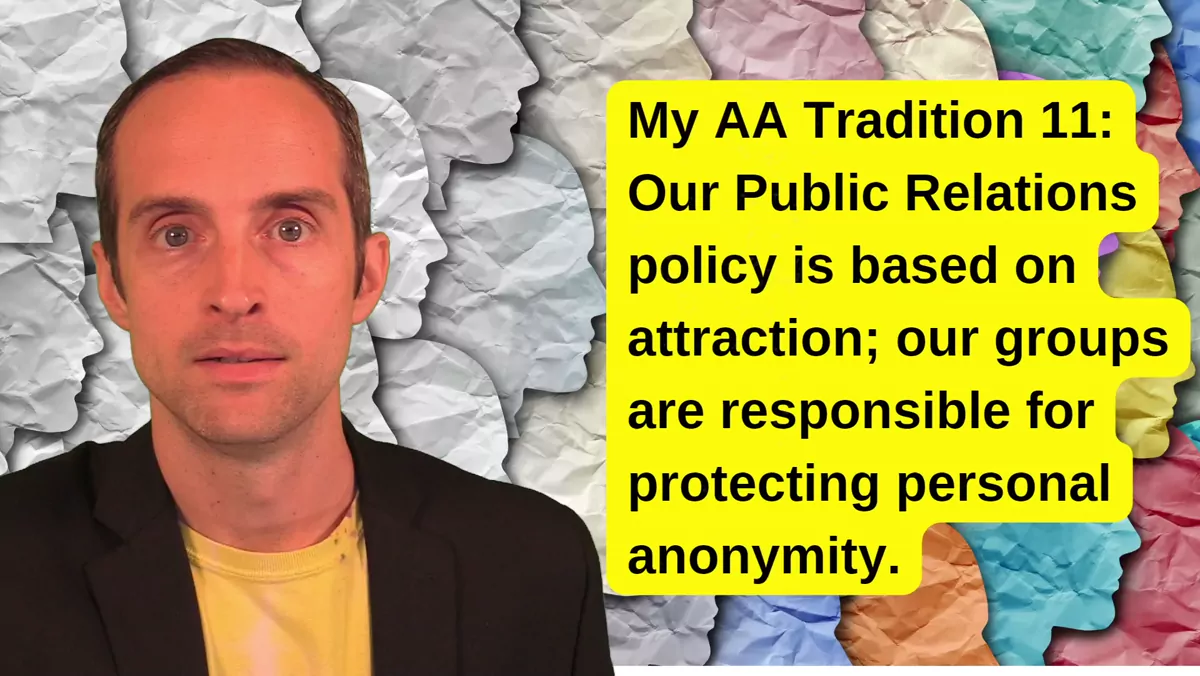
How I See Tradition 11 Should Work
My friends, let's talk about Tradition 11. This is how I see Tradition 11 should work in Alcoholics Anonymous. I consistently get complaints about my recovery videos and sharing my speaker meeting online. People say that I'm violating the 11th Tradition. And if you look at how it's written, sure, I am. Because this is how the 11th Tradition should look. I talk to people at AA meetings consistently who just say, oh, I'm not up for thinking about these things, or these things are over my head. No, we are in humility, we are equals. And I have just as much of a right as Bill Wilson or Dr. Bob or any other member of Alcoholics Anonymous to put out and operate how I think it should be.
This is what I would like AA Tradition 11 to change to: our public relations policy is based on attraction. We can just take out the part about promotion. Our groups are responsible for protecting personal anonymity. Our groups should never put out the members' identities. There should not be things like groups coming out and people identifying as certain groups and naming other group members at the group level. And our groups collectively need to ensure that people can go to Alcoholics Anonymous meetings without being identified based on attending a group.
Self-Centered Fear at the Personal Level
At a personal level, the 11th Tradition is based on self-centered fear, which is funny because in taking inventory, we identify self-centered fear as one of our personal defects. And the founders of Alcoholics Anonymous put Tradition 11 into that exact mindset. When people come to me and say, Jerry, you're violating the 11th Tradition by sharing your story and that you are a member of Alcoholics Anonymous, I say I have every right to be honest and clear about my story.
When I first got sober in my first year, I was a YouTuber and a content creator as I am now. And in the first year, I did it the way Wayne Dyer did it. Many people don't know that Dr. Wayne W. Dyer was in Alcoholics Anonymous, because he went and used all these little code phrases out of respect for the 11th Tradition. He said things like, "I'm a camel who starts his day on his knees and can go 24 hours without a drink," which is a way of saying "I'm in Alcoholics Anonymous." I did stuff like that for the first year, just saying I was in recovery and not mentioning specifically that I was in Alcoholics Anonymous, because I was doing what was suggested.
After doing that for a year, it got to feel like dishonesty and lying. Why am I being indirect when in every other aspect of my life I am very direct? Everybody that knows me knows that I go to Alcoholics Anonymous meetings almost every day, that I've been sober since 2014. So why, when I go to work, am I trying to remain anonymous? And the same answer comes back: well, what if you drink? That is self-centered fear. Well, you'll make Alcoholics Anonymous look bad if you drink. Self-centered fear.
People then say, well, Alcoholics Anonymous might look bad. Alcoholics Anonymous did look bad to me when I got sober. I did not think good things of Alcoholics Anonymous. Everybody I knew that was in Alcoholics Anonymous, I considered a jerk, an a-hole, and I didn't want to be like them. That's why I kept drinking. And looking at them sober, I thought, there's no reason to get sober in AA. Because they make it look bad. AA did not look good to me, and it already does not look good to many people. I see that we have more to gain by honestly and clearly sharing our stories. Because in all these AA meetings, people are so positive.
What If I Help Millions of People Get Sober?
I invite you to look at Tradition 11 as it's written like this, or a similar way, in a positive manner. What if I continue to share my journey in Alcoholics Anonymous very directly as I am now, and I intend to do going forward? What if I share very directly, and openly, and honestly my experience as a member of Alcoholics Anonymous? What if I help millions of other people get sober? What if that scenario? Don't the two of those look kind of stupid next to each other? "Ew, you might make Alcoholics Anonymous look bad if you relapse" versus "I might help millions of people get sober."
I've already helped a lot of people get sober with my videos online. My speaker meetings have collectively close to 100,000 views on YouTube, with an average of 20 minutes watch time. I've done videos promoting my sobriety all over the place. And a bunch of people struggling to get sober have watched my videos and have found them helpful. And no matter what happens to me going forward, Step 12 says that I carry the message. I have carried the message. And it doesn't even matter what happens to me from here, because I've already carried the message. I've already helped a bunch of people go to their first AA meeting, come back to AA meetings, think about getting sober, be more understanding, sober.
I realize our anonymity is valuable. But the place that shouldn't be compromised is at the group level. If I want to go around and tell the truth about my life, then that's my right. And I don't care about anybody else's opinion saying that I shouldn't share my story, that I should take my videos down, that I shouldn't make money off of my videos. Thanks for sharing. I know what the right thing to do is, and I'm doing it.
How Tradition 11 Has Stunted Our Growth
We need change. This is to me one of the worst parts of Alcoholics Anonymous right now: people fighting with each other because one person posted their medallion on social media and somebody else talking about breaking their anonymity. I've gotten so many pissed-off messages from people who almost always are struggling in their own life. When I'm celebrating how well my sobriety is going, they're at home, depressed, writing about the 11th Tradition. This to me has been one of the worst things Alcoholics Anonymous has done in terms of stopping our growth. Our growth has been greatly stunted by people not honestly sharing their story.
I put my speaker meetings — real AA meetings with just my face and just my story — on the internet right before people got stuck in their houses by authoritative, authoritarian governments. And those speaker meetings were really needed, because people suddenly weren't able to go to their usual meetings, and here I was. I looked on YouTube, and I saw that almost nobody had a real AA meeting with their actual face telling their actual story. And now, anytime somebody talks to me about the 11th Tradition, if you've been sent this by me, you will be getting this as a response. And I think that's a great response.
I hesitated to get sober because I thought it meant that I had to just bow my head down and do whatever other people told me. I thought that drinking was my way to rebel against a system that was meant to oppress me. And drinking was an effective rebellion, but it was a self-centered and foolish rebellion. What I see in Alcoholics Anonymous today, after being sober since 2014, is that now I can intelligently fight back and intelligently rebel against any part of a system where anything is needed. I can intelligently suggest and look for change, and I can selectively choose which rules or traditions or suggestions I should take and which ones I should disregard.
Anonymity Belongs at the Group Level
The way the 11th Tradition is written, it should be adjusted to only consider groups. Now, as a member of Alcoholics Anonymous, I don't care who else knows that I go to AA. However, it would be inconsiderate of me to go around saying exactly which groups I go to and exactly who goes to those groups. And that's where we need the 11th Tradition. We should not have groups out there publishing all the members, and I'm big into respecting your anonymity. I can say whatever I want to about my own life and about my own story, and about anyone else who's consented that I can share their story. I often share my experience with other people in AA as long as I can make it in a way that's not identifiable. So we do have a right to respect other people's decisions. But the 11th Tradition as it's written does not respect me — that I have a right to share my story without editing it, without omitting it.
And to me this is simply a reflection of consciousness. We collectively are moving towards more open sharing. We are collectively seeing the need that if we really want to do better on this planet and fix all of our challenges and rise up, we need honesty. We need transparency. We need to stop hiding. And I will not hide my membership in Alcoholics Anonymous for anyone.
A Rumor About Bill W and Why Openness Helps Me Stay Sober
I'll throw a little bit of rumor in here at the end for those of you that really care enough to read all of it. My speculation is that Bill W, who from what I hear was offered the chance to appear on Time Magazine, chose not to do that because he was operating in a way that he was not proud of. I hear he was sleeping around with a bunch of newcomers, and in fact his conduct was the impetus for the quote "Step 13." That Bill W was not proud of how he was living his life, and that he was afraid of making Alcoholics Anonymous look bad if he went on Time Magazine and shared his story. I am not afraid of making Alcoholics Anonymous look bad. I am proud of every way I'm conducting every single aspect of my life.
And I've come to believe that the 11th Tradition actually makes it easier for people to relapse. When I tell everybody that I'm sober and that I'm a member of AA and that this is what I'm doing, I'm accountable. I went to a conference a few years ago where most of the people there were drinking, and because I was very open about my sobriety, hardly anybody even offered me a drink. Nobody pressured me to drink, and everybody was very supportive of my sobriety. I see people out there at meetings talking about how nobody at work knows they're sober, and look, it's your life — you are free to make the choices you want to. In my experience, it's much easier to stay disciplined and on the path when I'm not being tempted. And if I was being offered drinks all the time, that would certainly make it easier or more likely for me to have a relapse. When everybody knows that I'm in AA and that I have no intention of drinking, then there's no temptations. I automatically don't get invited. I'm rarely invited to drinking events because I make it clear: if the main activity here is drinking, I have something better to do. I've seen so many people who don't tell people at work they're sober, and they get stuck in all these drinking events. And the 11th Tradition sets things up like that.
Going around trying to hide and act like AA is some secret society — it's not. It's a program that saves lives, and it's self-centered and stupid if we refuse to share our own story out of self-centered fear. When I drank, I used to operate out of hiding and out of lying and out of fear. And I refuse to live that way today. And I don't care who has a different opinion. I know what's right. I know that talking about my story all over the internet to millions of people and being clear that I'm a member of Alcoholics Anonymous — I am certain that is right. I am certain that is what's best for everybody else. So I absolutely will not compromise on this point at all. And not only that, I'm convincing every single person who asks about Tradition 11 that this is the number one thing we need to change in Alcoholics Anonymous, and this is my proposed change to it.
Thank you for being one of the few people who read all the way to the end. You can go to my website, where I have a complete autobiography — a very detailed fourth and fifth step of my life in alcoholism and all kinds of other addictions and how I got to three years sober. And then I carry that on with my newest videos today in my Life playlist. I love you. You're awesome.