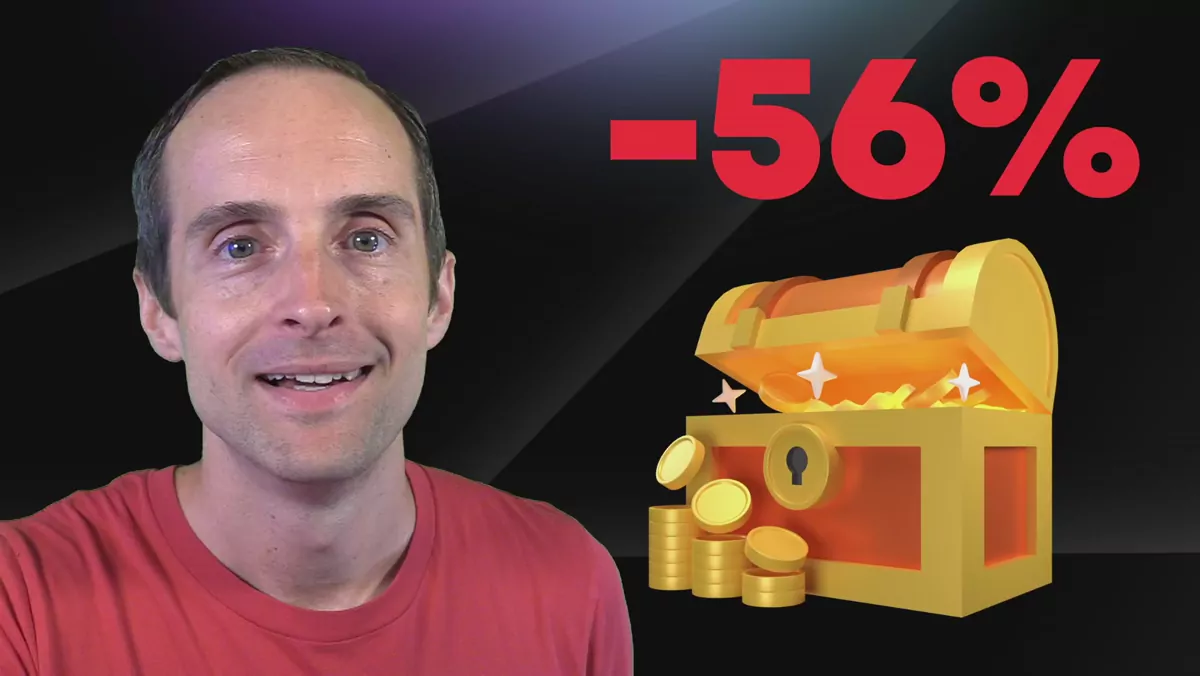
Every single crypto investor should know the statistic I'm about to explain, and keep it in mind every single day when buying cryptocurrency. I've made this because I want you to be wealthy. I want you to have financial freedom and an abundant life. Crypto is a great way to do that, but you have to be careful. This statistic is one of the most shocking things I've seen in crypto, and most of you have never seen it. Here's what it is: minus 50 percent is the average top 2,000 altcoin return since 2018.
I got this from Invest Answers and CoinGecko. They did a study where they pulled the top 2,000 altcoins from just five years ago. Five years is not that long. The average return was minus 56 percent, and that's only for the altcoins that did not go to zero. Many of them went to zero. So really, this number is even lower. And this counts all those altcoins that did 50x's and 100x's. If you had put $100 into every single top 2,000 altcoin, you would have spent $200,000 in 2018, and today you'd have less than $100,000. Not only that, but your $200,000 could have bought you a house that would probably be worth $300,000 or more. So you're going to say, well, Jerry, I'm smarter than average. I can pick better cryptos. The top 100 has to be better than this.
The Top 100 and the Top 10 Are No Escape
Well, yes, the top 100 is better than this. I'm taking this number from my own data that I pulled. I went through and pulled all the cryptos in the top 100 that did not go to zero in 2018, and the average return is zero. Same example: if you'd had $200,000 in 2018 and spread it equally among each of the top 100 altcoins, you'd have $200,000 today, except some of those went to zero and I had to pull in rank 101 and rank 102 just to fit it in there. So you'd really have less than that. If you missed the zeros, you would have made no money.
So you're going to say, well, Jerry, the top 10 has to be better than that, doesn't it? What if I just buy the top 10? The top 10 was actually worse at the time I pulled the data, because there were some hyped-up, over-speculated losers that dragged down everybody else. For the average top 10 altcoin, if you'd have put in $10,000 and split it up, $1,000 into each top altcoin including Ethereum, you'd have $5,000 today, five years later. These are statistics you need to keep in mind before you buy altcoins.
For comparison, if you'd have bought Bitcoin at the exact same time instead of these altcoins, this would be your return: 283 percent. So if you dumped $200,000 into the top 2,000 altcoins, you'd have less than $100,000. If you'd have bought a house for $200,000, you'd have maybe $300,000 or $400,000. If you'd have put $200,000 into Bitcoin, you would have well over half a million dollars. Now, how does that sound? Bitcoin has done awesome in the last five years, and so has Ethereum, even though I included Ethereum in all my altcoins. Ethereum actually brought the top 10 altcoin average up significantly. You would have doubled your money with Ethereum. So if you'd have put $200,000 into Ethereum five years ago, you would at least have gotten a 200 percent return on that.
Why 99 Percent of Altcoins Are Gambling
Now, this is what you need to know before you buy any more of these crap altcoins. Many of you say, well, Jerry, Bitcoin and Ethereum are for the rich, and you think Bitcoin and Ethereum aren't getting good returns going forward. Why wouldn't they? Look what they've done in the past. They've destroyed the rest of the altcoin market in returns. Why do you think that's going to change? I see no indication that it's going to change. So this is a statistic you need to keep in mind: 99 percent of altcoins are proven losers. I probably should have put that 99.9 percent of altcoins are nothing more than gambling.
You're going to the casino, you're betting on red, you're, God forbid, betting on those green zeros on the roulette table, and you're hoping you can get a great return. You're playing the lottery. You're going and buying scratch-offs. I look at people buying scratch-offs when I'm at the grocery store, and I think, well, he's paying the idiot tax right now, because that's what it is. And these altcoins, many of them are just taxing you. They're taking your money. Almost all of them are nothing more than money grabs, scams, Ponzi schemes, certificates of deposit where whoever buys in first gets to make the most money, and everybody else that buys in is a sucker paying the people at the top.
Now, you're going to say, well, Jerry, sure, 99 percent of altcoins are gambling, but I am smarter. I do better research. I put lots of time into crypto. Well, in my experience a lot of crypto YouTubers are shilling you crap just to get views. A lot of crypto YouTubers, I've seen the portfolios, and the coins they're covering, they don't even hold. You know what they've got in their portfolio? A bunch of Ethereum and a big stack of Bitcoin. They're telling you about these altcoins, but this is what they're actually holding. Sometimes they buy the altcoins before they tell you about them and sell them after they tell you about them. Many of the crypto YouTubers realize these altcoins are just gambling. If you want to gamble with them correctly, you have to enter at the right time, exit at the right time, and take a lot of time to get it just right.
I experienced a lot of gambling addiction when I was in my 20s, and one of the worst things that can happen to you is when you beat the odds and you attribute it to skill when really it's luck. I've seen a lot of your crypto portfolios. Most of you are in losses, as I was in losses for the first several years I was in crypto, and I was just buying Bitcoin and managing to lose money. I'd buy high and sell low, and buy lower and sell lower. Then I'd buy low and sell a tiny bit high, but it didn't cover my losses.
My Strategy: Look for the Absolute Strongest Investments
So you're thinking, well, this sounds pretty bad. What do I do? Based on the previous cycles, we can expect about seven big winners over the next five years. These are not exactly like lottery numbers, but to some degree they are, where you could just get lucky and pick the right one or the right two. This is where I'm learning. After nine years in crypto, the lesson I'm learning recently is that I need to do more and more research before I buy something, because as soon as you buy something, even if it's crap, you think it's one of these big winners. Out of all these altcoins, what do you think the odds are of picking one of the seven winners? We know from our previous stats that most of the top 10, most of the top 100, and nearly all of the top 2,000 are not big winners. They're losers. And picking incorrectly will cost you your multipliers. If you pick one correctly and 10 incorrectly, and you make a 10x on the one you pick correctly while the others all drain your portfolio, then all that work you did was worthless.
So yes, we do want to look for some big winners, but here's what my strategy is. I look for the absolute strongest investments. Recently, after my crypto channel was taken down for a week when I was wrongfully terminated by some spam reports, as has happened to most crypto channels that grow, I took a week off to really rethink my strategy. After looking at all this data, I see the necessity to get rid of the junk out of my portfolio. So I've drastically reorganized my portfolio into the very strongest investments I see on the market. I'm constantly looking and listening to what else might be strong, and I'm looking for why a given thing is weak. I really like data. The data we've seen from the past provides very clear indications that Ethereum and Bitcoin are going strong: hundreds of thousands of daily active users, prices not that far down from all-time highs, tons of conversation, tons of free marketing from holders. Every fundamental for Bitcoin and Ethereum is fantastic.
Lately I've been researching and seeing that Solana looks like it stands out among the third generation. Bitcoin is first generation, Ethereum is second generation, and Solana and the Internet Computer are my picks for the next generation, the massively scalable ones. The Internet Computer is not really a blockchain; it's an internet computer protocol. But to me, Solana and Internet Computer look to be the very best positioned to be that next generation platform. Bitcoin is first generation, although BRC-20s have junked it all up. Ethereum is the first smart contracts platform, and it's getting a ton of use. I love Solana because it has the most daily active users and the rest of the fundamentals are very strong on it. The Internet Computer has the most breakthrough technology that I see on the market. I don't know whether Solana or Internet Computer is going to be one of those big seven winners, but I can imagine that out of these four, I've probably picked three things that are going to stick around and keep providing really strong gains. If one of these is wrong, then the other one will probably make up for it with the biggest gains.
My Maybe List and What I've Dumped
I'll wrap up here with the ones on my maybe list. These have strong fundamentals but have some critical issues in them that I don't like, and I'm researching more. I am holding all of these as well. I've dumped almost everything else in my portfolio to stack up mostly on Ethereum, stacked up some more Bitcoin, and I've been stacking Solana. I already had a big Internet Computer stash.
On Polygon, there are a lot of users, but what I really don't like is that it's not even really a layer two in the sense that it's essentially its own network, and it's just now kind of getting the layer two aspect integrated with the rollups. Polygon has stiff competition. There aren't that many people using their true layer two aspect of it, and to me it looks like it could very easily lose out to something like Internet Computer or Solana or a different layer two competitor like Arbitrum, Optimism, or Base. While Polygon's been popular lately, they've dumped a bunch of money into partnerships that have gotten them so much attention and so many users, but these partnerships can very quickly evaporate and go to other chains. We're seeing things like BNB that are very attractive too, and these are others you might consider.
Some people even want to move to Fantom instead of Polygon, for example, but Fantom doesn't have the absolute lowest fees for mass scalability either. Polygon, though, has a ton of daily active users, and the rest of Polygon looks like it's in a very good position. Then there's BNB. The main thing I don't like about BNB is that it's driven by an exchange, Binance, and what we've seen is that centralized exchanges are often a house of cards and can come crumbling down to the bottom of the gap. That makes it a little bit harder for us to use this as a real estate broker, so to speak. That's how I see it. BNB is a global broker brand, it's a global signing agency because of the scaling that's handled by BNB's more scalable transactions. But why put your project on it when you could put it on Polygon, Solana, Internet Computer, Avalanche, Fantom, or Zen? So BNB, to me, is a project I think the competition is going to eat up over time. It's still very strong, but that's my concern.
DeSo, Avalanche, and Tron
I like DeSo, decentralized social, because it has the best technology I see right now for a decentralized social media network, and that is a huge narrative that is going to hit. This is one of the bigger holdings in my portfolios. But there are a few things I really don't like about DeSo, and with every single asset you're holding on to, it's important that you know the good, the bad, and the ugly. You need to understand every reason why it should fail. If you are constantly researching and holding altcoins and watching videos like this every day, and you feel insecure and need to constantly hear hopium every time the price goes down, then that's more than likely because you're holding a project that's fundamentally weak, and on some intuitive level you know it.
I'm not bothered when the Ethereum price dumps, even though that's about 40% of my portfolio right now. I don't care if the Ethereum price dumps, because I know fundamentally it's rock solid. I don't care. And if it dumps, great. I'm going to load up some more of it. With DeSo, what I don't like is that it only has a few thousand active users right now. They did have an app that went viral in the past, but DeSo is really small and on the edge of whether it's going to be great or die at this point. So DeSo is definitely riskier, but there are definitely higher gains to be made in it.
Avalanche has really good fundamentals, similar to Solana and Polygon, but the token dumpage on Avalanche is rough. There are just huge amounts of tokens getting dumped on the market. Now, if that equals more partnerships and growth of the network, that'll be good. But when you compare it to something like Ethereum, where occasionally the Ethereum Foundation dumps 30 million, Avalanche has just way, way more than that, and they're dumping it on a much smaller market.
Tron has been around a while, and Tron has actually been one of the most stable. It's practically a stablecoin, it's been so stable. It also hasn't had that big of pumps. And with Tron, what are people actually doing with it? I'm not sure. I'm investigating Tron more because there are a lot of fundamentals that are very strong for it. This one, maybe it could do well. Maybe it's just dying slower than the others. But I'm going to research Tron more. I don't have very much Tron.
Fantom and Zen
I also don't have very much Fantom. But Fantom was one of those big winners. Over the last five years, in a couple of different years, Fantom was one of the very highest gaining projects. And often the things that win big, win big again, like how the Dallas Cowboys just kept winning Super Bowls in the '90s, and the Patriots just kept winning Super Bowls. Often the projects that do really well get on a roll and keep winning. So with Fantom, I need to do some more research. I really like the business system and the reserves. They look set up to survive for the long term, which, as we can see, most cryptos don't do.
And finally, Zen. I do love Zen. It's been the fastest growing crypto project we've ever seen. That said, I dumped my Zen on Ethereum, because Zen on Ethereum, and Zen on any individual blockchain, is questionable, especially with the minting and the staking. There's so much of it being created. What I'm interested to do is see how Zen performs in the long run. In the long run, I think it's in a great position to succeed. I've minted a bunch of Zen, and it looks like in the future we'll be able to trade all our Zen across different networks. For example, I can burn my Zen onto the layer one and take it from any network to do that. But Zen in its current state is extremely early and extremely speculative, and I see no way that it's been around long enough to justify putting it on the level of the strongest projects.
The strongest of the strong
So these are the top 11 cryptos that I see right now. These by far are the strongest. Internet Computer is a little weak on the new accounts being created. It only has a few thousand new accounts a week. However, accounts are not like wallet addresses, in that you just use the one Internet Identity and you don't need any more addresses. But it's a bit weak on that. Solana, with the history of everything that happened with FTX, that's one of the main liabilities. And of course there are things with Ethereum, the gas fees, is it going to be scalable? In the long term, that's certainly questionable. And with Bitcoin, is there going to be some flaw with these BRC-20s that takes down the network? Just because these are the strongest doesn't mean they're infallible. But based on what we've seen before, these four to me look like very high probabilities of a great return.
And if you want to truly invest and not gamble, what I have learned is that you need to invest in things with the strongest fundamentals and just hold on. Hold on for the long term. Don't day trade. More than likely, 99% of you should not be day trading, should not be trading weekly or monthly, and should just be looking at this like a retirement portfolio: put it in, and then focus on making more money instead of using crypto.
I really appreciate you reading this, and I hope it was helpful. This comes from my experience of nine years in crypto, and I share it hoping it will help you build wealth and become the very highest caliber investor you can be. Almost all of the individual crypto reviews I do are negative, because, as I just showed you, almost all the altcoin returns in the long term are negative. If you want to see which projects I think are weak and why, and if you want the very best experience with me every day, the best way to work with me on this now is to schedule a private one-on-one call with me. That's where I'll share what I'm buying, answer your questions, and go deeper into everything I've laid out here, one-on-one.
If you want to go even deeper on the money side of all this, I've put together my Crypto Reviews playlist, where I walk through how I think about building and keeping wealth beyond just crypto. I could honestly talk to you for another two hours right now, but I've got to wrap it up. I really appreciate you reading this all the way to the end. Have a wonderful day.