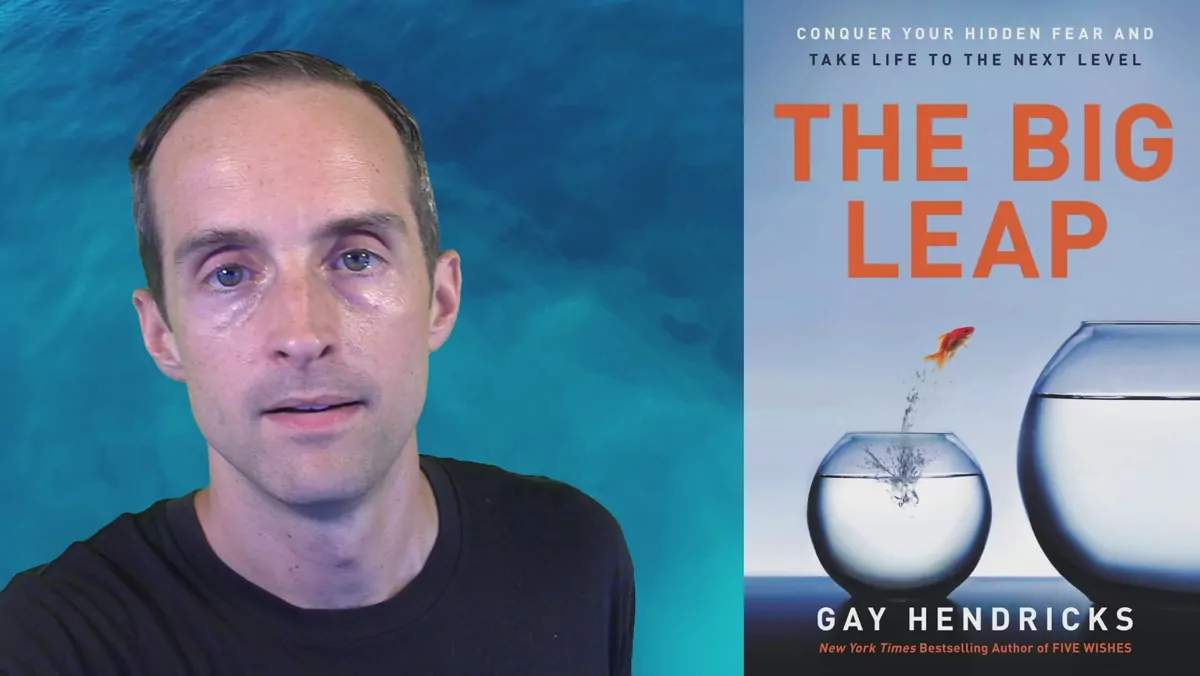
I just finished reading The Big Leap by Gay Hendricks, and this was one of the best books I've read in quite a while. It was very thought provoking. It got me thinking about where my genius is and what I do best in my life. It also had a lot of great relationship tips and a way of thinking about all of your problems, from sickness to accidents to relationship and money troubles in your business and your health. Even though it was only about five hours long, it set off a massive transformation that keeps going forward in my life. I want to give you some of the key points here so that I remember them and learn them, and so that you might take a look at the book yourself.
Finding My Zone of Genius
One of the big things The Big Leap talks about is that there are these different zones you can operate in. A zone of genius is where you're doing something you love, where time feels like it's just flying, where you'd do it happily for free, and where you're creating something that also leaves other people feeling really good. You add some real value to the world. Through this book, I finally figured out my own zone of genius.
I know I'm excellent as a live streamer. Lots of people have applauded my abilities playing games and creating crypto videos. I don't think anybody would say I'm excellent as a musician, but I'm competent, I'm good enough. The key question, though, is what am I really best at? That's something we all want to look inward and figure out. What I got out of The Big Leap is that my genius zone is that I love learning new things and teaching them. That is what I'm really good at, and that's what I really love doing. It doesn't have to be a big deal, and it doesn't have to be done in any one particular medium.
What we often do is box ourselves into this tiny definition of a person: well, I'm just a competitive gamer, or I'm just a crypto YouTuber, or I'm just a housewife, or I'm just a lawyer. We box ourselves in, often into an area that we may be excellent at, but that often isn't our genius. Our genius zone is the thing we would love to do if we had the ability, the money, and the time to do it. For me, as a YouTuber and a Twitch streamer, I'm live on Twitch doing this now and uploading it to YouTube afterward. The key is figuring out what it is that I really love doing and really have to give to the world, because I have so much freedom. I could grind out crypto videos every day and make a great income, but that gets boring.
Why Everything I Do Gets Boring
I've had this big question for a long time. Why is it that everything I do always gets boring? Why is it that I get really good at all these different things and then either stop doing them or sabotage them? I finally figured it out thanks to this book and a conversation I had on Twitch. The answer is that I love learning something new and teaching it, and that's when I've thrived in what I've done online. When I was learning Facebook ads and teaching that, that's when I first started blowing up online and it started getting meaningful. I started getting lots of views and followers. I sold a course on Udemy that made over 100,000 in earnings for me and a quarter million in sales. Then I taught people how to do Udemy, and I taught people how to do YouTube. The reason I was so successful on Udemy is because it was a platform that supported me learning something new and then teaching it. I'd learn a new skill, create a course about it, put the course up, and make money.
I've wondered for a long time why Udemy worked so well when everything else seemed to hit a glass ceiling, where I'd get to a certain level and just couldn't go any higher. On Udemy I was in the top 10 instructors when I got banned. And yet Udemy was also limiting, because having to create a course on something was limiting in itself. For example, with playing video games, you don't really want to make a course on how to win Warzone games. I've wondered why, when I was playing Call of Duty Warzone, I was having so much fun and my channel blew up, right up until I won about 100 Warzone solo games. That's the point where I got sick of doing it, and that's when things started to go weird on Facebook.
I started playing all these other games and charging for co-streams, and then I figured out another way to be successful gaming on Facebook, playing retro games. That was fun until I was making over 10 grand a month playing retro games. But then I got sick of that too, and I brought it all down by suddenly changing my race with no warning. I could have easily let Facebook know ahead of time and they could have supported me, but I just threw it out there, and the negative reactions led to being demonetized and everything on Facebook falling apart. Then I made a new crypto channel, and as soon as I hit 10,000 a month on that and over 10,000 subscribers, I immediately got bored. I was playing Gods Unchained, and both times I quit was right when I was starting to get good at it, right when I was able to play in the highest division and start getting good amounts of weekend ranked wins. I quit when I got good at it.
This book finally helped me identify the common thread in everything I've done. I hope this discussion is useful for you to look through your own life and think, what if there's a story you could put to everything that would make it all easy to understand? I've been really frustrated in my business online over the years, not understanding that my genius is learning something new and teaching it. That's what I love doing, and once I get good at something, I don't want to do it anymore. I don't want to grind out Warzone solo games when I've won four of them in a few-hour stream the day before. It's boring, and I always have to go somewhere new.
This book helped me see that when I'm consciously aware of my genius, I can set up my business to support it. Now I go live on Twitch with anything I'm doing, because that's the one place I can consistently show up. Then I make videos and upload them on YouTube, which brings lots of new traffic and records what I've done on Twitch. Everything is set up now with an understanding of what my genius is. I don't want to sell courses anymore, because some of the things I'm going to learn and teach don't support selling courses. I want to put everything I create out there for free and follow whatever my passion is. If I want to play a game, learn it, and get great at it, then I do that. And once I get good at the game, if I want to go make crypto videos or grow a new channel or make music or whatever it is, I've finally got my business set up in a way that can support my genius. This is why finding your genius in life is so important, and it's why this book was so helpful. If you can figure out what your highest offering to the world is and then set your life up around that, it makes everything so much easier.
How Success in One Area Can Sabotage Another
The Big Leap also covers how success in one area can often sabotage our life in other areas. This is why lots of people who are very successful financially have terrible relationships with other people. The book talks about how we've got a certain level of programming that says our life should only get so good, that we should only feel so many good feelings and have so many good things. This makes sense of why my business has been such a challenge while my relationships have been fantastic. My relationship with my wife, my kids, my mother, my going to my Alcoholics Anonymous meetings, my health, my life is absolutely amazing. The only area that's been a consistent challenge and a source of pain over the last few years has been my business.
Interestingly, the biggest financial success I've had in my business happened during the time when my marriage and my relationship with my mother were the most turbulent, in 2015 and 2016. Once my marriage started to get better and my relationship with my mother started to get better, the problem moved into my business, into the area of negative focus. This book makes clear the importance of consistently raising our beliefs and our ideas about how good our lives can be, and that we deserve lives as good as we can possibly comprehend. Many of the problems that manifest in our lives are really problems of I can't handle it this good. If my life is this nice, I've got to sabotage it. This is very obvious with things like addictions. In my experience, anytime my life would go well and I was drinking, my drinking would sabotage it. It also explains why, if you've just had a wonderful weekend trip with the love of your life, you'll often have some huge fight to bring yourselves back down to earth, and it'll often be over something stupid.
This has been an awesome book, and I've loved reading it. That's why I'm sharing it with you here, and why I'm going to keep cranking out vlogs about whatever I'm doing, which you can follow along with in my Life playlist. If this was useful for you and you want to go deeper with me one-on-one, the best way to do that today is to schedule a private one-on-one call with me.
Thanks a lot for being here and reading through my thoughts on The Big Leap. I hope figuring out your own zone of genius makes your whole life easier, the same way it has started to make mine.